Sheryl Sandberg, Leaning In on Mentoring

IMG_2400

Last night, I listened to KQED’s Public Radio broadcast of the City Arts and Lectures presentation by Sheryl Sandberg (Chief Operating Officer at Facebook, and author of Lean In: Women, Work, and the Will to Lead – published in March 2013) and Condoleezza Rice (former US Secretary of State). The event was held at The Nourse Theater in San Francisco, on 1 April 2013.

This is the second time I have heard a long talk by Cheryl Sandberg, who was also the keynote speaker at the 2011 Grace Hopper Celebration of Women in Computing (in Portland Oregon). It was particularly interesting to hear her discussion with the also-remarkable Dr. Rice of Stanford University. After last night’s talk, I was inspired to read Ms. Sandberg’s book, particularly Chapter 5 “Are You My Mentor?”  Since I was driving when I heard the radio show and could not take notes, it was good to find that most of the broadcast stories were also in the book.

Some of what I found particularly interesting in Lean In: Women, Work, and the Will to Lead:

  • Girls who grew up hearing the Sleeping Beauty fairy tale “…are told that if they can just find the right mentor, they will be pushed up the ladder and whisked away to the corner office to live happily ever after”.
  • “The strongest relationships spring out of a real and often earned connection felt by both [mentor and mentee].”
  • “We need to stop telling [young women], ‘Get a mentor and you will excel.’ Instead, we need to tell them, ‘Excel and you will get a mentor.'”
  • “While asking a stranger to be a mentor rarely, if ever, works, approaching a stranger with a pointed, well-thought-out inquiry can yield results.”
  • “Mentorship is often a more reciprocal relationship than it may appear, especially in situations where people are already working at the same company.  The mentee may receive more direct assistance, but the mentor receives benefits too, including useful information, greater commitment from colleagues, and a sense of fulfillment and pride.”
  • “A mentee who is positive and prepared can be a bright spot in a day.”
  • “Many companies are starting to move from informal mentoring that relies on individual initiative to more formal programs.  When taken seriously, these formal mentorship/sponsorship programs can be remarkably successful.”

I agree with much of what she writes but Ms. Sandberg’s sole context for mentoring seems to be corporate and focused on star performers, company staff who are usually highest-rated in performance reviews.  My first few mentoring programs were also in that context, then a friend in Human Resources gave me a copy of the excellent Harvard Business Review 2003 article “Let’s Hear it for B Players” by Thomas J. DeLong and Vineeta Vijayaraghavan, which spun me around.

In the much-heralded war for talent, it’s hardly surprising that companies have invested a lot of time, money, and energy in hiring and retaining star performers. Most CEOs find that recruiting stars is simply more fun; for one thing, the young A players they interview often remind them of themselves at the same age. For another, their brilliance and drive are infectious; you want to spend time with them. …But our understandable fascination with star performers can lure us into the dangerous trap of underestimating the vital importance of the supporting actors. A players, it is true, can make enormous contributions to corporate performance. Yet in our collective 20 years of consulting, research, and teaching, we have found that companies’ long-term performance—even survival—depends far more on the unsung commitment and contributions of their B players. These capable, steady performers are the best supporting actors of the business world.

After much thought, program design, and discussion with our sponsors and stakeholders at Sun Microsystems, we created additional mentoring programs for rising stars and solid contributors, in addition to the “high potential” programs created first. We also started mentoring programs for staff who were based outside of the USA.  Read all about this journey in the 2009 Sun Microsystems Labs Technical Report: “Sun Mentoring: 1996-2009″ by Katy Dickinson, Tanya Jankot and Helen Gracon.

“Leaning In” from the book title means “being ambitious in any pursuit.” The Anita Borg Institute (of which I am honored to be on the Advisory Board) is a founding partner of the new Lean In organization. I recommend the book Lean In: Women, Work, and the Will to Lead as a starting place for many interesting discussions.

4/17/2013: Lean In is the #1 New York Times Bestseller in “Hardcover Nonfiction” and “Combined Print & E-Book Nonfiction” categories!
IMG_6627

Images Copyright 2011-2013 by Katy Dickinson

2 Comments

Filed under Hopper - Anita Borg Institute, Mentoring & Other Business, News & Reviews

Fostering Triangular Partnership, Professional Mentoring

IMG_5270

The conference version of the book Triangular Partnership: the Power of the Diaspora (including the chapter “Professional Mentoring – Fostering Triangular Partnership”) is available for free download.

“Triangular Partnership” is a term used by People to People to describe the relationship of three global groups:

  • Diaspora
  • Developing Countries Institutions
  • Western Institutions

Some background:

How does professional mentoring interact with this Triangular Partnership, and with the global diaspora in particular?

Here are three successful professional mentoring programs in which the global diaspora takes a key role:

  • Below are two pie charts showing a summary of 2001-2009 data on mentor and mentee work locations (from p.77 of the Sun Microsystems Labs Technical Report: “Sun Mentoring: 1996-2009″ by Katy Dickinson, Tanya Jankot and Helen Gracon). As you can see, for this Sun Microsystems world-wide Engineering mentoring program, the largest number of both mentors and mentees were based in the USA (green), compared to those based in APAC (Asia-Pacific Region, blue) and EMEA (Europe-Middle East-Africa Region, red). Even so, there was a disproportionate number mentors based in the USA (more than in APAC and EMEA combined). In 2009, when this data was analyzed, Sun had about 15,000 Engineering staff distributed among thirty locations around the world, including large campuses in China, India and Europe – but most of Sun’s Engineering staff was in the USA. These charts show professional mentors’ willingness to engage in successful mentoring relationships beyond borders in order to build and strengthen a community.
MenteeLocation.Sun2009 . MentorLocation.Sun2009
  • A second example of mentors’ and western institutions’ willingness to reach beyond their national boundaries for a greater good is the TechWomen mentoring program, an initiative of the U.S. Department of State’s Bureau of Educational and Cultural Affairs (ECA). For TechWomen 2011, there were thirty-seven mentees from six Middle Eastern and North African (MENA) countries. For TechWomen 2012, there were forty-two mentees from eight MENA countries. All mentees were hosted at Silicon Valley companies for a month while working with both Professional and Cultural mentor volunteers from over fifty companies and organizations in the San Francisco Bay Area. TechWomen has been so successful that its size was doubled for 2013 and the geographic area expanded to include Sub-Saharan Africa, in addition to MENA. The purpose of TechWomen is to bring people together for greater understanding and to empower women and girls worldwide. In both TechWomen and the Sun Microsystems mentoring programs, many of the US-based mentors were either immigrants themselves or the children of immigrants. Sometimes those immigrant mentors or their families were from the same country as their mentee (a direct-diaspora connection), but most times not.
  • A final mentoring program example showing a more-direct diaspora connection was the sold-out December 2012 Inaugural Open Mentoring Session, presented by TiE Silicon Valley as part of their TiE SV MentorConnect program with MentorCloud. About TiE: “TiE, a not-for-profit global network of entrepreneurs and professionals, was founded in 1992 in Silicon Valley, California, USA. Although its birth name, The Indus Entrepreneurs, signifies the ethnic South Asian or Indus roots of the founders, TiE stands for Talent, Ideas and Enterprise. It is an open and inclusive organization that has rapidly grown to more than 57 chapters in 14 countries.” Feedback on the Open Mentoring Session: 82% of mentees completed the post-event survey and rated the event as “Highly Recommended” or “Recommended”. 90% of them said the event “exceeded” their expectations, and a whopping 95% said they would recommend a similar session to their friends.

These examples have shown two legs of the triangle – Diaspora and Western Institutions – using mentoring for community building, mutual-understanding, and professional growth. To see mentoring connections with the triangle’s third leg – Developing Countries Institutions – check out the customer logos on the MentorCloud home page, including:

  • Global Science and Technology Foundation (GSTF) – Sub-Sahara African Universities
  • Indian Institute of Science Alumni Association (IIScAA) – Knowledge Exchange Programme
  • International diaspora Engagement Alliance (IdEA)
  • The SABLE Accelerator – The South African Business Link to Experts
  • TechWadi – Building Bridges for Entrepreneurship – MENA region
  • TiE Silicon Valley
  • University of the Witwatersrand, Johannesburg, South Africa (Wits)

IMG_1012

Images Copyright 2012 by Katy Dickinson

19 October 2019: Post links updated. For more about MentorCloud business practices, see Collecting a Labor Judgement (15 January 2016).

1 Comment

Filed under Mentoring & Other Business

8 Essays on Mentoring

IMG_5719

MentorCloud has been asked to contribute a chapter to a book being edited by one of our customers. As I did when writing “Sun Mentoring: 1996-2009“, I am putting together chapter section drafts piece by piece, published in this blog and on the MentorCloud blog as they are developed. (By the way, Oracle is no longer distributing the Sun Microsystems Labs Technical Report: “Sun Mentoring: 1996-2009″  by Katy DickinsonTanya Jankot and Helen Gracon, but it is still available for free download on our family website and is also available for purchase from the ACM Digital Library.)  Here are the eight essays I have published so far:

Images Copyright 2013 by Katy Dickinson

Leave a comment

Filed under Mentoring & Other Business, News & Reviews

“she++” Documentary Film

IMG_6476

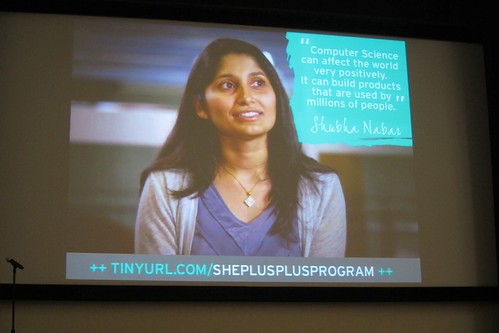
Last night, some of the leaders of the Anita Borg Institute met for dinner and a movie. The premiere film was “she++ the documentary” shown at Stanford University.  This remarkable short film on the value of Computer Science, particularly to girls and women, was inspired by the popular 2012 she++ (“She Plus Plus”) conference. The documentary was directed by two impressive young women: Stanford undergraduates Ellora Israni and Ayna Agarwal.  ABI was in the audience to show our support for this notable effort.

Founded in January 2012, she++ was Stanford’s first conference on women in technology. In April 2012, we hosted a lineup of inspirational women in tech–from companies such as Google, Facebook, Dropbox, and Pinterest, among others–and 250+ attendees on Stanford’s campus. After positive feedback from attendees, mentors, and the press, we have decided to expand she++ into a full-fledged community that inspires women to empower computer science. Through a number of initiatives, we aim to create community and momentum for female technologists.

The 2013 she++ conference is already filling up.

IMG_6480

IMG_6507

Images Copyright 2013 by Katy Dickinson

Leave a comment

Filed under Hopper - Anita Borg Institute, Mentoring & Other Business, News & Reviews

Easter Egg Hunt

IMG_6358

Despite all official weather prediction to the contrary, we had no rain but a warm lovely morning for today’s Easter Egg Hunt. This year, we made some procedural changes. Young people who have been coming to this party for years volunteered as Associate Bunnies – staying over the night before or arriving very early to help the Assistant Bunny (me) hide 500+ plastic eggs with candies inside. Jessica (Senior Associate Bunny, in the Washington DC Branch Office) drafted the Gold and Silver Egg poems:

Gold Egg (hidden on the roof beam of the cabana, next to the hot tub) – found by Paul:

In my hutch I am squatting,
Through a triangle I see,
Above the earth I’m spotting
A train, two dogs, and a tree.
Next door water is too hot
But folks sit in there alot.

Silver Egg (tied up inside the San Francisco fire plug) – found by Jim:

My nest was moved from the city,
There its job was very gritty.
It once was wet but now is dry.
A little river I can spy.
Like a bunny safe in a log,
I’m hidden here from nose of dog.

Hunters lined up by age on the new porch – where they could see the eggs in the garden and plan their launch strategy. One family arrived late – I was so pleased to watch the big kids re-hide their eggs so that the new little ones could hunt. One teenage boy dumped his whole basket for them. Of course, there was food and drink (John made pulled chicken sandwiches, mint tea, and punch) and WP668 caboose tours for all.

IMG_6363 . IMG_6362

IMG_6359

IMG_6385 . IMG_6392

IMG_6426

IMG_6444

IMG_6448

IMG_6417

Images Copyright 2013 by Katy Dickinson and John Plocher

3 Comments

Filed under Church, Home & Family

Flowers in Pipes for Easter

IMG_6234

I have been getting my garden in Willow Glen, California, ready for our annual children’s party – the great Easter Egg hunt this Sunday. We are also collecting goodies for our little guests, including stuffies, candies, and baskets.  Every child in the hunt picks a stuffed animal to be their personal advisor (since parents are not allowed to help), plus a basket for their eggs. Last year, we hosted over a dozen children searching for eggs on Easter morning.

Over the years, I have collected ceramic flue liners of many sizes – to use as planters. Some I inherited from my father’s garden. I have just planted two of these (plus an old steel pipe section) with red and yellow kangaroo paws, to go with the two I already have filled with pink geraniums. These tall planters create a new visual level (and keep the flowers away from our boy dog’s attentions). In the pictures, you can see the pipes against the background of WP668, our backyard caboose.  The new flowers will be a pretty background for the egg hunt.

IMG_6248 . IMG_6238

IMG_6249

Images Copyright 2013 by Katy Dickinson

Leave a comment

Filed under Caboose Project and Other Trains, Home & Family

Virtual Choir

IMG_4210

My daughter Jessica is the musician in our family: she sings folksongs and opera and frequently writes about music on her blog. In February 2013, during long bus trips through the Jordan mountains as part of the TechWomen delegation – to pass the time, Shahryan and I traded earbuds back and forth, each playing favorite songs stored on our smart phones. Although I am no musician, this blog entry is a gift of music for my friend Shahryan – who lives almost 9,000 miles away in Yemen.

American conductor Eric Whitacre is one of the most popular and performed composers of this generation. His Virtual Choir projects are both inspiring and amazing technically – and also present very good music. The projects are successful artistically and organizationally: for example, in 2012, Whitacre’s “Virtual Choir: Bliss” project was funded on Kickstarter at $122,555 (122% of asking).

In past projects, Eric Whitacre used a worldwide virtual choir singing recorded parts. For the just-released “Cloudburst”, he combined live and virtual choirs.

The lyrics are from “Cloudburst” by Mexican poet Octavio Paz. I hope you enjoy this music as much as I do.
Last Import-61

Images Copyright 2013 by Katy Dickinson

Leave a comment

Filed under Home & Family, Mentoring & Other Business, News & Reviews