Tag Archives: Graduate Theological Union

Yehuda Amichai and Suspicion

Yehuda Amichai poetry books

As part of my Islamic Studies certificate, in the Spring 2025 term I took a Graduate Theological Union (GTU) class called, “Literary Analysis of Islamic and Jewish Texts.” I was fascinated by the ancient Islamic literature we studied, particularly Attar‘s biography of the famous Sufi woman Rabi’a (also called Rabia Basri and Rābiʼa al-ʼAdawiyya al-Qaysiyya, 716-801 CE) in his Memorial of the Friends of God; however, I saw such a strong connection between battlefield soldiers like the modern Israeli poet Yehuda Amichai and incarcerated people that I chose that as my topic. Here is my paper.

Battlefield soldiers and incarcerated people are both groups who may find suspicion and watchfulness of their surroundings help them to survive in a fast-changing and dangerous world. In the paper I included three feedback quotes from men in reentry or who are still incarcerated about my Transforming Literature of the Bible class and its use of poetry. I gave a copy of the paper to the Elmwood Jail class this week and am curious to hear what they think. Here are the quotes,

“Poetry has helped me to express myself in a unique way. When I try to do poetry by sitting down and thinking about it, I think it is not as authentic as a spontaneous one. For example if I’m laying in bed and I’m thinking about something I jump out of bed and just start writing. Those are the best poems I have written.”

“I read lots of poetry in the class. Every poetry that I read had positive stories that taught me to be a better person even when I was in jail. It taught me to be strong in my faith and that everything is possible when you have faith to follow. No matter what we go through, everything is going to be OK.”

“The Brilliant poetry that is introduced to us in relation to the topics of study, are everything from heart felt amazement, shockingly heroic, Educationally sound, & a way to give multiple perspectives & ways of understanding. Artist & Poets…Bring understanding and awe, I’ve called home at times in excitement.”

Image (c) Copyright 2025 by Katy Dickinson. If you want to receive Katysblog posted by email, please sign up using the Sign Me Up! field (upper right on Katysblog home page).

Leave a comment

Filed under Chaplain, Church, News & Reviews

Fannie Lou Hamer as a Martyr

As part of my Islamic Studies certificate, in the Spring 2025 term I took a Graduate Theological Union (GTU) class called, “Martyrdom and Afterlife in the Qur’ān,” for which I gave a Presentation about notable American civil rights leader Fannie Lou Hamer. Our inspiring GTU professor was Dr. Mahjabeen Dhala. Part of my presentation explored what it meant for Hamer to be a martyr since martyrdom was a focus of our class discussions. I was happy to see a print of Fannie Lou Hamer decorating the offices of the Sentencing Project when I went to visit last week in Washington DC. Here is my Presentation.

If you want to receive Katysblog posted by email, please sign up using the Sign Me Up! field (upper right on Katysblog home page).

Leave a comment

Filed under Church, News & Reviews, Politics

Heaven in the Qur’ān and Christian Testament

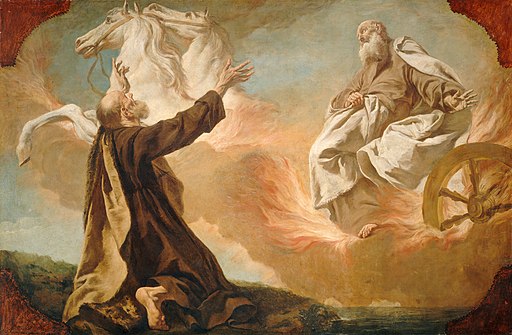
Elijah Taken Up in a Chariot of Fire, by Giuseppe Angeli, c. 1740.*

As part of my Islamic Studies certificate, I took a Graduate Theological Union (GTU) class in the Spring 2025 term called, “Martyrdom and Afterlife in the Qur’ān,” for which my final paper was, “Heaven in the Qur’ān and Christian Testament.” Our inspiring professor was Dr. Mahjabeen Dhala who presented us with a challenging reading list and led our class of Muslims, Christians, and Baháʼís in a series of discussions about death, the afterlife, martyrdom, and the end of days. I have studied with Dr. Dhala before and this class confirmed that she is one of the best teachers at the GTU.

I took the opportunity of the twenty-eight page final paper to explore a subject that I have been thinking about. Here is my introductory paragraph,

“In both Christianity and Islam, heaven exists and has always existed but there are different beliefs on how the living can engage with it. This paper provides an overview of some of these Abrahamic religions’s relationships with heaven, highlighting two key dissimilarities. The scope is intentionally constrained in addressing this vast and complex topic. I am not attempting to be comprehensive or to present all variants of belief. I will not discuss the specifics of physical resurrection, interim or last judgements, the Christian Jesus versus the Muslim Jesus (ʿĪsā ibn Maryam), or a variety of other tempting and fascinating topics. My comparisons will include the physicality of heaven, how some artists have envisioned how heaven looks, engaging with heaven during life, orthodox beliefs about heaven, when heaven opens, and mystical or heavenly cities. Writing this paper has become a journey of discovery as much as a research project. I keep finding new materials and points of view on eschatology and the end times. The Oxford Handbook of Systematic Theology offers this traditional definition, “eschatology comprised the ‘four last things’ that Christian faith expects to be the destiny of humans at the end of time: resurrection, last judgement, heaven, and hell.” Comparative eschatology is a big subject but considering the more limited question of what Islam and Christianity have to say about heaven seems possible in the space of a relatively short paper.”

You can read the whole paper here.

*This work is in the public domain in its country of origin and other countries and areas where the copyright term is the author’s life plus 100 years or fewer.

If you want to receive Katysblog posted by email, please sign up using the Sign Me Up! field (upper right on Katysblog home page).

Leave a comment

Filed under Church, News & Reviews

Transforming Literature of the Bible in Jail

Katy Dickinson, Georgetown Library, June 2025

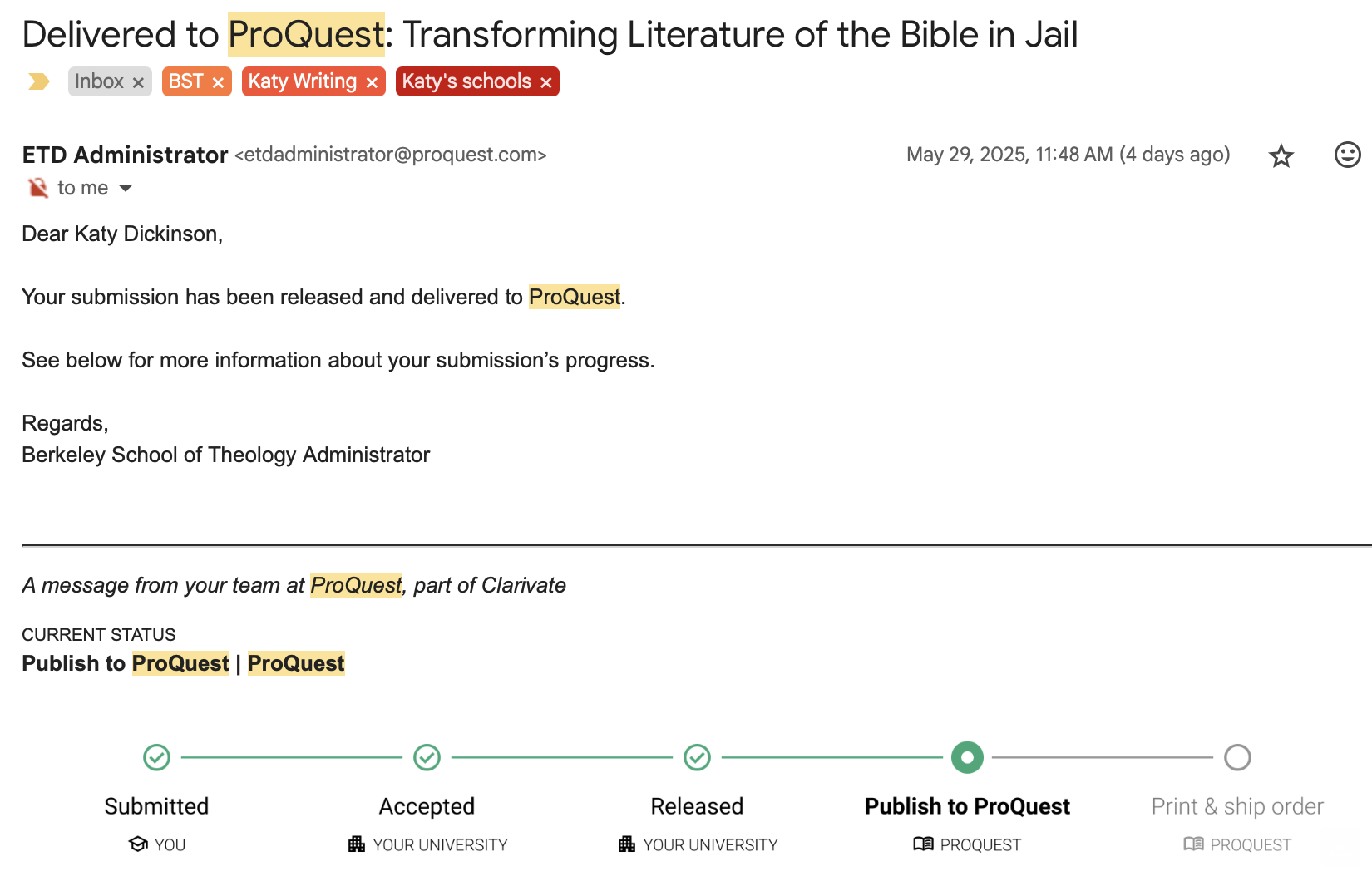
3 June 2025 Update – ProQuest just made my doctoral dissertation available! ProQuest # 31845163, full search: “Dickinson, Katy. Berkeley School of Theology ProQuest Dissertations & Theses, 2025. 31845163” – Available online (and soon in paper!) through the GTU Library.

Part of earning a Berkeley School of Theology (BST) doctorate is writing a dissertation or thesis. Mine is titled Transforming Literature of the Bible in Jail. It is 143 pages long, based on a 300 page project (a rewrite of the “Transforming Literature of the Bible,” TLB, class materials I have used as a jail Chaplain since 2018). TLB was originally developed in 1980-2008 by the Rev. Canon William Barnwell. Over twenty pages of my dissertation is the References & Bibliography section, that may be the most helpful part for future scholars.

Once a dissertation is written, it must be reviewed and defended, prepared and approved for publication, and submitted to ProQuest, the company that makes dissertations available to libraries worldwide. This complex writing, approval, and quality management process takes time. At the moment, my dissertation has been approved by BST and submitted to ProQuest. In a month or so, it will be available for public reading, both on the web and in a printed and bound book shelved in the Graduate Theological Union Library.

Here is my dissertation abstract,

Abstract

The Transforming Literature of the Bible scripture study and theological​ reflection program (TLB) provides faith-based study materials tailored to county jail​ inmate interests and challenges in a welcoming setting with the intention of reducing​ some of their disadvantages and supporting them in their goal to stay out of jail in the​ future. This project revised the 2018 TLB with a focus on supporting three groups of​ particularly disadvantaged inmates. The groups are those who are primarily-Spanish​ language speakers (mostly Latinx inmates who make up the majority in Santa Clara​ County, California), those who have reading difficulties, and those with mental health​ challenges. The high-level results of this project are, the TLB page count was cut in half,​ an image was added to each session (or chapter) with a process for theological reflection​ using that image as a focus, and a Spanish language translation of the TLB was​ developed and presented weekly. Mental health topics are presented in several TLB​ sessions in a way intended to encourage discussion​ without embarrassment. In response​ to a series of surveys of inmates and seminar observers in 2023–2024, 99% rated TLB as​ Excellent and overall satisfaction and 98% of inmates said that they would recommend​ the class. 92% of inmates said that it was important that TLB be presented in both​ English and Spanish and 98% said that the machine translations of TLB were of high​ quality and readability. This dissertation​ presents information on the TLB project and its​ methodology, background on incarceration, and an analysis of the theological and​ biblical context for the TLB and this project, with detailed research results.

BST and ProQuest send me emails giving publication status updates (basically saying, “please be patient – there is a process”).

Images (c) Copyright 2025 by Katy Dickinson. If you want to receive Katysblog posted by email, please sign up using the Sign Me Up! field (upper right on Katysblog home page).

Leave a comment

Filed under Chaplain, Church, Home & Family, News & Reviews

It’s Doctor

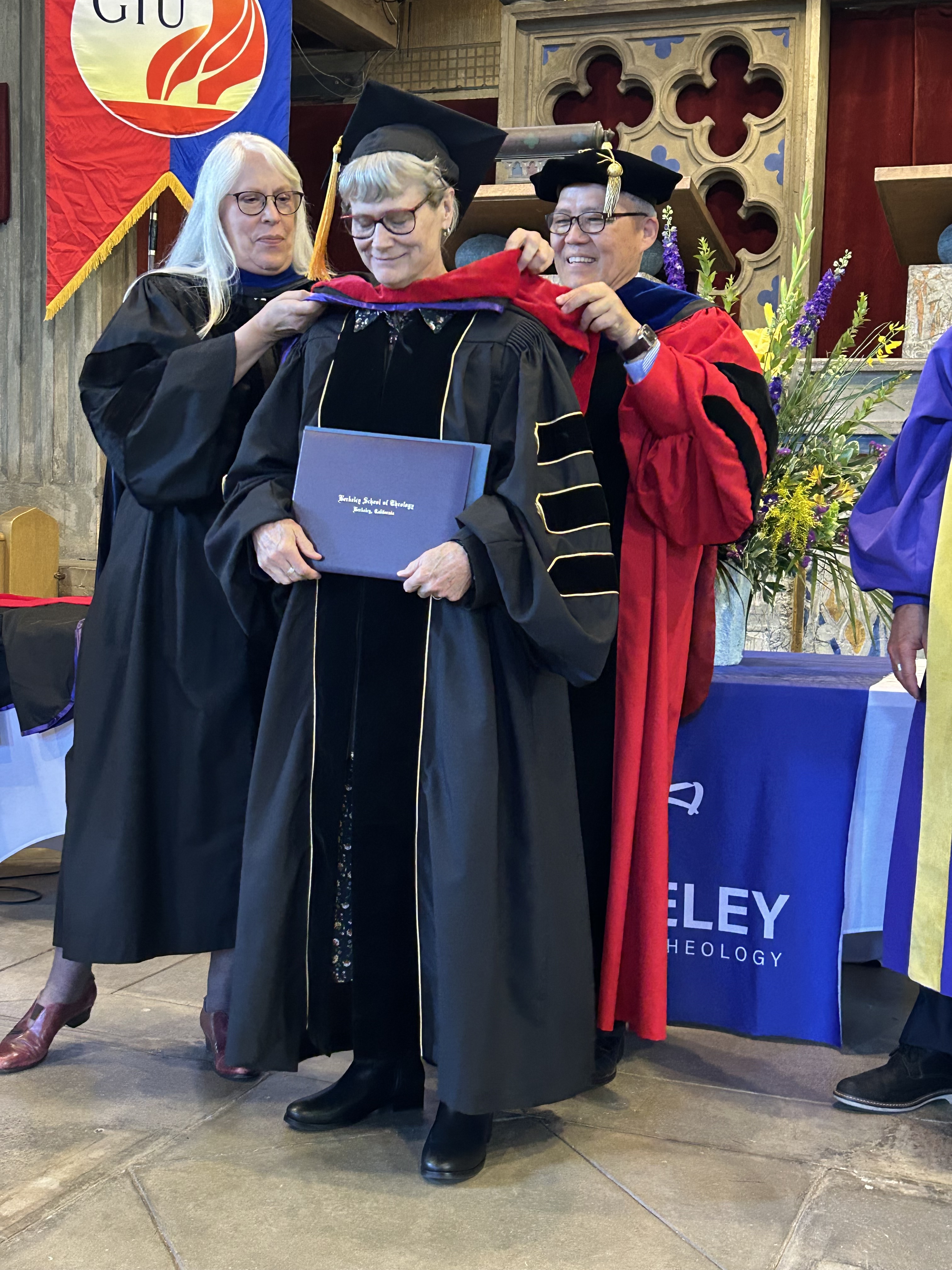
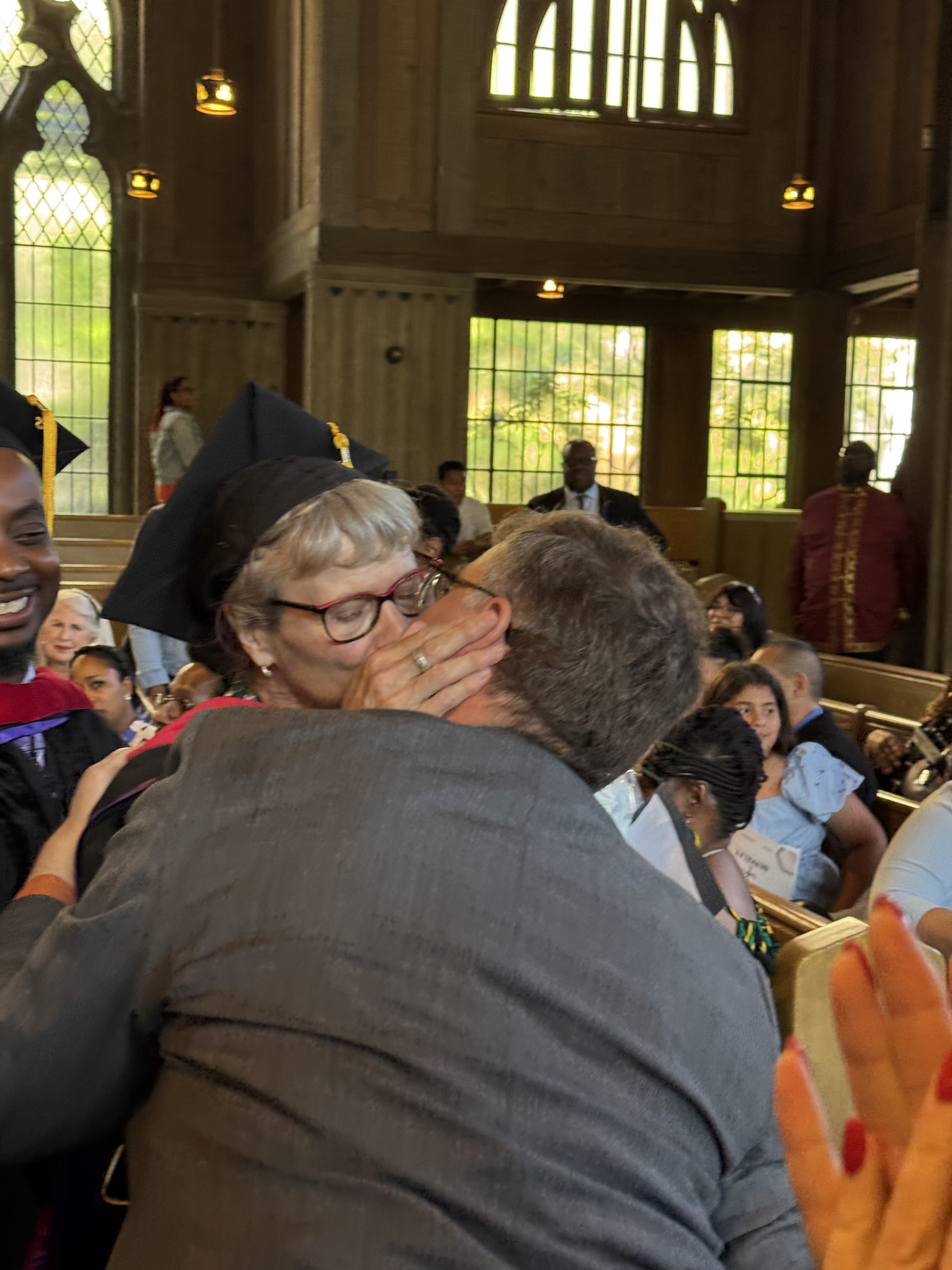
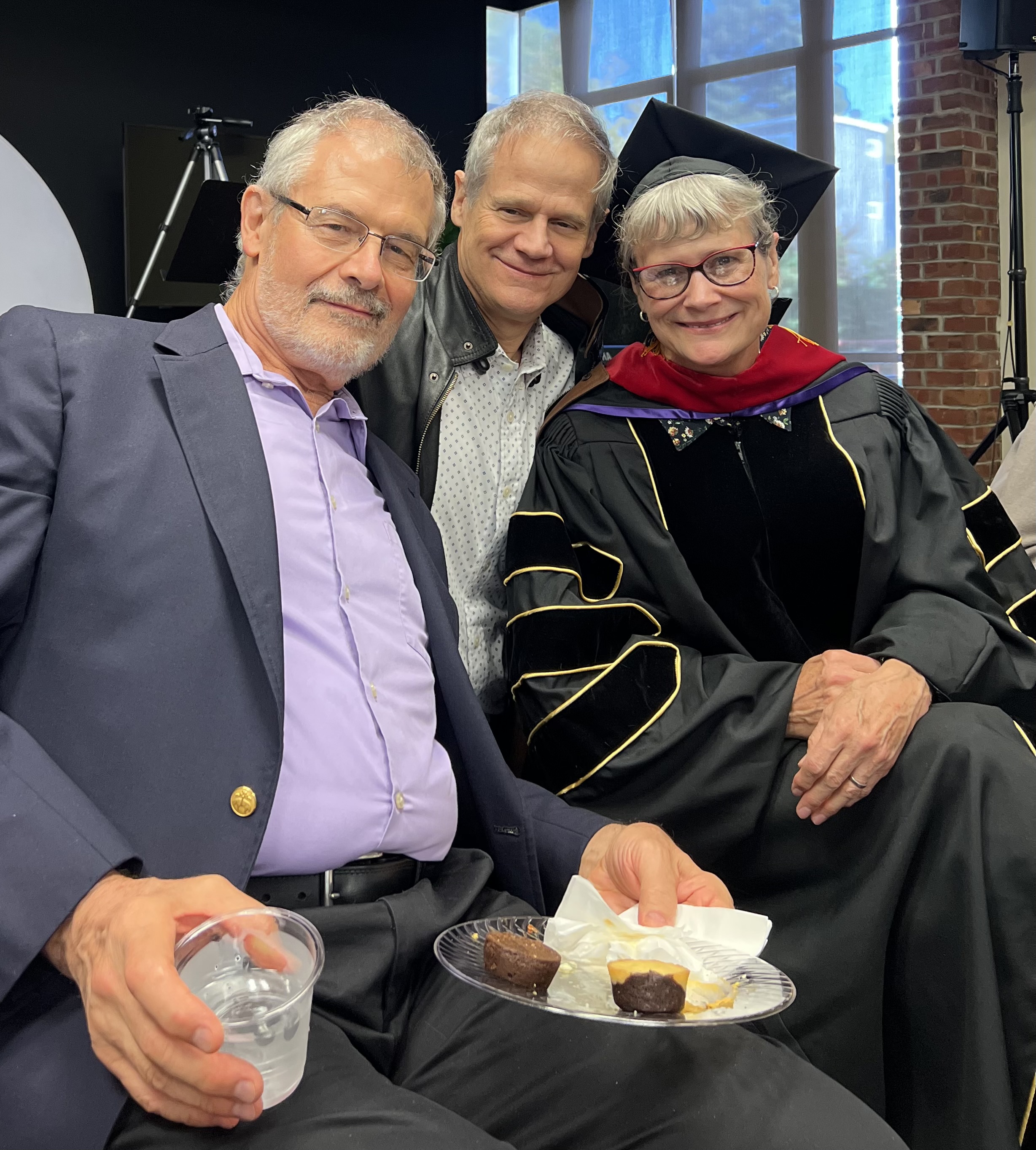
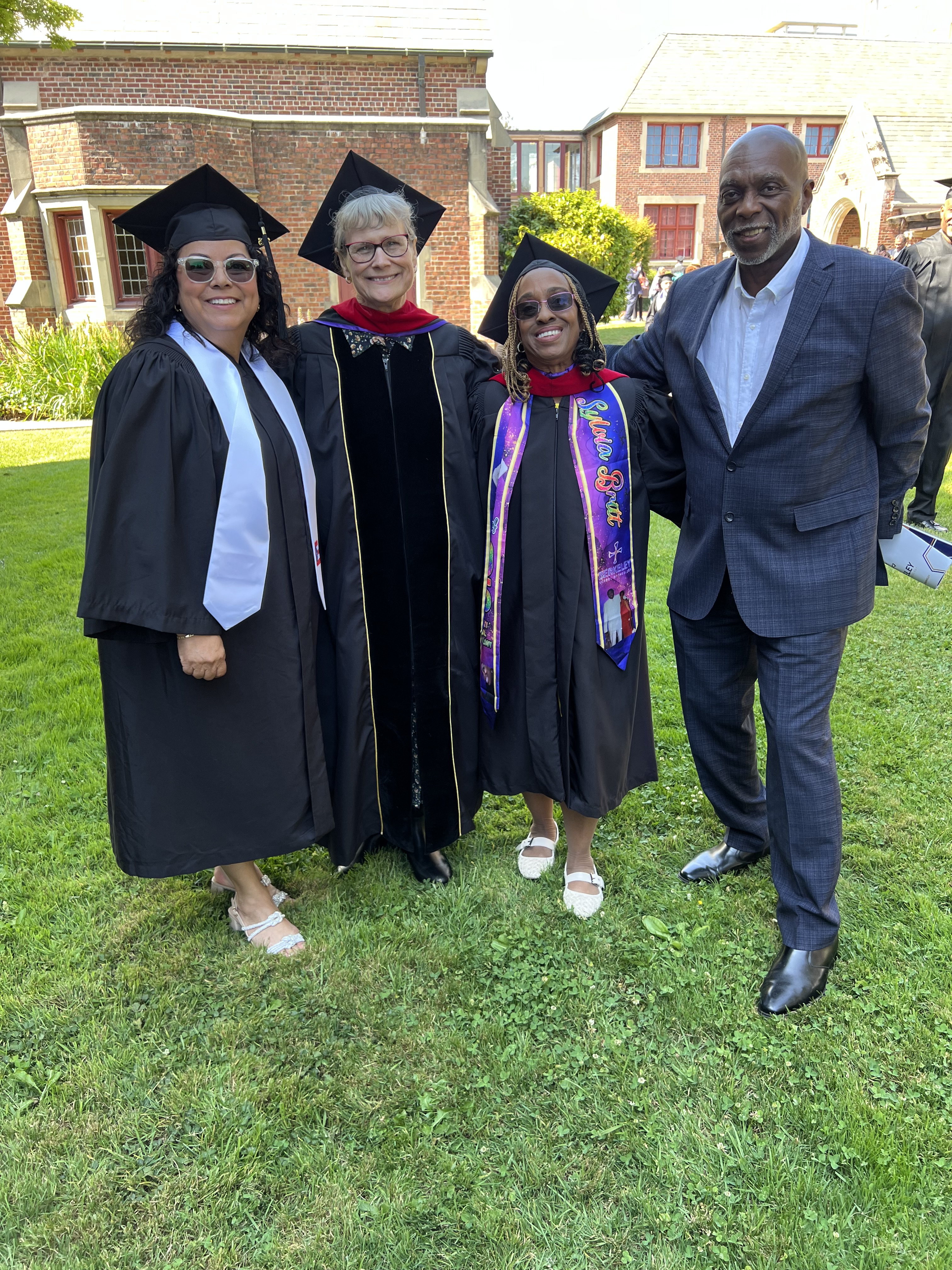
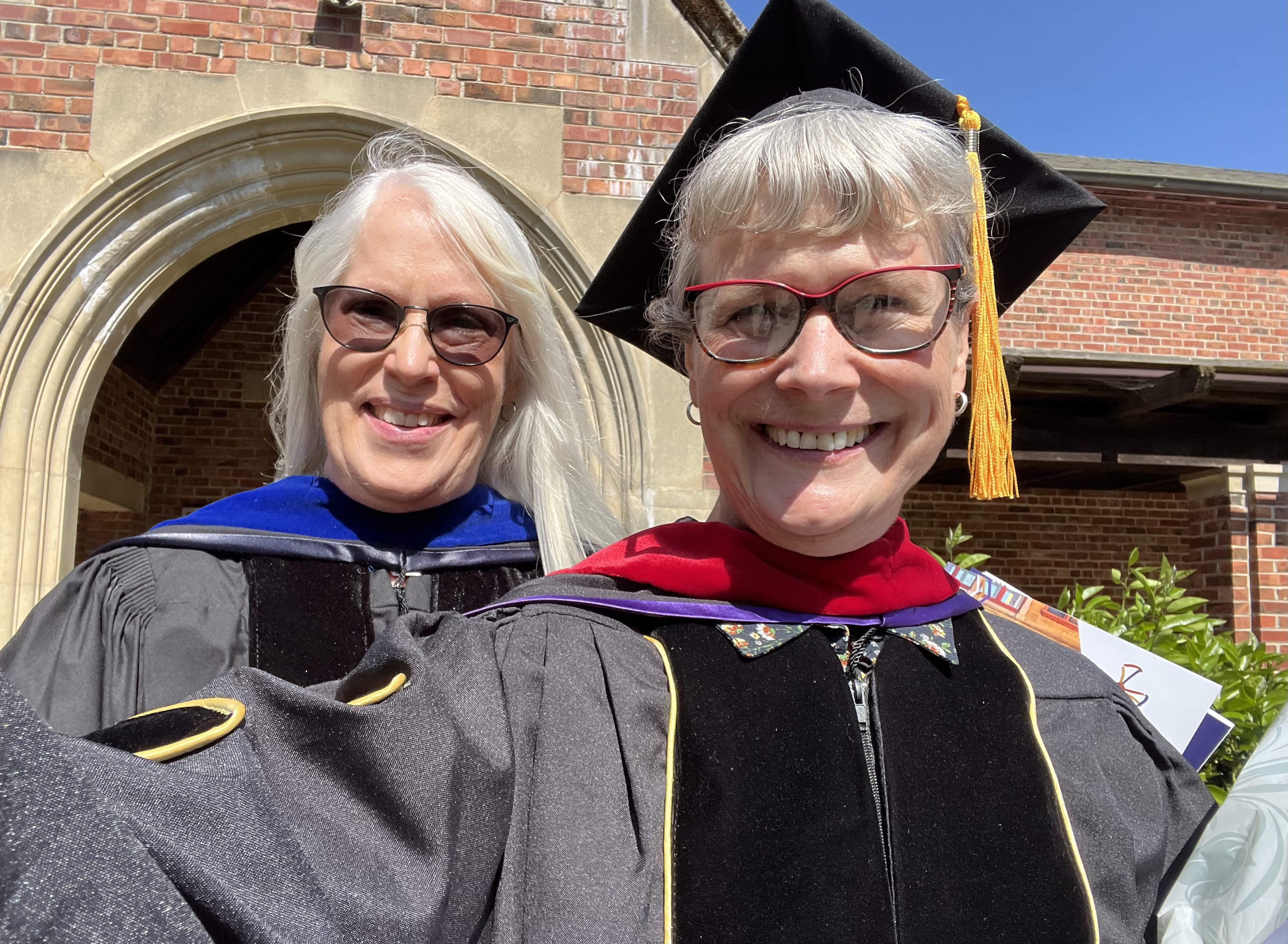
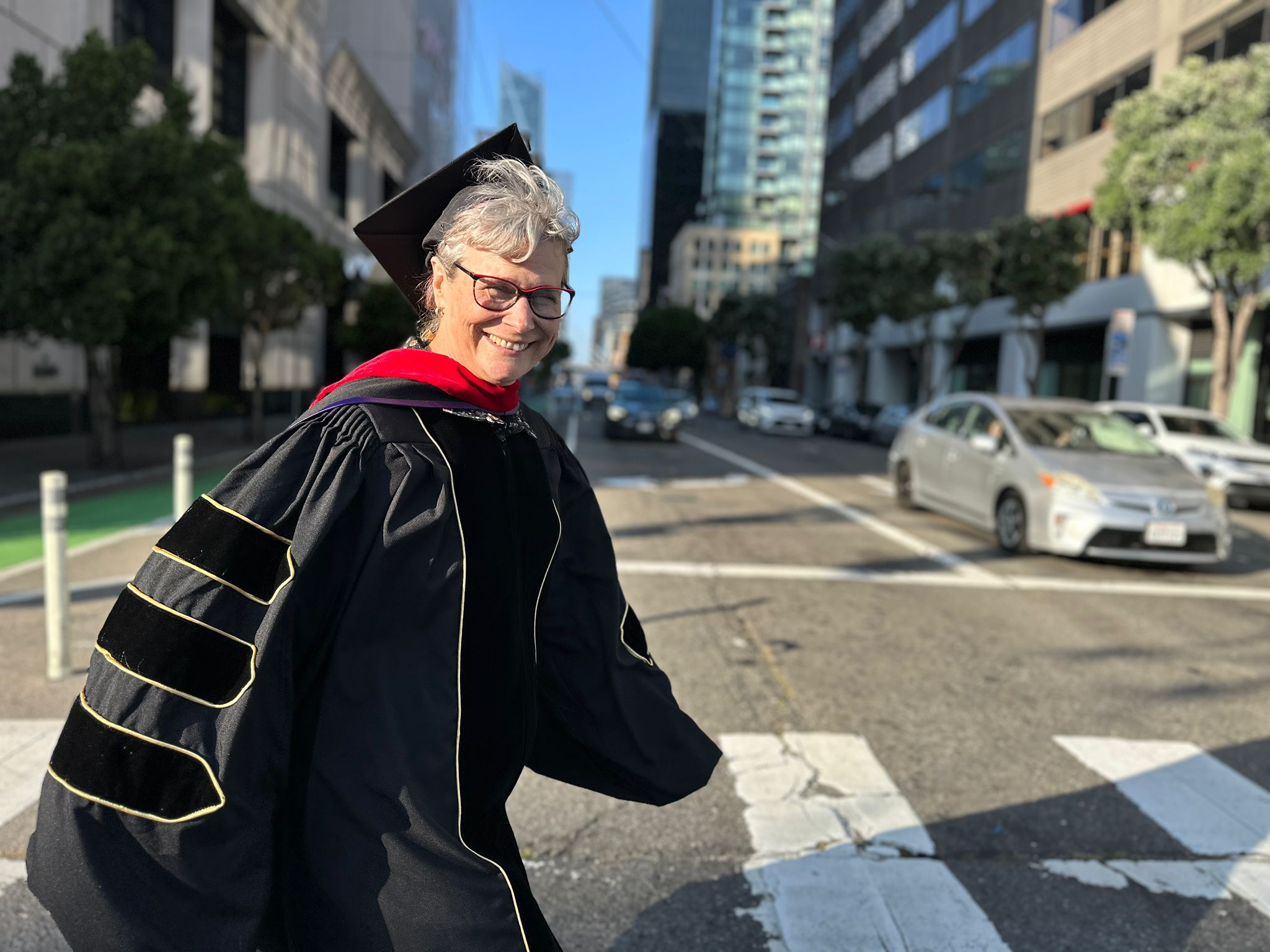
I was graduated with my Doctor of Ministry degree from the Graduate Theological Union‘s Berkeley School of Theology on 17 May 2025 – Hooray! I was surprised and honored at the graduation to be awarded BST’s Keith A. Russell Award for Prophetic Leadership in Community Ministry. My husband John, brothers Mark and Peter my Sister-in-Law Julie, daughter Jessica, Son-in-Law Matthew, grandson Alex, Son Paul, and friends Laura and Barbara were able to join the celebrations. It was a delight to have a cheering team. We graduates enjoyed taking pictures with our advisors and each other (especially the BST Student Council for which I have been the Vice Moderator for the last two years). I am continuing to take classes with GTU’s Center for Islamic Studies.

Images (c) Copyright 2025 by Katy Dickinson. If you want to receive Katysblog posted by email, please sign up using the Sign Me Up! field (upper right on Katysblog home page).

1 Comment

Filed under Chaplain, Church, Home & Family, News & Reviews

Reparations for African Americans, Next Steps

I submitted my final Spring 2023 term paper yesterday – hooray! It is titled “Reparations for African Americans, Next Steps” for “HSCE 5101: Examining the Case for Reparations for African Americans.” This class was led by Professors Dr. Aidsand F. Wright-Riggins, III and Dr. Ronald D. Burris of Berkeley School of Theology, at the Graduate Theological Union in Berkeley. The 19 page paper begins:

“This is a shifting time of change in the potential for reparations to African Americans, especially where I live in the San Francisco Bay Area. In the last few months, the governments of the State of California and the City and County of San Francisco have both been considering major financial reparations proposals on which legislation may be developed, with details being discussed almost daily in both the progressive and conservative news media. One group wrote on the California task force, ‘In addition to remedying the lingering effects of slavery, the report seeks to compensate black Californians for five categories of harms: housing discrimination, mass incarceration, unjust property seizures, and the devaluation of black businesses and health care.’ Other cities and states have made the national news discussing or acting on reparations, and a national bill supporting reparations has just been submitted in the U.S. Congress. In introducing this new legislation calling for $14 trillion in reparations, Representative Cori Bush said, ‘The United States has a moral and legal obligation to provide reparations for the enslavement of Africans and its lasting harm on the lives of millions of Black people.’

Despite the inherent lack of perspective in responding to very current events, in this paper I present four well known reparations cases and then propose next steps to achieve practical and sustainable reparations for African Americans. The course of action I propose will be based on some of the work that is already being done, as well as addressing gaps where more efforts are needed.”

Read the entire paper here.

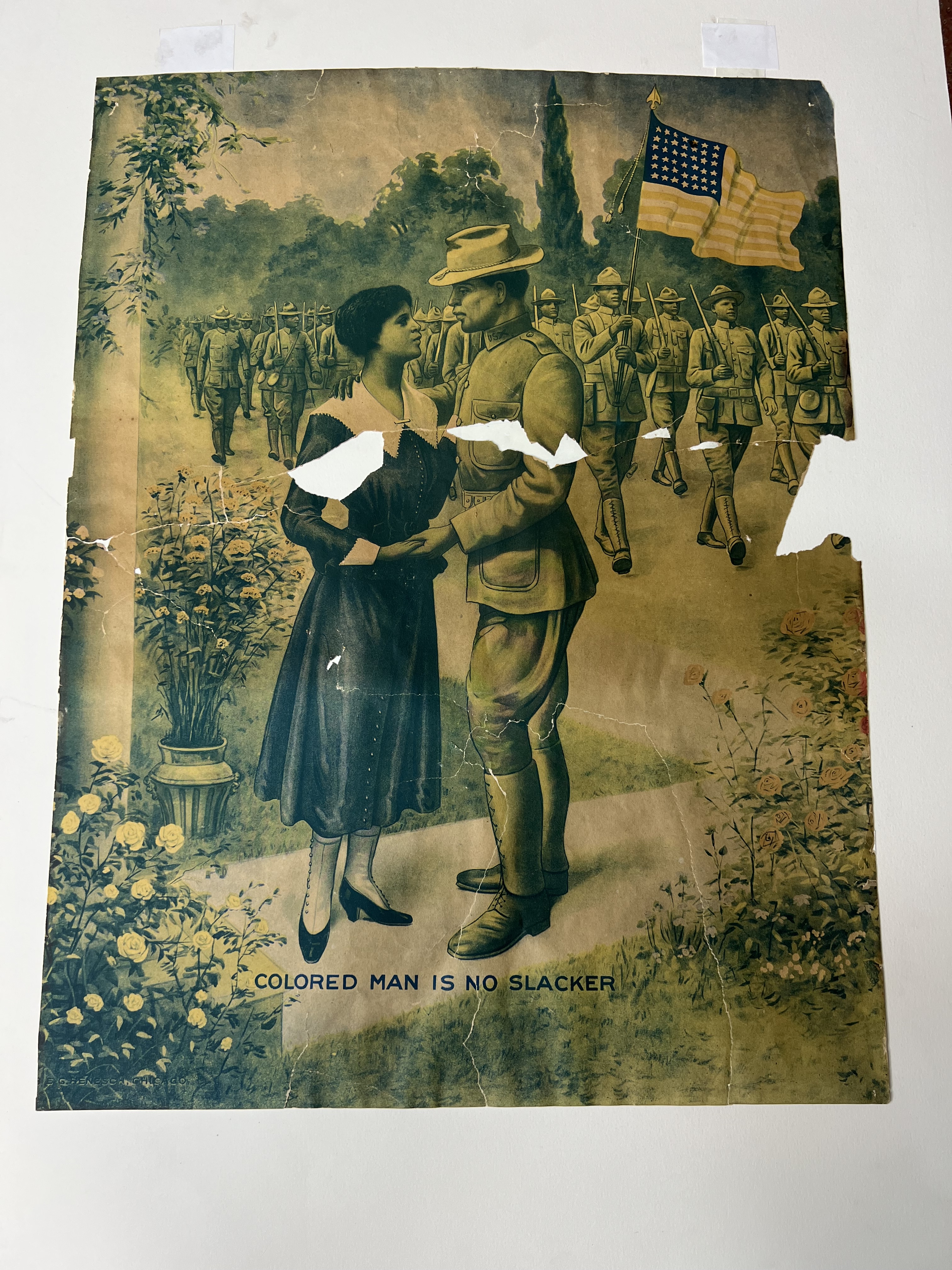
The World War I poster above (“Colored Man is No Slacker“) is from my mother’s art collection, in the Eleanor Creekmore Dickinson Charitable Art trust – and is mentioned in my paper.

If you want to receive Katysblog posts by email, please sign up using the Sign Me Up! button (upper right on Katysblog home). Image Copyright (c) 2023 by the Eleanor Creekmore Dickinson Charitable Art Trust.

Leave a comment

Filed under Church, News & Reviews, Politics

Sin and Satan in the Qurʾān and Bible

Satan with Angels and Adam, Bal'ami, Annals of al-Tabari manuscript, 1413-1416, Topkapı Saray Museum, Istanbul, Turkey,
Satan with Angels and Adam, Bal’ami, Annals of al-Tabari manuscript, 1413-1416, Topkapı Saray Museum, Istanbul, Turkey, This work is in the public domain in the United States because it was published (or registered with the U.S. Copyright Office) before January 1, 1928.

My term paper is titled “Sin and Satan in the Qurʾān and Bible” for “SARS-1000: The Qur’an: Origin, Application, Interpretations.” This Spring 2022 class was lead by Professor Mahjabeen Dhala, at the Graduate Theological Union in Berkeley. The paper begins:

In this paper, I consider sin and Satan, with a focus on the stories of Joseph and Job, both in the Qurʾān and in the Bible. I chose this topic because, as a jail Chaplain, I find prisoners are very aware of sin and Satan, and I wanted to learn more. The anthropomorphic personification of Satan is a huge topic, so I have concentrated on a limited set of scriptural verses to keep to term paper length, rather than allowing this to grow into a dissertation. There is much more to be said based on the thousands of scholarly and religious works (many with conflicting opinions) written on these topics over many centuries. I assert that ideas of embodied sin and the personification of Satan evolved over at least a thousand years (between 500 BCE and 610 CE), through Biblical and Qurʾānic stories and exegetical understandings that are sometimes not substantiated by sacred texts. Historical evolution presupposes a starting point, and this paper considers alternatives for the first Biblical mention of sin. 

Read the entire paper here. I also prepared a presentation to go with the paper, with illustrations inspired by both Biblical and Qurʾānic sources. See that presentation here.

If you want to receive Katysblog posts by email, please sign up using the Sign Me Up! button (upper right on Katysblog home).

Leave a comment

Filed under Chaplain, Church