
I admit to reading a great deal of science fiction and fantasy (in addition to literature, history, science, business, technology and other categories of composition), and that science fiction is perhaps not the best starting place for studying Theology, Ethics and Interfaith Encounters – the topics for my fourth year in the Education for Ministry (“EfM”) program of the University of the South – School of Theology. Nonetheless, in some ways, science fiction can be more rigorous than theology.
The Webster definition of Theology: “The study of religious faith, practice, and experience. The study of God and God’s relation to the world. A system of religious beliefs or ideas.” Webster’s definition for Science Fiction is: “Stories about how people and societies are affected by imaginary scientific developments in the future.”
My textbooks for this year are pictured above. EfM is an excellent program. I found all of these books interesting and worth reading (some are inspiring, superb, and worth reading more than once!). Since my EfM group is in Week 30 of a 36 week curriculum, I have finished reading all but the last on this list:
- Education for Ministry – Reading and Reflection Guide Volume A (2013)
- Theology for a Troubled Believer: An Introduction to the Christian Faith, Diogenes Allen (2010)
- And God Spoke: the Authority of the Bible for the Church Today, Christopher Bryan (2002)
- The Christian Moral Life: Practices of Piety, Timothy F. Sedgwick (2008)
- Living on the Border of the Holy: Renewing the Priesthood of All, L. William Countryman (1999)
- My Neighbor’s Faith: Stories of Interreligious Encounter, Growth, and Transformation, Edited by Jennifer Howe Peace, Or N. Rose, and Gregory Mobley (2012)
Last week, as I was finishing Living on the Border of the Holy, I identified a source of some of my frustration with my EfM reading this year. When a fantasy or science fiction author creates a fictional universe, self-consistency is a major concern:
What distinguishes a fictional universe from a simple setting is the level of detail and internal consistency. A fictional universe has an established continuity and internal logic that must be adhered to throughout the work and even across separate works. So, for instance, many books may be set in conflicting fictional versions of Victorian London, but all the stories of Sherlock Holmes are set in the same Victorian London. However, the various film series based on Sherlock Holmes follow their own separate continuities, and so do not take place in the same fictional universe….
A famous example of a fictional universe is Arda, of J. R. R. Tolkien’s books The Lord of the Rings and The Silmarillion. He created first its languages and then the world itself, which he states was “primarily linguistic in inspiration and was begun in order to provide the necessary ‘history’ for the Elvish tongues.” [from Wikipedia’s fictional universe article]
If a popular author does not present logic, continuity, and good writing, the powerful and vocal fan community is pleased to point out every inconsistent detail at length. (Continuity is also a major concern in films – if for no other reason than to avoid being listed on websites devoted to movie mistakes.) Since reading my first science fiction book many decades ago, I have come to expect logic, continuity, and good editorial practices to be key drivers. I have not always found those characteristics while reading these theology books.
Example One – from Living on the Border of the Holy
In Living on the Border of the Holy, the geographic metaphor in the title is found throughout the whole book. “Border” is used 108 times, “borderland” is used 42 times, and “country” (as in “border country” – but not counting hits for the author’s name) is used 65 times. The image of a border country is explained in many ways that I found contradictory and confusing:
- “The encounter with the HIDDEN is a kind of fault line running through the middle of our lives; no one can escape its presence. The HIDDEN forms a border country that turns out to be. paradoxically, our native land.” (p.6)
- “The border country, therefore, is a place of intense vitality. It does not draw us away from the everyday world so much as it plunges us deeper into a reality of which the everyday world is the surface.” (p.11)
- “It can be helpful to imagine our human encounter with the HOLY as life in a border country. It is a country in which, at privileged moments of access, we find ourselves looking over from the everyday world into another, into a world that undergirds the everyday world, limits it, defines it, gives it coherence and meaning, drives it. Yet this hidden world is not another world, but the familiar world discovered afresh.” (p.8)
- “The border country is the realm in which human existence finds its meaning. The border itself is the indispensable condition for this. If you could slip over entirely into the HIDDEN HOLY, you would no longer be in touch with the basic materials and experiences of human life. If you try to slip over entirely into the everyday world, then actions and experiences merely follow each other in succession without forming a larger whole.” (p.161)
In addition to reading two hundred pages, I spent time prayerfully considering Living on the Border of the Holy, and I discussed it for several hours with my EfM group. The mixed geographic metaphor and strained logic did not help my understanding:
- How can a land-feature simultaneously demarcate, undergird, and be a fault line?
- How can it both be someplace to which we have “privileged moments of access” and also our “native land”?
If this were a science fiction or fantasy book, I think these basic logic and presentation contradictions in the setting would have been sorted out by the editor before publication. I finally started ignoring the faulty metaphor and got on with considering the excellent content of Living on the Border of the Holy, especially its remarkable analysis of the priestly calling.
Example Two – from Theology for a Troubled Believer
There is no thematic metaphor in Theology for a Troubled Believer but there is certainly a strong cultural point of view. When I read stories about sympathetic, intelligent but non-humanoid characters, I can feel my mind opening to understand how human thinking and capabilities are influenced by our sensory input and body design. Notable examples of such aliens include:
I admire authors who can understand and present a very different way of thinking and carry it forward through an extended work of fiction. In contrast, when I read Theology for a Troubled Believer, I was frequently irritated (and occasionally infuriated) by the author’s narrow, privileged, academic, and American context for a topic that is far beyond one culture’s circumstances. For example:
- “The systemic search for reasons, or for the logos for anything and everything, is something we today take for granted. It is part of our mental makeup. We do it automatically.” (p.xviii) [While true for many educated Americans, I do not think that the “systemic search for reasons” is part of humanity’s mental makeup.]
- “…we who live in democracies find it strange to consider the act of the Good Samaritan and the acts of the ‘sheep’ in the parable of the Sheep and Goats as acts of justice. To those who think in terms of democratic societies, it is an act of mercy, not justice.” (p.23) [People living outside of democracies may also share this thinking.]
- “The natural world is also a witness to God’s power, wisdom, and goodness…. Nature is not used to move from unbelief to belief. Nature was always used by people who had already been moved by God’s grace to a life of faith as a way to gain a better idea of God’s power, wisdom, and goodness from nature’s immense size, intricate order, and usefulness to human life.” (p.50) [This sweeping generalization is not even true for the many Americans whom Nature has lead to belief!]
In addition to his insensitivity to other cultures, the author’s arrogance toward believers in Judaism and Islam is breathtaking. However, Diogenes Allen is most snarky about fellow scholars, particularly “philosophers of religion”. His negativity is tiring as a continuing theme. The best part of this book is Diogenes Allen’s inspiring analysis of the parable of the Good Samaritan and the absolute value of human beings – that alone makes Theology for a Troubled Believer worth the slog. However, I think if this book was in the science fiction or fantasy genre, a sensible editor would have gone to work with her red pen to make some much-needed improvements in its point of view and writing mechanics.
Example Three – from And God Spoke
I include And God Spoke because it was easily the best book of theology I read this year. And God Spoke is accessible, funny, and succinct. It includes lovely quotes by famous writers (C.S. Lewis: “Now the trouble about trying to make yourself stupider than you really are is that you very often succeed.”) and excellent writing in general:
“We need to beware a naïve belief that thinks it can take a couple of verses of scripture in isolation from their wider context and find there universal moral rules that are to be applied remorselessly in all cases, however complex. We need equally to beware of a naïve skepticism that can see in scripture only a mass of contradictions and inconsistencies from which it is possible to prove anything and nothing.” (p.10)
All in all, this is a book that makes the study of Christian faith, practice, and experience a pleasure. Interestingly, there is a section in And God Spoke that analyzes how words are used, based on the modes of language presented by literary critic Northrop Frye. Christopher Bryan writes about visionary or imaginative language as:
“…words used to take us beyond our reason or our loyalties to worlds where our ordinary modes of consciousness are only one possibility among many, where imagination, fantasy, dreams, and intuition have play…. Words used in this last mode can carry us in imagination to other worlds — to the worlds of the gods, of myth, of universes transcending the universe we know. And here we find stories of our relationship to those worlds — stories of creation, fall, and redemption. Here we find those grand, overarching narratives that shape our understanding of the universe around us, and our place in it.” (pp.35-36)
The author goes on to write that visionary language is the most significant and normative for much of the Bible. Imaginative language is thus a shared mode of expression for both the Bible and for science fiction / fantasy. And God Spoke meets the best standards of science fiction and is a good example to all future books of theology.

Science Fiction and Fantasy Books
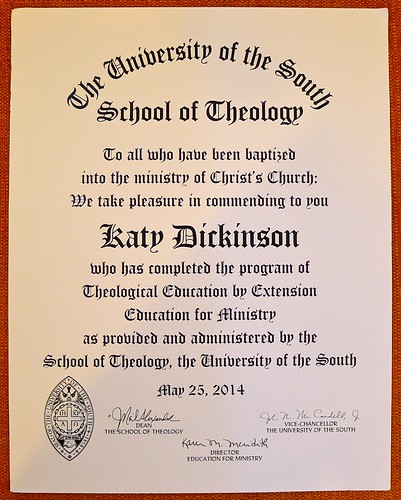
My EfM Diploma! (arrived early)
Images Copyright 2014 by Katy Dickinson





 KatysBlog