Tag Archives: Episcopal church

Why can’t theology be like science fiction?

University of the South School of Theology EfM Year 4 Books 2014

I admit to reading a great deal of science fiction and fantasy (in addition to literature, history, science, business, technology and other categories of composition), and that science fiction is perhaps not the best starting place for studying Theology, Ethics and Interfaith Encounters – the topics for my fourth year in the Education for Ministry  (“EfM”) program of the University of the South – School of Theology.  Nonetheless, in some ways, science fiction can be more rigorous than theology.

The Webster definition of Theology: “The study of religious faith, practice, and experience. The study of God and God’s relation to the world. A system of religious beliefs or ideas.”  Webster’s definition for Science Fiction is: “Stories about how people and societies are affected by imaginary scientific developments in the future.”

My textbooks for this year are pictured above. EfM is an excellent program. I found all of these books interesting and worth reading (some are inspiring, superb, and worth reading more than once!). Since my EfM group is in Week 30 of a 36 week curriculum, I have finished reading all but the last on this list:

  • Education for Ministry – Reading and Reflection Guide Volume A (2013)
  • Theology for a Troubled Believer: An Introduction to the Christian Faith, Diogenes Allen (2010)
  • And God Spoke: the Authority of the Bible for the Church Today, Christopher Bryan (2002)
  • The Christian Moral Life: Practices of Piety, Timothy F. Sedgwick (2008)
  • Living on the Border of the Holy: Renewing the Priesthood of All, L. William Countryman (1999)
  • My Neighbor’s Faith: Stories of Interreligious Encounter, Growth, and Transformation, Edited by Jennifer Howe Peace, Or N. Rose, and Gregory Mobley (2012)

Last week, as I was finishing Living on the Border of the Holy, I identified a source of some of my frustration with my EfM reading this year.  When a fantasy or science fiction author creates a fictional universe, self-consistency is a major concern:

What distinguishes a fictional universe from a simple setting is the level of detail and internal consistency. A fictional universe has an established continuity and internal logic that must be adhered to throughout the work and even across separate works. So, for instance, many books may be set in conflicting fictional versions of Victorian London, but all the stories of Sherlock Holmes are set in the same Victorian London. However, the various film series based on Sherlock Holmes follow their own separate continuities, and so do not take place in the same fictional universe….

A famous example of a fictional universe is Arda, of J. R. R. Tolkien’s books The Lord of the Rings and The Silmarillion. He created first its languages and then the world itself, which he states was “primarily linguistic in inspiration and was begun in order to provide the necessary ‘history’ for the Elvish tongues.” [from Wikipedia’s fictional universe article]

If a popular author does not present logic, continuity, and good writing, the powerful and vocal fan community is pleased to point out every inconsistent detail at length. (Continuity is also a major concern in films – if for no other reason than to avoid being listed on websites devoted to movie mistakes.)  Since reading my first science fiction book many decades ago, I have come to expect logic, continuity, and good editorial practices to be key drivers.  I have not always found those characteristics while reading these theology books.

Example One – from Living on the Border of the Holy

In Living on the Border of the Holy, the geographic metaphor in the title is found throughout the whole book.  “Border” is used 108 times, “borderland” is used 42 times, and “country” (as in “border country” – but not counting hits for the author’s name) is used 65 times.  The image of a border country is explained in many  ways that I found contradictory and confusing:

  • “The encounter with the HIDDEN is a kind of fault line running through the middle of our lives; no one can escape its presence. The HIDDEN forms a border country that turns out to be. paradoxically, our native land.” (p.6)
  • “The border country, therefore, is a place of intense vitality.  It does not draw us away from the everyday world so much as it plunges us deeper into a reality of which the everyday world is the surface.” (p.11)
  • “It can be helpful to imagine our human encounter with the HOLY as life in a border country. It is a country in which, at privileged moments of access, we find ourselves looking over from the everyday world into another, into a world that undergirds the everyday world, limits it, defines it, gives it coherence and meaning, drives it. Yet this hidden world is not another world, but the familiar world discovered afresh.” (p.8)
  • “The border country is the realm in which human existence finds its meaning. The border itself is the indispensable condition for this. If you could slip over entirely into the HIDDEN HOLY, you would no longer be in touch with the basic materials and experiences of human life. If you try to slip over entirely into the everyday world, then actions and experiences merely follow each other in succession without forming a larger whole.” (p.161)

In addition to reading two hundred pages, I spent time prayerfully considering Living on the Border of the Holy, and I discussed it for several hours with my EfM group.  The mixed geographic metaphor and strained logic did not help my understanding:

  • How can a land-feature simultaneously demarcate, undergird, and be a fault line?
  • How can it both be someplace to which we have “privileged moments of access” and also our “native land”?

If this were a science fiction or fantasy book, I think these basic logic and presentation contradictions in the setting would have been sorted out by the editor before publication.  I finally started ignoring the faulty metaphor and got on with considering the excellent content of Living on the Border of the Holy, especially its remarkable analysis of the priestly calling.

Example Two – from Theology for a Troubled Believer

There is no thematic metaphor in Theology for a Troubled Believer but there is certainly a strong cultural point of view. When I read stories about sympathetic, intelligent but non-humanoid characters, I can feel my mind opening to understand how human thinking and capabilities are influenced by our sensory input and body design.  Notable examples of such aliens include:

I admire authors who can understand and present a very different way of thinking and carry it forward through an extended work of fiction. In contrast, when I read Theology for a Troubled Believer, I was frequently irritated (and occasionally infuriated) by the author’s narrow, privileged, academic, and American context for a topic that is far beyond one culture’s circumstances. For example:

  • “The systemic search for reasons, or for the logos for anything and everything, is something we today take for granted.  It is part of our mental makeup.  We do it automatically.” (p.xviii) [While true for many educated Americans, I do not think that the “systemic search for reasons” is part of humanity’s mental makeup.]
  • “…we who live in democracies find it strange to consider the act of the Good Samaritan and the acts of the ‘sheep’ in the parable of the Sheep and Goats as acts of justice.  To those who think in terms of democratic societies, it is an act of mercy, not justice.” (p.23) [People living outside of democracies may also share this thinking.]
  • “The natural world is also a witness to God’s power, wisdom, and goodness…. Nature is not used to move from unbelief to belief.  Nature was always used by people who had already been moved by God’s grace to a life of faith as a way to gain a better idea of God’s power, wisdom, and goodness from nature’s immense size, intricate order, and usefulness to human life.” (p.50) [This sweeping generalization is not even true for the many Americans whom Nature has lead to belief!]

In addition to his insensitivity to other cultures, the author’s arrogance toward believers in Judaism and Islam is breathtaking. However, Diogenes Allen is most snarky about fellow scholars, particularly “philosophers of religion”. His negativity is tiring as a continuing theme.  The best part of this book is Diogenes Allen’s inspiring analysis of the parable of the Good Samaritan and the absolute value of human beings – that alone makes Theology for a Troubled Believer worth the slog.  However, I think if this book was in the science fiction or fantasy genre, a sensible editor would have gone to work with her red pen to make some much-needed improvements in its point of view and writing mechanics.

Example Three – from And God Spoke

I include And God Spoke because it was easily the best book of theology I read this year. And God Spoke is accessible, funny, and succinct. It includes lovely quotes by famous writers (C.S. Lewis: “Now the trouble about trying to make yourself stupider than you really are is that you very often succeed.”) and excellent writing in general:

“We need to beware a naïve belief that thinks it can take a couple of verses of scripture in isolation from their wider context and find there universal moral rules that are to be applied remorselessly in all cases, however complex. We need equally to beware of a naïve skepticism that can see in scripture only a mass of contradictions and inconsistencies from which it is possible to prove anything and nothing.” (p.10)

All in all, this is a book that makes the study of Christian faith, practice, and experience a pleasure.   Interestingly, there is a section in And God Spoke that analyzes how words are used, based on the modes of language presented by literary critic Northrop Frye. Christopher Bryan writes about visionary or imaginative language as:

“…words used to take us beyond our reason or our loyalties to worlds where our ordinary modes of consciousness are only one possibility among many, where imagination, fantasy, dreams, and intuition have play…. Words used in this last mode can carry us in imagination to other worlds — to the worlds of the gods, of myth, of universes transcending the universe we know. And here we find stories of our relationship to those worlds — stories of creation, fall, and redemption. Here we find those grand, overarching narratives that shape our understanding of the universe around us, and our place in it.” (pp.35-36)

The author goes on to write that visionary language is the most significant and normative for much of the Bible. Imaginative language is thus a shared mode of expression for both the Bible and for science fiction / fantasy. And God Spoke meets the best standards of science fiction and is a good example to all future books of theology.

Science Fiction and Fantasy Books
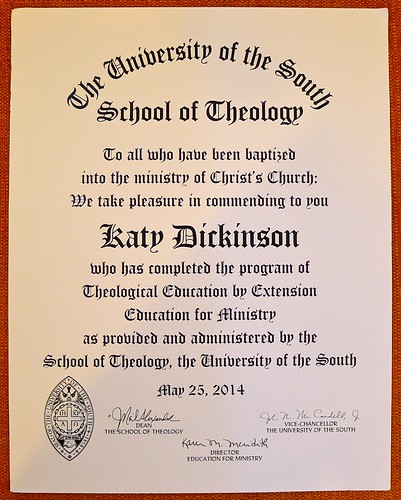

University of the South, School of Theology EfM, Diploma Katy Dickinson 2014
My EfM Diploma! (arrived early)

Images Copyright 2014 by Katy Dickinson

2 Comments

Filed under Church, News & Reviews

Happy 450th Birthday, Shakespeare!

Shakespeare Bust 2014 by Katy Dickinson

Today is the traditional celebration of the birth and death of William Shakespeare – in fact, this is the Bard’s 450th Birthday! I am dedicating this, my 1,500th blog entry since I first wrote posted on 2 June 2005, to my favorite author: William Shakespeare.

I encourage you to spend today with the Bard:

Today is also the birthday of America’s Folger Shakespeare Library, that opened in Washington DC on April 23, 1932 and is home to the world’s largest and finest collection of Shakespeare materials.  Whether you loathe or adore Shakespeare, today is his big day!

On 3 May 2014, the St. Andrew’s Shakespeare Reading Group celebrated The Bard’s 450th birthday with a cake:
William Shakespeare 450th Birthday Cake

King Lear card by Katy Dickinson 2014
Antique German collectable card showing Shakespeare’s King Lear and his court

Images Copyright 2014 by Katy Dickinson

Leave a comment

Filed under Church, News & Reviews

Unemployment Reporting, EfM

P1070410

Last summer, as soon as I was laid off from MentorCloud (great vision and staff, being paid would have been better…), I filed my unemployment claim with the California Employment Development Department (EDD).

Things have changed with EDD since I last wrote about it in 2009. The every-two-weeks reporting forms are the same but instead of a check in the mail, now they send a VISA credit card from Bank of America. This has lead to some problems.

Unfortunately, BofA is not my bank and the name on the BofA card is not precisely the same version of my name that is on my regular bank account, so they will not set up an auto-transfer. I get no notice when EDD puts funds into the VISA account, so every week, I have to: go to the BofA ATM to ask for the balance (the teller inside BofA cannot do this for an EDD card), if there is any money in the account, I go to my regular bank and tell them the precise balance, then my bank can transfer the funds into my checking account. I could just use the EDD VISA card to pay for stuff but not knowing how much is in it and telling EDD exactly what I spend money on do not work for me.

The EDD reporting form asks questions like:

  • Was there any reason (other than sickness or injury) that you could not have accepted full-time work each workday?
  • Did you look for work?
  • Did you work or earn any money, WHETHER YOU WERE PAID OR NOT?

That last one is difficult for me to answer, because of my work as an accredited Education for Ministry (EfM) mentor for the University of the South – School of Theology. The EfM program pays me a $126/month stipend during nine months of the year. I tried reporting that amount to EDD once a month during the week in which it was deposited but that did not work.  EDD stopped deposits and after two fussy letters, scheduled a phone call for me to explain about EfM. The call time was set for sometime during 3 pm to 5 pm Wednesday. When the EDD representative finally called at 5:15 pm, I explained that EfM is a weekly adult formation class for the laity – a four-year program of Bible study, church history, and theology I joined in 2010. The small payment is not per-hour or per-session but per-month and only for nine months – even though I work on the EfM program year-round. Nonetheless, the EDD representative asked me to report as if it were paid $28/weekly. Now that is sorted out, I hope that they will resume payments to the BofA VISA card.

Image copyright 2013 by Katy Dickinson

19 October 2019: Links Updated. For more about MentorCloud business practices, see Collecting a Labor Judgement (15 January 2016).

1 Comment

Filed under Home & Family, Mentoring & Other Business, News & Reviews

Dunk the Bishop and Other Convention Activities

P1100964

Last weekend, the Episcopal Diocese of El Camino Real on California’s central coast held its 2013 convention – and celebrated the start of our seventh year under the inspiring leadership of Bishop Mary Gray-Reeves. I have been honored to be elected to serve as a convention delegate (or alternate) for the last ten years. My home parish of St. Andrew’s hosted the convention this year in Saratoga.

ECR includes 13,000 people in 47 congregations:

The Diocese of El Camino Real stretches from south of San Francisco to north of Santa Barbara. The congregations of El Camino Real are found in the five counties of San Benito, San Luis Obispo, Santa Clara, Santa Cruz and Monterey. Although the youngest diocese in California, ECR’s Trinity Cathedral, in San Jose, is the oldest cathedral structure in the State of California.

Conventions are for celebration of our ministry, updates, and managing the business of the church. However, this year we also enjoyed dunking Bishop Mary. She gamely “volunteered” to get wet as a fundraiser for our youth mission trip. Tickets were sold: $10 for 3 balls to try to dunk, or $20 not to dunk the Bishop. The youth raised $1,200 from ticket sales in one night!  As always, the Rev. Stephenie Cooper and my husband John Plocher were the “Assistant Secretaries for Everything Else” – that is, running the computers and displays for the ECR  convention.

Other more-conventional (ahem) activities included:

  • Celebrating the two month visit of The Rev. Fred Kalibwami to ECR from the Diocese of Western Tanganyika (DWT)
  • Bishop Mary’s annual address to the diocese, including announcing the purchase of  Sargent House for the Bishop’s new offices in Salinas.
  • Honors to notable volunteers and lifetime contributors:
    • Bishop’s Cross Recipients: The Rev. Roger Barney, and The Rev. Canon Linda Taylor
    • Simple Servant Awards: Don and Diane Cooley, and Rosemary Tisch
  • Lunch gathering of the Education for Ministry mentors in ECR (including me!)
  • Reports on key ministries – outreach to the jails, campus ministry at four universities, and caring for the poor and homeless in our communities.
  • Election of delegates to the General Convention of the Episcopal Church (held every three years). I was elected as first Alternate for the 2015 General Convention.
  • Displays by diocesan and charity groups, plus sales of crafts and Bishop Mary’s newest book Unearthing My Religion

P1100997

P1110017

P1110022

IMG_0262

P1110218

Images Copyright 2013 by Katy Dickinson

1 Comment

Filed under Church, Home & Family, News & Reviews

Honored Women’s Day

P1060294

On 17 August 2013, the Episcopal Diocese of El Camino Real held the 8th annual event to celebrate its women. Honored Women’s Day was held at Saint Paul’s Episcopal Church in Salinas, California. The gathering was organized by the diocesan Episcopal Church Women. Sixteen awards were presented by Wanda Bryan for dedicated leadership and inspiring volunteerism. The day include a worship service lead by the Right Reverend Bishop Mary Gray-Reeves who blessed the women of the diocese. Some of the awards were for lifetime service but young women were also acknowledged for their remarkable contributions. One lady was represented by a cardboard cutout and another by her granddaughter as they were not well enough to attend.

Before the awards, there was a brief reading of “Yet We Persist”, a 2009 historical reflection on Episcopal Church Women by Katerina Katsarka Whitley that opens with

Voice 1: We are called old-fashioned;
Voice 2: We are called passe;
Voice 3: We are thought of as irrelevant;
Together: Yet, we persist. Why?
Narrator: Our history declares that we cannot be ignored, that we have relevance, and that the church could not have functioned without us.
Voice 1: Look at Mission in the past two centuries: Without us, who would have cared for the needs of missionary families?
Voice 2: Who would have raised the money?
Voice 4: Without us, who would have worried about young girls and children working in factories?
Voice 2: Who would have raised the money?
Voice 5: Without us, who would have taken action against the sickness of alcohol and its damage to families?
Voice 2: Who would have raised the money?
Voice 4: Who would have worked to claim the vote for women?

The “Yet We Persist” story starts in 1867 and tells of the hundred years of letter writing, lobbying, disappointments, but persistent efforts to have women deputies finally seated in the Episcopal General Convention in 1967, and the further work required for women to be ordained as priests in 1976. In 1989, the Rt. Rev. Barbara Harris of the Diocese of Massachusetts became the first woman Bishop of the Episcopal Church – and of the worldwide Anglican Communion. “Yet We Persist” ends in  2006, when the Rt. Rev. Katharine Jefferts Schori became the Episcopal Presiding Bishop and the first woman elected as a primate in the Anglican Communion. It was an inspiring presentation and inspiring day.

P1050948

P1060049

P1060130

P1060251

Images Copyright 2013 by Katy Dickinson

3 Comments

Filed under Church, News & Reviews

Local News, Distant News

P1040445

For neighborhood news here in Willow Glen, California, we have email lists. I manage a list for the houses in our immediate area – where yesterday I announced finding a thrown-away kitten (and settled the cute little guy in a new home that night) – and there are other lists for our Northeast Quadrant, and for our whole section of the City of San Jose (Willow Glen takes up about 3 square miles).

For national news, I listen to National Public Radio on station KQED. I sometimes check in at the New York Times but their 10-story-a-month free-limit blocks my regular usage.  I have been a KQED sustaining member for decades and don’t want to pay more than that for news.

For international updates, I read Al Jazeera (English) and the BBC – two services with similar web designs but different points of view and sources. My daughter Jessica recommended Al-Jazeera, a service started by the royal family of Qatar where she studied at CMU-Q. Maybe Qatar’s backing is why Al Jazeera has no advertisements? Current stories I found interesting on Al-Jazeera:

Image Copyright 2013 by Katy Dickinson

Leave a comment

Filed under Church, News & Reviews

Creekmore Family Reunion, Knoxville Tennessee

IMG_1323

After our visit to Loon Lake, Wisconsin, with the Plocher family last week, John and I flew to Knoxville, Tennessee, for a reunion of my Creekmore relations. My mother, Eleanor Creekmore Dickinson, was born and raised at 1007 Circle Park in Knoxville, spending summers at our Elkmont family cabin in the Great Smoky Mountains. My brothers and I and our cousins and friends also spent many happy childhood weeks at the cabin and nearby swimming hole. My brother Mark is the oldest of our generation and I am next – we have a first cousin who is twenty years younger. More Elkmont history and photos are in my Elkmont, Tennesee 2011 blog entry.

It was delightful to get together with my mother and brothers, aunts and uncles, cousins and nieces and nephews. My mother, Mark, Jessica and Matthew met us in Knoxville.  Unfortunately, Paul could not come because of final exams at Foothill College. My brother Pete was able to bring his whole family.

We went as a group to see “Dear Lodge” – the Creekmore’s Elkmont Cabin #6, now part of the “Elkmont Emergency Stabilization Project” of the US National Park Service’s “Elkmont Historic District: Appalachian Club”. Despite the many “US Property – No Trespassing” signs, the cabin’s back door was flat on the kitchen floor, plus a window and the front door of the cabin were open. However, we were happy that the holes in the floor my daughter saw during her visit in 2008 have been repaired.

We had a big family dinner at Latitude 35 in Knoxville after visiting the mountains.  Part of the fun of a reunion is telling funny stories on each other.  Here is one I shared:

When my brothers and cousins and I were little, our mothers, aunts, and uncles would sometimes take us to a drive-in at night, usually to see a Godzilla monster movie. There would be two cars: the adults would put us kids in one and lock themselves in the other so that they could watch the movie and eat their popcorn in peace. They rolled the windows down just enough to let in the movie speaker and some air. Of course, we kids would quietly get out of our car to sit on the hood or catch frogs in the grass. One evening, we had an idea. We snuck up on the grown-ups’ car and pushed some of our frogs into the window opening. Unfortunately, one of the frogs dropped into my Aunt Mary’s soda and then immediately jumped down the front of her blouse. The resulting commotion in the adult car was  spectacularly noisy. We got in big trouble (but it was worth it!).

Yesterday, John and my mother and I went to service at St. John’s Episcopal Cathedral where my parents were married in 1952. Then, we visited the family graves at Highland Memorial Cemetery on the way to the airport.

IMG_1564

IMG_1412

IMG_1460

IMG_1621

IMG_0088

Images Copyright 2013 by Katy Dickinson

4 Comments

Filed under Church, Home & Family, News & Reviews