Category Archives: Politics

Public Objects to San Jose Water Company Plan

IMG_7355

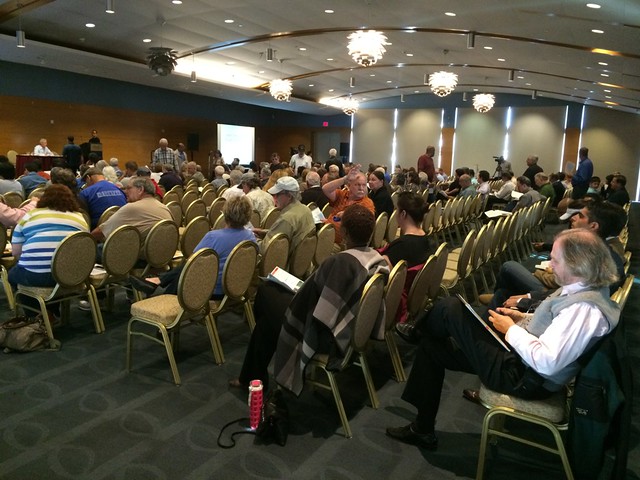
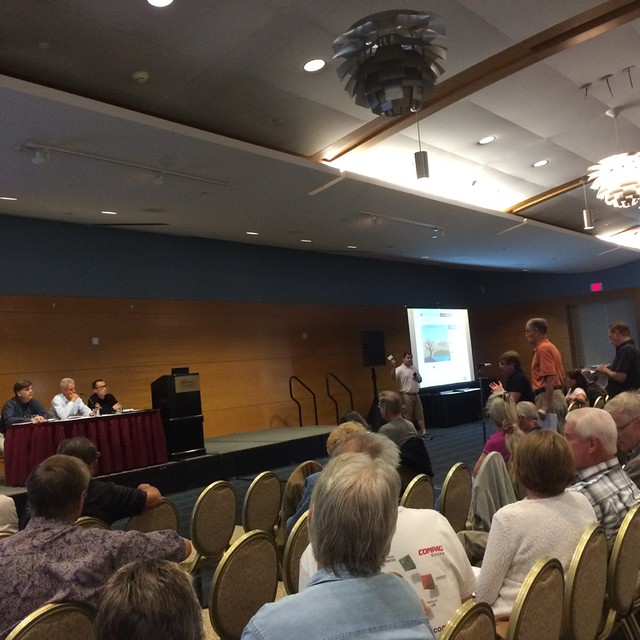
On 28 May 2015 in downtown San Jose, California, the San Jose Water Company held the first and only public hearing on their Proposed Water Shortage Contingency Plan – that is, how they will respond to Executive Order B-29-15 by the Governor of the State of California (signed 1 April 2015) requiring a further statewide 25% reduction in potable urban water usage through February 28, 2016. The private San Jose Water Company serves over a million people in the greater San Jose metropolitan area (about 230,000 paying customers) – including many in core Silicon Valley cities: Campbell, Cupertino, Los Gatos, Santa Clara, San Jose, and Saratoga.

In his introductory remarks, John B. Tang (Vice President of Government Relations and Corporate Communications, San Jose Water) said that they expected a decision by the California Public Utilities Commission (PUC) by 15 June 2015. He further mentioned that there has already been a 17 foot drop in groundwater during the last year (subsidence) and that it would take up to 300% of normal rainfall to retreat from the drought.  Mr. Tang said that San Jose Water is asking for residential customers to cut 30% of their water usage – by average rather than by individual customer usage. There will be an appeal process published later to address issues of medical needs and larger-than-4 family size. Palle Jensen (Senior Vice President-Regulatory Affairs, San Jose Water) and Bob Day (Director of Customer Service, San Jose Water) also spoke.  Mr. Jensen in particular expressed his frustration in only having 25 days to prepare their plan.  He several times blamed the plan’s shortcomings on the short development time allowed and on requirements given to San Jose Water by the Santa Clara Valley Water District and other agencies.

My son Paul and I were among about 350 upset local citizens, landowners, and small business owners who attended the meeting.  All who spoke objected to how the San Jose Water Company has chosen to respond to the Governor’s new water reduction order. Of the dozens who came to the microphone after many hours of patiently standing in line in the auditorium, no one objected to conserving water or minimized the seriousness of the California drought, now in its fourth year. They did energetically disapprove of how the San Jose Water Company proposes to respond.

Specifically:

  • California’s Executive Order calls for a 25% water usage reduction as compared 2013 and directs that “These restrictions should consider the relative per capita water usage of each water suppliers’ service area, and require that those areas with high per capita use achieve proportionally greater reductions than those with low use.” [emphasis added]
  • The San Jose Water Company’s plan calls for a 30% reduction of the average water usage across residential customers.  Apartments and business will only have to reduce landscape watering.  However, private homes will have in addition to conserve inside water usage. According to the 2010 U.S. Census, 31% of  City of San Jose citizens live in “Housing units in multi-unit structures” – that is, about a third of area housing that will not have to conserve water under this plan.
  • The single most recommended change requested by the public to the San Jose Water plan was to ask that reductions be based on individual (per capita) usage for all customers rather than by average of only residential customers.
  • The criticism most frequently expressed at the hearing was that no notes were taken by the three executives (other than to record who spoke and what city they came from) and no recording was made – indicating that this meeting was only for legal requirements, rather than to listen seriously.  There was no indication that the San Jose Water Company proposal would be modified before its submission to the PUC.  However, the executives did say that they would consider changes to the program in the future.
  • The size of a residential lot is not taken into consideration in the proposed plan.  Several speakers from the public said that they have many large trees that will die without water this summer.  One woman with a big lot said she had already deeply cut her water use and the new plan would require her to cut 88% of her water usage in addition to paying much higher water rates because of drought surcharges.  She said it cost her over $4,000/each to have large dead trees removed so that they did not create a fire hazard. Another man with a larger property said he had already cut his water usage by 45% but was being asked to reduce even more.  The San Jose Water executives eventually mentioned that the Santa Clara Valley Water District has an agricultural exemption program that homeowners who grow their own food or have orchards can investigate.
  • Some businesses (commercial nurseries, golf courses) are exempt from the restrictions; however, swimming pool and spa companies will not be allowed to fill new pools.  About five of the speakers from the audience identified themselves as being associated with pool or spa companies who foresaw serious job losses.  They said that swimming pools use less water than even drought-resistant landscaping (and one third of the water of a grass lawn), so the restriction on filling new pools did not make sense.
  • One speaker reported that other water companies in the San Francisco Bay Area are being far less strict in their requirements of customers.  For example, the nearby East Bay Municipal Utility District (“East Bay MUD”) is only seeking to reduce water use by 20%.
  • Several speakers objected to San Jose Water encouraging neighbors to tattle on each other. There is even a special webpage to make local spying easy. (Compare this to a southern California community that last month started giving cash rewards to their Water Saver of the Month to encourage conservation success.)

Our own family lives in the Willow Glen neighborhood of San Jose, part of the San Jose Water Company’s service area.  We have a large lot bordered by the Guadalupe River. As I wrote in February, the Guadalupe River in San Jose was dry in summer 2014 for the first time since we bought our house 18 years ago. The river rose this winter but only a few water pools are left now. Our riparian property is home to a large number and variety wild animals, including birds, reptiles, amphibians, and insects.  We have dozens of very large trees – old native oaks, cottonwoods, redwoods, ashes, olives and other nut and fruit trees – that are already stressed by the long drought. We have been reducing our water use for many years and are in the process of applying to the Landscape Conversion program of the Santa Clara Valley Water District. That is, we are letting our lawn die and planning to replace the grass with less-water-hungry plants. We will redirect the lawn water to do what we can to save our trees.  Fires set by the homeless who often settle along the riverbank are a big concern for us.  There was a serious fire caused by a campfire a few years ago just upstream from our house.  We are very motivated to keep our trees watered and in good health to reduce fire risk.

From the 9th edition of the New Sunset Western Garden Book: The Ultimate Gardening Guide (2012) p.719:

“How to Fight Drought:
When drought comes, and with it the possibility of local bans on lawn watering or punishing hikes in water bills, what can you do? It’s too late at that point to install a water-conserving landscape, but you can take steps to save the plants you have.
Save established trees and shrubs first. These are costly to replace and have the greatest impact on your landscape. (A lawn can be replaced with sod in an afternoon, but a 70-foot-tall redwood can take 20 years or more to replace)….”
IMG_7205

IMG_7222

IMG_7357

Images Copyright 2015 by Katy Dickinson

1 Comment

Filed under Home & Family, News & Reviews, Politics

Race, Townships, and Tour Guides in South Africa

IMG_7824

The January 2015 TechWomen mentoring program Delegation to South Africa rode from place to place in a big bus. Because traffic was often heavy, IIE arranged for tour guides to give background and tell us more about what we were seeing on the long drives. During the week, we had three guides with very different perspectives:

  • One guide was from an old Afrikaner family who did not seem happy about many of the changes since Apartheid ended (around 1994).
  • Another was (I think) what South Africans call Coloured (“people of mixed ethnic origin who possess ancestry from Europe, Asia, and various Khoisan and Bantu tribes” – according to Wikipedia).
  • The third was a European immigrant.

I don’t know if we were purposefully given guides with such varied points of view but it was very interesting nonetheless.

One of the many fascinating exhibits at the Apartheid Museum in Johannesburg addressed the complex question of what it meant and means to be in part of a South African ethnic/racial group. For example, here is a quote from the South Africa “Population Registration Act” of 1950 on display in the museum:

“A white person is one who in appearance is, or who is generally accepted as, a white person, but does not include a person who, although in appearance obviously a white person, is generally accepted as a coloured person.  A native is a person who is in fact or is generally accepted as a member of any aboriginal race or tribe from Africa.  A coloured person is a person who is not a white person not a native.”

Each of our Apartheid Museum tickets was randomly printed “White” or “Non-White” on the back – dividing the delegation in two. The halves of the delegation had the disturbing experience of entering the museum through different doors and seeing the first exhibit from separated walkways. I grew up during the Civil Rights Movement in America. It was hard to explain to my TechWomen colleagues from the Middle East why splitting of the Delegation by race made me feel angry and ill.  We have worked so hard to build a community of sisters from the Silicon Valley, Africa, and the Middle East in TechWomen – intentionally dividing us felt very bad, even for such a brief educational experience.

In getting to all of our meetings and events, almost every day the Delegation was driven past many miles of Townships which showed varying degrees of infrastructure quality (roads, electricity, fences, garbage pickup) and prosperity. I think South Africa Townships are something like American suburbs but not as ethnically integrated as what I see in California suburbs.  From what the guides said, there are very active, expensive, and controversial government programs to upgrade and sometimes relocate the Townships. In just a week, I could not possibly understand the subtleties of these programs and their politics but it did seem that South Africa has a great deal of work ahead of it.  One of my take-aways from the trip was a new context in which to think about America’s own race and ethnic complexities.

IMG_6815

IMG_7822

IMG_8622

IMG_7513

IMG_8645

IMG_8604

IMG_8625

Images Copyright 2015 by Katy Dickinson

Leave a comment

Filed under Mentoring & Other Business, News & Reviews, Politics

We Are Citizen Diplomats

IMG_7293

Last month, I attended a reception in San Francisco for IVLP (The International Visitor Leadership Program – the U.S. Department of State’s premier professional exchange program). At that event, I sent this tweet:

State Dept Intl Visitors program since 1940s hosted 200,000 to US (7,000 by @IVLPSF) 330 later were heads of state: We are citizen diplomats
07:04 PM – 20 Nov 13 @katy_dickinson

I was surprised when this tweet was redistributed several times.  After each retweet, I considered what it means to be a citizen diplomat. I learned about IVLP through the TechWomen program and the Institute of International Education (IIE West Coast). I was pleased to be an ILVP event host myself – having a group from the Middle East and North Africa for dinner and a WP668 caboose tour in April 2013.

The phrase citizen diplomat was used by the State Department speaker to describe those who support the IVLP program. The State Department website defines citizen diplomacy as:

Citizen Diplomacy is the concept that the individual has the right to help shape U.S. foreign relations “one handshake at a time.” Citizen diplomats can be students, teachers, athletes, artists, business people, humanitarians, adventurers or tourists. They are motivated by a desire to engage with the rest of the world in a meaningful, mutually beneficial dialogue.

This week, I have been making travel arrangements for my first visit to Sub-Saharan Africa, as part of the TechWomen delegation to Rwanda in February 2014. This will be my third time as a delegation member, having also traveled to Morocco (2011) and Jordan (2013) with the US State Department’s TechWomen program. While it feels presumptuous to call ourselves so, I think the hundreds of remarkable and generous Silicon Valley women professionals who have served as TechWomen mentors since 2010 are indeed citizen diplomats.

When our 78 mentees from the Middle East and Africa were working with us in October 2013 here in California, the US federal government shut down for 16 days. It was an embarrassing but excellent example of both the good and bad sides of the American democratic system. The bad side was watching some of the world’s elite and most powerful leaders squabbling in public. The good side was watching America continue to function pretty well without them. I imagine the other TechWomen mentors got to discuss all of this as often as I did with our international guests. If that isn’t citizen diplomacy, I don’t know what is.

IMG_7280

IMG_7311

Images Copyright 2013 by Katy Dickinson

4 Comments

Filed under Caboose Project and Other Trains, Mentoring & Other Business, News & Reviews, Politics

TSA Afraid of Rocks

IMG_5890

Ever since I read “Why It’s Time To Break The Code Of Silence At The Airport” by Christopher Elliott (15 February 2013, TheHuffingtonPost) and my daughter’s TSA posts (including “TSA Touching Crosses The Line: Update”), I have been considering how much more invasive and offensive the TSA has become over time and how we enable this behavior by not objecting to it.

This weekend, I flew from the San Francisco Bay Area to Los Angeles for training (to renew my mentor certification with Education for Ministry, a program of the University of the South – School of Theology), and to visit my brother and family in La Crescenta. I used two small-ish airports, San Jose (SJC) and Burbank (BUR) for convenience.

This morning, I walked quickly to the head of the extremely short security check point line at Burbank, hoping to have time for a quiet coffee before boarding my flight home. However, I was pulled out of line in the nearly-empty security area not once but twice.

  1. The first time I was pulled from line was so that the security lady could feel my face – after her full-body scanner drew a little yellow box around my apparently-dangerous earring. As you can see from the picture below (and as she herself could clearly see), there wasn’t anything for her to find while she patted down my ear, cheek, and short hair.
  2. The second time I was pulled out a few minutes later was so that the security man could unpack my small roller bag, re-scan my toiletries, and try to take away my rock.  I was bringing home a small piece of granite as a souvenir of La Crescenta.  He said, after feeling my rock, that I had to get rid of it or check my bag because a rock could be a weapon.  It seems that there is a TSA rule saying that rocks over five pounds are dangerous.  I chose to keep my rock, so I was escorted out of the security area, then had to walk back to the airline counter (where the counter lady told me that she hears an unusual number of complaints about the Burbank TSA), check my carry-on bag, and go through security all over again.

I made my flight home, but no quiet coffee for me.  I object.

IMG_5892 . IMG_5893

Images Copyright 2013 by Katy Dickinson

Leave a comment

Filed under Church, Home & Family, Mentoring & Other Business, News & Reviews, Politics

Bees and Democracy

IMG_2287

I have been reading a fascinating article in the March 2012 Smithsonian Magazine called “Hive Mind” by Carl Zimmer. The article describes the work of Cornell University biologist Thomas Seeley, an expert in honeybees, swarm intelligence, and collective decision making.

The decision-making power of honeybees is a prime example of what scientists call swarm intelligence. Clouds of locusts, schools of fish, flocks of birds and colonies of termites display it as well.

Seeley and his colleagues have discovered a few principles honeybees use to make smart decisions:

  1. Enthusiasm: passion in the bee communications dance
  2. Flexibility: decaying number of dance repetitions is tied to the value of what the dance is communicating
  3. Quorum: silencing lower value dance communications as the number of higher value dancers rises to a decision threshold

Seeley draws comparisons between how a honeybee hive makes decisions and how both the human brain and a democracy work:

Both swarms and brains make their decisions democratically. Despite her royal title, a honeybee queen does not make decisions for the hive. The hive makes decisions for her. In our brain, no single neuron takes in all the information from our senses and makes a decision. Millions make a collective choice. …Groups work well, he argues, if the power of leaders is minimized. A group of people can propose many different ideas – the more the better, in fact. But these ideas will only lead to a good decision if listeners take time to judge their merits for themselves… Groups also do well if they’re flexible, ensuring that good ideas don’t lose out simply because they come late in the discussion.

Just because animals do something does not mean it is also appropriate for people. Nonetheless, comparing human systems to patterns in nature presents both in an interesting context.

Image Copyright 2009 by Katy Dickinson

Leave a comment

Filed under News & Reviews, Politics

Cactus Fence

This is an update on my blog entry “Gardening Around the Homeless” dated 10 April 2006. We live on the bank of the Guadalupe River in Willow Glen, California. In 2006, I started to create an informal cactus fence to deter homeless transients from passing through or camping on our river bank. I am even more motivated to continue this project by two big river bank fires recently caused by homeless campers just upstream of our property. I have planted both Echinopsis and Opuntia (prickly pear), plus some Yucca for height; they are all growing well.

DSCN5803 DSCN5805

DSCN5806

Images Copyright 2009 by Katy Dickinson

2 Comments

Filed under Home & Family, News & Reviews, Politics

Remote Inauguration

We were very excited that Jessica, my 20-year-old daughter, attended this week’s Presidential inauguration in Washington, DC. You can see her blog entries and photos at  http://feelingelephants.wordpress.com/. Ours is a politically passionate family. One of my earliest memories was glee that my candidate (John F. Kennedy) won the presidential election over my older brother’s candidate (Barry Goldwater), in 1964.

Our family has always been split between liberal and conservative. The divergence of our current family politics is best shown in two objects: a framed picture of the late President Ronald Reagan that my father put up in the front hall of their San Francisco house (intended to be seen by everyone who came over for parties to phone Obama voters, hosted by my mother), and the shoe with BUSH –> in gold paint on the toe that someone gave my father for Christmas:

Bush Shoe photo: copyright 2009 Katy Dickinson

I was at work at Sun during Tuesday’s inaugural morning so I went over to the Menlo Park campus Crossroads conference room to watch history unfolding
live by CNN TV broadcast on the big screen. Because I usually get my news from National Public Radio (NPR), it was particularly interesting to see how the great and powerful look and interact:

    • Why did Jimmy and Roselyn Carter greet  George and Barbara Bush with a kiss for Barbara but then walk by  Bill and Hilary Clinton, who were right next to the Bushes, without a word?
    • The senior President Bush does not seem to be aging well. He sat next to Hilary Clinton and behind the new First Lady  Michelle Obama, so there were many pictures of him with his mouth open looking confused.
    • Hilary Clinton, on the other hand, looked radiant two days before her confirmation as our new Secretary of State.
    • It was fascinating to watch outgoing President George W. Bush during his last minutes in office. I saw Bush pat the leg of one of the tall Marines in full dress uniform as he walked past – like you would pat a friendly dog.

It was certainly a great day for San Francisco, with soon-to-be President Barack Obama walking into the ceremony right behind Senator Dianne Feinstein
and Speaker of the House Nancy Pelosi. This is a welcome change from President G.W. Bush pretending that California did not exist. Having Dianne Feinstein serve as Chair of the Joint Congressional Committee on Inaugural Ceremonies meant that we got to see a great deal of her between speakers and events. We are so proud of her!

Except when greeting people, President Obama seemed grim during much of the event. The only time I caught a big smile was when he messed up his inaugural
oath (he had to take it again later). The biggest smile of the day, however, was that of cellist  Yo-Yo Ma who appeared delighted to be performing with violinist
Itzhak Perlman. There was much wondering how the instruments and musicians could play “Air and Simple Gifts” so well on that cold day. This was cleared up when it was  announced today that those on the inaugural stage heard the musicians live but a prior recording was broadcast for everyone else. However
real the broadcast, Ma’s smile and the superb music were a genuine delight.

CNN in Sun’s conference room

Inauguration on CNN in Sun's conference room photo: copyright 2009 Katy Dickinson

Feinstein, Obama, Pelosi on CNN

Feinstein, Obama, Pelosi, inauguration CNN photo: copyright 2009 Katy Dickinson

Obama taking the oath, CNN

Obama taking the oath, inauguration CNN photo: copyright 2009 Katy Dickinson

Clintons, Obama, G.H.W. Bush, CNN

Clintons, Michelle Obama, G.H.W. Bush, inauguration CNN photo: copyright 2009 Katy Dickinson

Hilary Clinton, CNN

Hilary Clinton, inauguration CNN photo: copyright 2009 Katy Dickinson

Perlman, Montero, Ma, McGill, CNN

Itzhak Perlman, Gabriela Montero, Yo-Yo Ma, Anthony McGill, CNN photo: copyright 2009 Katy Dickinson

Photos Copyright 2009 by Katy Dickinson

1 Comment

Filed under News & Reviews, Politics