Category Archives: Politics

Three Border Walls

Untitled

Before I built a wall I’d ask to know
What I was walling in or walling out,
And to whom I was like to give offence.
Something there is that doesn’t love a wall,
That wants it down. …
He moves in darkness as it seems to me,
Not of woods only and the shade of trees.
He will not go behind his father’s saying,
And he likes having thought of it so well
He says again, “Good fences make good neighbours.”
– Robert Frost, 1914

After watching John Oliver’s 20 March 2016 comic-news analysis on the proposed Border Wall, I remembered the lines in “Mending Wall“, the first poem I read by the great American poet Robert Frost.  I have had experience with three border walls in recent years:

Israel-Palestine Wall – Bethlehem, 2016

Between the TechWomen Delegations to Jordan and Zimbabwe, last month a group of us visited Gaza and the West Bank in addition to more usual Israel-Palestine tourist locations such as Jerusalem and MasadaBethlehem is a mixed Muslim-Christian city in the West Bank, typified for me by Manger Square, which has the Church of the Nativity at one end and the Mosque of Omar at the other.  The wall runs through Bethlehem, in one case right around an existing home.

This wall is regularly a target location for violent confrontations between citizens and soldiers, one of which we regrettably observed from two blocks away, as we were preparing to leave the city.  The wall is also a ground for artistic and political communication: it is covered with paintings and graffiti, including some by famous artists like Banksy. In a Bethlehem shop, we saw a traditional olive wood nativity scene – with the addition of a barrier wall keeping out the three wise men.

Israel-Palestine Wall in Bethlehem 2016 . Israel-Palestine Wall in Bethlehem 2016

Israel-Palestine Wall in Bethlehem 2016

Berlin Wall Sections – Mountain View, California, 2010

Two graffitied sections of the 1961-1989 Berlin Wall lived in an office park near where I worked in Mountain View, California, for many years. I used to visit them sometimes during lunch, thinking of the people who died climbing the Berlin Wall trying to get to freedom.  In 2013, the sections were moved to the front of the public library.

The original sign in front of these sections said: “…Between November 9 and 12, 1989 the Wall was breached; not from without with bombs or bullets, but from within by the sound of freedom and the vision of a better life that had drifted over the Wall. The World must not forget that it was America’s resolve and its political and economic ideals that made this bloodless revolution and most significant historical event possible.”  I don’t know if that sign is still with the sections since they moved.

Berlin Wall Section, Mountain View, California, 2010 . Berlin Wall Section, Mountain View, California, 2010

California USA-Mexico Wall, 2008

In 2008, my husband and I flew with friends to Baja California to see the grey whales at Laguna San Ignacio. Coming home, we got fuel and checked out with Mexican customs in Mexicali, then flew 9 miles north across the US border to check in at Calexico. The Calexico general aviation airport is directly on the USA-Mexico border fence.  It was strange to see our two nations that are culturally and economically one family – with a line drawn between them.

California USA-Mexico Wall, 2008 . California USA-Mexico Wall, 2008

California USA-Mexico Wall, 2008

Photos Copyright by Katy Dickinson 2008-2016

2 Comments

Filed under Church, News & Reviews, Politics

Republican Elephant Killed in Accident (1956)

IMG_7428

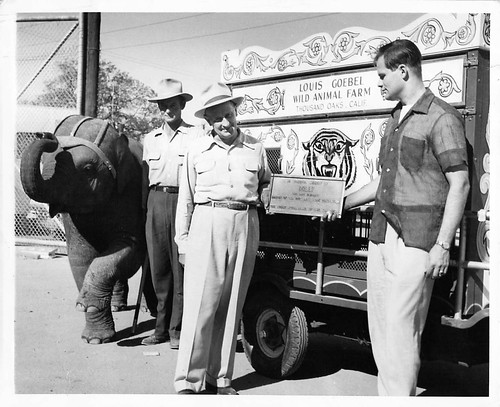
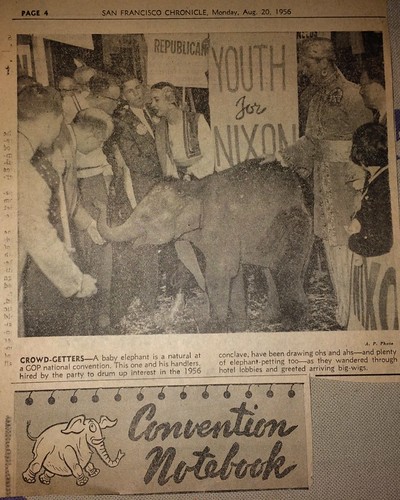
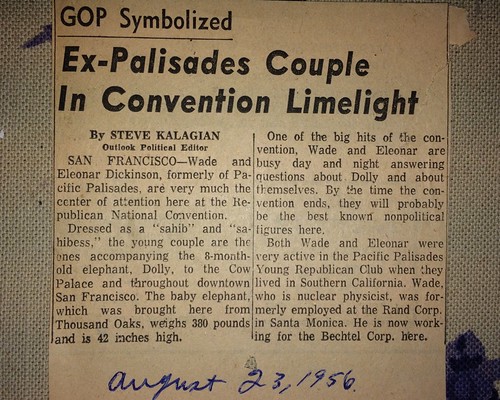
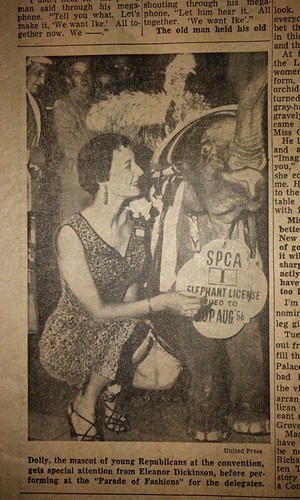
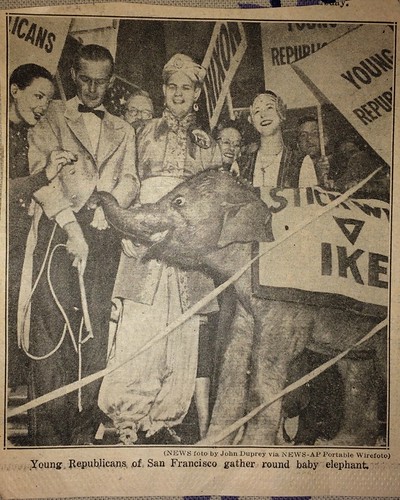
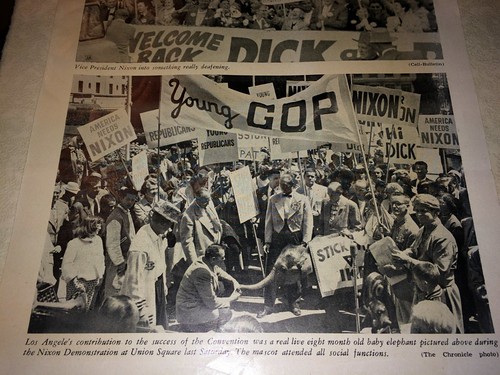
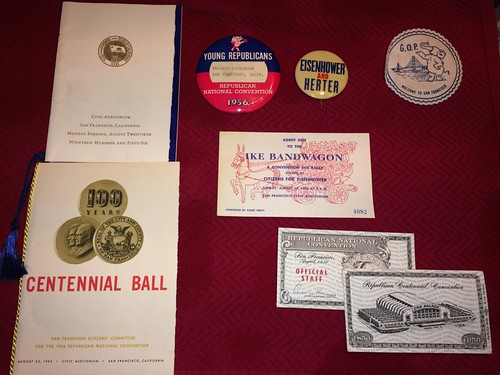
I grew up knowing about Dolly, the baby elephant my parents took care of during the August 1956 Republican National Convention. I was sad today to learn the end of her story. I have been looking through a family treasure box recently and came across a folder of newspaper clippings from 1956. Some I had seen before – of my parents dressed in Indian finery escorting Dolly, an eight month old elephant from the Louis Goebel Wild Animal Farm in Southern California. There were cheerful news stories from New York, Chicago, Pacific Palasades, my mother’s hometown of Knoxville, Tennessee, as well as from the San Francisco Bay Area. Dolly as the symbol of the Young Republicans, went to all of the convention social events and even greeted President Eisenhower (who was successfully re-elected several months later). She was usually pictured wearing her big “Elephant License 1” from the Society for the Prevention of Cruelty to Animals (SPCA).

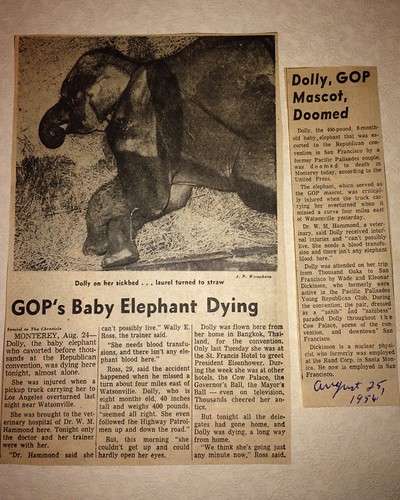
It was a shock to come upon two final news stories about how Dolly was killed in a traffic accident when the truck taking her home from San Francisco overturned. She died near Watsonville, California, in need of a blood transfusion and far from any elephant who could give it to her.

Four years later, by the 1960 presidential election, my mother had become a Democrat, firmly opposed to my father’s continued support of the Republican party. 1960 was the first election I remember: my 3-year-old self was so delighted that my candidate, John F. Kennedy, won.  I wonder if Dolly’s death had anything to do with my mother’s shift in politics?

Wade Dickinson with elephant at Goebel Wild Animal Farm 1956

IMG_7427

IMG_7429

IMG_7425

IMG_7422

IMG_7444

IMG_7448

1956 Dolly elephant

Leave a comment

Filed under Home & Family, News & Reviews, Politics

Family Treasure Box

Wade Dickinson 1964 Louis Goebel Wild Animal Farm with elephant

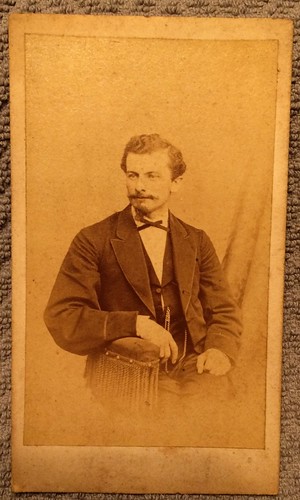
The family that purchased our San Francisco home three years ago is remodeling and found a big flat metal box in the attic. I am grateful that they were kind enough to ship it to me since it is stuffed with family documents and photographs. I have been sorting and scanning the contents, finding both treasures and surprises. There was a stack of small faded family photos of Swiss ancestors, dated 1863 to 1890 (I recognize a few names and faces). There were also photos of military bomb tests taken my father (Wade Dickinson) in the 1950s, and a picture of my father taking delivery of a baby elephant at the Louis Goebel Wild Animal Farm. He and my mother wrangled the elephant for the 1956 Republican National Convention in San Francisco. Also included were my mother’s diploma from the University of Tennessee (Knoxville 1952), my father’s diploma from West Point (USMA 1949) , plus a humorous 1951 diploma for “Doctor of Nuclear Phenomeknowledgy” from the researchers at the Oak Ridge School of Reactor Technology where my father studied Nuclear Engineering. There is even a flyer from my mother’s first art exhibit in San Francisco (1965?) and a photo of her modeling in the Junior League of San Francisco fashion show.  Unpacking treasure is interesting.

family treasure box 2015

Eleanor Dickinson Junior League Fashion Show San Francisco 1955 . Wade Dickinson USMA 1945

USAF military bomb test 1952?

Wade Dickinson certificate Oak Ridge School of Reactor Technology 1951

1870 Washington DC . Grandma Lily in Geneve 1871

2015_09_04_13_16_58.pdf000
Photos Copyright 1951-2015 by Katy Dickinson

2 Comments

Filed under Home & Family, News & Reviews, Politics

5th Day General Convention: Presiding Bishop Election

IMG_9698

The big news today at the 78th Episcopal General Convention (GC) in Salt Lake City was that we elected a new Presiding Bishop (PB) to a nine year term.  Bishop of North Carolina Michael Curry was the favorite for our Deputation from the Diocese of El Camino Real (ECR). He was elected with overwhelming support on the first ballot:

  • House of Bishops 121 votes (70%)
  • House of Deputies 800 votes (99%)

Bishop Michael Curry is the first African-American PB and, in fact, the first PB of color. We are trying to find out if any other PB in history has ever been elected on the first ballot. The process is that the House of Bishops (HofB) elects the PB and then the House of Deputies (HofD) votes to confirm. The Rev. Gay Clark Jennings (President of the HofD) lead the celebration of the 230th anniversary of the House of Deputies while we were waiting for HoB to send news of their election. The HofD dates from 1785 and is very proud of being four years older than the HofB: the House of Deputies  is referred to as the “elder house”. After the anniversary party, the HofD refused its President’s strong suggestion that we go to lunch. We sang “We are all together” at her until she relented and let us consider more resolutions until the big PB vote.  There was great rejoicing  after our quick and extremely positive confirmation of the HofB election of Bishop Curry.

In the afternoon after the PB election (and lunch), Rev. Tom Sramek and I walked down the hall to sit in the audience area of the House of Bishops – to see the Diocese of El Camino Real‘s Bishop Mary working among the purple people. (The traditional color for Bishops to wear is purple – and most of them do.) The Vice President of the HofB was presiding. Some of the differences I saw:

  • HofB is less than half the size, overwhelmingly male, and the average age is much older than the HofD
  • HofB is much less tightly managed and their parliamentary functioning lacks the high polish and style of the Rev. Gay Clark Jennings
  • HofB sits in small groups at round tables – promoting collegiality and more interaction – while HofD sit a long tables
  • There are no Alternates in HofB – everyone there can wear the purple

After our visit to the HofB, it was time for the ECR dinner where Bishop Mary hosted us in celebrating our new PB!

IMG_9576

IMG_9618

IMG_9740

IMG_9780

Images Copyright 2015 by Katy Dickinson

2 Comments

Filed under Church, News & Reviews, Politics

Road Diet Controversy in Willow Glen

IMG_8735

The Road Diet has caused a great deal of energetic debate in the Willow Glen neighborhood of San Jose, California, most recently among the 500+ who attended the public discussion at Willow Glen High School on 18 June 2015.  Most of the discussion was about:

  1. Bad for Business: The Road Diet trial has reportedly had a very negative effect on local businesses (particularly in the 0.4 mile downtown area on Lincoln Avenue between Willow Street and Minnesota Avenue).  Many small business owners at the meeting spoke of a significant decline due to customer frustration with traffic congestion.  Several spoke about shopping elsewhere to avoid the intermittent Lincoln Avenue gridlock.
  2. Good for Bikes: Several in the bicycling community reported their satisfaction at having a new bike lane, even if it does not connect yet to other bike corridors.
  3. Driver Frustration caused by increased traffic congestion on Lincoln Avenue was a common topic.
  4. Data, Analysis, and Interpretation: Questions were raised by many about Road Diet data – as well as concern about key elements (like accidents, pedestrian traffic, and parking) not being measured at all.

Here is a summary by the Willow Glen Business Association about the Road Diet:

In Fall 2014 District 6 Council Member Pierluigi Oliverio proposed that the City of San José Department of Transportation (DOT) implement a trial road diet on Lincoln Avenue in Spring 2015.   The trial was completed in March, April and May 2015.   You may read the DOT’s reports about the trial here:

What is a Road Diet? Watch this video to learn about road diets.

A recent news story “San Jose: Lincoln Avenue ‘road diet’ divides Willow Glen community” reported on how the Road Diet is polarizing this small community.

Council Member Olivierio wrote (in November 2014) that he backed the Road Diet to help the Willow Glen business district “…feel quaint, pedestrian friendly, and become a more desirable location to shop and stroll.” According to Interim Director Jim Ortbal of the Department of Transportation (DOT), the purpose of the Lincoln Avenue Road Diet was threefold:

  • Improve safety for all users
  • Create a calmer traffic environment
  • Enhance travel for people walking and biking

DOT staff reported at length on traffic volume and speed data for 45 locations in the Willow Glen area.  However, on 18 June, the DOT was not able to present information indicating success on any of the three goals.  For example, DOT said they could not report on safety because it would take one to two years of data collection to determine patterns.  When pressed, DOT staff said that there were about the same number of accidents reported to the police.  Some speakers (including myself) testified to the current situation causing dangerous traffic congestion and frustration for both drivers and walkers at certain times of day. Other members of the public said that they felt safer walking in the area as a result of the Road Diet. DOT reported a small increase in bikers but they did not measure walkers.

A group of four Stanford University Public Policy graduate students conducted their own Analysis and Recommendations for Lincoln Ave Road Diet.  Their recommendations were:

  • Clarify and prioritize the goals of the road diet to better gauge whether the road diet successfully achieves its policy objectives.
  • Determine the road diet’s impact on Lincoln Avenue businesses by gathering and analyzing pre- and post-diet data on business sales receipts.
  • Survey area residents to gauge perceptions of the road diet’s impact on livability.
  • Gather more pedestrian and bicycle traffic count observations over a longer time period to determine if the post-diet increases are statistically significant.

Some of the best suggestions I heard at the 18 June public hearing were:

  • Create a pedestrian scramble at both Willow/Lincoln and Minnesota/Lincoln rather than making walkers wait for two long lights.
  • Get rid of the Road Diet middle passing lane (that some were calling the “suicide lane” and others said was often blocked by parked trucks making deliveries), allowing just one lane in each direction, then increase the available parking with diagonal striping, and maybe widen the sidewalks at the same time.
  • Build a parking structure (for example in the now-empty lot on the corner of Willow/Lincoln) to reduce the number of cars circling trying to find a place to park.

The DOT is asking for a quick decision on the success of the 3-month Road Diet so that they can know what to do when they repave Lincoln Avenue in October 2015.

Click here to see the entire Willow Glen Road Diet Series.

IMG_8298

IMG_8320

Images Copyright 2015 by Katy Dickinson

6 Comments

Filed under News & Reviews, Politics

Public Objects to San Jose Water Company Plan

IMG_7355

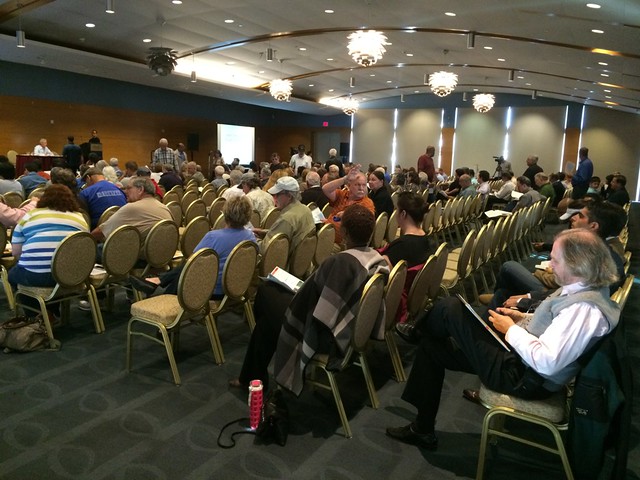
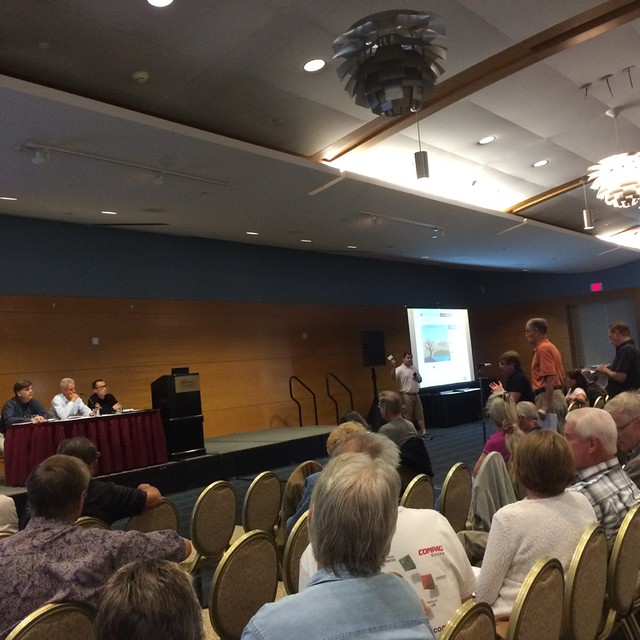
On 28 May 2015 in downtown San Jose, California, the San Jose Water Company held the first and only public hearing on their Proposed Water Shortage Contingency Plan – that is, how they will respond to Executive Order B-29-15 by the Governor of the State of California (signed 1 April 2015) requiring a further statewide 25% reduction in potable urban water usage through February 28, 2016. The private San Jose Water Company serves over a million people in the greater San Jose metropolitan area (about 230,000 paying customers) – including many in core Silicon Valley cities: Campbell, Cupertino, Los Gatos, Santa Clara, San Jose, and Saratoga.

In his introductory remarks, John B. Tang (Vice President of Government Relations and Corporate Communications, San Jose Water) said that they expected a decision by the California Public Utilities Commission (PUC) by 15 June 2015. He further mentioned that there has already been a 17 foot drop in groundwater during the last year (subsidence) and that it would take up to 300% of normal rainfall to retreat from the drought.  Mr. Tang said that San Jose Water is asking for residential customers to cut 30% of their water usage – by average rather than by individual customer usage. There will be an appeal process published later to address issues of medical needs and larger-than-4 family size. Palle Jensen (Senior Vice President-Regulatory Affairs, San Jose Water) and Bob Day (Director of Customer Service, San Jose Water) also spoke.  Mr. Jensen in particular expressed his frustration in only having 25 days to prepare their plan.  He several times blamed the plan’s shortcomings on the short development time allowed and on requirements given to San Jose Water by the Santa Clara Valley Water District and other agencies.

My son Paul and I were among about 350 upset local citizens, landowners, and small business owners who attended the meeting.  All who spoke objected to how the San Jose Water Company has chosen to respond to the Governor’s new water reduction order. Of the dozens who came to the microphone after many hours of patiently standing in line in the auditorium, no one objected to conserving water or minimized the seriousness of the California drought, now in its fourth year. They did energetically disapprove of how the San Jose Water Company proposes to respond.

Specifically:

  • California’s Executive Order calls for a 25% water usage reduction as compared 2013 and directs that “These restrictions should consider the relative per capita water usage of each water suppliers’ service area, and require that those areas with high per capita use achieve proportionally greater reductions than those with low use.” [emphasis added]
  • The San Jose Water Company’s plan calls for a 30% reduction of the average water usage across residential customers.  Apartments and business will only have to reduce landscape watering.  However, private homes will have in addition to conserve inside water usage. According to the 2010 U.S. Census, 31% of  City of San Jose citizens live in “Housing units in multi-unit structures” – that is, about a third of area housing that will not have to conserve water under this plan.
  • The single most recommended change requested by the public to the San Jose Water plan was to ask that reductions be based on individual (per capita) usage for all customers rather than by average of only residential customers.
  • The criticism most frequently expressed at the hearing was that no notes were taken by the three executives (other than to record who spoke and what city they came from) and no recording was made – indicating that this meeting was only for legal requirements, rather than to listen seriously.  There was no indication that the San Jose Water Company proposal would be modified before its submission to the PUC.  However, the executives did say that they would consider changes to the program in the future.
  • The size of a residential lot is not taken into consideration in the proposed plan.  Several speakers from the public said that they have many large trees that will die without water this summer.  One woman with a big lot said she had already deeply cut her water use and the new plan would require her to cut 88% of her water usage in addition to paying much higher water rates because of drought surcharges.  She said it cost her over $4,000/each to have large dead trees removed so that they did not create a fire hazard. Another man with a larger property said he had already cut his water usage by 45% but was being asked to reduce even more.  The San Jose Water executives eventually mentioned that the Santa Clara Valley Water District has an agricultural exemption program that homeowners who grow their own food or have orchards can investigate.
  • Some businesses (commercial nurseries, golf courses) are exempt from the restrictions; however, swimming pool and spa companies will not be allowed to fill new pools.  About five of the speakers from the audience identified themselves as being associated with pool or spa companies who foresaw serious job losses.  They said that swimming pools use less water than even drought-resistant landscaping (and one third of the water of a grass lawn), so the restriction on filling new pools did not make sense.
  • One speaker reported that other water companies in the San Francisco Bay Area are being far less strict in their requirements of customers.  For example, the nearby East Bay Municipal Utility District (“East Bay MUD”) is only seeking to reduce water use by 20%.
  • Several speakers objected to San Jose Water encouraging neighbors to tattle on each other. There is even a special webpage to make local spying easy. (Compare this to a southern California community that last month started giving cash rewards to their Water Saver of the Month to encourage conservation success.)

Our own family lives in the Willow Glen neighborhood of San Jose, part of the San Jose Water Company’s service area.  We have a large lot bordered by the Guadalupe River. As I wrote in February, the Guadalupe River in San Jose was dry in summer 2014 for the first time since we bought our house 18 years ago. The river rose this winter but only a few water pools are left now. Our riparian property is home to a large number and variety wild animals, including birds, reptiles, amphibians, and insects.  We have dozens of very large trees – old native oaks, cottonwoods, redwoods, ashes, olives and other nut and fruit trees – that are already stressed by the long drought. We have been reducing our water use for many years and are in the process of applying to the Landscape Conversion program of the Santa Clara Valley Water District. That is, we are letting our lawn die and planning to replace the grass with less-water-hungry plants. We will redirect the lawn water to do what we can to save our trees.  Fires set by the homeless who often settle along the riverbank are a big concern for us.  There was a serious fire caused by a campfire a few years ago just upstream from our house.  We are very motivated to keep our trees watered and in good health to reduce fire risk.

From the 9th edition of the New Sunset Western Garden Book: The Ultimate Gardening Guide (2012) p.719:

How to Fight Drought:
When drought comes, and with it the possibility of local bans on lawn watering or punishing hikes in water bills, what can you do? It’s too late at that point to install a water-conserving landscape, but you can take steps to save the plants you have.
Save established trees and shrubs first. These are costly to replace and have the greatest impact on your landscape. (A lawn can be replaced with sod in an afternoon, but a 70-foot-tall redwood can take 20 years or more to replace)….”
IMG_7205

IMG_7222

IMG_7357

Images Copyright 2015 by Katy Dickinson

1 Comment

Filed under Home & Family, News & Reviews, Politics

Race, Townships, and Tour Guides in South Africa

IMG_7824

The January 2015 TechWomen mentoring program Delegation to South Africa rode from place to place in a big bus. Because traffic was often heavy, IIE arranged for tour guides to give background and tell us more about what we were seeing on the long drives. During the week, we had three guides with very different perspectives:

  • One guide was from an old Afrikaner family who did not seem happy about many of the changes since Apartheid ended (around 1994).
  • Another was (I think) what South Africans call Coloured (“people of mixed ethnic origin who possess ancestry from Europe, Asia, and various Khoisan and Bantu tribes” – according to Wikipedia).
  • The third was a European immigrant.

I don’t know if we were purposefully given guides with such varied points of view but it was very interesting nonetheless.

One of the many fascinating exhibits at the Apartheid Museum in Johannesburg addressed the complex question of what it meant and means to be in part of a South African ethnic/racial group. For example, here is a quote from the South Africa “Population Registration Act” of 1950 on display in the museum:

“A white person is one who in appearance is, or who is generally accepted as, a white person, but does not include a person who, although in appearance obviously a white person, is generally accepted as a coloured person.  A native is a person who is in fact or is generally accepted as a member of any aboriginal race or tribe from Africa.  A coloured person is a person who is not a white person not a native.”

Each of our Apartheid Museum tickets was randomly printed “White” or “Non-White” on the back – dividing the delegation in two. The halves of the delegation had the disturbing experience of entering the museum through different doors and seeing the first exhibit from separated walkways. I grew up during the Civil Rights Movement in America. It was hard to explain to my TechWomen colleagues from the Middle East why splitting of the Delegation by race made me feel angry and ill.  We have worked so hard to build a community of sisters from the Silicon Valley, Africa, and the Middle East in TechWomen – intentionally dividing us felt very bad, even for such a brief educational experience.

In getting to all of our meetings and events, almost every day the Delegation was driven past many miles of Townships which showed varying degrees of infrastructure quality (roads, electricity, fences, garbage pickup) and prosperity. I think South Africa Townships are something like American suburbs but not as ethnically integrated as what I see in California suburbs.  From what the guides said, there are very active, expensive, and controversial government programs to upgrade and sometimes relocate the Townships. In just a week, I could not possibly understand the subtleties of these programs and their politics but it did seem that South Africa has a great deal of work ahead of it.  One of my take-aways from the trip was a new context in which to think about America’s own race and ethnic complexities.

IMG_6815

IMG_7822

IMG_8622

IMG_7513

IMG_8645

IMG_8604

IMG_8625

Images Copyright 2015 by Katy Dickinson

Leave a comment

Filed under Mentoring & Other Business, News & Reviews, Politics