Tag Archives: Willow Glen

Willow Glen Road Diet Failure

Willow Glen Lincoln Avenue Road Diet Failure San Jose California 17 May 2016

Our family has lived in Willow Glen for almost twenty years. It is a comfortable and neighborly area of San Jose, California with large gardens, good restaurants and shops, and charming architecture. Lincoln Avenue – the neighborhood’s downtown – is part of what makes Willow Glen a “San Jose Treasure”. Unfortunately, during the last year Lincoln Avenue has been inflicted with a “Road Diet” which has increased traffic and accidents while discouraging customers from shopping and dining in its otherwise-attractive small businesses.

I first wrote about the “Road Diet Controversy in Willow Glen” about a year ago and the situation has not improved.  On 21 March 2016, there was a debate among seven of the candidates for the Willow Glen District 6 City Council seat at which the Road Diet was a major topic.  Julia Baum of the Mercury News reported on 29 March 2016 reported:

“Candidates answered questions about eminent domain, job creation and the city’s widespread homeless population, but the discussion about the Lincoln Avenue road diet highlighted the evening. Most of the candidates supported permanently keeping Lincoln Avenue to one lane each way and not returning to the original four-lane configuration.”

I do not understand why the failed Road Diet is so popular with Willow Glen’s political leaders (and candidates for political leadership).  During this last year, I have spoken regularly with Lincoln Avenue small business owners who are to a person upset at their loss of business due to heavy and dangerous traffic combined with too-little parking.  One small business owner told me that in her own observation, Lincoln Avenue accidents have more than tripled this year (eighteen accidents since the five reported by the San Jose Department of Transportation “SJ-DOT” at the 18 June 2015 public hearing).  The SJ-DOT web page has posted no more current information since “Lincoln Avenue Road Diet Trial” slides from that public hearing.  I have a call into the SJ-DOT office to see if I can get better information.

The SJ-DOT reported on 18 June 2015 that the Purpose of the Lincoln Avenue Road Diet is:

  • Improve safety for all users
  • Create a calmer traffic environment
  • Enhance travel for people walking and biking

As you can see from the photos (taken this week), big trucks routinely park in the Lincoln Avenue middle passing lane to make deliveries, reducing what was a four-lane road in early 2015 to a two-lane road with two bike lanes now.  Neighbors have told me that traffic on side streets around Lincoln Avenue (between Willow/Minnesota) is heavier and often dangerously fast – because drivers are trying to get around the traffic jams downtown.  I walk down Lincoln Avenue most days and dodging bicycles on the sidewalk is a frequent hazard.  I have been told that many cyclists do not want to use the bike lanes because they are too dangerous with all of the traffic.

Considering its stated Purposes, the Road Diet seems to be a complete failure.

Click here to see the entire Willow Glen Road Diet Series.

Willow Glen Lincoln Avenue Road Diet Failure San Jose California 19 May 2016

.

Willow Glen Lincoln Avenue Road Diet Failure San Jose California 19 May 2016

Willow Glen Lincoln Avenue Road Diet Sign 2015

Images Copyright 2016 by Katy Dickinson

5 Comments

Filed under Home & Family, News & Reviews, Politics

New Front Yard

IMG_9441

During the last week or so, we have been following up on the water conserving landscape plans I wrote about in August. So far, we have removed the old lawn, brought in new topsoil and decorative boulders, created Paul’s seating area, and placed hundreds of new plants. While I am in Monterey tomorrow with the TechWomen mentors and Emerging Leaders from Africa, the Middle East and Central Asia, John is going to finish installing the new watering system. The last step is to put mulch (bark chips) around the plants to conserve water and protect them. So far, I am happy with the results!  Once everything is complete, I can submit receipts to the Santa Clara Valley Water District (SCVWD) for a refund of part of the cost of this big project.

August 2015:
IMG_6443

October 2015:
IMG_8673

IMG_8692

IMG_8716

IMG_8787

IMG_9286

IMG_9393

IMG_9365

IMG_9400

IMG_9424

IMG_9434

IMG_9439

IMG_9428

Images Copyright 2015 by Katy Dickinson

1 Comment

Filed under Home & Family, News & Reviews

Moving Day for Mom

IMG_7912

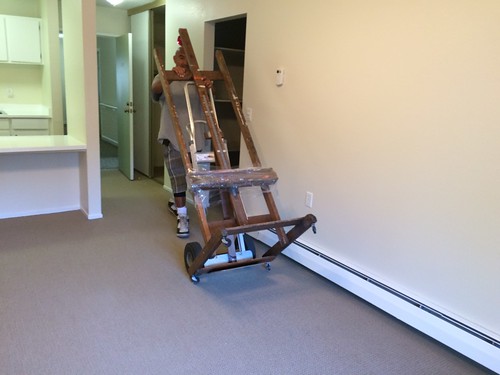
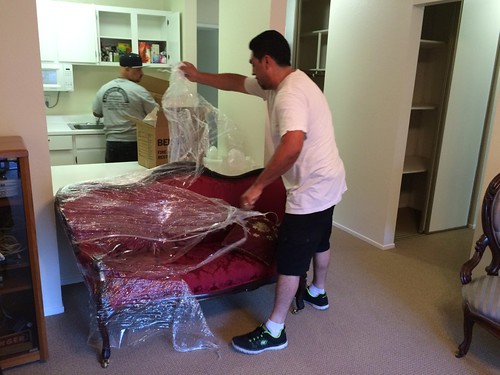
Yesterday was tough. About 12 of us (5 family members plus a great team of professional movers) spent 12 hours shifting my mother from her Independent Living apartment to a new Assisted Living apartment across the parking lot on the same campus. My kids took their Grandmother out for the day (to breakfast and church and to visit the Cantor Arts Center) while my brother, husband, and I moved her stuff. She did not want to move but her family and doctors all see that with progressive memory loss, my mother needs more help than we can provide with less-than-fulltime caregivers. We hired movers who took photos of everything and did their best to set up the new apartment in exactly the same arrangement as the old. Her cats were unhappy to be kept safe in carriers all day – and are probably still hiding under the bed.  We moved everything: furniture, kitchen, art, more art, art supplies, her big easel, electronics, and an entire deck-full of heavy plants and planters.  The point in reproducing the old place in the new was that she would not notice – and she didn’t.  Success meant that our day of sorting, heavy lifting and tricky decision-making went largely unrecognized.  Hooray?

A few years ago, I was touched when my younger brother sent me this poem about difficulties in taking care of our mother. My two brothers live much farther away, so I manage her day-to-day business, caretakers, and medical decisions. My brothers and I confer on resolving larger issues.  Sometimes it feels like having another child myself – but one who gets less mature as time passes.  No matter what, we love her as she is.

The Guardian
by Joseph Mills

I don’t think my brother realized all
the responsibilities involved in being
her guardian, not just the paperwork
but the trips to the dentist and Wal-Mart,
the making sure she has underwear,
money to buy Pepsis, the crying calls
because she has no shampoo even though
he has bought her several bottles recently.
We talk about how he might bring this up
with the staff, how best to delicately ask
if they’re using her shampoo on others
or maybe just allowing her too much.
“You only need a little, Mom,” he said,
“Not a handful.” “I don’t have any!”
she shouted before hanging up. Later
he finds a bottle stashed in her closet
and two more hidden in the bathroom
along with crackers, spoons, and socks.
Afraid someone might steal her things,
she hides them, but then not only forgets
where, but that she ever had them at all.

I tease my brother, “You always wanted
another kid.” He doesn’t laugh. She hated
her father, and, in this second childhood,
she resents the one who takes care of her.
When I call, she complains about how
my brother treats her and how she hasn’t
seen him in years. If I explain everything
he’s doing, she admires the way I stick up
for him. Doing nothing means I do nothing
wrong. This is love’s blindness and love’s
injustice. It’s why I expect to hear anger
or bitterness in my brother’s voice, and why
each time we talk, no matter how closely
I listen, I’m astonished to hear only love.

“The Guardian” by Joseph Mills, from Love and Other Collisions. © Press 53, 2010.

IMG_7922

IMG_7926

IMG_7935

IMG_7953

Images Copyright 2015 by Katy Dickinson

Leave a comment

Filed under Home & Family, News & Reviews

Water Conservation Landscape Program – Santa Clara Valley

MyPlanImage2 17June2015

We have been reducing our home water use for many years and have recently been approved to proceed with a landscape redesign as part of the Landscape Rebate Program of the Santa Clara Valley Water District (SCVWD). In April 2015, we started the process of replacing our 1006 square feet of water-hungry front lawn with a garden that needs less irrigation. During the last four months while the severe California drought has helped our our lawn to die,  John and Paul and I have completed these process steps:

  1. “Pre-Inspection Survey” by Conservision – in which our eligible landscaping was officially measured and evaluated and reported to SCVWD, 8 May 2015.
  2. Returned “Landscape Rebate Program Request for Application Form” to SCVWD, 8 May 2015.
  3. Received blank “Landscape Rebate Program Application Form” from SCVWD – mailed to us 3 June 2015
  4. Returned “Landscape Rebate Program Application Form” to SCVWD – mailed 22 June 2015, complete with detailed garden diagrams (created using Garden Planner software) with plant, materials, and irrigation equipment lists. This required much cross checking of the Sunset Western Garden Book against the SCVWD Qualifying Plant List – as well as family discussions about what we want at the end of this process.
  5. Received “Notice to Proceed” from SCVWD, dated 28 July 2015.

In designing the new garden, I was very disappointed that many of the California native plants I had originally thought to use in my landscape design were marked in the Qualifying Plant List as having “Genetic Concerns”.  I think most home gardeners will be like me – unwilling to hire/pay a plant ecologist (or find a qualifying native plant database) to determine the local wild populations. I ended up picking from listed plants that are non-natives.

“*G = Genetic Concerns This genus contains species native to Santa Clara County or cultivars that have parents which are native to Santa Clara County. Consult a plant ecologist or native plant database to determine if your landscape project is located within 5 miles of wild populations. If so, please follow these suggestions to protect local genetic integrity: 1) select a local ecotype 2) avoid use of cultivars or hybrids, especially those with non-local or unknown parentage and 3) avoid use of nonnative ornamentals which share the same genus in order to prevent unnatural hybridization.” (from the SCVWD Qualifying Plant List)

I think that the complex and drawn-out application process assumes that most people will be hiring a landscaping company to do the work.  The Landscape Conversion Rebate potentially pays $2 per square foot for converting high water using landscape to low water using landscape (through December 31, 2015).   SCVWD will only reimburse for materials (plants, equipment, dirt, mulch, rocks), not labor, so even with the rebate this could be a very expensive project for those who cannot do the work themselves.  My planting list includes:

  • Phormium – flax (purple/brown)
  • Bearded iris (red and purple and yellow)
  • Muhlenbergia rigens – deer grass
  • Helictotrichon sempervirens – Blue oat grass
  • Verbena lilacina (purple)
  • Verbena peruviana (red)
  • Achillea tomentosa – woolly yarrow (yellow/grey)
  • Agapanthus inapertus (purple)
  • Narcissus – daffodils (yellow)
  • Dymondia margaretae (yellow/grey)

I have 90 days from 28 July to finish!

IMG_6443

Photo Copyright 2015 by Katy Dickinson. Diagram created using Garden Planner software

3 Comments

Filed under Home & Family, News & Reviews

New Fire Hydrant in Willow Glen

IMG_6357

Three years ago, I wrote about our north east Willow Glen neighborhood losing one of its two fire hydrants and what it took to get it replaced. A fire hydrant helps firefighters tap into the municipal water supply to extinguish a fire. We are delighted to be getting a third local fireplug – even if it has meant dancing do-si-do with large construction equipment to get into our driveways all week. It will be a month before the new/larger water pipes become active but with the severe California drought continuing into its fourth year, having better access to emergency water is one less thing to worry about.

IMG_6343

IMG_6327

The San Francisco Bay Area saw a big dry lightning storm last night – which fortunately does not seem to have added to the count of wildfires already burning in the Golden State.  On the drive home from vacation in the San Juan Islands in Washington State, last week John and Paul and I drove through the thick smoke of the Stouts Creek Fire in Oregon, which has burned over 20,800 acres (32.5 square miles) since 30 July. There was smoke along Highway 5 for more than 200 miles south of that fire – giving us a great sunset over Shasta Lake in California.  It was a scary reminder of how destructive fires can be.

IMG_6121

IMG_6164

Images Copyright 2015 by Katy Dickinson

Leave a comment

Filed under Home & Family, News & Reviews

Road Diet Controversy in Willow Glen

IMG_8735

The Road Diet has caused a great deal of energetic debate in the Willow Glen neighborhood of San Jose, California, most recently among the 500+ who attended the public discussion at Willow Glen High School on 18 June 2015.  Most of the discussion was about:

  1. Bad for Business: The Road Diet trial has reportedly had a very negative effect on local businesses (particularly in the 0.4 mile downtown area on Lincoln Avenue between Willow Street and Minnesota Avenue).  Many small business owners at the meeting spoke of a significant decline due to customer frustration with traffic congestion.  Several spoke about shopping elsewhere to avoid the intermittent Lincoln Avenue gridlock.
  2. Good for Bikes: Several in the bicycling community reported their satisfaction at having a new bike lane, even if it does not connect yet to other bike corridors.
  3. Driver Frustration caused by increased traffic congestion on Lincoln Avenue was a common topic.
  4. Data, Analysis, and Interpretation: Questions were raised by many about Road Diet data – as well as concern about key elements (like accidents, pedestrian traffic, and parking) not being measured at all.

Here is a summary by the Willow Glen Business Association about the Road Diet:

In Fall 2014 District 6 Council Member Pierluigi Oliverio proposed that the City of San José Department of Transportation (DOT) implement a trial road diet on Lincoln Avenue in Spring 2015.   The trial was completed in March, April and May 2015.   You may read the DOT’s reports about the trial here:

What is a Road Diet? Watch this video to learn about road diets.

A recent news story “San Jose: Lincoln Avenue ‘road diet’ divides Willow Glen community” reported on how the Road Diet is polarizing this small community.

Council Member Olivierio wrote (in November 2014) that he backed the Road Diet to help the Willow Glen business district “…feel quaint, pedestrian friendly, and become a more desirable location to shop and stroll.” According to Interim Director Jim Ortbal of the Department of Transportation (DOT), the purpose of the Lincoln Avenue Road Diet was threefold:

  • Improve safety for all users
  • Create a calmer traffic environment
  • Enhance travel for people walking and biking

DOT staff reported at length on traffic volume and speed data for 45 locations in the Willow Glen area.  However, on 18 June, the DOT was not able to present information indicating success on any of the three goals.  For example, DOT said they could not report on safety because it would take one to two years of data collection to determine patterns.  When pressed, DOT staff said that there were about the same number of accidents reported to the police.  Some speakers (including myself) testified to the current situation causing dangerous traffic congestion and frustration for both drivers and walkers at certain times of day. Other members of the public said that they felt safer walking in the area as a result of the Road Diet. DOT reported a small increase in bikers but they did not measure walkers.

A group of four Stanford University Public Policy graduate students conducted their own Analysis and Recommendations for Lincoln Ave Road Diet.  Their recommendations were:

  • Clarify and prioritize the goals of the road diet to better gauge whether the road diet successfully achieves its policy objectives.
  • Determine the road diet’s impact on Lincoln Avenue businesses by gathering and analyzing pre- and post-diet data on business sales receipts.
  • Survey area residents to gauge perceptions of the road diet’s impact on livability.
  • Gather more pedestrian and bicycle traffic count observations over a longer time period to determine if the post-diet increases are statistically significant.

Some of the best suggestions I heard at the 18 June public hearing were:

  • Create a pedestrian scramble at both Willow/Lincoln and Minnesota/Lincoln rather than making walkers wait for two long lights.
  • Get rid of the Road Diet middle passing lane (that some were calling the “suicide lane” and others said was often blocked by parked trucks making deliveries), allowing just one lane in each direction, then increase the available parking with diagonal striping, and maybe widen the sidewalks at the same time.
  • Build a parking structure (for example in the now-empty lot on the corner of Willow/Lincoln) to reduce the number of cars circling trying to find a place to park.

The DOT is asking for a quick decision on the success of the 3-month Road Diet so that they can know what to do when they repave Lincoln Avenue in October 2015.

Click here to see the entire Willow Glen Road Diet Series.

IMG_8298

IMG_8320

Images Copyright 2015 by Katy Dickinson

6 Comments

Filed under News & Reviews, Politics

Public Objects to San Jose Water Company Plan

IMG_7355

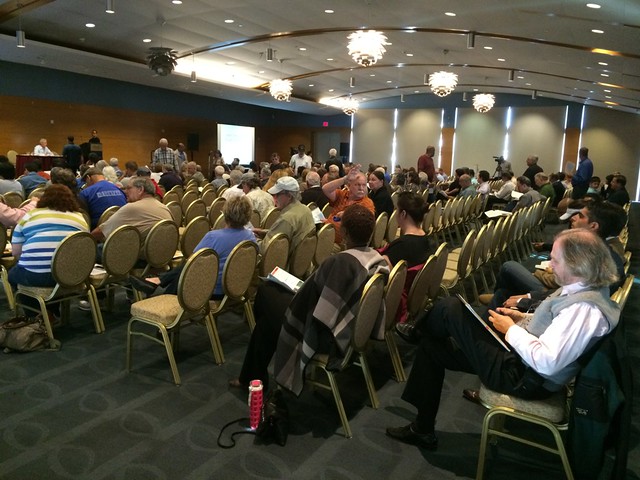
On 28 May 2015 in downtown San Jose, California, the San Jose Water Company held the first and only public hearing on their Proposed Water Shortage Contingency Plan – that is, how they will respond to Executive Order B-29-15 by the Governor of the State of California (signed 1 April 2015) requiring a further statewide 25% reduction in potable urban water usage through February 28, 2016. The private San Jose Water Company serves over a million people in the greater San Jose metropolitan area (about 230,000 paying customers) – including many in core Silicon Valley cities: Campbell, Cupertino, Los Gatos, Santa Clara, San Jose, and Saratoga.

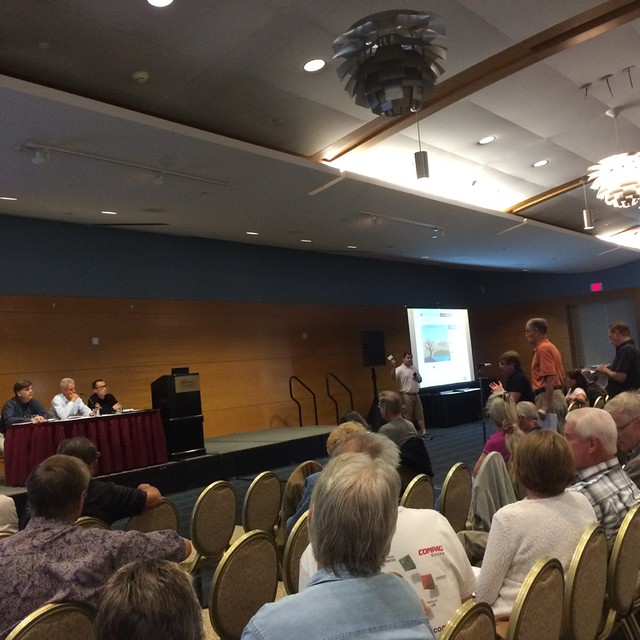
In his introductory remarks, John B. Tang (Vice President of Government Relations and Corporate Communications, San Jose Water) said that they expected a decision by the California Public Utilities Commission (PUC) by 15 June 2015. He further mentioned that there has already been a 17 foot drop in groundwater during the last year (subsidence) and that it would take up to 300% of normal rainfall to retreat from the drought.  Mr. Tang said that San Jose Water is asking for residential customers to cut 30% of their water usage – by average rather than by individual customer usage. There will be an appeal process published later to address issues of medical needs and larger-than-4 family size. Palle Jensen (Senior Vice President-Regulatory Affairs, San Jose Water) and Bob Day (Director of Customer Service, San Jose Water) also spoke.  Mr. Jensen in particular expressed his frustration in only having 25 days to prepare their plan.  He several times blamed the plan’s shortcomings on the short development time allowed and on requirements given to San Jose Water by the Santa Clara Valley Water District and other agencies.

My son Paul and I were among about 350 upset local citizens, landowners, and small business owners who attended the meeting.  All who spoke objected to how the San Jose Water Company has chosen to respond to the Governor’s new water reduction order. Of the dozens who came to the microphone after many hours of patiently standing in line in the auditorium, no one objected to conserving water or minimized the seriousness of the California drought, now in its fourth year. They did energetically disapprove of how the San Jose Water Company proposes to respond.

Specifically:

  • California’s Executive Order calls for a 25% water usage reduction as compared 2013 and directs that “These restrictions should consider the relative per capita water usage of each water suppliers’ service area, and require that those areas with high per capita use achieve proportionally greater reductions than those with low use.” [emphasis added]
  • The San Jose Water Company’s plan calls for a 30% reduction of the average water usage across residential customers.  Apartments and business will only have to reduce landscape watering.  However, private homes will have in addition to conserve inside water usage. According to the 2010 U.S. Census, 31% of  City of San Jose citizens live in “Housing units in multi-unit structures” – that is, about a third of area housing that will not have to conserve water under this plan.
  • The single most recommended change requested by the public to the San Jose Water plan was to ask that reductions be based on individual (per capita) usage for all customers rather than by average of only residential customers.
  • The criticism most frequently expressed at the hearing was that no notes were taken by the three executives (other than to record who spoke and what city they came from) and no recording was made – indicating that this meeting was only for legal requirements, rather than to listen seriously.  There was no indication that the San Jose Water Company proposal would be modified before its submission to the PUC.  However, the executives did say that they would consider changes to the program in the future.
  • The size of a residential lot is not taken into consideration in the proposed plan.  Several speakers from the public said that they have many large trees that will die without water this summer.  One woman with a big lot said she had already deeply cut her water use and the new plan would require her to cut 88% of her water usage in addition to paying much higher water rates because of drought surcharges.  She said it cost her over $4,000/each to have large dead trees removed so that they did not create a fire hazard. Another man with a larger property said he had already cut his water usage by 45% but was being asked to reduce even more.  The San Jose Water executives eventually mentioned that the Santa Clara Valley Water District has an agricultural exemption program that homeowners who grow their own food or have orchards can investigate.
  • Some businesses (commercial nurseries, golf courses) are exempt from the restrictions; however, swimming pool and spa companies will not be allowed to fill new pools.  About five of the speakers from the audience identified themselves as being associated with pool or spa companies who foresaw serious job losses.  They said that swimming pools use less water than even drought-resistant landscaping (and one third of the water of a grass lawn), so the restriction on filling new pools did not make sense.
  • One speaker reported that other water companies in the San Francisco Bay Area are being far less strict in their requirements of customers.  For example, the nearby East Bay Municipal Utility District (“East Bay MUD”) is only seeking to reduce water use by 20%.
  • Several speakers objected to San Jose Water encouraging neighbors to tattle on each other. There is even a special webpage to make local spying easy. (Compare this to a southern California community that last month started giving cash rewards to their Water Saver of the Month to encourage conservation success.)

Our own family lives in the Willow Glen neighborhood of San Jose, part of the San Jose Water Company’s service area.  We have a large lot bordered by the Guadalupe River. As I wrote in February, the Guadalupe River in San Jose was dry in summer 2014 for the first time since we bought our house 18 years ago. The river rose this winter but only a few water pools are left now. Our riparian property is home to a large number and variety wild animals, including birds, reptiles, amphibians, and insects.  We have dozens of very large trees – old native oaks, cottonwoods, redwoods, ashes, olives and other nut and fruit trees – that are already stressed by the long drought. We have been reducing our water use for many years and are in the process of applying to the Landscape Conversion program of the Santa Clara Valley Water District. That is, we are letting our lawn die and planning to replace the grass with less-water-hungry plants. We will redirect the lawn water to do what we can to save our trees.  Fires set by the homeless who often settle along the riverbank are a big concern for us.  There was a serious fire caused by a campfire a few years ago just upstream from our house.  We are very motivated to keep our trees watered and in good health to reduce fire risk.

From the 9th edition of the New Sunset Western Garden Book: The Ultimate Gardening Guide (2012) p.719:

How to Fight Drought:
When drought comes, and with it the possibility of local bans on lawn watering or punishing hikes in water bills, what can you do? It’s too late at that point to install a water-conserving landscape, but you can take steps to save the plants you have.
Save established trees and shrubs first. These are costly to replace and have the greatest impact on your landscape. (A lawn can be replaced with sod in an afternoon, but a 70-foot-tall redwood can take 20 years or more to replace)….”
IMG_7205

IMG_7222

IMG_7357

Images Copyright 2015 by Katy Dickinson

1 Comment

Filed under Home & Family, News & Reviews, Politics