Tag Archives: Willow Glen

Suggestions to Improve Willow Glen Road Diet

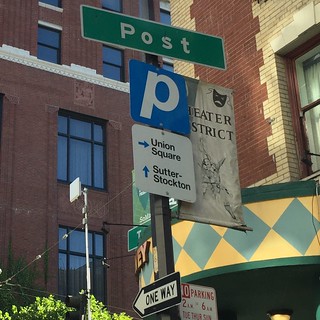
San Francisco sign to Parking Garage June 2016

Although the pro-Road-Diet faction is distributing a handout declaring success, the controversy is still very active indeed here in Willow Glen.  The San Jose City Council will discuss making the Road Diet (“Lincoln Avenue Pilot Project”) permanent at their 28 June 2016 meeting. Please join me there if you want your voice to be heard on this contentious local issue.

Good news is that the Willow Glen Neighborhood Association (WGNA), one of the loudest advocates in favor the Road Diet – which has not held a WGNA Board meeting in over a year in violation of its own By-Laws and the California Nonprofit Public Benefit Corporation code 600b – has just scheduled a meeting for tomorrow night (23 June 2016: 7:00p.m. – 9:00p.m., at the Willow Glen Public Library Community Room, 1157 Minnesota Avenue, San Jose).  This is the first community meeting on the topic since 18 June 2015.

Note after publication: The WGNA changed their 23 June agenda to take off discussion of the Road Diet.

What Next?

John Plocher and I have been discussing what our own recommendations are in response to the unhappy Road Diet feedback we have heard this last year from local business owners.  The five categories of problems I described in my 17 June 2016 post are:

  1. Traffic safety and speed
  2. Parking
  3. Bicycles
  4. Delivery Trucks
  5. Community Trust

Of these five, parking is the biggest concern to local businesses (and the problem least addressed) in the current Road Diet improvements.  I was in San Francisco yesterday for a business meeting and noticed not only how many public parking garages there are (in addition to many private garages and lots) but how excellent the signage is to those parking garages (see photos).  On Lincoln Avenue, we have one public parking lot with minimal signage (behind the Bank of America building on Lincolnshire Way).  Several of the business owners I interviewed said that their customers did not know about this one parking lot.

Comparisons:

  • Willow Glen’s central business area on Lincoln Avenue is 0.7 miles long (from Minnesota to Willow) with one public lot.
  • University Avenue in Palo Alto, where the central business area is 0.8 miles long (from Middlefield to Alma), has at least seven public parking lots and multi-storey garages.
  • Downtown Campbell lists ten parking garages and lots for their downtown.
  • Murphy Avenue in Sunnyvale is surrounded by large parking lots – including the lots for Macy’s and CalTrain.

Proposal!

  1. If there were at least two multi-storey parking garages on Lincoln Avenue, it would change the dynamics of traffic significantly for the better and would eliminate many of the problems of the Road Diet.
    • Additional public parking would make it easier for Lincoln Avenue lunch customers t0 get in and out – helping to reverse the current drastic reduction in lunch traffic described by so many business owners.
    • More parking would reduce traffic by the number of cars circling to find parking, and would help to keep Lincoln Avenue customers from parking on neighborhood side streets.
    • Getting cars off the street would also make more space for trucks to park for deliveries.
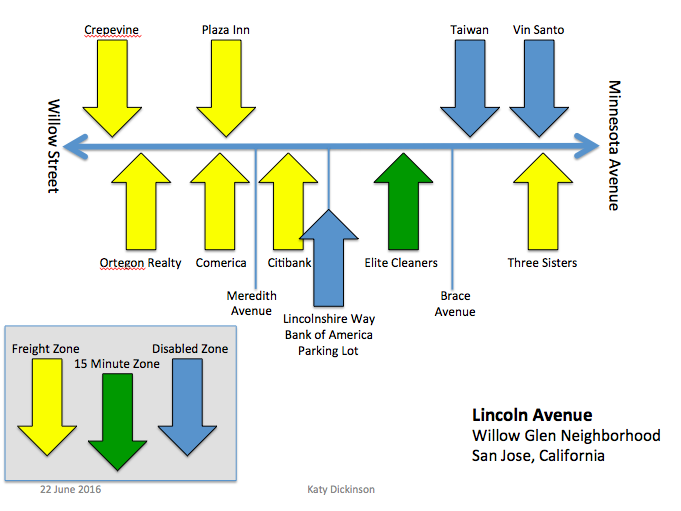
    • Public parking structures would also include more Disabled Parking Zones.  As you can see from my diagram, there are few Blue parking spaces on Lincoln Avenue now – and none from Lincolnshire to Willow.  There are Blue parking spaces in private parking lots – all clearly marked with signs saying some variation of  “Customer Use Only” (some of the lots have private guards to keep out non-customers).
  2. Add more and better signage to parking.
  3. Two areas to consider placing new multi-storey garages on Lincoln Avenue:
    • The fenced and empty dirt lot at Willow and Lincoln, across the street from Willow Glen Town Square
    • Behind the Bank of America building (which I understand was recently sold), where part of the lot is now available for public parking

Multi-storey garages need not be ugly: the structure at San Jose Airport decorated with artful hands is a good example of civic art combined with parking.

Lincoln Avenue Diagram

Lincoln Avenue Willow Glen San Jose CA June 2016 parking

San Francisco sign to Parking Garage June 2016

Lincoln Avenue parking sign at Lincolnshire Way Willow Glen June 2016

San Jose Airport Parking hands art July 2012

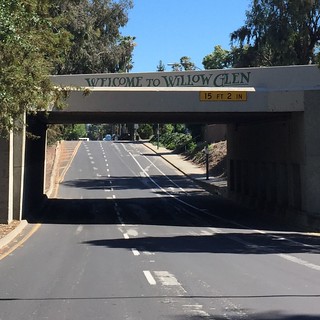
Welcome to Willow Glen sign San Jose CA June 2016

Click here to see the entire Willow Glen Road Diet Series.

Images Copyright 2012-2016 by Katy Dickinson

2 Comments

Filed under News & Reviews, Politics

Road Diet Evaluation, and More Business Speak

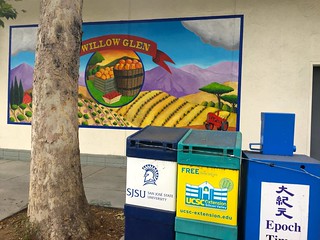
Willow Glen Mural June 2016

Starting around March 2015, the Road Diet on Lincoln Avenue in Willow Glen changed a busy four-lane road with no bike lanes into a two-lane road with two bike lanes plus a turning lane in the middle. The San Jose City Council will discuss making this very controversial Road Diet (“Lincoln Avenue Pilot Project”) permanent at their 28 June 2016 meeting. Please join me there if you want your voice to be heard.

This is part of a series in which I use my professional experience in data collection and analysis to clarify our local discussion.  See my 17 June 2016 post for the 3 official San Jose Department of Transportation (“SJ-DOT”) project goals, plus the 5 problem categories I have identified through discussion and interviews.  In my opinion, the Road Diet has generally failed to meet its goals, particularly because SJ-DOT reported that there were 22 crashes during the last year, compared to 8 the year before.

This post has two sections:

  1. “Lincoln Avenue Road Diet Evaluation” by Bret Levine, 19 June 2016
  2. Selected Quotes on the Road Diet from 4 More Local Businesses

Lincoln Avenue Road Diet Evaluation by Bret Levine

Note: Bret Levine is a PhD student in Evaluation and Applied Research Methodology at Claremont Graduate University.

Since its inception, the Lincoln Avenue Road Diet has polarized support in both directions.  Though perhaps you’ve heard reasons for or against the Road Diet, I’d like to present my evaluation of the Road Diet through the lens of applied research. This began with my inquiry into the methods, measures, data analyses, and data collection processes that I noticed with the Road Diet since 2015.

Ethics as an Experiment

The Road Diet is a “trial” was described as an “experiment”. Therefore if we begin to treat the Road Diet as an experiment, we should hold its merits to similar guidelines in which we hold other experiments. Surely for the Lincoln Avenue Road Diet, a change in commerce that impacts such a wide array of people, we should hold the Road Diet to the strictest standards possible.

For guidelines on conducting ethical research many scientists and researchers nationwide will refer to the US National Institutes of Health (“NIH”), the primary agency of the United States government responsible for biomedical and health-related research. On the NIH website you can find a list of “Ethics in Clinical Research”, which is a set of ethical guidelines for conducting research that involves participants. Again, the Road Diet Trial is by no means a traditional “experiment”, however, this should not deter the use of ethical standards in experimentation given that real people (participants) are affect by the treatment (Road Diet). Additionally, the NIH guidelines are flexible enough to be used as guidance for applied research as well.

It is under the pretenses of these ethical principles that I have concluded that the process of enacting the Lincoln Avenue Road Diet and the measures used for analysis have led to the unethical treatment of those people affected:

  1. Social and Clinical value – The word “impact” is fitting for the road diet, given that commuters, cyclists, pedestrians, businesses, and Willow Glen residents are all affected by the change in the public space. In terms of research, the impact of the Road Diet might encompass many research questions, such as the five following. These are only a handful of questions that would need to be asked before an experiment is put into action. Each of these questions can then be operationalized for data collection so that there is actual information that can represent the answers to these questions. Few of these questions were answered from any of the methods chosen to analyze the results of the Road Diet.
    1. How does the Road Diet impact traffic in surrounding neighborhoods?
    2. How is safety on Lincoln Avenue affected by the Road Diet?
    3. What is the level of satisfaction for commuters, cyclists, and pedestrians?
    4. Are businesses better off as a result of the Road Diet?
    5. Are residence satisfied with the Road Diet?
  2. Fair subject selection – Those most effected by the Road Diet were not fully taken into consideration. Most importantly (as outlined later) was the safety of pedestrians, bicyclists, and motorists which was not measured correctly.
  3. Favorable risk-benefit ratio – Neither the risks nor benefits of the Road Diet were presented with any factual substance during the formation or execution.
  4. Respect for potential and enrolled subjects – As quoted from the ethical guidelines: “For research to be ethical, most agree that individuals should make their own decision about whether they want to participate or continue participating in research.” This would directly contradict with the Willow Glen Business Association (“WGBA”) 10-4 vote against the Road Diet (“Willow Glen business group says it’s time to end the Lincoln Avenue road diet” June 2015 Mercury News article by Leeta-Rose Ballester), which was agreed upon to be upheld by Hans Larsen of the SJ-DOT via his presentation before the Road Diet would be put in place (“Lincoln Avenue Road Diet Trial” 15 February 2015).

WGNA Survey vs. WG Business Association Survey

The WGNA survey on the Lincoln Avenue Road Diet allowed for multiple entries from the same person(s). The bottom of the results page noted the removal of same-IP-address without significant changes to the results of the survey, however one can change their IP address simply by filling out the survey with their phone or computer on an alternate router or internet provided. Also, the same person can take the survey from alternate devices other than their own.

The Willow Glen Neighborhood Association (“WGNA”) so-called survey is not survey – it’s a bias measure of popular opinion, conjured from repeated button pressing. The fact that redundant IP addresses were controlled for doesn’t mean anything. You can change your IP address by joining another network.

The Department of Transportation (SJ-DOT) Data Collection Report (1 June 2015), provided conflicting results from the Willow Glen Business Association (“WGBA”) Road Diet Survey conducted by business owners, managers, and property owners. Both sets of results can be found here. The SJ-DOT survey described “notable pedestrian volume increases” (anecdotally – no numbers) while 130 business owners, managers, and property owners on the WGBA survey noted a negative change in the number of people coming into their business (m =2.33, n = 130). Other variables that may have explained the notable increase in pedestrian presence “after” the road diet were not accounted for – in particular time of the year was one such variable. The “before” Road Diet pedestrian volume was measured in February 2015 while the “after” Road Diet observation was made in April 2015. Obviously, these are times during the year that we may expect to see changes in pedestrian volume on Lincoln Avenue – either as a symptom of weather or merely change in season fromWinter to Spring.

Additionally, the SJ-DOT final report failed to provide collision data during the trial while the owners, managers, and property owners felt that the Road Diet was between “no change” and “a little less safe” (m = 2.69, n = 130) for drivers. Not only did the SJ-DOT report not include collision data, but emergency vehicle access as well as changes for vehicles and access for the handicapped were not included. Most shocking is that the main focus of the Road Diet was safety, yet those whose safety is most impacted by the Road Diet were not measured at all: customers, commuters, cyclists, pedestrians, and employees.

In addition to conflicting with the SJ-DOT final report, the WGBA survey provided additional results on the impact of business on Lincoln Avenue. In addition to reduction to people entering their business, owners and managers noted negative changes in satisfaction level of their customers (m = 2.24, n = 128) as well as negative changes in their bottom lines i.e. sales and revenue (m = 2.36, n = 128) as a result of the Road Diet.

Final Road Diet Results Presentation

Sections of the results presentation from the WGBA survey were not accurately presented. Arguably, pie charts do not take into account the embodiment of those that have responded to survey results and can arguably be misleading. For example, the pie charts included in the WGBA survey results grouped together positive and negative responses into 2 bulk categories. This does not take into account the sensitivity built into the survey that should be used to psychometrically represent the differences in opinion. Accompanied with averages (means) that I’ve provided at times in this post, help to capture an overall representation of the entire sample. At first blush, safety appears to have improved as a result of the Road Diet according to the pie charts in the WGBA survey (p. 4). Upon closer examination owners, managers, and property owners felt that Lincoln Avenue was between “a little safer” and “no change” for Pedestrians (m = 3.42, n = 131) and “a little safer” for cyclists (m = 3.62, n =131). These opinions are not represented in the analyses (“Willow Glen Business Association Survey of Members Regarding Road Diet Trial” 14 June 2015).

Methods

If the central research question is along the lines of, “How does the Road Diet impact residents, businesses, and commerce on Lincoln Avenue” the methods chosen to answer this question are vastly inaccurate. There are additional measures (focus groups, interviews, observations, archival data etc.) that could have been utilized to help answer questions, notwithstanding creating accurate surveys to capture sampled opinions. Additionally there could have been much more research – including actual data – on similar cases where Road Diets were put into place.

Questions that affect such a depth and breadth of people and resources should not be answered by shoddy measures and unscientific research. Cultural changes such as increasing cycling or walking amongst a community or city require a great deal of research and time before changes should be made. The people of Willow Glen are owed due scientific process and inquiry before such hasty decisions negatively affect their lives.

External Consultation and Conclusion

An external report by the Stanford Public Policy Program (“Analysis and Recommendations for Lincoln Ave Road Diet” 12 June 2015, by: Dev Davis, Misa Fujisaki, Miho Tanaka, Lucy Xiao) concluded similar results to my analysis: clarify the goals of the Road Diet, ensure that businesses are not harmed, survey residence, and gather more data on pedestrians and cyclists. The motto of both of our analyses is that more information is needed.  However, in regards to this letter, more information comes with a caveat.

Given the feedback from the strongest measures available (WGBA survey), conflict with previous methods (DOT vs. WGBA survey), and new light from NIH guidelines – ethically speaking on behalf of those impacted by the Road Diet – the Road Diet cannot continue until more information in collected and analyzed. The potentially detrimental effects (public safety and the harm on small businesses) on participants of the Road Diet should outweigh the potentially beneficial effects.

As agreed upon with Hans Larsen from the SJ-DOT, on 23 June 2015, the WGBA voted to end the Road Diet (this vote is recorded in a letter “Attachment I” of the SJ-DOT 6 June 2016 report to the San Jose Mayor and City Council), yet the Road Diet has been in place for almost 1 year since the “no” vote. The current existence of the Road Diet is in violation with the original agreement and could be in violation of the ethical guidelines for participants.

There is enough data now to analyze the effects that the Road Diet has had on those that have been impacted, whilst curbing any detrimental effects that have already been caused. The Road Diet was rushed into place without the forethought of research, the opinion of local leaders, the opinion of the Willow Glen residents, nor the opinions of local organizations and businesses. The safety and prosperity of the people of San Jose should be of the upmost importance whenever impactful changes are put in place.

Selected Quotes on the Road Diet from 4 More Local Businesses

Except as indicated, those quoted are either business owners or managers on Lincoln Avenue in Willow Glen, between Minnesota and Willow. My 17 June 2016 post includes 10 business quotes. Some people I interviewed wanted their opinions to be quoted using their names and others wanted to be anonymous. Several who asked to be anonymous said that Road Diet discussions had become so heated that they feared retribution or loss of customers. I have respected each interviewee’s preferences below.

    1. Vince (retail store in Lincoln Avenue): “Many store owners have stated that ‘The Road Diet’ has negatively affected their business on Lincoln Ave. The City Council seems immune to their numbers…i.e. sales. The Road diet seems to agree with many nearby neighbors who like to walk and or bike into downtown. Willow Glen needs customers from the surrounding areas to sustain businesses. They simply cannot survive on those who live within walking distance. Restaurant customers do not have time to come sit and eat in downtown Willow Glen. With the Road Diets traffic it simply takes too much of their lunch hour….restaurants have been affected indeed. Our retail store is a destination and our clientele now just deal with the headache of traffic and road rage now associated with the Road Diet. I have seen more accidents in the last six months with this new road design: people just losing it… driving too fast through the middle, cars rear ending each other from the stop and go motions all the way down Lincoln. Everyone thinks parking is a problem. However, many are not familiar with the fact that the Bank of America parking lot is and always has been free parking. I am upset at our local political representives in the way they handled this entire debacle called The Road Diet. We were lied to and mis-lead the entire time from City Council: saying that the Road Diet was a temporary trial; however, it is now permanent. It was basically shoved down our throats and there is really nothing we can do about it. Proof of declining sales within the businesses on Lincoln should have been enough. I’ve seen numerous social media websites where it now seems many local neighbors have mentioned that businesses against The Road Diet do not care about the people’s safety. People have threatened other businesses. Remember there are more accidents now that ever before…..and you want to talk about safety?? It’s a shame that we now have this anomosity of community vs. business owners.”
    2. Wayne Zhang (Taiwan Restaurant on Lincoln Avenue): “The Road Diet is not good for local business. People are hard to bring here with the Road Diet. There is not enough parking in this area. I have owned Taiwan Restaurant for about a year but the business started in 1982. Our business is impacted because the lunch traffic is not good. People worry about parking at lunch and on weekends too. Bikes are OK so far. Trucks parking in the middle turn lane on Lincoln Avenue is just not right, they block traffic. I don’t agree with the Road Diet.”
    3. Anonymous #7 (retail store on Lincoln Avenue): “I don’t see bikes using the bike lanes as planned, more people are on foot. Traffic can be heavy but the biggest customer complaint is parking. Solve that and there will be less traffic because fewer cars will be looking for parking. Adding a wider bike lane as a right turn lane on Willow/Lincoln helped traffic flow. Lincoln Avenue needs good signs for public parking – people don’t know where to go. I don’t know if the Road Diet caused it but business has been slower; this could be because of ecommerce. I love Willow Glen. It is a great community: neighborly with people who try to work together. I offer to meet customers at the curb to handoff what they bought so that they can avoid parking. There are not enough handicapped parking spaces for my customers to park on the street. I have senior customers who have to park far away and walk to my store.”
    4. Craig Gorman (Intero Real Estate – on Meridian Avenue in Willow Glen): “There are pluses and minuses to the Road Diet. The idea behind it was great but implementation and follow through on the plan has been weak. The original plan said there would be lots of parking and enhanced retail sales – more people would be driving past slower. This didn’t happen. The effect of the Road Diet varies on what the business is. I have heard less people talking about going to lunch on Lincoln Avenue, more are going to downtown Campbell instead because it is easier to get in and out. Willow Glen residents are predominantly in an upper income range. For them, it is OK to have a more expensive lunch but their time is limited. You can’t put a price on that – the decision where to eat is often based on time, not cost. I haven’t seen or heard of more traffic accidents. I was shocked to learn that the SJ-DOT reported so many more for last year: 22 accidents compared with 8 the year before.”

Happy Father's Day Willow Glen June 2016

Click here to see the entire Willow Glen Road Diet Series.

Images Copyright 2016 by Katy Dickinson

Leave a comment

Filed under News & Reviews, Politics

Willow Glen Road Diet Report Analysis

Willow Glen, San Jose, California sign 19 June 2016

This is part of my continuing series on Willow Glen‘s Lincoln Avenue Roadway Configuration Pilot Project (“Road Diet“). These are observations from a detailed review of the San Jose Department of Transportation (“SJ-DOT”) publications on the Road Diet, looking at reports from the SJ-DOT from 2015 and 2016. Thanks to John Plocher  who assisted me with this review.

Please send comments, error corrections, or additions – they are welcome!  The San Jose City Council will discuss making the Road Diet (“Lincoln Avenue Pilot Project”) permanent at their 28 June 2016 meeting. Please join me there if you want your voice to be heard on this contentious local issue.
San Jose Department of Transportation, Road Diet Project Area Location Map, 6 June 2016
SJ-DOT Road Diet Project Area Location Map, 6 June 2016

San Jose Department of Transportation, Road Diet Volume and Speed Data Collection Location Map - Detail, 6 June 2016
SJ-DOT Road Diet Volume and Speed Data Collection Location Map – Detail, 6 June 2016

Analysis of the Road Diet 2016 Report from the SJ-DOT

Observations are listed roughly in the order that the information appears in the report.

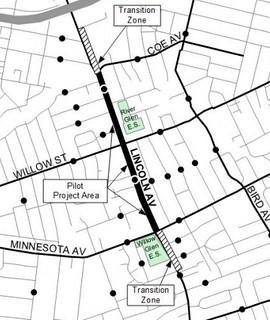
  1. The Road Diet map of the SJ-DOT above shows the Project Area under consideration.
  2. A key finding from the 2016 SJ-DOT report is on p.4: “Based on the one year of ‘after’ collision data, it is inconclusive whether the modified lane configuration has had a measurable long-term impact on traffic safety… the total number of crashes was higher than the year prior to the pilot project.” That is, there were 22 crashes during the last year, compared to 8 the year before.
  3. My observations are limited to data inside the Project Area and Transition Zones which together are 1.1 miles long (Lincoln Avenue from Nevada Avenue to Lonus Street).  The Project Area without the Transition Zones is just 0.7 miles (Lincoln Avenue from Minnesota Avenue to Coe Avenue).
  4. There were SJ-DOT sensors (or “automatic recorders”) in a variety of locations inside and outside of the Project Area during the time of measurement.  Only two of SJ-DOT sensors were actually in the Project Area or Transition Zones: one South of Meredith Avenue on Lincoln Avenue, and the other South of Glen Eyrie Avenue on Lincoln Avenue.
  5. The SJ-DOT reports are full of detailed and confusing information from outside of the Project Area (measured because the SJ-DOT is responsible for more than just the Road Diet).
  6. On p.6 under “1B Neighborhood Street Traffic Volume and Speed Findings”, the report says most streets were unchanged but two were worse (two passed the threshold into “adverse”).  On pp.6-7 under “1c. Major Street Traffic Volume and Speed Findings”, both Pine and Minnesota showed a strong increase in speeders. That is, areas outside of the Road Diet area are less safe because of the Road Diet.
  7. On p.7 of the 2016 report, Travel Times are given for “the Lincoln Avenue Corridor” which is 2.64 miles long.  By more than doubling the area measured (from 1.1 miles to 2.64 miles), significant variations in the Non-Road-Diet sections distort the data and conclusions.
  8. There are only two indications of cost in the SJ-DOT report, both in the “Policy Alternatives” section on p.14.  One says that not modifying a traffic signal will save $65,000 and the other says that removing modifications to that signal will cost $15,000.  There is no indication how much has been spent on the Road Diet so far, including the long list of additional improvements already implemented (listed on p.10).  There is also no indication of what it would cost to remove the Road Diet or make it permanent.
  9.  The San Jose City Budget Message dated 30 May 2014 includes the following: “Pedestrian Safety …The City Manager is directed to allocate $45,000 in one-time Construction Excise Tax funding for this type of minor pedestrian safety improvement on Lincoln Avenue.”  This is the only funding reference we have identified so far for the Road Diet.
  10. On p.17, “Calmer Traffic Environment” says that “motor vehicle speeds decreased on Lincoln Avenue”.  Looking at “Attachment B – Lincoln Avenue Volume & Speed Summary”, the average change in the Project Area was 7% decrease in volume, and the average percent of speeders in the Project Area went down 6.3%.
  11. The SJ-DOT data analysis does not define a margin of error, making it hard to understand if any of SJ-DOT’s reported measures are statistically significant.  Variations seen in SJ-DOT report tables for areas outside of the Road Diet are often much larger than variations inside of the Road Diet area.
    • Example of variation outside of the Project Area: “Attachment E – Lincoln Avenue Travel Time” shows a -30% to +82% change to areas outside of the Road Diet.
    • Example where margin of error matters: “Attachment B – Lincoln Avenue Volume & Speed Summary” show that volume and speed measures are down on average 4% in 2016.  This measure may very well be so small as to be within the statistical margin of error.
  12. “Attachment E – Lincoln Avenue Travel Time” shows for the Minnesota to Willow segment of Lincoln Avenue:
    • Northbound traffic was on average faster (22% less time or 35 seconds faster)
    • Southbound traffic was on average much slower (36% more time or 1 minute, 13 seconds slower)
  13. “Attachment F – Lincoln Avenue Intersection Level of Service Summary” shows that the LOS (Level of Service) is unchanged for the Lincoln/Minnesota and Lincoln/Willow intersections.  Both of these intersections are still “D” on a scale of A to F, where: A is less than ten seconds, and F is more than 80 seconds delay to get through an intersection.

Click here to see the entire Willow Glen Road Diet Series.

Willow Glen, San Jose, California sign 17 June 2016

Images Copyright 2016 by Katy Dickinson, with thanks to the SJ-DOT for their maps

Leave a comment

Filed under News & Reviews, Politics

Businesses Speak on Willow Glen Road Diet

Willow Glen sign San Jose California June 2016

My family has lived in the pleasant Willow Glen neighborhood of San Jose, California, for almost twenty years. We have raised our kids here and I run my business Mentoring Standard out of my office in Willow Glen.  The people here are friendly and diverse, the local downtown on Lincoln Avenue offers good restaurants, shops, and services. Willow Glen homes – from small cottages to mansions – are famously charming with large, well-kept gardens on broad streets with big trees. Willow Glen earns its title as “San Jose’s Local Treasure“.

Regrettably, since 2014 there has been a fight going on about the Lincoln Avenue Road Diet imposed as a “short-term experiment” by a group for whom the main speaker has been Willow Glen’s outgoing City Councilman, Pierluigi Oliverio.  Starting around March 2015, the Road Diet on Lincoln Avenue changed a busy four-lane road with no bike lanes into a two-lane road with two bike lanes plus a turning lane in the middle. The San Jose City Council will discuss making the Road Diet (“Lincoln Avenue Pilot Project”) permanent at their 28 June 2016 meeting. Please join me there if you want your voice to be heard on this contentious local issue.

After a year of listening to my neighbors and local business people unhappily discussing the Road Diet, and reading passionate opinions online (for examples, see the Facebook pages: “Willow Glen Road Diet”, and “Stand Up for the Neighborhood – End the Willow Glen Road Diet”, and “Willow Glen Charm”), I decided to use my professional experience in data collection and analysis to clarify the discussion if I could, for myself if not for my neighborhood. This is my fifth post on this topic.

Last month, I contacted the San Jose Department of Transportation (SJ-DOT) for an update on their 1 June 2015 report. SJ-DOT published the new report today.  While waiting for the SJ-DOT report, I started listening to the local business owners, the individuals and families who offer goods and services on Lincoln Avenue between Minnesota and Willow.

Yesterday and today, I walked up and down Lincoln Avenue and had in-depth discussions with many local business owners and managers.  There was a range of opinions on the Road Diet but no one said that it improved business on The Avenue. The businesses I talked with were a mix: restaurants, retail stores, professional and personal services.  Some people I interviewed wanted their opinions to be quoted using their names and others wanted to be anonymous.  Several who asked to be anonymous said that Road Diet discussions had become so heated that they feared retribution or loss of customers.  I have respected each interviewee’s preferences below.

Thanks for those who took the time to share their thoughts, experiences, observations and opinions.  Much appreciated!

Road Diet – Stated Goals

Last year, the SJ-DOT reported in a community meeting 18 June 2015 that the Purpose of the Lincoln Avenue Road Diet is to:

  • Improve safety for all users
  • Create a calmer traffic environment
  • Enhance travel for people walking and biking

In the Memorandum dated 6 June 2016 and published today by SJ-DOT Director Jim Ortbal, he writes: “Based on the one year of ‘after’ collision data, it is inconclusive whether the modified lane configuration has had a measurable long-term impact on traffic safety… the total number of crashes was higher than the year prior to the pilot project.” That is, there were 22 crashes during the last year, compared to 8 the year before.

Lincoln Avenue traffic is slower because of the Road Diet but drivers seem much more frustrated.    Maybe the traffic is calmer but the drivers are angrier?

Adding bike lanes did enhance travel for cyclists but cyclists using the sidewalks has decreased safety for pedestrians.

Based on my observations and what I have heard in interviews, the Road Diet has generally failed to meet its goals during the last year.  Many people told me that they thought that creating the Road Diet had more to do with property development requirements than with benefiting our neighborhood.

Summary of 5 Problems

In summary, the problems with the Willow Glen Road Diet sort into 5 categories:

  1. Traffic safety and speed: The Road Diet has slowed traffic on Lincoln Avenue; however, while some think the street is safer, there were many reports in interviews of driver frustration resulting in dangerous driving or speeding detours into surrounding neighborhood streets or parking lots.  SJ-DOT reported that there were 22 crashes during the last year, compared to 8 the year before.
  2. Parking:  Lincoln Avenue parking was a challenge long before the Road Diet. In some ways, the Road Diet made the parking problem worse (for example, in heavy traffic it is hard to parallel park, and also difficult to move from one full parking lot to another looking for an open space).  However, the presence of the bike lanes makes it easier to open your car door without hitting an oncoming car (but easier to hit a cyclist). The Road Diet did not address this problem.
  3. Bicycles: The Road Diet put two new bike lanes on Lincoln Avenue but they are lightly used.  Many cyclists are observed to ride on the sidewalk regularly, presumably to avoid the dangers of heavy roadway traffic.  It is legal to ride bikes on the sidewalk (except for a few streets in downtown San Jose) but not safe for pedestrians.
  4. Delivery trucks: Lincoln Avenue is full of business that need regular delivery of goods and supplies.  In the morning before most stores open, deliveries are easy but later in the day, trucks frequently have to park illegally in the center turn lane.  This compresses the regular traffic even more and creates a barrier for emergency vehicles trying to get into Lincoln Avenue. The Road Diet did not address this problem.
  5. Community Trust: The way that the Road Diet was managed caused anger and mistrust of city government among most of the people I interviewed.  In my post Willow Glen Road Diet – Failure Update, I included a 2014-2015 timeline from Allen Rice of how the Road diet was created and implemented, intentionally avoiding impact reviews. There has not been a community meeting about the Road Diet since 18 June 2015.  Many Willow Glen residents are looking forward to electing a new City Council representative in November 2016.  Of the five problems, this loss of trust has the greatest destructive potential for our community.

In my own opinion, the Road Diet could be made to work but only if all five of these problems are effectively addressed at the same time.

Road Diet restriping Lincoln Ave March 2015

Selected Quotes from Local Businesses

Those quoted are either business owners or managers on Lincoln Avenue in Willow Glen, between Minnesota and Willow.

Cathi Karns (of Whatnots & Dodads – antique and collectible store): “What we have seen is that Lincoln Avenue is not safer. There are more angry drivers. I was spit on by a driver recently when making a turn – I have never seen such rage. There was a fight between a driver and someone trying to cross the street recently. Some of my customers now avoid coming downtown. The Road Diet hasn’t helped anybody. More Lincoln Avenue businesses closed their doors this year. I see bicycles riding on sidewalks, not using the new bike lanes because traffic is not safe. People are driving faster and are more erratic. With the turn lane going in both directions, it is nicknamed the ‘suicide lane’. Ambulances have gotten stuck because of traffic and trucks in the middle lane. It was simpler when there were four lanes and people could move around.”

Anonymous #1 (retail store): “Less cars are passing on Lincoln Avenue, so spontaneous shoppers are lost. The Road Diet makes it harder to get in. Businesses chose to be on Lincoln Avenue because it was a good location but the Road Diet changed that equation. We need customers to see our windows, signage, what we offer. How can emergency vehicles get through when the center lane is often blocked by trucks? The Road Diet has made the traffic system fragile – there is nowhere to go because Lincoln Avenue is too congested. We need a transparent, honest evaluation of the actual data.”

Lincoln and Minnesota traffic accident 15 May 2015 Willow Glen

Chris (John’s of Willow Glen – restaurant): “Our lunch business was affected.  Customers with one hour for lunch before the Road Diet could drive here from work in downtown San Jose, Campbell, or Cambrian.  That business has dried up – it now takes too long to get here, park, eat, pay, and drive back.  We are seeing more people on the weekends, much busier than it used to be.  The area is growing and is a destination for families and young people to spend a day here.  John’s has not lost business, it is the same or up 5% but I would love to have seen what business would have been without the Road Diet. Parking is bad, there isn’t enough.  I have seen no increase in people riding bikes since the Road Diet.  Traffic is slower so it is probably safer. Pedestrians need to be aware when crossing Lincoln Avenue – they create a backup if they cross when the intersection ahead has a green light.  The way the Road Diet was handled, the lack of transparency in the process was a problem.  There were mistruths in what was promised and what was delivered. Commuters go onto side streets in the neighborhoods to avoid Lincoln Avenue.  Lincoln Avenue creates tax revenue.  A thriving downtown is important for the city and neighborhood.  Home values are higher.  We depend on our neighbors and they depend on us.”

Anonymous #2 (beauty salon): “Multiple clients have used the Road Diet as an excuse for being late for appointments. Drivers who are frustrated drive fast through neighborhood streets. I had a client hit by a car in the crosswalk by a frustrated driver trying to catch the light. Drivers overlook street crossers even when they carry a flag.”

Pedestrian crossing Lincoln Avenue Willow Glen with a flag 16 June 2016

Tanya Rios (Willow Glen Creamery – frozen desserts): “I have not had a single customer complaint.  The center lane comes in handy to turn into the Town Square parking garage.  It’s time management – I leave 15 minutes early if there is traffic.  After school there are always way more cars than expected.  It is life’s punishment for being in a rush.”

Anonymous #3 (professional services): “Driving is easier and it is easier to get into our driveway – crossing one lane of traffic instead of two.  Crossing the street is safer than it used to be.  There have been more traffic accidents since the Road Diet.  Where can trucks park but in the middle (turning lane)? Only in early morning can trucks park at the curb.  Our business offers professional services with no walk-in customers – so there was no effect by the Road Diet.  Business for clothing stores, restaurants, and spas is down because they need walk-ins.  Willow Glen Elementary School puts out so much traffic that people have to find alternate routes.  Commuters should use other streets than Lincoln Avenue.”

Truck parked in turn lane on Lincoln Avenue in Willow Glen 16 June 2016

Victor Martinez (Plaza Inn Mexican Food – restaurant): “It is a nightmare in the morning with the cars backed up to cross Minnesota Avenue.  People get upset and start driving faster – cutting in front of other cars. I have seen people get irritated and cut through the neighborhoods and parking lots, dangerously speeding trying to avoid traffic.  Business is worse.  It takes so long to get here during lunch that customers refuse to come here.  We are easily 20% worse in the last year, compared to before.  People ride bikes on the sidewalks and in the wrong direction – only using the bike lanes once in a while.  I don’t mind the two lanes but parking is worse.  We should have diagonal parking.”

Anonymous #4 (professional services): “I have seen runners use the bike lane but bikers use the sidewalks – the bike lanes are too dangerous.  Road Diets work in cities but not in neighborhoods like Willow Glen.  Crowds of people, bikes, and cars are in one small area – this is putting people at risk.  A few months ago someone had a heart attack and the fire truck could not get in to provide emergency care – they had to go around the block because of traffic. Lunch used to be my busiest time but not any more.”

Biker on the sidewalk on Lincoln Avenue Willow Glen 11 June 2016

Anonymous #5 (restaurant): “The Road Diet was not well thought out.  They did not do their homework. Parking is more difficult.  Trucks have to stop in the middle to deliver.  Lights, traffic light timing should be adjusted.  There is less speeding so it may be safer.  There are traffic jams and drivers are angry because the lines are so long and they can’t make a left turn. There have been more accidents and everyone has lost business.  The pedestrian lights do not go on when people cross the street and flags do not work – some people keep driving. The three month trial did not happen.  We got no option to vote. It’s all political, we can’t fight it. ”

Anonymous #6 (restaurant): “I enjoyed Lincoln when it had four lanes, people moved faster and it was not as congested.  The two lanes now has slowed everything down and traffic is annoying.  Safety-wise, it is more pedestrian friendly based on my own experience as a walker.  Traffic is slower but people being frustrated causes situations.  They just want to get there.  We definitely need more parking.  I have see more bicyclists, even bicycle parties, more community sense – but not for the commuters.”

Click here to see the entire Willow Glen Road Diet Series.

Smile You're in Willow Glen sign 17 June 2016

Images Copyright 2016 by Katy Dickinson

7 Comments

Filed under Home & Family, News & Reviews, Politics

Willow Glen Road Diet – Failure Update

bicycle rider on Lincoln Ave Willow Glen on 11 June 2016

I have been speaking with Willow Glen residents and Lincoln Avenue small business owners this week about the controversial Road Diet. I have yet to meet anyone local who is in favor of the Road Diet; however, I have heard many stories about accidents and almost-accidents due to crowded and fast traffic on Lincoln Avenue.

I illustrated my Road Diet Failure blog post (19 May 2016) with photos of trucks parked in the center passing lane on Lincoln Avenue – a frequent traffic-blocking occurrence. This post is illustrated with bicyclists avoiding the two bike lanes on Lincoln Avenue – riding on the sidewalk among the pedestrians rather than in crowded road traffic.   Also included is a photo of the 3-wheel cycle rider who often does dangerous trick riding on Lincoln Avenue sidewalks. I have never seen a cyclist cited by police for riding on the sidewalk.

The Road Diet Working Group website has not been updated in a year. I understand from the San Jose Department of Transportation that a full analysis of Road Diet crash and safety data will be made available by the end of June 2016, updating the most-recent report now posted on their website (dated 1 June 2015). I am looking forward to seeing current information.

The following history and analysis of the Road Diet is published with the permission of Allen Rice – who submitted it to the City of San Jose last year. I added and corrected web links.

There is a Stand Up for the Neighborhood – End the Willow Glen Road Diet Facebook page for updates and discussion.

“Three Points”
by Allen Rice, 7 August 2015

1. Genesis of Lincoln Avenue Road Diet

(In the discussion that follows, WGNA is the Willow Glen Neighborhood Association. WGBA is the WG Business Association, DOT is the San Jose Department of Transportation, and RDWG is the Road Diet Working Group. Text in quotes was taken directly from the indicated document.)

5/21/14 Councilman Oliverio receives “Request from Kevin O’Connor from D.O.T. for Lincoln Avenue Pedestrian Safety Improvement” (Budget Document #4)
Mayor’s Budget Document Log numbers the request BD #4, and labels it “Pedestrian Safety Improvement.” (No date in document)

5/30/14 Mayor’s June Budget Message for Fiscal Year 2014-2015 again refers to BD #4: “The
City Manager is directed to allocate $45,000 in one-time Construction Excise Tax funding for this type of minor pedestrian safety improvement on Lincoln Avenue.” (2014-2015 Mayor’s Budget Document Log)

6/10/14 City Council meeting of 6/10/14, budget message appears as item 3.3. (City Council Agenda 06-10-14 Item: 3.3)
This shows the same text as before, $45K for a pedestrian improvement. (City Council Agenda June 10, 2014 Amended Agenda)
The budget was passed.

10/14/14 WGBA meets. Agenda shows an item which was to be “City of San Jose proposed bike lanes on Lincoln”. (WGBA Agenda 10-14-14)
Minutes of the meeting show this as item 5.f. The minutes show only one action resulting from this item, which was the rejection by the WGBA of bike lanes on Lincoln. In 5.f.ii,” Pierluigi Oliviero addressed the board to add that if we want to do a road diet study, let’s implement that now and judge the impact on the avenue. This is based on prior discussion of a Road Diet.” No vote on this is recorded in the minutes, no Board member is assigned an action item. (WGBA Minutes 10-14-14)

10/16/14 WGNA meets. (WGNA Minutes 10-16-14) Chris Roth, WGNA President provides this outline:

  • “Pierluigi asking for 60 day trial
  • Trial would cost $40k
  • DOT would be running trial
  • Northbound on Lincoln at Le Boulange would be squeezed
  • Southbound on Lincoln at Aqui’s will be squeezed
  • Asking for WGNA Yea or Nea
  • WGBA meeting will have road diet drawings/renderings”

10/31/14 WGBA Executive Committee meets. Item 7 is “The Executive Committee recommends that the WGBA support the DOT proposal for a Road Diet 60 day test in spring 2015. This will need to be approved by the Board. ” ( Though the text in quotes was originally taken from these minutes, we could not find them on the WGBA website as of 8/6/15. The site was recently somewhat revised.)

11/4/14 Councilman Oliverio describes his plan to avoid the expense of an EIR [Environmental Impact Report] in a blog post on his District 6 website (“Lincoln Avenue – How Many Lanes?”) In this post, and in the context of a Road Diet discussion, he makes the statement “I put forward a budget proposal that was approved by the city council back in June 2014 to allocate funding for Lincoln Avenue improvements.”

11/12/14 WGBA Board meets. The agenda for this meeting contained an item, “Proposed Road Diet Test”, for Approval. We could not find this agenda as of 8/6/15. (WGNA Minutes 11-12-14)  Road Diet as item 4 “The WGBA directed Tom Trudell and the Our Avenue Committee to get input from the community regarding the Road Diet. They met with Chris Roth, WGNA, Tim Mulcahy, and Hans Larsen and John Brazil with the DOT and Pierluigi Oliviero.” The Board voted to go ahead, and Tom Trudell was assigned to create and chair a Road Diet Working Group.

11/20/14, a Community Meeting on the Road Diet is held. Per a flyer about the meeting, WGNA was its sponsor. WGNA does not have the minutes of this meeting, and we have not been able to locate them.

11/21/14, the Road Diet Working Group holds its first meeting, with all members selected.(RDWG Minutes 11-21-14) Of 9 members, 5 are from either WGNA (President, Treasurer) or WGBA (President, Board Member, Our Avenue subcommittee Member).

2. RDWG Failure to Allow Active Public Input

The ad hoc Road Diet Working Group first met 11/21/14 to “Provide feedback to the City of San Jose’s Department of Transportation (DOT) on development of a road diet test on Lincoln Ave to be implemented in spring 2015.” (See minutes above) Among other items covered during this first meeting was a decision to NOT make these meetings public; rather, members were to “solicit” input from “their constituents”. Subsequent meetings were held on 12/4/14, 12/21/14, 1/23/15, 2/6/15, 3/6/15, 4/3/15, 4/29/15, and 5/29/15. (Minutes are available)

Minutes of the meetings show no record of any member of the public attending. Minutes of the 12/22/14 meeting show a request by community activists Richard Zappelli and Ed Rast to address the Group at some point. This was denied: “Peter Allen will communicate further with Richard Zappelli to let him know that the RDWG has thoroughly reviewed their submitted material and taken their recommendations into consideration.” (see 12/22/14 minutes)

The minutes for each meeting have the recurrent action item “All RDWG members will continue talking with their constituents for feedback to bring back to the group for discussion”.

3. Arbitrary Definition of Success and Scope

2/12/15 a second Community Meeting was held, with the DOT providing a written and PowerPoint description of the scope and methodology for the test. No objectively goals were provided in either source, against which success or failure could be measured. A Willow Glen resident, Allen Rice, asked what objective goals had been specified to measure the success or failure of the test. The DOT response (Jim Ortbal or Jim Bittner) was that it would be dependent upon “how people feel”. Instead of firm goals, a commitment was made, which appears in the handout for the meeting, that “If Either WGNA or WGBA officially oppose a permanent application of the road diet, the markings will be removed and Lincoln will return to its current configuration.” (Emphasis in the original, under “Benchmarks”, see minutes)

At its meeting of 6/23/15, the WGBA voted its “Final Recommendation to DOT: Do not move ahead with permanent Road Diet implementation.” (Last Item, see minutes)

Expectations

The Road Diet has been accomplished by a small subset of the community, intentionally avoiding the “costly” formal process. Limited from the outset by a limited amount of “found” money, the “Test” was constantly limited in its scope.

The Willow Glen Community, was told from the beginning that the Road Diet was a TEST, with two possible outcomes. IF 1) both WGNA and WGBA felt the test was successful, then its results would go before the City Council for a decision on whether it should be made permanent. But, IF 2) either organization voted against, the 4-lane configuration would be returned and the Road Diet would NOT be presented to the City Council for action.

The manner in which the Road Diet was created is highly suspect. The WGBA voted against. Out of a due respect for process and community, we expect the street to be re-striped, in the original configuration, no later than October 2015.

Click here to see the entire Willow Glen Road Diet Series.

3-wheel cycle rider near Lincoln Ave Willow Glen on 25 May 2016

bicycle rider near Lincoln Ave Willow Glen on 13 June 2016

bicycle rider near Lincoln Ave Willow Glen on 12 June 2016

Images Copyright 2016 by Katy Dickinson
4 Comments

Filed under News & Reviews, Politics

Willow Glen City Council Election, June 2016

Vote sign 7 June 2016

While the eyes of America and the world were on the contest for the US Presidency, our Willow Glen neighborhood in San Jose was locked in a passionate political race of its own. Our City Council seat will be opened up by term limits, so eight candidates ran for District 6 (Willow Glen) in yesterday’s election. In November 2016, there will be a run off between the two top-vote-earners, both of the women in the race: Helen K. Chapman (who earned 19.82%, with 3,247 votes) and Devora “Dev” Joan Davis (who earned 20.88%, with 3,421 votes). Four other districts held City Council elections yesterday but District 6 gathered the most candidates and the most votes (16,381 counted, with 52 of 52 precincts reporting).  These numbers are based on 70% of the Santa Clara County ballots counted.

I did not see even one sign out in Willow Glen yards for any presidential or senatorial or Assembly candidate (US or California) but all eight candidates in our San Jose City Council District 6 race generated much signage.  The most creative effort I saw was from candidate Reuben Navarro (or one of his supporters) who wrapped his car in political advertising (see photo below).

The Road Diet controversy was much discussed by the candidates and by Willow Glen.   Chapman’s statement on the Road Diet says that a full review is needed. Davis does not give a statement about the Road Diet on her website but on 31 March 2016 told the press she was waiting to see its impact.  Our incumbent City Councilman for District 6, Pierluigi Oliverio, proposed the Road Diet project in 2014 and it has probably been the most debated effort of his political career so far.  In yesterday’s election, Oliverio unsuccessfully ran for US Congress, earning just over 4% of the votes in the current count.

I understand from the San Jose Department of Transportation (SJ-DOT) that a full analysis of Road Diet crash and safety data will be made available by the end of June 2016, updating the most-recent report now posted on their website (dated 1 June 2015).  The SJ-DOT reported in a public meeting on 18 June 2015 that the Purpose of the Lincoln Avenue Road Diet is to:

  • Improve safety for all users
  • Create a calmer traffic environment
  • Enhance travel for people walking and biking

Observation indicates that the Road Diet has failed in all three of its goals.  I am looking forward to seeing the data and analysis from SJ-DOT – and to hearing the two remaining City Council candidates address this vexatious local issue.

Click here to see the entire Willow Glen Road Diet Series.

Reuben Navarro car Lincoln Avenue Willow Glen 7 June 2016

Reuben Navarro sign Willow Glen 7 June 2016

Norm Kline sign Willow Glen 7 June 2016

Peter Allen sign Willow Glen 7 June 2016

Myron Von Raesfeld sign Willow Glen 7 June 2016

Chris Roth sign Willow Glen 7 June 2016

Erik Fong sign Willow Glen 7 June 2016

Devora Dev Davis sign Willow Glen 8 June 2016

Helen Chapman sign Willow Glen 8 June 2016

American Flag Willow Glen 8 June 2016

Images Copyright 2016 by Katy Dickinson
2 Comments

Filed under News & Reviews, Politics

Goodbye old pepper

New maple tree
Our neighborhood sadly said goodbye to what was probably its oldest tree this month. Despite regular arborist care, the California Pepper split in half on 30 March. It had lived 81 years (1935-2016), and measured at least 162 inches in circumference and 51.59 inches in diameter. When it fell, my son Paul said that the light into his room got noticeably brighter.  The old pepper was wet enough inside to be home to a Aneides lugubris, the Arboreal salamander, a species of climbing salamander native to California. The cut wood pieces were pink-orange and were quickly picked up by local wood workers.

Neighbors Gary and Linda hired more arborists to try to save what was left but an ultrasound test said that the remaining trunk could not survive and might fall on their house. This month, after four honey bee hives (and their honey) were carefully relocated, the rest of the tree came down and was replaced by a hopeful new Autumn Blaze Maple tree.

September 2014 – Thanks to Google Maps!

Pepper Tree, Belmont, San Jose Sep 2014

March 2016

31 March 2016 California Pepper tree fallen San Jose CA

31 March 2016 Gary and Linda with fallen California Pepper tree San Jose CA

Salamander inside California Pepper tree San Jose CA March 2016

pink wood from California Pepper tree San Jose CA March 2016

May 2016

Pepper Tree, Belmont, San Jose May 2016

Pepper Tree, Belmont, San Jose May 2016

Pepper Tree, Belmont, San Jose May 2016

Pepper Tree stump, Belmont, San Jose May 2016

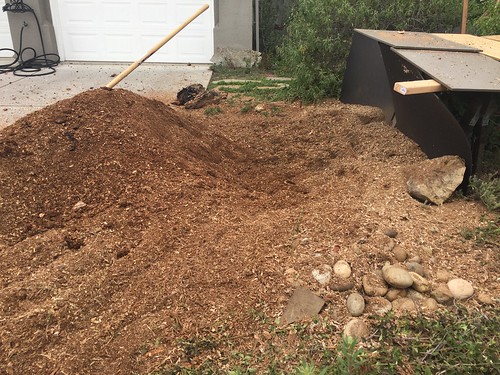
Pepper Tree chips, Belmont, San Jose May 2016

Linda and Gary with new maple tree

Images Copyright 2016 by Katy Dickinson – with thanks to Google Maps for the 2014 image

Leave a comment

Filed under Home & Family, News & Reviews