Right now, someone is particularly angry at me for not communicating through the means she prefers. She wrote me an email saying that she wants letters on paper and will read email but thinks blogs are impersonal and not worth her time.
So, why write blogs?
I work two jobs (for TechWomen and Huawei), each of which is interesting and worthwhile
I love a distractingly wonderful husband, two remarkable kids in college, two dogs, a cat, and two birds, each of whom would like and deserves more of my attention
Our daughter is getting married in six weeks, with over a hundred guests
I am working with my brothers to advise and support two interesting parents (both over 80) whose health is failing
I am on several volunteer Boards and I teach a group of twenty adorable kids three hours a week in an after-school program, all of whom have justified expectations of my time and nurturing
I have plants that expected better when they came into my garden, and weeds that are much happier than they should be
I have a stack of well-written and highly-recommended books that leak guilt at me when I look in their direction
I am over-committed and over-scheduled doing work I love and do well. When my daughter went to college, she made a wise decision. She could either try to keep in touch with her large circle of friends and relations individually, and do nothing else. Or, she could blog and hope that her admirers would follow her news in a less-direct but more complete way.
“Reading maketh a full man, conference a ready man, and writing an exact man.” Sir Francis Bacon (1561 – 1626)
When I don’t blog, I find that I drop out of touch and actually spend more time communicating to worse effect. I love writing and taking pictures and I think sharing what I see with my readers benefits both. I am frequently contacted by interesting people who ask to use one of my pictures or want to continue a discussion started on my blog. For example, I was on the local TV news last week because of my blog entries last year about FEMA. I have included recent pictures of strange local cars and old metal signs for you today – just for fun! Publishing here makes me consider more deeply and starts many of my conversations with my family and friends in the middle of current experience, instead of spending half of each meeting catching each other up.
My parents will celebrate their 59th wedding anniversary this Sunday. My father recently had a bad fall and has been in the hospital – we are thankful that he got back home today. Happy day folks!
My daughter Jessica was graduated from Carnegie Mellon University with honors last weekend. Ten of her proud family flew to Pittsburgh, Pennsylvania, from Boston, Pasadena, San Francisco, and San Jose to celebrate the occasion. My father, Wade Dickinson, who attended Carnegie Tech before graduating from West Point was particularly proud to see his granddaughter graduate from his alma mater.
Jessica majored in Ethics, History, and Public Policy (that’s one major offered by CMU in Humanities and Social Sciences). You can see a video of her advisor talking about Jessica’s accomplishments. Jessica was presented with a blank diploma folder because she will return to CMU as a 5th Year Scholar next year, to work on a special project and also complete her Minor in Vocal Music and concentration in Arabic. Jessica got to wear what she calls “commencement flare” in addition to her simple black robes:
A red stole for being an Andrew Carnegie Scholar
A maroon stole for spending a semester studying at CMU-Q in Doha, Qatar
A purple cord with tassels for being an honors student
Unfortunately, Jessica’s fiance Matthew was graduating at the same time from William and Mary hundreds of miles away, so we did not get to attend his commencement. The family did get to spend an afternoon visiting Frank Lloyd Wright’s masterpiece of architecture, Fallingwater, which is like touring an lovely modern sculpture. This is the 75th anniversary for the house built on a waterfall.
Jessica is packing up her house this week to return home to the San Francisco Bay Area for the summer. She is getting married in August, then she and Matt will live in Pittsburgh next year.
My mother, Eleanor Creekmore Dickinson, turned 80 last month. To celebrate, I made a video from pictures of her life provided by many members of the family. The video contained a selection of the 1,346 best pictures I found from the last 150 years. Recent photos were available in digital form but older images had to be scanned. I was able to use some pictures from the 80th birthday video I made for my father, Wade Dickinson. However, scanning technology has improved so many of those 2006 photographs had to be re-scanned.
Here is the process – how the video was made, with generous technical support from my husband John and music advice from my daughter Jessica and brother Pete:
Decide when the story starts: establish the historical, social, and geographic context
I started 80 years before my mother was born, with ancestor pictures.
I included pictures from my mother’s parents’ childhood, courtship, and marriage.
Collect many many images
Include pictures from each decade, if possible.
Show important people and places: siblings, the house where she grew up, where she went during the summer.
Scan yearbooks, invitations and announcements, certificates, awards, diplomas and other documents important to her life.
Presenting both formal and informal pictures tells a fuller story.
Include images from both family and work life. My mother is an artist, so I included pictures of her drawings, paintings, and sculptures.
Scan pictures
Crop if needed to focus on what is important in the picture.
Leave off photo borders and frames (not always possible with old fragile photos).
Scan many more than you will need so that you have a choice of images with both landscape and portrait orientations
Put the images into a web page photo arrangement template.
I used the “Keepsakes” photo layout pages which are part of Apple iPhoto – there are other programs available.
I included a variety of page layouts for one to six pictures per page – keeping the same color background for each page for continuity.
I wrote footer notes with dates and names and key places – sparingly, not on every page.
I had planned to display the image sequence using iMovie but that application badly degraded the image resolution, so I used iPhoto instead.
Collect music to go with the images
We wanted a music medley with tracks from several periods in my mother’s life. Some songs I bought from iTunes. Jessica sang others and sent me the recording.
We wanted the music selections timed to start and end as certain images displayed. This required much work.
John exported the iPhoto slide show into iMovie to create a timed sound track. He then exported the sound track back into iPhoto for the image display. This was complex but created the best sound/image combination using the tools we had.
Decide how long the show will be – we aimed for 20 to 30 minutes.
Show early versions to friends and relations and ask for feedback.
Make a paper book of the video for a lasting momento. This is very easy to do with iPhoto Keepsakes but there is a 100 page limit. The resulting book arrives quickly and is of good quality.
This project took about 40 hours of work over two months to complete.
My mother loved it!
.
.
Images Copyright 2011 by Katy Dickinson 28 March 2014 – links and references updated
Last Friday was my parents’ 57th wedding anniversary. They were married in June 1952 in Knoxville, Tennesee. My father grew up in Hickory Township,
Pennsylvania. He met my mother at a Knoxville dance while he was working at the nuclear center at Oak Ridge.
“This exhibition presents the Center’s entire Rodin collection, 200 works in all. The Cantor Arts Center’s collection of Rodin bronzes is the largest in the world outside Paris, second only to the Musee Rodin. The majority of the collection remains on the ground floor, occupying three galleries. Approximately 170 works by Rodin are on view inside the Center, mostly cast bronze, but also works in wax, plaster, and terra cotta. Twenty bronzes, including The Gates of Hell, on which Rodin worked for two decades to complete, are outside in the Sculpture Garden. The Burghers of Calais are nearby on campus. The Rodin Sculpture Garden is open all hours, with lighting for nighttime viewing. Admission is free.”
We also got to see a Deborah Butterfield bronze cast driftwood horse in Cantor’s front hall.You may have seen another member of sculptor Butterfield’s herd at SFO, the San Francisco airport. Another favorite sculpture at Cantor is “Stone River” by Andy Goldsworthy.
We were very excited that Jessica, my 20-year-old daughter, attended this week’s Presidential inauguration in Washington, DC. You can see her blog entries and photos at http://feelingelephants.wordpress.com/. Ours is a politically passionate family. One of my earliest memories was glee that my candidate (John F. Kennedy) won the presidential election over my older brother’s candidate (Barry Goldwater), in 1964.
Our family has always been split between liberal and conservative. The divergence of our current family politics is best shown in two objects: a framed picture of the late President Ronald Reagan that my father put up in the front hall of their San Francisco house (intended to be seen by everyone who came over for parties to phone Obama voters, hosted by my mother), and the shoe with BUSH –> in gold paint on the toe that someone gave my father for Christmas:
I was at work at Sun during Tuesday’s inaugural morning so I went over to the Menlo Park campus Crossroads conference room to watch history unfolding
live by CNN TV broadcast on the big screen. Because I usually get my news from National Public Radio (NPR), it was particularly interesting to see how the great and powerful look and interact:
The senior President Bush does not seem to be aging well. He sat next to Hilary Clinton and behind the new First Lady Michelle Obama, so there were many pictures of him with his mouth open looking confused.
Hilary Clinton, on the other hand, looked radiant two days before her confirmation as our new Secretary of State.
It was fascinating to watch outgoing President George W. Bush during his last minutes in office. I saw Bush pat the leg of one of the tall Marines in full dress uniform as he walked past – like you would pat a friendly dog.
Except when greeting people, President Obama seemed grim during much of the event. The only time I caught a big smile was when he messed up his inaugural
oath (he had to take it again later). The biggest smile of the day, however, was that of cellist Yo-Yo Ma who appeared delighted to be performing with violinist Itzhak Perlman. There was much wondering how the instruments and musicians could play “Air and Simple Gifts” so well on that cold day. This was cleared up when it was announced today that those on the inaugural stage heard the musicians live but a prior recording was broadcast for everyone else. However
real the broadcast, Ma’s smile and the superb music were a genuine delight.
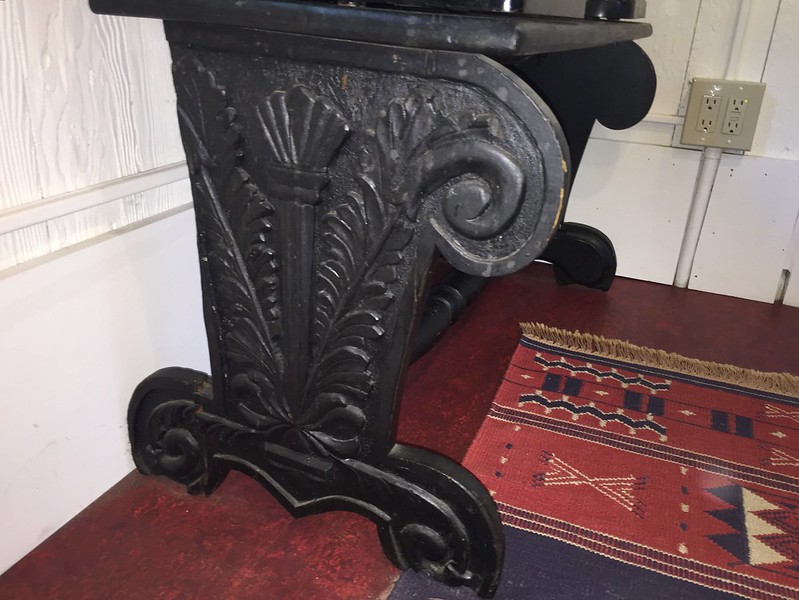
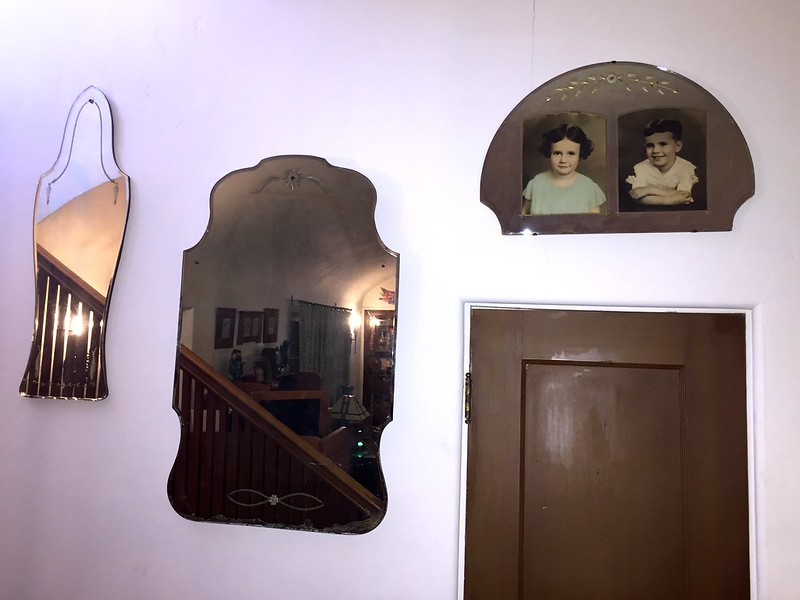
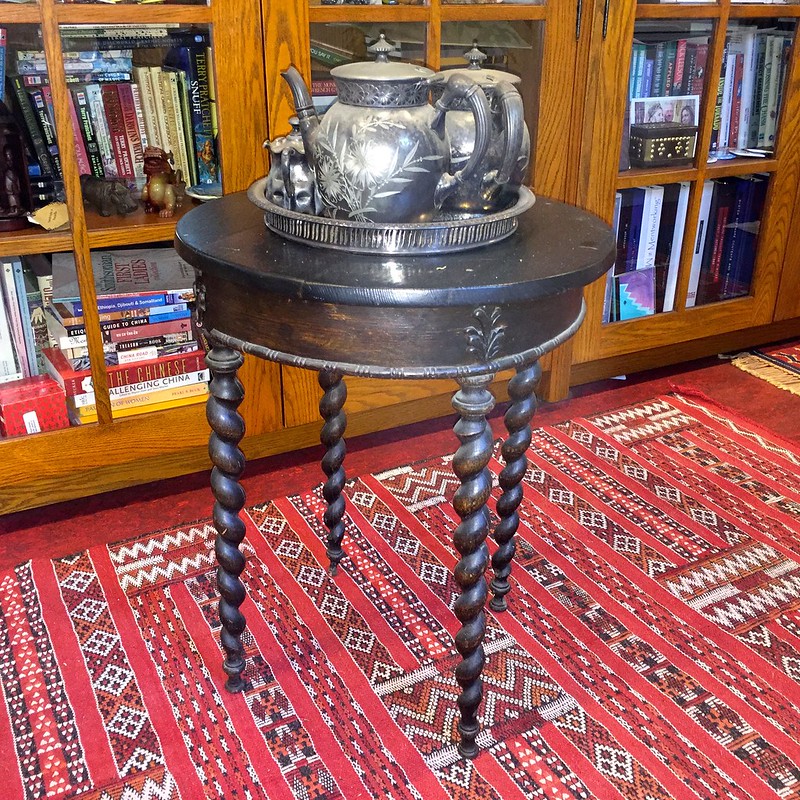
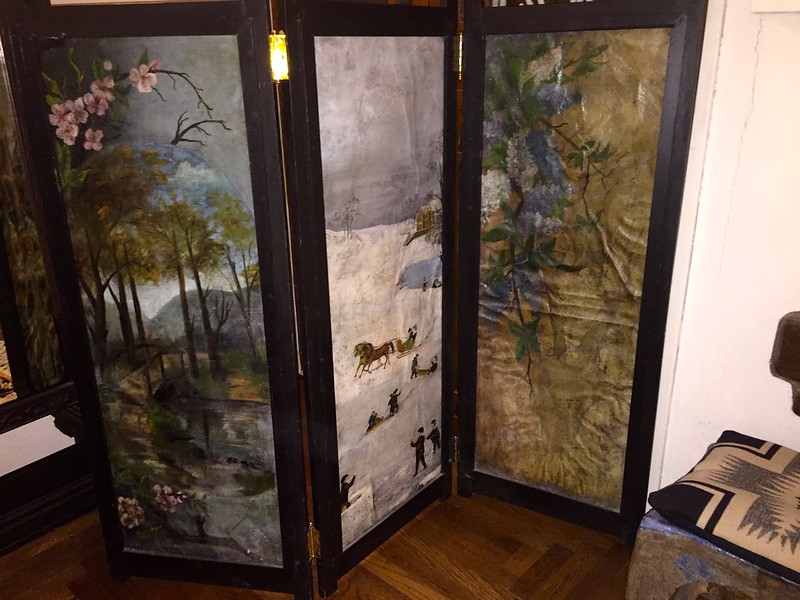
My brothers and I are working out an equitable and peaceable way to distribute family stuff. Unfortunately, we are the descendants of many generations of craft workers, artists, and collectors, so there are a great many things to be considered: furniture carved by our Mother‘s Grandmother, mirrors and stained glass created by our Mother‘s Grandfather, our Father’s Grandfather’s iron train set, our Father’s Mother’s painted set of cider mugs with matching pitcher, paintings and drawings by our Mother, etc.
Having seen several excellent examples of nasty, greedy, and predatory behavior during estate distributions, we are seeking a better way to bestow heirlooms fairly. Our motivation comes from growing up during a family fight over an estate that started in 1990 and lasted for more than ten years; the quarrel about which descendant got what eventually outlasted the lifetime of the original executor. We hope to avoid that experience in our generation. As our Father says: “I would rather burn it than fight about it.”
I am writing this out because when I searched the web for a good example, a property distribution process to model ours on, everything I found seemed to be associated with contentious divorces. I did not find any models in which the parties were assumed to be on speaking terms. My brothers and I each want some family stuff but we also want to preserve our good relationship more than we want any particular thing. I hope that the system we have developed over the last six years will be of use to other families who share our values.
Our parents are both living and have very generously and foresightedly agreed to distribute a selection of their family possessions in advance of their passing (which we hope will be many years in the future). My brothers and I have been in this distribution process for the last six years and have already sorted out who gets which of the larger pieces of furniture. In addition to getting a family chore done, we are learning more about each other and getting closer through these discussions. In this context “distribute” means transferring ownership but not necessarily the objects themselves. For example, my parents dining room table was given to me several years ago in one of our distributions; however, my parents will continue to use the table for their lifetimes.
At first, the distribution lists were annual and small, with just three or four heirlooms going to each of us. The distribution we are discussing now is our most ambitious, with fifty-four heirlooms to be sorted into three groups of eighteen. Here is an overview of the process we originally used:
Our parents make a list of heirlooms for us to consider and distribute. Usually, this means my having several discussions with our Mother since I live closest. One of my brothers lives at the other end of California and the other lives across the country, in Massachusetts.
My brothers and I ask questions – how big is it? what condition is it in? where did it come from – is there any special meaning to it? Sometimes pictures are distributed.
My brothers and I check with our spouses to collect their opinions.
My brothers and I have a three-way phone call during which we decide who gets what. The call is only between the three of us, no spouses or parents.
I tell our Mother what we decided in our call.
Our Mother writes each of us a letter giving us the items.
With so many more items to distribute this time, it has been harder to come to a decision. Our Mother sent us a list in August we are still discussing. We had not seen many of the items, so the whole family took a house tour when my brothers visited during Christmas. We walked around the house we grew up in and asked our Mother to point to each item on her list. Last Saturday, my brothers and I had a preliminary phone call.
We discussed what “family furniture” meant to us. If our Mother bought it, does that still count as “family”? When our Great Grandparents’ early Victorian house on Circle Park in Knoxville, Tennessee, was torn down in 1964, our Grandmother removed the front doors. Eventually our Mother had the doors installed on her house in San Francisco. Are those antique doors “family furniture”?
My brothers asked me to sort the fifty four items into three groups prior to our next call. I decided to ignore the potential market value of the items and focus on three important categories: size, history, and who actually wants the thing. I created three groups of 18 items with roughly the same number of things in each of these categories in each group:
Size:Small (antique toys, table clocks, the Cherokee hunting bow, the cider set), Medium (side tables, small chairs, stained glass panels and mirrors, our Great Grandfather’s glass case of stuffed birds), and Large (the front doors, our Father’s white leather arm chair, an 8′ tall hall mirror in a gold plaster frame, a huge wooden ice box, a set of balloon back chairs with seat cushions embroidered by our Great Grandmother).
Special Family Origin: anything made by a family member, the bannister from the Circle Park house, our Great Grandmother’s wicker rocking chair, etc.
Desireability: Anything that more than one of us expressed interest in during the preliminary phone call.
I sent the sorted groups to my brothers with the following proposed process:
Step 1 – Before the Meeting – Review the groups, ask questions, talk with spouses, say if there are one or two “heart’s desire” items
Step 2 – During the Meeting – Each of us picks a group (1, 2 or 3)
Step 3 – Accept / acknowledge conditions to replace installed items (such as the front doors)
Step 4 – Discuss trades. Other than trades, the group is distributed intact, where and as is.
I am curious to see how well this sorting worked and whether the distribution discussion goes better as a result.
Note: None of the items pictured are for sale. I do not provide pricing or sales advice for similar items. Please do not ask.
Images Copyright 2008-2016 by Katy Dickinson
13 June 2016: Images retaken and reposted, note added. 4 Feb 2021: photo links updated.
If you want to receive Katysblog posts by email, please sign up using the Sign Me Up! button (upper right on Katysblog home).



 KatysBlog