Tag Archives: Theology

What the Presiding Bishop Said

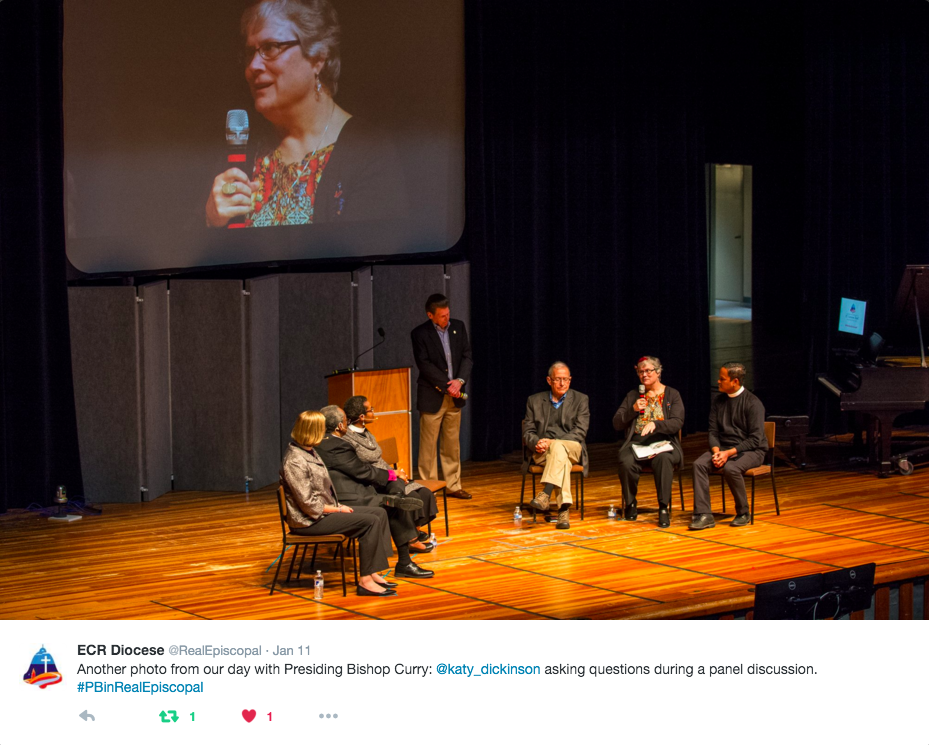
Tweet from RealEpiscopal 11 Jan 2017, Katy Dickinson and Presiding Bishop Panel on 7 Jan 2017, photo by Elrond Lawrence

“You are doing it.  Keep going.” is what Episcopal Church Presiding Bishop Michael Curry said in Salinas, California, on 7 January 2017. I was a member of the panel that asked questions after his keynote. From my notes, my opening question was:

“The Silicon Valley has a skewed population.  In the high tech world where I work, there are about 25% female, 4% Latino, and 2% Black in the computing professions.  In Elmwood Jail where I lead an Education for Ministry seminar each week, men and women are separate and there are 42% Latino and 29% Black. I feel like I live in two worlds. What can we do to reach out, to bring this divided community together?”

When Bishop Michael answered “You are doing it.  Keep going.”  I heard that the answer lay in outreach ministries like mine – and in telling people about that work. Individuals with a foot on both sides can connect a community.

It is a good but a little scary to have an experimental program succeed so well.  I have been thinking a great deal about what Bishop Michael said – and about what to do next.  The Episcopal Diocese of El Camino RealSaint Andrew’s Episcopal ChurchCIC, and EfM have strongly backed our jail-based seminar during the last year.  My first step was to talk with the CIC Chaplain for Elmwood, and then with the EfM program at the University of the South – School of Theology, about starting an additional class at Elmwood.  They support expanding the program.  Now to find more funding!

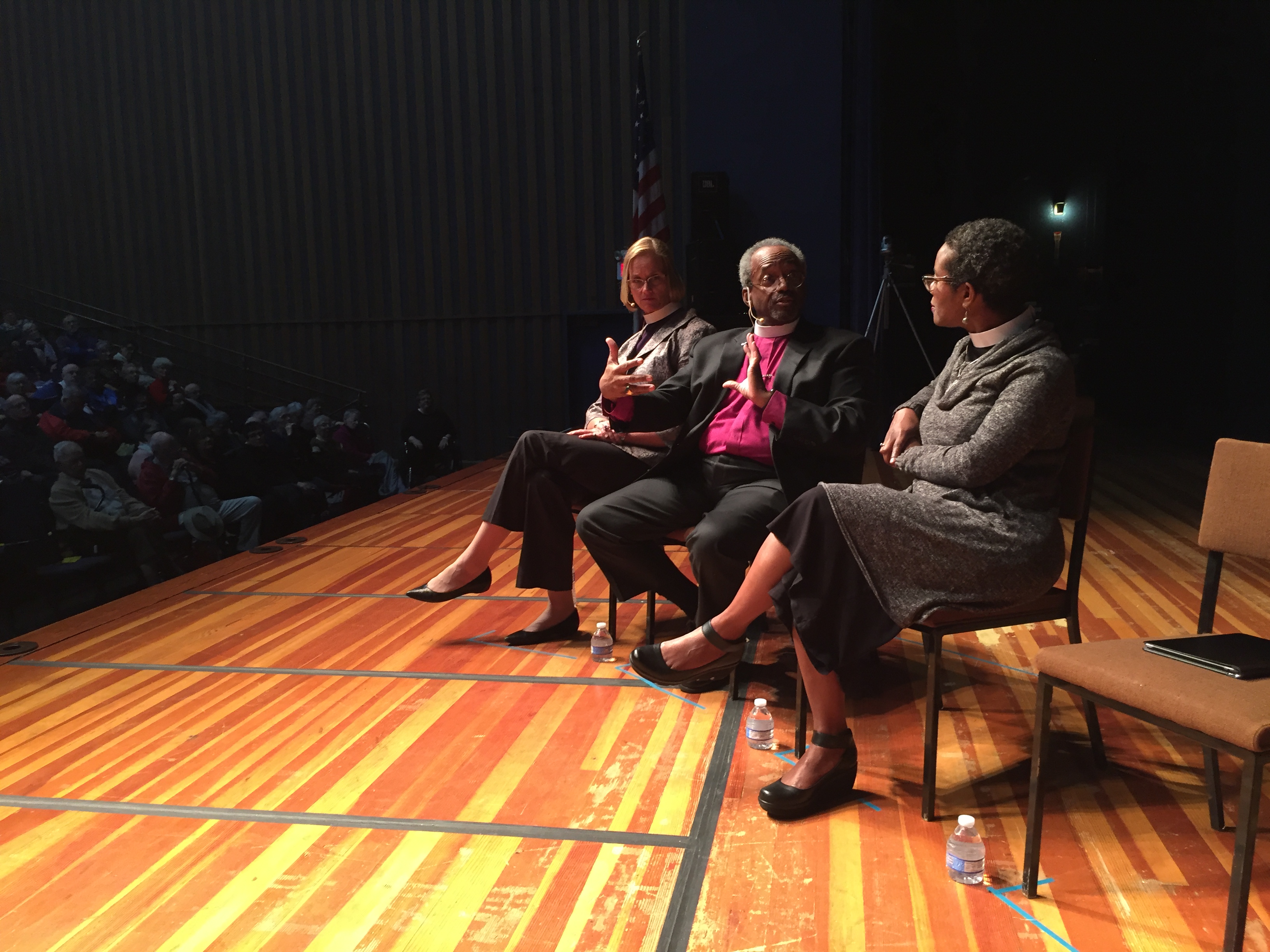
Canon Stephanie Spellers, Bishop Mary Gray-Reeves, Presiding Bishop Michael Curry, Salinas, 7 Jan 2017

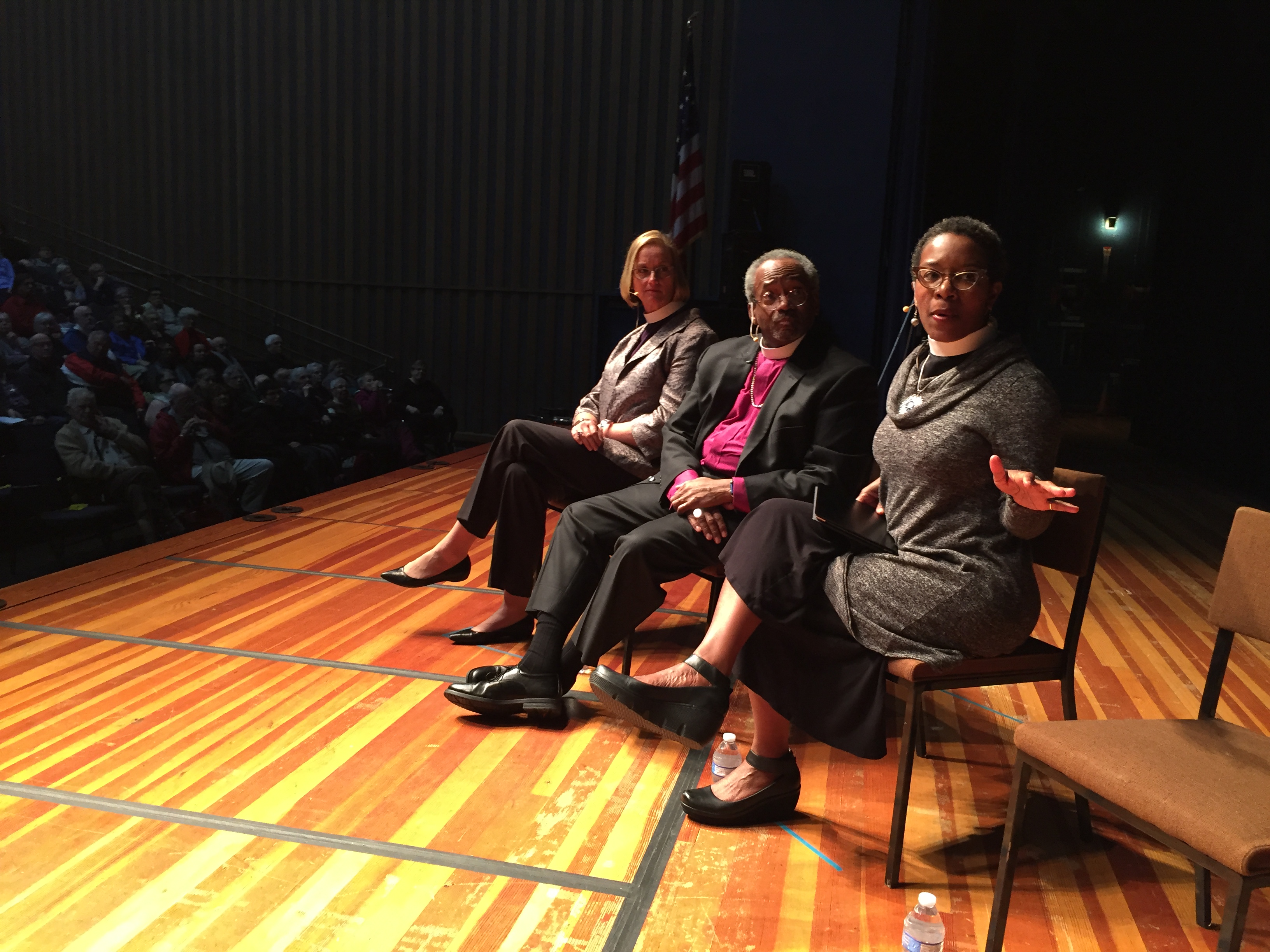
Canon Stephanie Spellers, Bishop Mary Gray-Reeves, Presiding Bishop Michael Curry, Salinas, 7 Jan 2017

Canon Stephanie Spellers, Bishop Mary Gray-Reeves, Presiding Bishop Michael Curry, Salinas, 7 Jan 2017

If you want to receive Katysblog posts by email, please sign up using the Sign Me Up! button (upper right).

Images Copyright 2016 by Katy Dickinson and Elrond Lawrence


1 Comment

Filed under Church, News & Reviews

Images of God

1. Basilica of San Vitale - Lamb of God mosaic

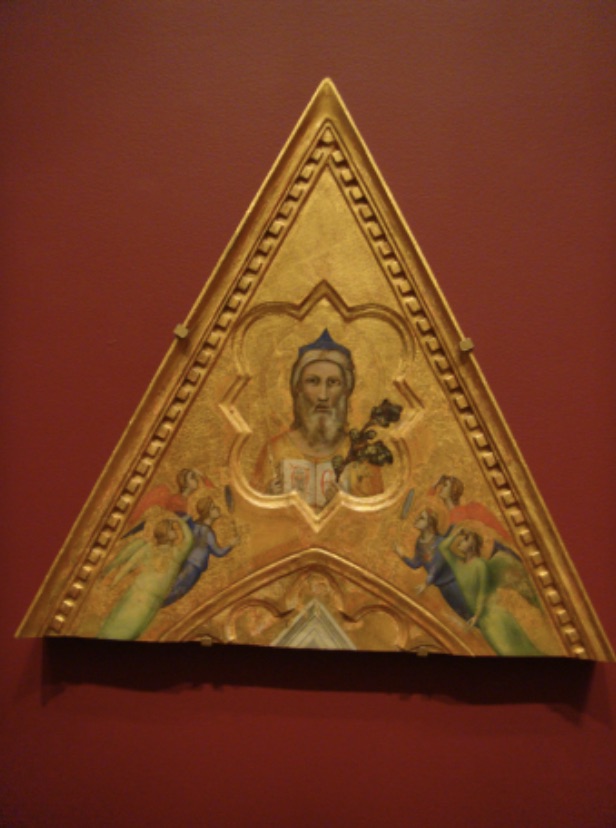
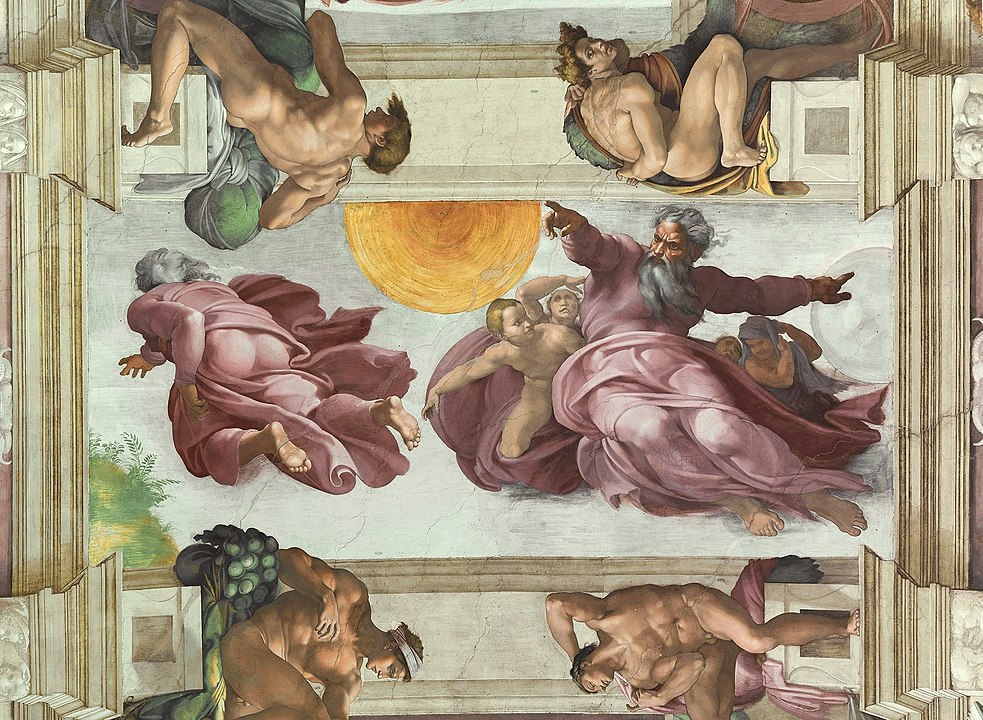
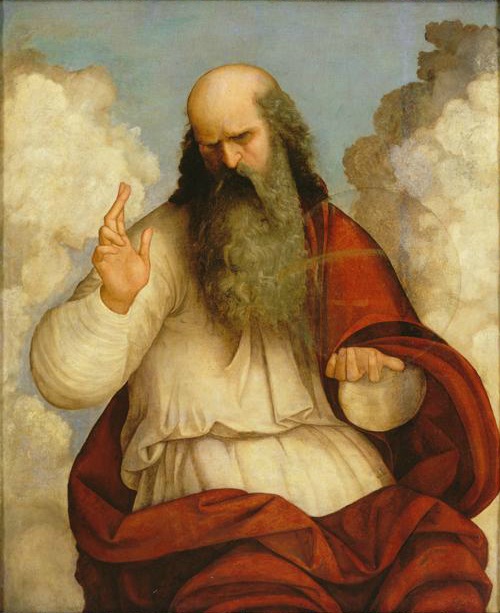
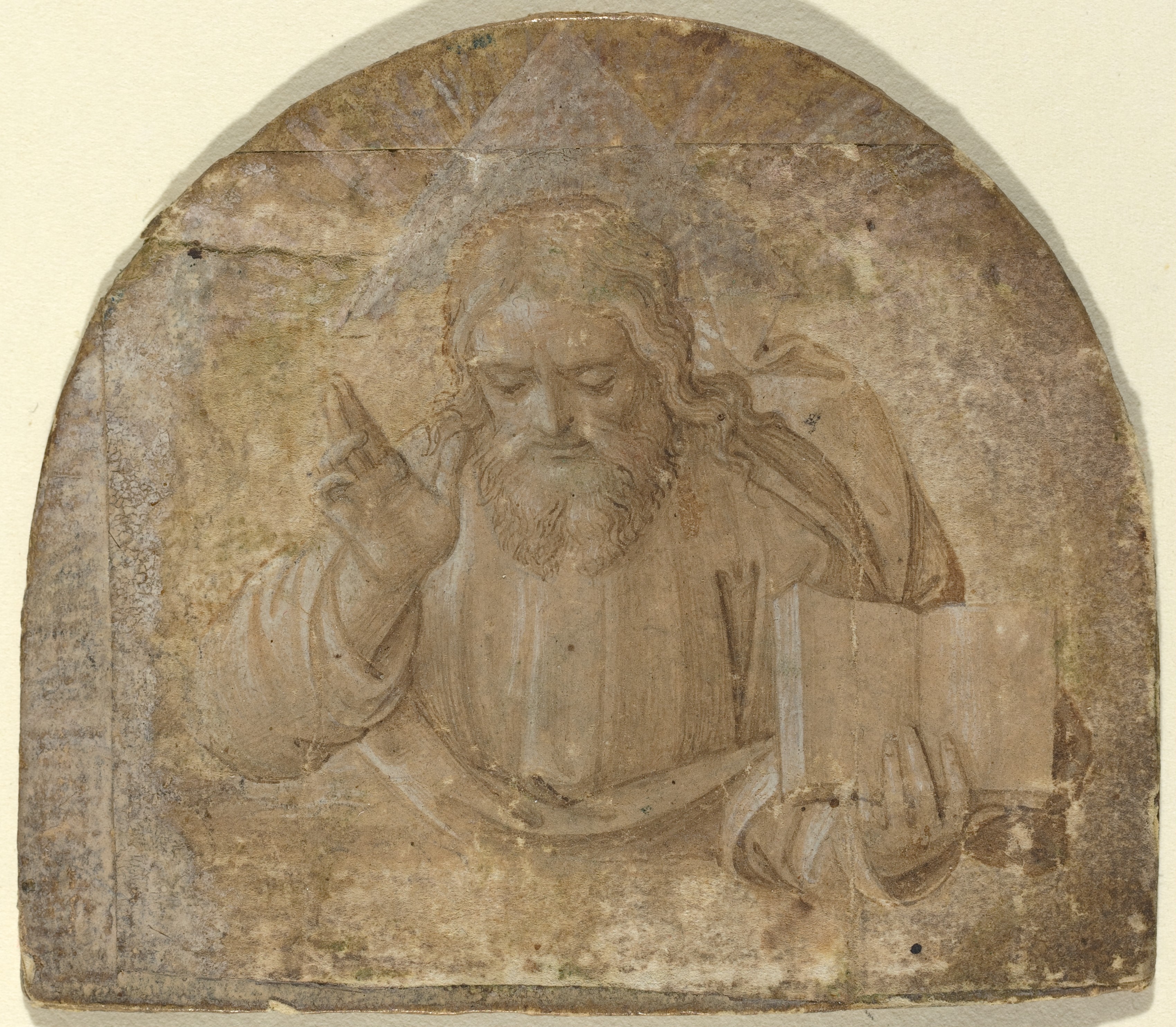
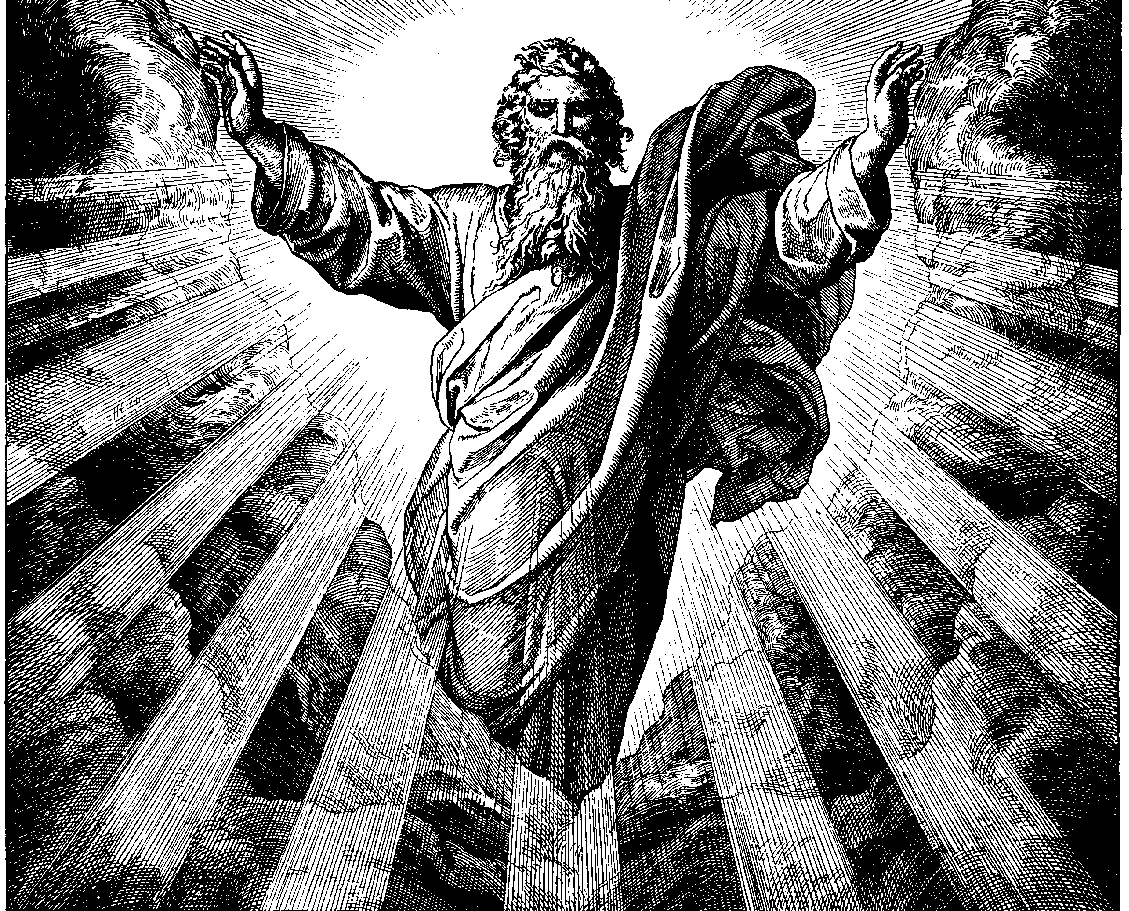
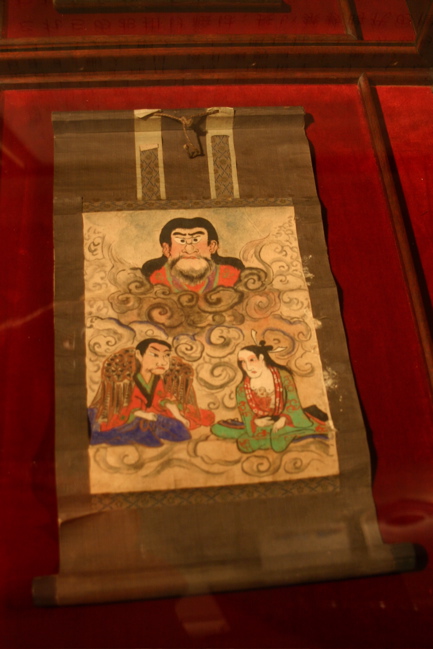
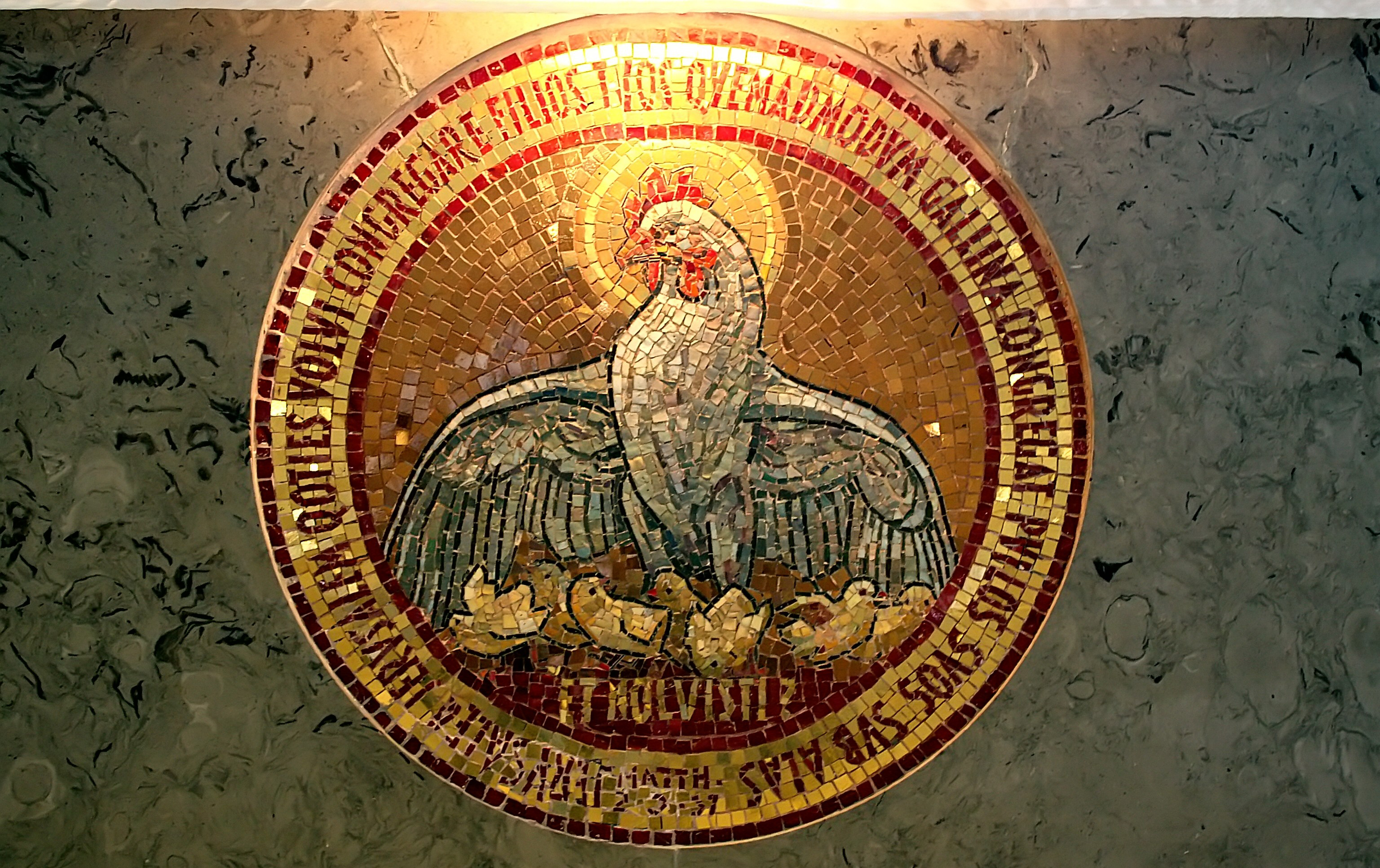
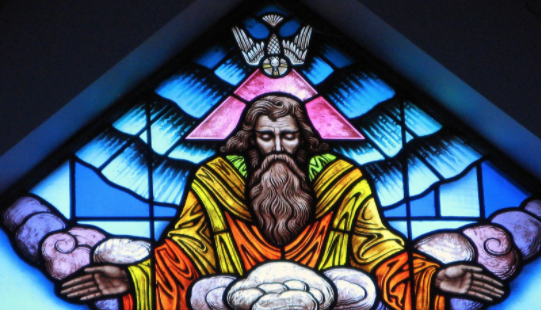
This is an online version of a handout I created for my weekly Education for Ministry seminar at Elmwood Correctional Facility (County Jail – in Milpitas, California).  The students in EfM Year 1 (the Hebrew Bible) were reading Genesis 1:27 “So God created humankind in his image, in the image of God he created them; male and female he created them.” Here are 21 varied images of God, dated from 527 – 2017, plus Bible verses describing God, for class discussion.

Update June 2002: Trinity – Images of God (7 June 2020 Prelude) – images in this post were used in St. Andrew’s Episcopal ChurchTrinity Sunday service. Update 22 October 2021, fixed broken link.

2. Vault mosaic - San Vitale - Ravenna 2016

List of Pictures:

Description More Information Image Source
1. Lamb of God (Jesus Christ) – mosaic in the presbytery, Basilica of San Vitale, Ravenna, Italy (527 CE) Basilica of San Vitale Basilica of San Vitale – Lamb of God mosaic
2. God in Heaven – mosaic in the apse, Basilica of San Vitale, Ravenna, Italy (527 CE) Basilica of San Vitale Vault_mosaic_-_San_Vitale_-_Ravenna_2016
3. Christ Pantocrator – All Powerful – mosaic, chapel of San Zeno, Rome, Italy (822) Santa Prassede Mosaic of the vault of the chapel of San Zeno (IX century)
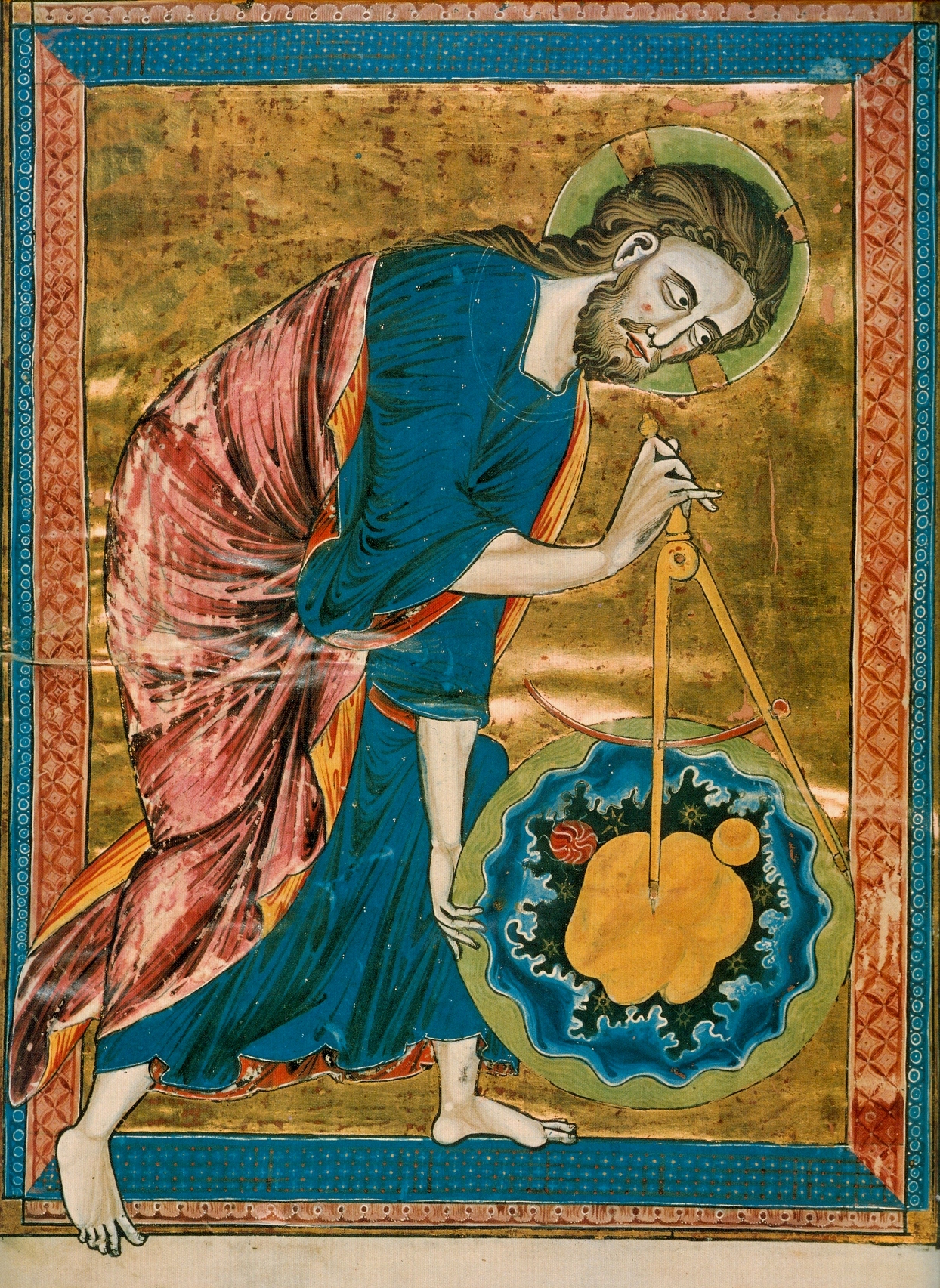
4. God as Architect of the Universe – Frontispiece of Bible Moralisee, Paris, France (1230) Bible moralisée God the Geometer
5. God the Father – painting by Giotto, Florence, Italy (1330) Giotto God the Father with Angels
6. Ghent Altarpiece (detail) – painting by Hubert and Jan van Eyck, Saint Bavo Cathedral, Ghent, Belgium (1432) Ghent Altarpiece Retable de l’Agneau mystique (Altarpiece of the Mystical Lamb)
7. The Creation of the Heavenly Bodies (detail) – painting by Michelangelo di Lodovico Buonarroti Simoni, Sistine Chapel, Rome, Italy (1512) Michelangelo Sistine Chapel: Creation of the universe
8. God the Father – painting by Cima Da Conegliano, Venice, Italy (1517) Cima da Conegliano Cima da Conegliano, God the Father
9. God the Father – painting by Ludovico Mazzolino, Ferrara, Italy (1520) Ludovico Mazzolino Ludovico_Mazzolino_-_God_the_Father
10. God the Father – painting by Girolamo dai Libri, Verona, Italy (1555) Girolamo dai Libri God_the_Father_with_His_Right_Hand_Raised_in_Blessing
11. Picture Bible “Die Bibel in Bildern” (detail) – engraving by Julius Schnorr (1860) Julius Schnorr von Carolsfeld Schnorr_von_Carolsfeld_Bibel_in_Bildern
12. Holy Lord Sabaoth – Russian Icon (date?) Russian icons Holy Lord Saboath
13. Kakure Kirishitan Heaven – scroll painting, Ikitsuki Island, Nagasaki, Japan (date?) Kakure Kirishitan The Hidden Christians (at Ikitsuki Museum, Nagasaki, Japan)
14. God as Mother Hen – Dominus Flevit Church, Jerusalem, Israel (1955) Dominus Flevit Church Mosaic_Art_at_Dominus_Flevit
15. God as Dove (Holy Spirit) – stained glass by James Scanlan, Cathedral of St. Mary & St. Anne, Cork, Ireland (1990) Catholic Cathedral of St. Mary & St. Anne Stained Glass at the Cathedral of St. Mary & St. Anne
16. Father (and Holy Spirit) – stained glass at St. Virgil Church, in Morris Plains, New Jersey USA (contemporary, date?) St. Virgil Parish Top Panel, Stained Glass wall depicting Ascension of Jesus
17. George Burns as God, from movies “Oh, God!” (1977), and “Oh, God, Book II” (1980) Oh, God! Classics of the Corn
18. Alanis Morissette as God, from movies “Dogma” (1999), and “Jay and Silent Bob Strike Back” (2001) Dogma (film) View Askewniverse Wiki: God
19. Morgan Freeman as God, from movies “Bruce Almighty” (2003), and “Evan Almighty” (2007) Evan Almighty Evan Almighty Morgan Freeman as God
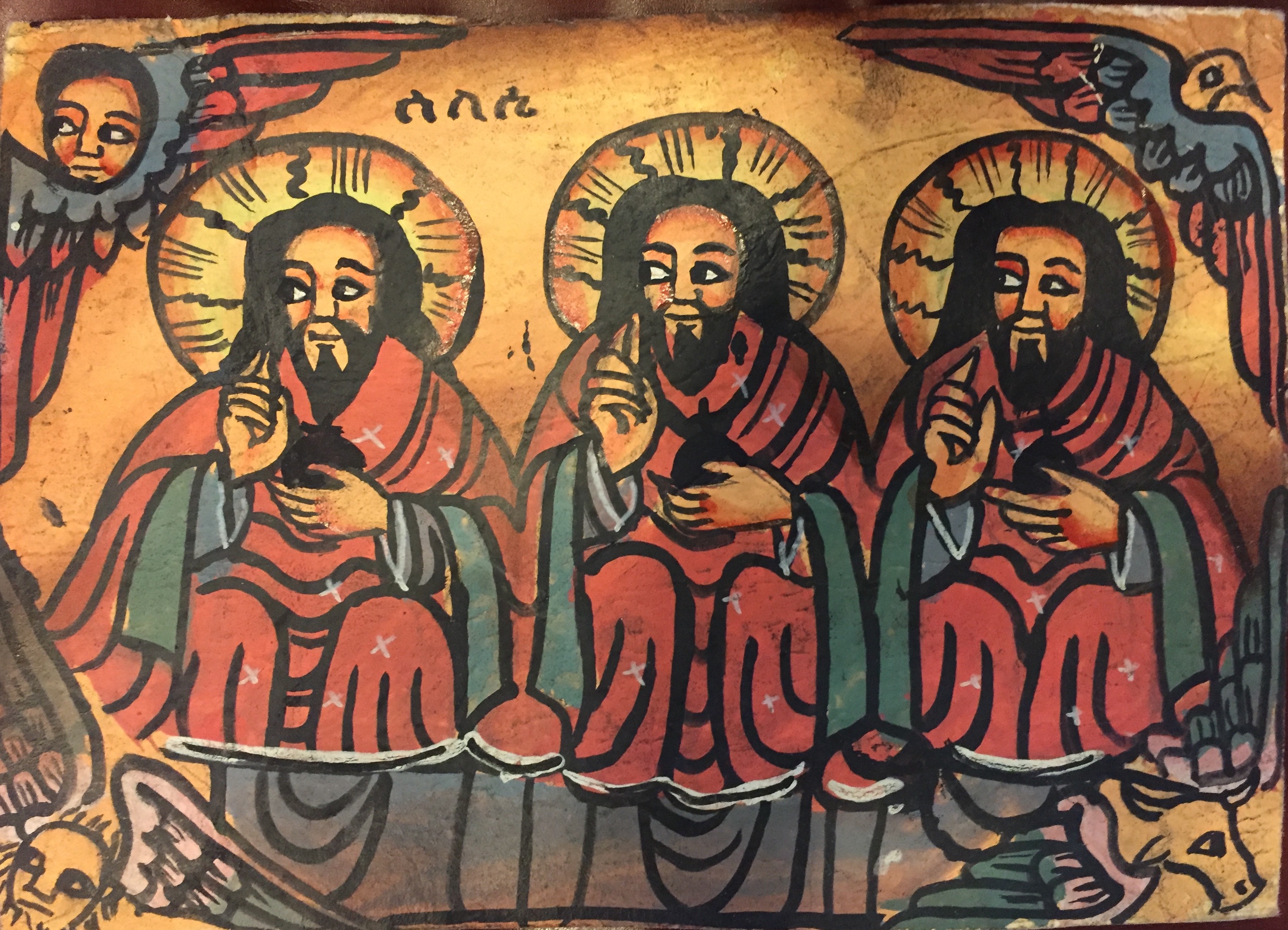
20. Ethiopian Orthodox Trinity – painted hide (2014) Ethiopian Orthodox Tewahedo Church Picture by Katy Dickinson – Painted icon purchased in Ethiopia 2016. Icon Pictures and More Icon Pictures
21. “The Shack” – movie (2017) The Shack “The Shack – A Film Review,” Formed Faith, 20 June 2017

Pictures of God:

3. Mosaic of the vault of the chapel of San Zeno (IX century)

4. God the Geometer

5. Giotto - God the Father with Angels

6. van Eyck - Altarpiece of the Mystical Lamb

7. Michaelangelo - Creation of the Sun and Moon
8. Cima da Conegliano, God the Father

9. Ludovico_Mazzolino, God the Father

10. Girolamo dai Libri, God the Father

11. Schnorr_von_Carolsfeld_Bibel_in_Bildern

12. Holy Lord Sabaoth - icon

13. Kakure Kirishitan Heaven

14. Mosaic Art at Dominus Flevit

15. Dove Stained Glass - Cathedral of St. Mary and St. Anne

16. Father (and Holy Spirit) - St. Virgil Parish

17. George Burns as God

18. Alanis Morissette as God

19. Morgan Freeman as God

20. Ethiopian Orthodox Trinity Icon 2016

21. Jesus, Man, God, and Holy Spirit, Trinity from The Shack movie 2017

Images of God in the Bible (Selected):

Beasts

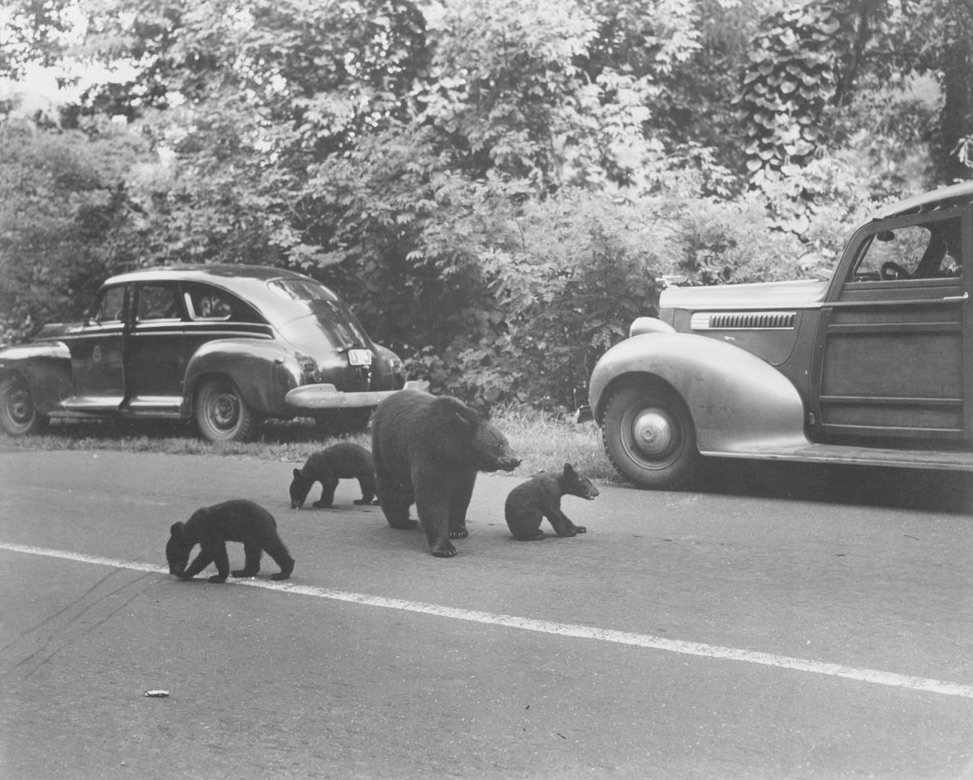
  • 1 Bear: “I will meet them as a bear that is bereaved of her whelps” Hosea 13:8
  • 2 Lamb: “This took place in Bethany across the Jordan where John was baptizing. The next day he saw Jesus coming toward him and declared, ‘Here is the Lamb of God who takes away the sin of the world!’” John 1:28-29
  • 3 Moth: “Like a moth you eat away all that is dear to us.” Psalm 39:12

1940 three bear cubs, Smokey Mountains TN

Birds

  • 4 Eagle: “You have seen what I did to the Egyptians, and how I bore you on eagles’ wings and brought you to myself.” Exodus 19:4
  • 5 Eagle: “He shielded him and cared for him; he guarded him as the apple of his eye, like an eagle that stirs up its nest and hovers over its young, that spreads its wings to catch them and carries them aloft.” Deuteronomy 32:10-11
  • 6 Bird: “Hide me under the shadow of your wings.” Psalm 17:8
  • 7 Bird: “Let me abide in your tent forever, find refuge under the shelter of your wings.” Psalm 61:4
  • 8 Bird: “For you have been my helper, and under the shadow of your wings I will rejoice.” Psalm 63:7
  • 9 Bird: “He shall cover you with his pinions, and you shall find refuge under his wings.” Psalm 91:4
  • 10 Dove: “And when Jesus had been baptized, just as he came up from the water, suddenly the heavens were opened to him and he saw the Spirit of God descending like a dove and alighting on him.” Matthew 3:16
  • 11 Hen: “Jerusalem, Jerusalem, you who kill the prophets and stone those sent to you, how often I have longed to gather your children together, as a hen gathers her chicks under her wings, and you were not willing.”
    Luke 13:34 and also Matthew 23:37

Woman

  • 12 “You were unmindful of the Rock that bore you; you forgot the God who gave you birth.” Deuteronomy 32:18
  • 13 “From whose womb did the ice come forth, and who has given birth to the hoarfrost of heaven?” Job 38:29
  • 14 “Yet it was you who took me from the womb; you kept me safe on my mother’s breast.” (God as a midwife) Psalm 22:9
  • 15 “As the eyes of servants look to the hand of their master, as the eyes of a maid to the hand of her mistress, so our eyes look to the Lord our God, until he has mercy upon us.” Psalm 123:2
  • 16 “But I have calmed and quieted my soul, like a weaned child with its mother; my soul is like the weaned child that is with me.” Psalm 131:2
  • 17 “For a long time I have held my peace, I have kept myself still and restrained myself; now I will cry out like a woman in labor, I will gasp and pant.” Isaiah 42:14
  • 18 “Can a woman forget her nursing child, or show no compassion for the child of her womb? Even these may forget, yet I will not forget you.” Isaiah 49:15
  • 19 “As a mother comforts her child, so I will comfort you; you shall be comforted in Jerusalem.” Isaiah 66:13
  • 20 “Yet it was I who taught Ephraim to walk, I took them up in my arms; but they did not know that I healed them. I led them with cords of human kindness, with bands of love. I was to them like those who lift infants to their cheeks. I bent down to them and fed them.” Hosea 11:3-4

Fire and Clouds

  • 21 “The Lord went in front of them in a pillar of cloud by day, to lead them along the way, and in a pillar of fire by night, to give them light, so that they might travel by day and by night.” Exodus has seven mentions, in: 13:21-21 through 33:10
  • 22 “They have heard that you, O Lord, are in the midst of this people; for you, O Lord, are seen face to face, and your cloud stands over them and you go in front of them, in a pillar of cloud by day and in a pillar of fire by night.” Numbers 14:14
  • 23 “The Lord appeared at the tent in a pillar of cloud; the pillar of cloud stood at the entrance to the tent.” Deuteronomy 31:15
  • 24 “You led them by day with a pillar of cloud, and by night with a pillar of fire, to give them light on the way in which they should go.” Nehemiah 9:12 and 9:19
  • 24 “He spoke to them in the pillar of cloud; they kept his decrees, and the statutes that he gave them.”Psalm 99:7

2013 Sunset Beirut Lebanon by Katy Dickinson

See linked pages for individual image copyrights.

Image links updated from time to time. Additional text added 8 June 2020.
If you want to receive Katysblog posts by email, please sign up using the Sign Me Up! button (upper right).

3 Comments

Filed under Church

Ethiopian Icons

P1220142

My Episcopal home church in Saratoga, California, is spare in design – with most of the color coming from huge stained glass windows by Mark Adams. Visiting Ethiopian Orthodox churches and the Ethiopian Ethnological Museum last month presented me with the new world of brightly colored Ethiopian icons. Some were new and others were ancient but the color palette, style, and topics were similar regardless of age.

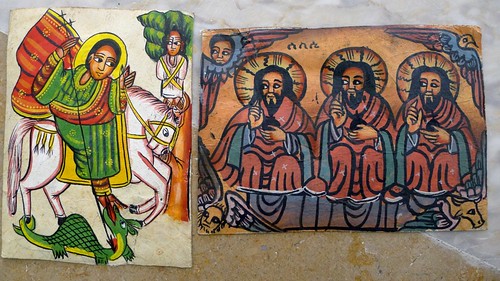
The icon topic that was very surprising to me was the Trinity (as seen in the last photo below). In my Protestant Christian faith tradition, Jesus is commonly represented in art but only rarely are God and the Holy Spirit shown, except symbolically (such as when the Holy Spirit is shown as a dove). Ethiopian icons showing the Trinity as three mature, identical, kingly men with haloes sitting in a row were disturbing.

P1220154

P1220144

P1210440

P1210442

P1210589

Untitled

Images Copyright 2014 by Katy Dickinson and John Plocher

1 Comment

Filed under Church, News & Reviews

Ethiopian Art, Crafts, and Icons

P1210889

I was going to write a “Crafts in Ethiopia” blog entry like my Crafts in Rwanda entry from February.  Then I realized that in Ethiopia there is heavy overlap between art, craft, and religious icons. Some of the works I brought home are between these categories. For example, if the two paintings on goat skin above were not religious in content, I would consider them crafts; however, because one is depicts Saint George and the other represents the Holy Trinity, and both are heavily inspired in design by ancient icons still in active church use, I am not sure into what category they fall.

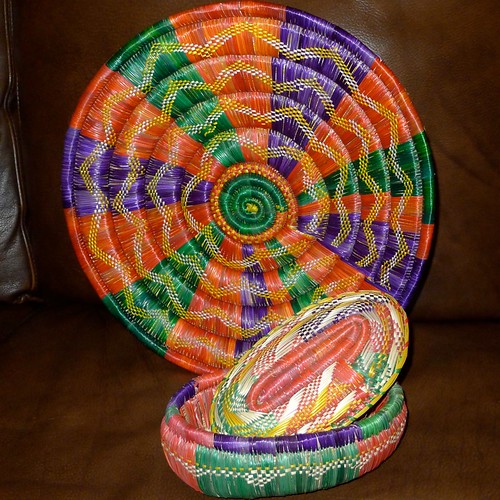
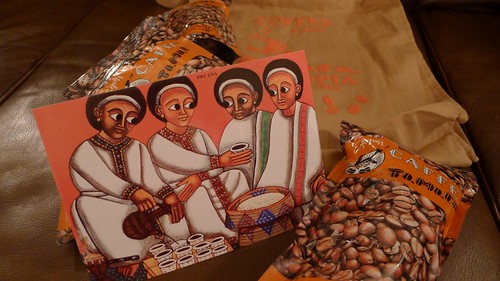
The image below of coffee drinkers is clearly craft – even though its media, design, and execution are very similar to the paintings above. The baskets, woven scarves, and jewelry items pictured below are also crafts. The silver cross ear rings and bracelet are something else – maybe religious crafts? The great variety, symbolism, and social importance of Ethiopian Orthodox crosses puts them in another category.

P1220421

P1220409

P1220420

P1220419

P1210895

Images Copyright 2014 by Katy Dickinson

2 Comments

Filed under Church, News & Reviews

Why can’t theology be like science fiction?

University of the South School of Theology EfM Year 4 Books 2014

I admit to reading a great deal of science fiction and fantasy (in addition to literature, history, science, business, technology and other categories of composition), and that science fiction is perhaps not the best starting place for studying Theology, Ethics and Interfaith Encounters – the topics for my fourth year in the Education for Ministry  (“EfM”) program of the University of the SouthSchool of Theology.  Nonetheless, in some ways, science fiction can be more rigorous than theology.

The Webster definition of Theology: “The study of religious faith, practice, and experience. The study of God and God’s relation to the world. A system of religious beliefs or ideas.”  Webster’s definition for Science Fiction is: “Stories about how people and societies are affected by imaginary scientific developments in the future.”

My textbooks for this year are pictured above. EfM is an excellent program. I found all of these books interesting and worth reading (some are inspiring, superb, and worth reading more than once!). Since my EfM group is in Week 30 of a 36 week curriculum, I have finished reading all but the last on this list:

  • Education for Ministry – Reading and Reflection Guide Volume A (2013)
  • Theology for a Troubled Believer: An Introduction to the Christian FaithDiogenes Allen (2010)
  • And God Spoke: the Authority of the Bible for the Church Today, Christopher Bryan (2002)
  • The Christian Moral Life: Practices of Piety, Timothy F. Sedgwick (2008)
  • Living on the Border of the Holy: Renewing the Priesthood of All, L. William Countryman (1999)
  • My Neighbor’s Faith: Stories of Interreligious Encounter, Growth, and Transformation, Edited by Jennifer Howe Peace, Or N. Rose, and Gregory Mobley (2012)

Last week, as I was finishing Living on the Border of the Holy, I identified a source of some of my frustration with my EfM reading this year.  When a fantasy or science fiction author creates a fictional universe, self-consistency is a major concern:

What distinguishes a fictional universe from a simple setting is the level of detail and internal consistency. A fictional universe has an established continuity and internal logic that must be adhered to throughout the work and even across separate works. So, for instance, many books may be set in conflicting fictional versions of Victorian London, but all the stories of Sherlock Holmes are set in the same Victorian London. However, the various film series based on Sherlock Holmes follow their own separate continuities, and so do not take place in the same fictional universe….

A famous example of a fictional universe is Arda, of J. R. R. Tolkien’s books The Lord of the Rings and The Silmarillion. He created first its languages and then the world itself, which he states was “primarily linguistic in inspiration and was begun in order to provide the necessary ‘history’ for the Elvish tongues.” [from Wikipedia’s fictional universe article]

If a popular author does not present logic, continuity, and good writing, the powerful and vocal fan community is pleased to point out every inconsistent detail at length. (Continuity is also a major concern in films – if for no other reason than to avoid being listed on websites devoted to movie mistakes.)  Since reading my first science fiction book many decades ago, I have come to expect logic, continuity, and good editorial practices to be key drivers.  I have not always found those characteristics while reading these theology books.

Example One – from Living on the Border of the Holy

In Living on the Border of the Holy, the geographic metaphor in the title is found throughout the whole book.  “Border” is used 108 times, “borderland” is used 42 times, and “country” (as in “border country” – but not counting hits for the author’s name) is used 65 times.  The image of a border country is explained in many  ways that I found contradictory and confusing:

  • “The encounter with the HIDDEN is a kind of fault line running through the middle of our lives; no one can escape its presence. The HIDDEN forms a border country that turns out to be. paradoxically, our native land.” (p.6)
  • “The border country, therefore, is a place of intense vitality.  It does not draw us away from the everyday world so much as it plunges us deeper into a reality of which the everyday world is the surface.” (p.11)
  • “It can be helpful to imagine our human encounter with the HOLY as life in a border country. It is a country in which, at privileged moments of access, we find ourselves looking over from the everyday world into another, into a world that undergirds the everyday world, limits it, defines it, gives it coherence and meaning, drives it. Yet this hidden world is not another world, but the familiar world discovered afresh.” (p.8)
  • “The border country is the realm in which human existence finds its meaning. The border itself is the indispensable condition for this. If you could slip over entirely into the HIDDEN HOLY, you would no longer be in touch with the basic materials and experiences of human life. If you try to slip over entirely into the everyday world, then actions and experiences merely follow each other in succession without forming a larger whole.” (p.161)

In addition to reading two hundred pages, I spent time prayerfully considering Living on the Border of the Holy, and I discussed it for several hours with my EfM group.  The mixed geographic metaphor and strained logic did not help my understanding:

  • How can a land-feature simultaneously demarcate, undergird, and be a fault line?
  • How can it both be someplace to which we have “privileged moments of access” and also our “native land”?

If this were a science fiction or fantasy book, I think these basic logic and presentation contradictions in the setting would have been sorted out by the editor before publication.  I finally started ignoring the faulty metaphor and got on with considering the excellent content of Living on the Border of the Holy, especially its remarkable analysis of the priestly calling.

Example Two – from Theology for a Troubled Believer

There is no thematic metaphor in Theology for a Troubled Believer but there is certainly a strong cultural point of view. When I read stories about sympathetic, intelligent but non-humanoid characters, I can feel my mind opening to understand how human thinking and capabilities are influenced by our sensory input and body design.  Notable examples of such aliens include:

I admire authors who can understand and present a very different way of thinking and carry it forward through an extended work of fiction. In contrast, when I read Theology for a Troubled Believer, I was frequently irritated (and occasionally infuriated) by the author’s narrow, privileged, academic, and American context for a topic that is far beyond one culture’s circumstances. For example:

  • “The systemic search for reasons, or for the logos for anything and everything, is something we today take for granted.  It is part of our mental makeup.  We do it automatically.” (p.xviii) [While true for many educated Americans, I do not think that the “systemic search for reasons” is part of humanity’s mental makeup.]
  • “…we who live in democracies find it strange to consider the act of the Good Samaritan and the acts of the ‘sheep’ in the parable of the Sheep and Goats as acts of justice.  To those who think in terms of democratic societies, it is an act of mercy, not justice.” (p.23) [People living outside of democracies may also share this thinking.]
  • “The natural world is also a witness to God’s power, wisdom, and goodness…. Nature is not used to move from unbelief to belief.  Nature was always used by people who had already been moved by God’s grace to a life of faith as a way to gain a better idea of God’s power, wisdom, and goodness from nature’s immense size, intricate order, and usefulness to human life.” (p.50) [This sweeping generalization is not even true for the many Americans whom Nature has lead to belief!]

In addition to his insensitivity to other cultures, the author’s arrogance toward believers in Judaism and Islam is breathtaking. However, Diogenes Allen is most snarky about fellow scholars, particularly “philosophers of religion”. His negativity is tiring as a continuing theme.  The best part of this book is Diogenes Allen’s inspiring analysis of the parable of the Good Samaritan and the absolute value of human beings – that alone makes Theology for a Troubled Believer worth the slog.  However, I think if this book was in the science fiction or fantasy genre, a sensible editor would have gone to work with her red pen to make some much-needed improvements in its point of view and writing mechanics.

Example Three – from And God Spoke

I include And God Spoke because it was easily the best book of theology I read this year. And God Spoke is accessible, funny, and succinct. It includes lovely quotes by famous writers (C.S. Lewis: “Now the trouble about trying to make yourself stupider than you really are is that you very often succeed.”) and excellent writing in general:

“We need to beware a naïve belief that thinks it can take a couple of verses of scripture in isolation from their wider context and find there universal moral rules that are to be applied remorselessly in all cases, however complex. We need equally to beware of a naïve skepticism that can see in scripture only a mass of contradictions and inconsistencies from which it is possible to prove anything and nothing.” (p.10)

All in all, this is a book that makes the study of Christian faith, practice, and experience a pleasure.   Interestingly, there is a section in And God Spoke that analyzes how words are used, based on the modes of language presented by literary critic Northrop Frye. Christopher Bryan writes about visionary or imaginative language as:

“…words used to take us beyond our reason or our loyalties to worlds where our ordinary modes of consciousness are only one possibility among many, where imagination, fantasy, dreams, and intuition have play…. Words used in this last mode can carry us in imagination to other worlds — to the worlds of the gods, of myth, of universes transcending the universe we know. And here we find stories of our relationship to those worlds — stories of creation, fall, and redemption. Here we find those grand, overarching narratives that shape our understanding of the universe around us, and our place in it.” (pp.35-36)

The author goes on to write that visionary language is the most significant and normative for much of the Bible. Imaginative language is thus a shared mode of expression for both the Bible and for science fiction / fantasy. And God Spoke meets the best standards of science fiction and is a good example to all future books of theology.

Science Fiction and Fantasy Books
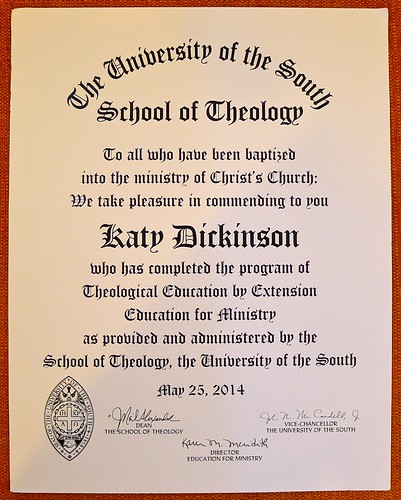

University of the South, School of Theology EfM, Diploma Katy Dickinson 2014
My EfM Diploma! (arrived early)

Images Copyright 2014 by Katy Dickinson

2 Comments

Filed under Church, News & Reviews

Convention, Theology of Marriage

IMG_5843

The Episcopal Diocese of El Camino Real here on California’s central coast, held its annual convention at St. Andrew’s, Saratoga two days ago. I have been a convention delegate for many years.  This convention was short but very well managed. Our Bishop, the Right Reverend Mary Gray-Reeves, was President of the Convention.  She lead us in worship and took care of business effectively, with charm, intelligence, and humor. My husband John and Rev. Stephenie Cooper ran the computers and projection system for the event, sitting behind the screen and only dashing out to vote as needed.
One of the highlights of the convention for me was the very interesting presentation on the just-published Report
 of 
the Diocese 
of 
El 
Camino
 Real
 Task 
Force
 on 
the
 Theology 
of 
Marriage . Four of the eight authors talked about their work, process, and findings. The authors are: The 
Rev.
 Dr.
 Ernest
 L. 
Boyer , 
Jr. (Chair 
of 
the 
Task 
Force)
, The 
Rev. 
Michael 
Ferrito, 
 The 
Rev. 
Dr. 
Caroline 
J. 
Addington 
Hall,
 The 
Rev. 
Fred 
W. 
Heard,
 The 
Rev. 
Lawrence 
Robles,
 The 
Rev. 
Deacon 
Judith 
A. 
Sato,
 Dr. 
Marilyn 
Westerkamp,
 and Mrs. 
Julie 
Zintsmaster. Even though the task force included men and women with a very wide range of opinions, they were able 
to 
identify 
seven
 theological statements of a Christian Marriage:

  1. Christian Marriage is a vocation, a calling, a way of living
  2. Christian Marriage is a covenant between two persons and God
  3. Christian Marriage is an expression of human beings as the image of God, that is, an expression of God as Love and God as relationship through the Trinity
  4. Christian Marriage is a call to discover what Christ meant when he asked us to seek Christ in others and to love one another
  5. Christian Marriage is a physical embodiment of our spiritual reality
  6. Christian Marriage is an expression of Christ’s ministry of reconciliation
  7. Christian Marriage is a foundation for community and a Christian service in the world

To see more of John’s and my ECR convention photos in addition to those below, check out the diocesan web page.

IMG_5592 IMG_5516 IMG_5519
IMG_5636 IMG_5633 IMG_5632
IMG_5915 IMG_5762 IMG_5681

Images by Katy Dickinson, Copyright 2010

Leave a comment

Filed under Church, News & Reviews