Tag Archives: TechWomen

TechWomen Mentors Lunch

IMG_5976 . IMG_5949

16 TechWomen 2011-2012 mentors (and potential-2013 mentors) gathered at my house in San Jose California last weekend for a potluck lunch and to hear Conference Chair Taghrid Samak tell us about EgyptNEGMA (Entrepreneurship for Development in Egypt – to be held next week at MIT).  One of our own TechWomen mentees, Heba Hosny, is an EgyptNEGMA-2013 finalist. My guests enjoyed the new porch and a tour of WP668 – the backyard caboose where I have my office.  Three had also been mentors in my SEED mentoring program at Sun Microsystems.  It was such a pleasure to be able to host this remarkably talented and energetic group of technical women!

IMG_5979

IMG_5986

Images Copyright 2013 by Katy Dickinson

Leave a comment

Filed under Caboose Project and Other Trains, Home & Family, Mentoring & Other Business

Honoring Our Own Generosity

IMG_5648 . IMG_5647

LORD POLONIUS
My lord, I will use them according to their desert.

PRINCE HAMLET
God’s bodykins, man, much better: use every man
after his desert, and who should ‘scape whipping?
Use them after your own honour and dignity: the less
they deserve, the more merit is in your bounty.
Take them in.

– William Shakespeare, Hamlet Act II, Scene ii, 1600

I recently returned home from my fifth trip to the Middle East, visiting Jordan and Lebanon. I was in Jordan as a member of the TechWomen delegation – TechWomen is an initiative of the U.S. Department of State’s Bureau of Educational and Cultural Affairs (ECA). I visited Lebanon to see my friends, the TechWomen program alumnae and to talk with Al-Makassed (the Makassed Philanthropic Islamic Association of Beirut).

As the Vice President for MentorCloud, I talked a great deal about mentoring during my trip. I traveled with my daughter Jessica. She and I were welcomed with world-class generosity and open hearts and minds. In discussing the motivations for mentors, I often use the phrase paying it forward. That is, mentors often say that they are giving back the wise and generous advice and support that they themselves were given during their development. I was surprised and concerned when discussing these motivations for mentors not once but twice to be told that in Arabic, the saying is not “Give and Take” but “Take and Give”. This seemed to reflect doubt among some audience members that mentoring would work in their culture. I have been thinking about these discussions for the two weeks that I have been home.

During one of our long bus trips in Jordan, our tour guide played a video for us in which His Majesty King Abdulla of Jordan gives a Royal Tour of his country. “Jordan – The Royal Tour” is a 2002 tourism promotion piece but a good overview nonetheless. During the tour, King Abdulla tells a story from his youth. His uncle (then heir-apparent to King Hussein) and he were traveling in the desert and met an old man on a white horse. The man wanted to give them lunch, so he sold the stallion, his only possession, to buy fifteen sheep for a feast. Of course, when this became known, the white stallion was repurchased with fifteen more sheep as a present in return. King Abdullah calls this tradition of generous welcome the “code of the desert”. My experiences in the Middle East have been consistent with the King’s story – I have been honored by extraordinary generosity.

So, why would my Middle Eastern audiences doubt their community’s welcoming of mentoring – a relationship based on long-term generosity? As a life-long fan of William Shakespeare, I thought of the interchange above between Hamlet and Polonius – about the merit in treating others according to our own honor and dignity. Coming to terms with our own generosity and motivations is part of the journey that leads many of us to become mentors.

Recommended additional reading: “Is Giving the Secret to Getting Ahead?”  by Susan Dominus, 13 March 2014, _New York Times_

IMG_4380

Images Copyright 2013 by Katy Dickinson

2 Comments

Filed under Mentoring & Other Business

Encountering Wild Cyclamen in Jordan

Last Import-95

When the TechWomen delegation visited the northern Jordan mountains near village of Koura, I was surprised to see a wild Cyclamen flowering in a limestone field.    The surprise was that a pretty flower I have always considered as a delicate indoor table decoration would be someone else’s wildflower.

As a lifelong gardener and long-time reader of Pacific Horticulture, I am familiar with much of the native and ornamental flora of California and the American West. Many of the plants and trees I saw in Jordan and Lebanon were also familiar – since the climate is not too different from my home. Except for the overwhelming amount of limestone, the parts of Jordan I saw look like California’s Gold Country or the mountains and desserts of the State of Nevada where my family has often gone exploring. I understand that Jordan’s Wadi Rum has more of the granite that is so common here in the western USA.

My unexpected encounter with a wild cyclamen gave me a better understanding of how the biologist felt who identified the thought-to-be-long-extinct Coelacanth in a fisherman’s net in 1938.

Added 4 December 2014 – November photo of TechWomen’s Seham Al Jaafreh of Jordan with cyclamen in Washington DC:

IMG_2979

Images Copyright 2013-2014 by Katy Dickinson

2 Comments

Filed under Mentoring & Other Business

Mentoring vs. Coaching vs. Sponsorship

Last Import-1

During recent weeks while I was traveling with the TechWomen delegation in Jordan, and then when I was talking about MentorCloud and mentoring with  Al-Makassed (the Makassed Philanthropic Islamic Association of Beirut) and TechWomen participants in Lebanon, my frequent explanations about professional mentoring got shorter. In particular, my differentiations between mentoring, coaching, and sponsorship got more crisp through repetition. I understand clearly these three words are often used interchangeably and that each of the three kinds of relationships often contain elements of the other two. However, I have found it helps to distinguish the three.  Key differentiating elements are:

  • Power (positional or hierarchical authority, degree of control)
  • Topic (specific tasks, life change)
  • Duration of the relationship (short-term, long-term)
  • Reward (benefit or pay, particularly to the senior member of the relationship)

Sponsorship or Patronage

In this relationship, the patron or sponsor is in a position of authority and intentionally using their power to advance the interests or career of their favorite, client, or sponsee. Sponsorship can be positive (as in the development of a successor or talented junior associate) or negative (as seen in destructive favoritism or political corruption). The favorite may be a long-term political or organizational dependent. A sponsor or patron may protect and support the favorite over time while they grow their abilities or advance within an organizational structure. The patron may directly control the work of the favorite, takes responsibility for the favorite, and may benefit directly by their work – or indirectly by accepting credit for their success. The favorite’s own capabilities may be questioned because the patron is seen to be responsible for their achievements. This is a limited relationship – that is, a patron will have only one or a very small number of favorites. See Wikipedia’s article on
Patronage for legal and illegal examples.

Coaching

Coaching is a relationship or kind of communication with the primary goal of conveying specific knowledge, training, or skills. A coach is more knowledgeable and experienced than their client or student, at least in the target topic or task area. The coach may be paid to be in the relationship as the student’s work supervisor, master craftsman, or teacher. A coach may have many students but the relationship is often limited to the time it takes to transfer the specific information or deliver expected results.  The coach may or may not have longer-term hierarchical authority over the student.

Mentoring

Mentoring is a longer-term relationship focused on larger professional or life issues. The mentor is usually much more experienced than the mentee but may or may not be an expert in the same professional area. The mentor and mentee should not be in a supervisory relationship; that is, the important power difference between them is one of wisdom rather than positional authority. Mentor and mentee often work together long-term and become friends. The mentor may advocate for the mentee but does not control the mentee and does not take responsibility for the mentee’s success. Mentors may have many mentees, sometimes in one-to-one or one-to-many structures.  Mentors are usually unpaid professional volunteers who get satisfaction from “paying it forward” – that is, giving back some of the guidance that benefited them during their own development.  Mentoring is a personal relationship in a professional setting.

Key deliverables from the mentor are:

  • Introductions to experts or wise people who can help the mentee.
  • References to key resources, training, experiences which will expand the mentee’s understanding, experience, or context.
  • Feedback – the mentor acts as a sounding board for the mentee.  The mentor may offer specific advice or may only provide enough guidance for the mentee to figure out his or her own way.

Additional Reading:

Last Import-16

Images Copyright 2013 by Katy Dickinson

1 Comment

Filed under Mentoring & Other Business

Goats Happen

Last Import-297

In one of the many long bus trips that the TechWomen delegation took around Jordan recently, our guide told us the story of being awakened one morning in the middle of the capital city Amman by the sound of a goat herd being driven through the streets, to which his neighbor remarked “Goats happen”. From the ruins of Jerash, to the streets of Petra, and alongside every highway, we did indeed see sheep and goats (and occasionally camels) everywhere we went. Sometimes the herds were associated with the flat tents of transient families or refugees but more often they were just moving along the road. Most of us mentors are city girls, not used to the urban goat.

Last Import-145

IMG_4089

IMG_4190

IMG_4096

IMG_4380

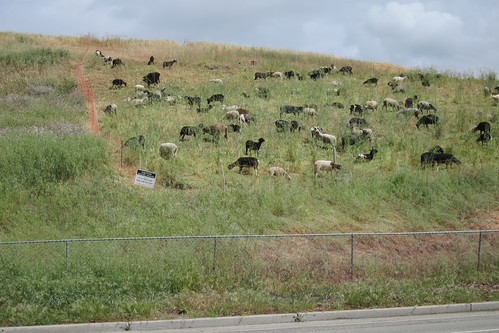
5 April 2013 – Goats even happen in in Palo Alto, California: herd clearing weeds (the fence sign says CAUTION / Electric Perimeter – Area Closed / Do Not Feed Goats / Keep Dogs on Leash):
IMG_6531

Images Copyright 2013 by Katy Dickinson

1 Comment

Filed under Mentoring & Other Business, News & Reviews

Phoenix Cities: Beirut and San Francisco

IMG_5150

Last Import-933

I was born and raised in San Francisco, a city destroyed in a major earthquake in 1906, whose flag symbol is the Phoenix – a mythic bird that arises from the ashes of its prior life. In SF, the ’06 quake is still a matter of common reference, over a hundred years later. Last week, I visited Beirut, Lebanon, a lovely and energetic city rebuilding itself after the devastating 15-year civil war which ended in 1990. Just as with San Francisco, Beirut seems determined to rise up again without forgetting or pretence. My daughter Jessica and I were visiting our friends from the U.S. State Department’s TechWomen mentoring program, and Al-Makassed (the Makassed Philanthropic Islamic Association of Beirut).

I grew up boating on Lloyd Lake in Golden Gate Park, which features the “Portals of the Past” – the white marble portico of an elegant Nob Hill house destroyed in 1906, donated to the park as a permanent remembrance of the great earthquake and fire. In Beirut, I saw a similar desire to honor and remember in the preservation of the Martyr’s Square statue, with its bullet holes unrepaired.

There are still many evidences of the Lebanese Civil War but as buildings are renewed or replaced, most blast marks and bullet holes will quietly disappear. Beirut displays evidence of its ancient Roman past – a visitor can see corinthian columns next to the downtown shopping area, a Roman bath near the government buildings, and old foundations preserved behind glass under a modern building. I respect the city’s desire to acknowledge and preserve its more recent history as well.

Last Import-828

Last Import-936

Last Import-923

Last Import-938

IMG_5423

Images Copyright 2012-2013 by Katy Dickinson

Leave a comment

Filed under Mentoring & Other Business, News & Reviews

Where We Stayed in Jordan and Lebanon

The TechWomen enjoyed some very good hotels while traveling in Jordan. My daughter Jessica and I were also pleased with our lodging in Beirut, Lebanon. In case you are headed there, here is where we stayed and also the names of our tour guides:

Hotels:

Four Seasons Hotel, Amman, Jordan
(5th Circle, Al-Kindi Street, Jabal Amman, Tel. +962 (6) 550-5555)
Last Import-9

Kepinski Hotel Ishtar – Dead Sea, Jordan
(Swaimeh, Dead Sea Road, P.O. Box 941806, 11194 Amman +962 5 356 8888)
IMG_3981

Phoenicia Hotel – Beirut, Lebanon
(P.O. Box 11, Beirut 846 Lebanon, Front Desk +961-1-369100)
IMG_5406

Tour Guides:

  • Michael Schuring, Amman, Jordan, Tel: +962 65 68 55 53
  • Natacha Asmar, Lebanon Tour Guide and Archaeologist, Tel: +961-3-476474, Syndicat Des Guides Touristiques Liban

Images Copyright 2013 by Katy Dickinson

2 Comments

Filed under Mentoring & Other Business, News & Reviews