Tag Archives: teaching

High School IEP – Individualized Education Program

We held my son Paul’s IEP today and I thought it might help other parents going through this annual special education ritual to read about it. Paul just finished his Sophomore (grade 10) year in High School here in the San Francisco Bay Area. An IEP or Individualized Education Program is a meeting and set of documents describing the interventions or accomodations which will support the unique educational needs of a particular disabled child. The IEP is essentially the record of what has happened during the prior year and what the school, teachers, parents, and child agree will help that child learn best within the school. (There are much more precise and complex ways to define an IEP, of course.) IEPs can be used in public or private schools. Paul attends public school.

Paul has had an IEP since about 2nd grade. When he was younger, the IEP focussed more on understanding and evaluating his disabilities and what services might help him. Now that Paul is almost 16, the IEP is more focussed on the resources and program needed to support Paul’s more-or-less understood educational, social, and cognitive challenges.

Once, when Paul was worried that his IEP accomodations were not fair and that taking advantage of them was like cheating, one of the school administrators explained to him that he had to work so much harder and longer hours than most students because of his disabilities, the accomodations were to level the playing field so that he could compete in the mainstream school. This made good sense to Paul.

This morning, after weeks of preliminary discussions, nine of us met for the IEP.  As he has matured, Paul himself has been increasingly consulted during his IEPs and he spoke at length several times during this meeting. We all left an hour and a half later with a twenty-ish page stack of papers but a short list of accomodations and course work for Paul’s 2008-2009 (Junior) year in High School. Here is what we signed off on:

    • Accomodations:
      1. Uses own laptop computer at school
      2. Access to school computer, printer access (while working at school)
      3. Extra time on exams and assignments, when pre-arranged with teacher
      4. Alternative setting for test taking, as needed (allowed same access
        to test instructions and question answering as other students taking that test)
      5. Possible that test can be read aloud if needed
      6. Classroom aide in English and History, transitional aide support in Geometry
      7. Homework log prepared by classroom aide
    • Classroom Aide’s Duties:
      1. Note taking assistance
      2. Collect papers distributed in class
      3. Facilitate turning in assignments
      4. Social diffusion (modeling)
      5. Completion of homework log
    • Tentative 2008-2009 Course Work:
      1. Geometry
      2. Ceramics
      3. English
      4. U.S. History
      5. Physical Education
      6. Study Skills (2 periods)

This year (2007-2008), Paul took one more solid subject (Biology) along with Math, Art, English, History, and P.E. but he had only one Study Skills period. We all decided that since Paul recently passed his High School exit exam and has almost completed his required courses for graduation, the stress of a 4th solid wasn’t worth it. We will find out in August which teachers are assigned to these classes and how Paul’s schedule works out in detail.
Leave a comment

Filed under Home & Family, News & Reviews

Living in a Cat World

15 March 2010: More on this topic is in the blog entry “Transitions for Young Adults with Neurocognitive Deficits”

Yesterday, my daughter Jessica published a wonderful blog post called Some things that work about a superb teacher, Linda Herreshoff. Linda was my son’s teacher for three years at Jordan Middle School in the Palo Alto Unified School District. Linda’s class is full of kids like Paul, who have social-cognitive challenges often diagnosed with an Autism Spectrum label, like: Asperger’s syndrome, high functioning Autism, Non-Verbal Learning Disorder, or Pervasive Developmental Disorder – Not Otherwise Specified (PDD-NOS). Almost all of Linda’s kids are boys who are smart or very smart and have parents who will not give up. Paul matured and learned and thrived in Linda’s class as never before. Her love, wisdom, teaching skill, and patience are awesome.

Part of Jessica’s blog post was a reference to the Liller Family Blog Entry on Asperger’s Syndrome, which starts off with this excellent summary:

Most children live in a dog world: A dog loves to be around people and socially interact with them. They willingly show affection, and follow their master’s commands. They also love to play and hang around other dogs no matter what activity their engaged in.

Asperger’s children live in a cat world: A cat is generally a loner. They prefer doing things their own way and like/need their solitude. Cats come to people on their own terms in their own time and they aren’t very social unless they choose to be. They have a routine and like to stick to it. They have one interest at a time (usually that silly piece of string they love to paw at). And when backed into a corner, a cat will lash out.

Paul is almost six feet tall now and just about done with his Sophomore year in High School. We were thrilled today to hear that he has just passed the California High School Exit Exam (CAHSEE). (Paul will be in High School for two more years. He took the CAHSEE this year just in case he needed several tries to pass it.) During our family dinner tonight celebrating Paul’s passing the CAHSEE, John and Jessica and Paul and I made a list of benefits and disadvantages of Paul’s social-cognitive challenges. As you will see, the two are almost mirror images of each other:

  • Benefits
    • Completely unaware of peer pressure
    • Amazing ability to concentrate
    • Generous, loving, and much given to small acts of meaningful kindness
    • Believes in long-term commitment, dedicated and loyal
    • Fastidious
    • Doesn’t lie well
    • Good sense of direction, sequencing, and paths
    • Loves ritual
    • Good at card and board games because he remembers all of the rules and the details of play
  • Disadvantages
    • Perseverant, stubborn, hard to influence
    • Gets stuck emotionally – sometimes needs help to move on
    • Can’t organize things – homework or papers or his room
    • Finds change difficult
    • Slow to mature
    • Extremely literal
    • Holds grudges with a very long memory
    • Does not take tests well
    • Follows all of the rules and expects everyone else to also

Of course, some of these behaviors sound like any teenage boy… (Also, Jessica says she treats all of her Engineering friends like they have Asperger’s and this works very well.)

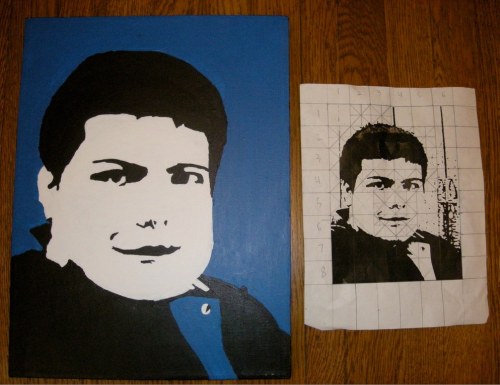
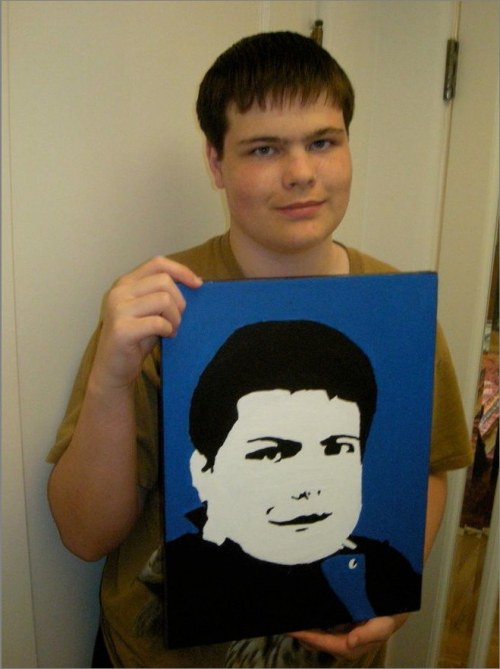
Paul has been enjoying taking Art this year. Here he is with his new self-portrait.
2 July 2020 update: see Paul’s art portfolio on Paulselement
Paul's portrait and planning sheet photo: copyright 2008 Katy Dickinson

Paul and his portrait photo: copyright 2008 Katy Dickinson

Images Copyright 2008 by Katy Dickinson

29 Dec 2016 – Links Updated

2 Comments

Filed under Home & Family

1782 William Crawford, Simon Girty, and History

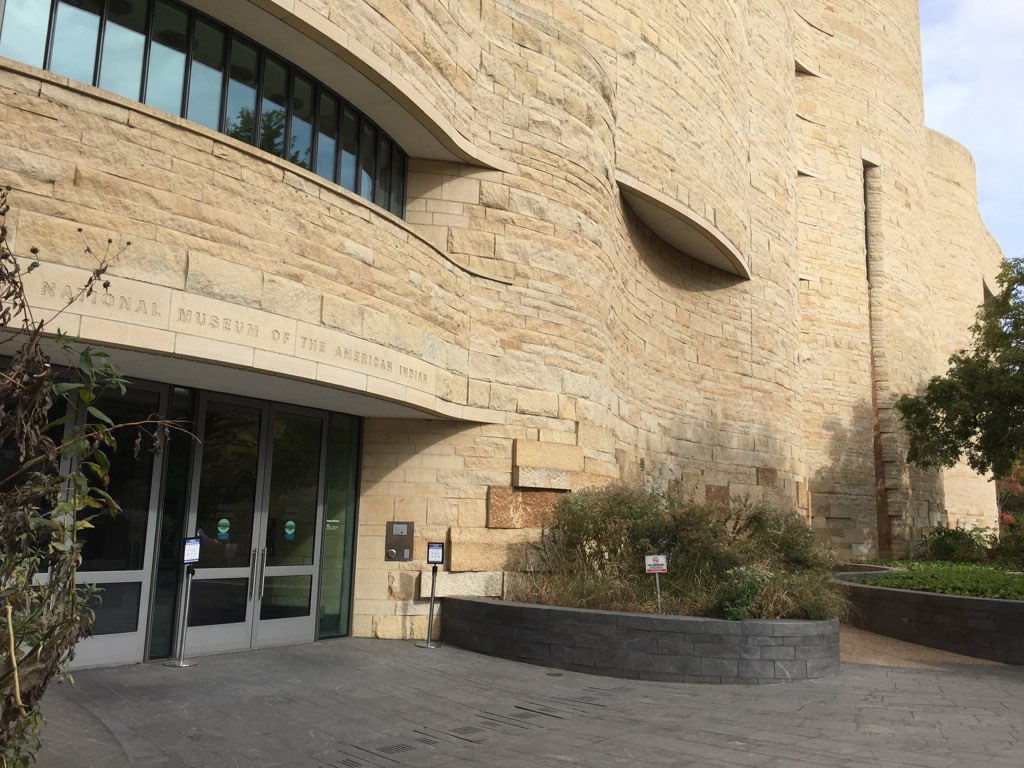
National Museum of the American Indian 2017


Last month
when I visited Washington, D.C. for the first time in many decades, I toured the National Museum of the American Indian, opened as part of the Smithsonian Institution in 2004. It seemed to me that one way of understanding more about the complex relationship between the European/American cultures and the American Indian cultures was to read reports from individuals who had personally experienced both. In the museum store, I bought two books:

    • Women’s Indian Captivity Narratives, Editor: Kathryn Zabelle Derounian-Stodola, Penguin Classics, 1998, ISBN-10: 0140436715, ISBN-13: 978-0140436716
    • Captured by the Indians: 15 Firsthand Accounts, 1750-1870, Editor: Frederick Drimmer, Dover Publications, 1985, ISBN-10: 0486249018, ISBN-13: 978-0486249018

In these books, I was interested to read for the first time about the death by burning in 1782 of General George Washington’s friend, Colonel William Crawford. This disturbing story was told in:

    • “That is Your Great Captain” by Dr. John Knight, 1783 (in Captured by the Indians)
    • “To Eat Fire Tomorrow” by John Slover as told to Hugh H. Brackenridge, 1782 (in Captured by the Indians)
    • “A Narrative of the Life of Mary Jemison” by James E. Seaver, 1824 (in Women’s Indian Captivity Narratives)

Knight and Slover were captured with Crawford after Crawford’s failed expedition against the Ohio Indians (Wyandot, Huron, Delaware, and Shawnee tribes). Knight and Mary Jemison’s husband Hiokatoo (of the Seneca tribe) were witnesses to Crawford’s death; Slover was told of it by his captors.

Trying to sort out what happened by reading these memorable accounts is a good exercise in detection and understanding the difficulties of History even when first-hand accounts are available. For example, a major participant in Crawford’s violent death was Simon Gurty (or Girty). Gurty is described in a footnote in Women’s Indian Captivity Narratives as “…a Pennsylvania adventurer who… alternated allegiance between the Americans and the British, aiding the latter during the War of 1812”.

Here are two accounts of the same exchange between Gurty and the dying Crawford:

    • “The flames arose and the scorching heat became almost insupportable. Again [Crawford] prayed to Gurty in all the anguish of his torment, to rescue him from the fire, or shoot him dead upon the spot. A demoniac smile suffused the countenance of Gurty, while he calmly replied to the dying suppliant, that he had no pity for his sufferings; but that he was then satisfying the spirit of revenge, which for a long time he had hoped to have an opportunity to wreak upon him.” (Mary Jemison retelling Hiokatoo’s story)
    • “In the midst of these extreme tortures [Crawford] called to Simon Girty and begged him to shoot him. Girty made no answer. He called to him again. Girty, by way of derision, told the colonel he had no gun. At the same he turned to an Indian who was behind him, laughed heartily, and by all his gestures seemed delighted at the horrid scene.” (John Knight telling what he witnessed)

In seeking more information about these stories, I found yet another version of this exchange:

    • “Overcome by agony, Crawford cried out, ‘Girty! Girty! For God’s sake, Girty, shoot me through the heart!’ The raucous din grew ominously silent as all eyes came to rest on the man called Girty. After a moment of introspection, he rose from his seated position by the fire and strode to where Crawford lay sobbing. ‘I cannot,’ Girty replied softly. ‘As you can see, I have no gun.’ Turning away from Crawford’s mangled figure, Girty grinned at the onlookers and belched forth a sinister giggle.”
    • From: “A Monster So Brutal: Simon Girty and the Degenerative Myth of the American Frontier, 1783-1900″. Volume Forty, 1998 Essays in History, Published by the Corcoran Department of History at the University of Virginia. by Daniel P. Barr, Kent State University.

While Gurty is clearly the villain in all three story versions, there are also differences in both specifics and style. The “Monster So Brutal” story version purports to be a retelling of Knight’s and Slover’s accounts – with no reference to Mary Jemison version of Hiokatoo’s story. However, the “Monster So Brutal” story is very exaggerated and includes details I do not find in the first hand accounts. “A Monster So Brutal” also says that Slover was an eyewitness to Crawford’s death. Slover’s account in Captured by the Indians just says “At this time I was told that Colonel Crawford had been burnt…”. Maybe there is more than one version of Slover’s story?

Having read these books, I have a greater appreciation for the complexity of this early period of American history and the interactions of the Indian, British, French, and American cultures. It is certainly more exciting than I remember from my required American History courses in High School and college!

25 Jan 2008: original blog post,
27 Feb 2021: formatting updated, photo added

If you want to receive Katysblog posts by email, please sign up using the Sign Me Up! button (upper right on Katysblog home). Image Copyright 2017 by Katy Dickinson.

1 Comment

Filed under News & Reviews, Politics

Peninsula School – A Successful Alternative

Jessica.2002

My daughter Jessica is almost done with her first Freshman semester at university. She is very happy and seems to be thriving. Over Thanksgiving, she and five school friends celebrated together by cooking meals for each other at a hotel in Washington, D.C. and playing cards when not cooking or touring the nation’s capital. All of them were California kids who now attend Eastern colleges. Washington D.C. was a convenient meeting place for those who did not go west for the break.

It interested me that four of those who gathered were Jessica’s friends from Peninsula School (Menlo Park, CA), and only one was a High School friend. Jessica attended Peninsula School from age three through 8th grade. Her group called itself the Uns (since they were in neither the Boys’ group nor the Girls’). The bonds of comradery, communication, and trust formed by the Uns from the time they were barefoot little kids making mud pies together in Nursery Blue seem to be holding firm despite the High School and college diaspora. The Uns are still cooking together, using the skills they developed through many class camping trips with Peninsula School. From reading their blogs, these are capable and interesting young adults whose progress I admire.

Peninsula School is a “progressive” or “alternative” school, meaning their focus is on development rather than grades. (Jessica calls Peninsula her “hippie school”.) In fact, Jessica did not get formal grades or take tests until she was in 8th grade and applying to High School. Nonetheless, she was regularly awarded high honors at Harker High School (she was entered into the Cum Laude Society) and is flourishing at Carnegie Mellon University where she is in the Humanities Scholars program and several CMU concert choruses.

With so many schools now teaching to the test and being obsessed with grades from the earliest grammar school years, Peninsula School is a good example of a better way. It is not a perfect choice but no school is. For example, Peninsula was as much the wrong choice for our son (who has serious learning disabilities) as it was a great choice for our daughter. Even though Peninsula was an excellent school for Jessica, it took several years for her Math knowledge to catch up to Harker’s standards. (She is taking Calculus II at CMU next semester.)

Perhaps one of the hardest parts of being a Peninsula parent for 11 years was my quiet fear that Peninsula might be too much of an academic risk. That is, I shared a concern with some other parents that our children would not do well in more conventional schools. However, if my daughter’s Peninsula School class is a representative (if small) example, Peninsula kids can compete very successfully in both standard and world-class rigorous academic environments.

Peninsula School is not the only successful alternative school. There were at least two kids in Jessica’s Harker class who came to the prep school with a very different point of view. Jessica came from Peninsula and her best friend at Harker came from Ananda Living Wisdom school. It was interesting to see how both girls succeeded in the grade-conscious pressure cooker environment of Harker School. Despite their alternative school origins, both girls did well academically and were accepted into good colleges (Carnegie Mellon and U.C. Berkeley). Better still, neither has lost her creative flair, curiosity, or independence.

I was not sure if it was just these two girls who had blossomed from non-standard seed beds until I put together a list of where Jessica’s Peninsula School classmates ended up after High School. From what I can tell, the whole class is now in college:

    • Academy of Art University (San Francisco)
    • Bard College (Annandale-on-Hudson, NY)
    • California College of the Arts (San Francisco and Oakland, CA)
    • Carnegie Mellon University (Pittsburgh, PA)
    • Colorado College (Colorado Springs, CO)
    • Foothill College (Los Altos Hills, CA) 2 going
    • Portland State (Portland, OR)
    • Rensselaer Polytechnic Institute (RPI, Troy, NY)
    • Stanford University (Stanford, CA) 2 going
    • Swarthmore College (Swarthmore, PA)
    • University of California at Berkeley (Berkeley, CA)
    • University of California at Davis (Davis, CA) 2 going
    • University of California at Santa Cruz (Santa Cruz, CA) 3 going
    • Wesleyan (Middletown, Connecticut)

Pretty good for graduates of a “hippie school”!

Update: Jessica was graduated in 2012 from Carnegie Mellon University in Pittsburgh PA, with college and university honors, Phi Beta Kappa.
More on her class: Peninsula School – Grads Doing Well (9 May 2013).

Pictured are Jessica’s 8th grade school play: The Mouse that Roared, and Jessica selling the jewelry she designed.

Jessica.2002.MousePlayPeninsulaSchool

Jessica.JewelryPeninsulaSchool.2002

Images Copyright 2002 by John Plocher

1 Comment

Filed under Home & Family, News & Reviews

Singing Competition – CMEA

Today was a big day for Jessica, my 18-year-old daughter. She checked the web site and was happy to find out that Smith College has accepted her application. We have now heard back from 3 of the 9 colleges to which Jessica applied. (University of Rochester also accepted her, MIT alas said no.) We will hear from the remainder by 2 April. It is a long and difficult wait.

Also, John and Jessica and I just got back from the CMEA (California Association for Music Education) Solo & Ensemble Festival at San Jose State Univ., that is: a musical performance competition. Jessica was the last singer today. She sang an aria in Russian from Nicolai Rimsky-Korsakov’s The Czar’s Bride and was awarded the highest rating of “Superior” along with a Command Performance. The judge said Jessica’s was the only Command Performance he awarded today!

Susan Nace (Harker’s superb music teacher and the director for Cantilena, Harker’s Upper School Women’s Choir) accompanied Jessica on piano. We are very proud of Jessica and continue to be delighted with the excellent music education and support provided by Ms. Nace.

2 Comments

Filed under Home & Family

Athletics and Disabilities

Today starts my son’s 2nd week participating in track and field as a Freshman in High School. Since Paul has a rich variety of learning disabilities
(social/cognitive, dyslexia, dysgraphia, etc.), sports is one of his hardest school subjects. Paul’s disabilities aren’t visible – he is a tall, hefty, and smart – which causes problems when he does not respond as expected. He went out for track and field because one of the coaches is also his Math teacher. They get along well and Math is Paul’s best subject. We hope that having a coach who already understands Paul will help him stay with running.

Paul was on the wrestling team in 8th grade last year. His team mates wrestled to win but Paul wrestled to learn how to be on a regular sports team. He set himself goals for his matches like: 1) don’t quit, 2) don’t bleed. Paul’s approach has much in common with the Athlete Oath for the Special Olympics:

    Let me win. But if I cannot win,
    let me be brave in the attempt.

It has been raining hard all afternoon but the coach told Paul last week that “Neither rain, nor sleet, nor snow, nor hail…”* will stop training runs. I just talked to Paul on the phone and he said he was “wet, wet, wet, wet, wet,” after running for hours in the rain. But he stuck it out!

* motto used by the U.S. postal service, adapted from Herodotus

1 Comment

Filed under Home & Family

On Getting Paid, and Novels

One of my favorite books for good writing and good story telling both is Herman Melville‘s Moby Dick. Here is Ishmael in Chapter I on getting paid:

    Again, I always go to sea as a sailor, because they make a point of paying me for my trouble, whereas they never pay passengers a single penny that I ever heard of. On the contrary, passengers themselves must pay. And there is all the difference in the world between paying and being paid. The act of paying is perhaps the most uncomfortable infliction that the two orchard thieves entailed upon us. But being paid, — what will compare with it? The urbane activity with which a man receives money is really marvellous, considering that we so earnestly believe money to be the root of all earthly ills, and that on no account can a monied man enter heaven. Ah! how cheerfully we consign ourselves to perdition!

I find that most of my favorite books are novels even though the novel as a literary form was not always well thought of in 1851 when Moby Dick was published. Here is Jane Austen, another of my favorite authors, writing with her usual grace on that subject:

    Northanger Abbey, 1818The progress of the friendship between Catherine and Isabella was quick as its beginning had been warm; and they passed so rapidly through every gradation of increasing tenderness, that there was shortly no fresh proof of it to be given to their friends or themselves. They called each other by their Christian name, were always arm-in-arm when they walked, pinned up each other’s train for the dance, and were not to be divided in the set; and, if a rainy morning deprived them of other enjoyments, they were still resolute in meeting in defiance of wet and dirt, and shut themselves up to read novels together. Yes, novels; for I will not adopt that ungenerous and impolitic custom, so common with novel writers, of degrading, by their contemptuous censure, the very performances to the number of which they are themselves adding: joining with their greatest enemies in bestowing the harshest epithets on such works, and scarcely ever permitting them to be read by their own heroine, who, if she accidentally take up a novel, is sure to turn over its insipid pages with disgust. Alas! If the heroine of one novel cannot be patronised by the heroine of another, from whom can she expect protection and regard?

Leave a comment

Filed under News & Reviews