Tag Archives: teaching

Caboose Clinic: The Adventures of WP668

P1110880

I presented a “Caboose Clinic” to the Coast Division of the National Model Railroad Association on 8 December 2013 in San Leandro, California. The title of my talk was “The Adventures of WP668 1916-2013: Buying and Restoring a Western Pacific Caboose”. You can see additional information about the backyard caboose in which I have my office on WP668’s web page: http://wp668.org. About forty guys and one woman attended my clinic. I was glad that they asked so many questions and seemed to have a good time.

As always, my thanks and appreciation to all who have made WP668’s long adventures possible, especially:

WP668 today:
P1120032

WP668 in active service, 1971:
Used with permission of Don Marenzi
WP668.CannonCA.DonMarenzi.1971

Images Copyright 1971 by Don Marenzi, and 2013 by Katy Dickinson and John Plocher

Leave a comment

Filed under Caboose Project and Other Trains, Home & Family, News & Reviews

Honoring Nelson Mandela

P1110799

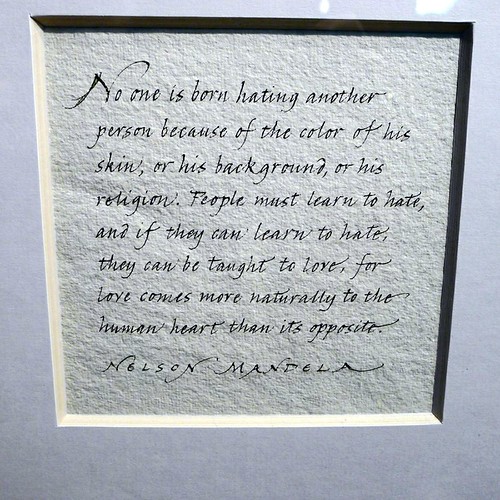
Working on my Christmas shopping, late Friday I made my annual trip to the Artifactory Holiday Fair craft sale at Hoover House in Palo Alto. I was touched to see that Inja (of Inja Ink Calligraphy) had stopped her other work to write out a  Nelson Mandela quote on the day he died. The new piece was on display for consideration and honor, not for sale.

“No one is born hating another person because of the color of his skin, or his background, or his religion. People must learn to hate, and if they can learn to hate, they can be taught to love, for love comes more naturally to the human heart than its opposite.”

I had been feeling sad at the passing of a hero and role model.  Inja’s gentle tribute lifted my heart.

P1110800

Images Copyright 2013 by Katy Dickinson

1 Comment

Filed under News & Reviews

Paul Applying to San Jose State University

P1090446

I am delighted to write that my son Paul is finishing up his last year at Foothill College and applying to transfer to San Jose State University (SJSU) in 2014. In addition to studying Studio Art, Paul is interested in becoming a credentialed art teacher for children with disabilities. Samples of his art are below – with more in his online portfolio: Paul’s Element.

Raising a kid with disabilities is a challenge and I am proud of Paul and of our whole family for his successful progress. Paul has been blessed with some remarkable and excellent teachers – to whom I am forever grateful:

Paul also had more than his share of poor teachers but we survived them. I only ask that they and…

  • …the teachers who did not want disabled kids like Paul in their class:
  • …the administrators who told us that Paul would be lucky to get to college:
  • …the head of school who kicked Paul out because his disabilities were bringing down her scores:
  • …the career counsellors who took Paul and the other disabled kids on a tour of the sewer plant:

Please consider this…

Jane Goodall went in the back door to become an ethologist. That’s something I’ve thought about a lot, because people with autism usually have to go in the back door. We have a lot of trouble following the normal paths. We don’t do very well in interviews, which are a big problem for us, and a lot of autistic people also have extremely “uneven” academic skills. An autistic person can test at the bottom of the IQ range on one subscale and at the very top on another. For example, I had great difficulty with algebra because there’s no way to visualize it.  I couldn’t be doing what I’m doing if there weren’t any back doors.

Dr. Temple Grandin, 2009
In 2010, Dr. Temple Grandin was listed in the Time 100 list of the 100 most influential people in the world in the “Heroes” category.

Wish Paul luck in being accepted!  We will hear back from SJSU by March 2014.

P1040537

P1040549

IMG_2360

P1080880

Images Copyright Katy Dickinson and Paul D. Goodman 2011-2013

6 Comments

Filed under Home & Family, News & Reviews

Grace Hopper Conference – GHC13

P1080013

I came home yesterday after an inspiring day at the Grace Hopper Celebration of Women in Computing.  I joined 4,600 other technical women at the sold-out GHC13 in Minneapolis, MN.  My GHC13 day started at 6:30 am switching my bag to a downtown hotel (all hotels near the convention center were sold out for the day I arrived), then to breakfast hosted by Facebook Chief Operating Officer Sheryl Sandberg, followed by a keynote panel with Maria Klawe (President, Harvey Mudd College), Sheryl Sandberg, and Telle Whitney (President, Anita Borg Institute).  Then,  Trish Tierney (of the Institute of International Education) and I presented on “Empowering Technical Women Through Global Mentoring” and later I presented a poster on the “Lifetime Value of Mentoring“.  My daughter Jessica Dickinson Goodman also presented her poster on “The Arduino Dress“. The poster next to mine was “Girl Scouts: An Analysis of STEM Activities and a Call to Action” by Maria Ebling of IBM Research. Jessica and I got back to our hotel room by 10 pm with bags of loot and tshirts from GHC’s wonderful sponsor companies, universities, and organizations.

I flew back to the Bay Area yesterday in time to have dinner with my new TechWomen mentee from Algeria. She and I are going to another event together tonight and plan to tour San Francisco this weekend, as well as seeing the musical 1776 at the American Conservatory Theater.

P1080006 . P1080004

P1080029

P1080031

P1080046

P1080086

Images Copyright 2013 by Katy Dickinson

Leave a comment

Filed under Home & Family, Hopper - Anita Borg Institute, Mentoring & Other Business, News & Reviews

Book Distributed

P1070462

I am delighted that Triangular Partnership: the Power of the Diasporathe pre-publication review edition of the 160 page book I edited has been published and distributed today, including my chapter on professional mentoring. Here I am with Dr. Enawgaw Mehari, Founder and President of the People to People (P2P) organization  and Dr. Kinfe Gebeyehu, Vice President of P2P, at the 5th Annual Global Ethiopian Diaspora Conference on Health Care and Medical Education, in Washington D.C.  About a dozen of the chapter authors attended the conference so I asked them to sign my copy.

P1070464

Images Copyright 2013 by Katy Dickinson

19 October 2019: Links Updated.

1 Comment

Filed under Mentoring & Other Business, News & Reviews

Lifetime Value of Mentoring

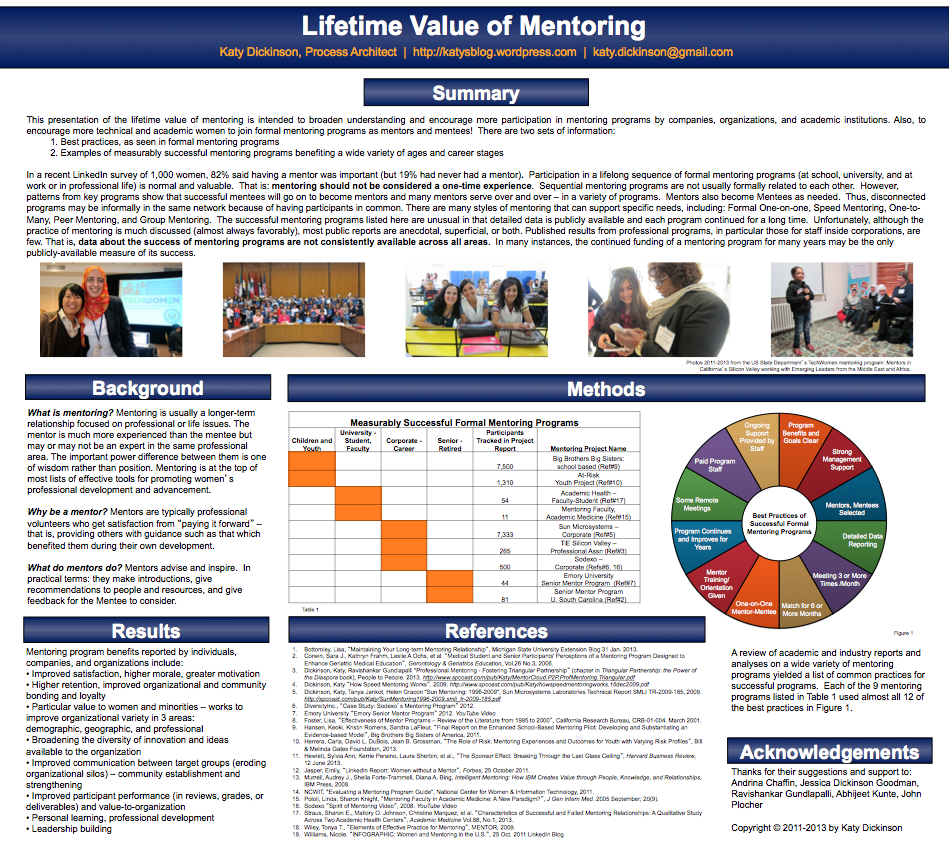
Hopper Conference poster by Katy Dickinson GHC13 mentoring poster 2013

I am almost done with my Grace Hopper Celebration of Women in Computing poster on “Lifetime Value of Mentoring“, to be presented next week. GHC13 is sold out again – as it has been every year since at least 2009! I am very much looking forward to attending next week.  My daughter Jessica Dickinson Goodman will be presenting her own GHC13 poster.

In addition to the poster, Trish Tierney (Executive Director of the Institute of International Education in San Francisco) and I are presenting a SOL (Student Opportunity Lab) on “Empowering Technical Women Through Global Mentoring”. The material of this GHC13 SOL was developed in collaboration with four TechWomen co-presenters from the Middle East who regretfully are unable to attend this SOL in person. Thanks to Sukaina Al-Nasrawi of Lebanon and Maysoun Ibrahim of Palestine (TechWomen Inaugural Class 2011), Adla Chatila of Lebanon and Heba Hosny of Egypt (TechWomen Class 2012) for their welcome support and valuable advice.

Since the poster is large (40″ x 36″) and the image font above is small, here is the text so far for my poster:

Summary

This presentation of the lifetime value of mentoring is intended to broaden understanding and encourage more participation in mentoring programs by companies, organizations, and academic institutions. Also, to encourage more technical and academic women to join formal mentoring programs as mentors and mentees! There are two sets of information:

  1. Best practices, as seen in formal mentoring programs
  2. Examples of measurably successful mentoring programs benefiting a wide variety of ages and career stages

In a recent LinkedIn survey of 1,000 women, 82% said having a mentor was important (but 19% had never had a mentor). Participation in a lifelong sequence of formal mentoring programs (at school, university, and at work or in professional life) is normal and valuable. That is: mentoring should not be considered a one-time experience. Sequential mentoring programs are not usually formally related to each other. However, patterns from key programs show that successful mentees will go on to become mentors and many mentors serve over and over – in a variety of programs. Mentors also become Mentees as needed. Thus, disconnected programs may be informally in the same network because of having participants in common. There are many styles of mentoring that can support specific needs, including: Formal One-on-one, Speed Mentoring, One-to-Many, Peer Mentoring, and Group Mentoring. The successful mentoring programs listed here are unusual in that detailed data is publicly available and each program continued for a long time. Unfortunately, although the practice of mentoring is much discussed (almost always favorably), most public reports are anecdotal, superficial, or both. Published results from professional programs, in particular those for staff inside corporations, are few. That is, data about the success of mentoring programs are not consistently available across all areas. In many instances, the continued funding of a mentoring program for many years may be the only publicly-available measure of its success.

Background

What is mentoring?

    Mentoring is usually a longer-term relationship focused on professional or life issues. The mentor is much more experienced than the mentee but may or may not be an expert in the same professional area. The important power difference between them is one of wisdom rather than position. Mentoring is at the top of most lists of effective tools for promoting women’s professional development and advancement.

Why be a mentor?

    Mentors are typically professional volunteers who get satisfaction from “paying it forward” – that is, providing others with guidance such as that which benefited them during their own development.

What do mentors do?

    Mentors advise and inspire.  In practical terms, Mentors make introductions, give recommendations to people and resources, and give feedback for the Mentee to consider.

Results

Mentoring program benefits reported by individuals, companies, and organizations include:

  • Improved satisfaction, higher morale, greater motivation
  • Higher retention, improved organizational and community bonding and loyalty
  • Particular value to women and minorities – works to improve organizational variety in 3 areas: demographic, geographic, and professional
  • Broadening the diversity of innovation and ideas available to the organization
  • Improved communication between target groups (eroding organizational silos) – community establishment, strengthening
  • Improved participant performance (in reviews, grades, or deliverables) and value-to-organization
  • Personal learning, professional development
  • Leadership building

References

  1. Bottomley, Lisa, “Maintaining Your Long-term Mentoring Relationship”, Michigan State University Extension Blog 31 Jan. 2013.
  2. Corwin, Sara J., Kathryn Frahm, Leslie A Ochs, et al. “Medical Student and Senior Participants’ Perceptions of a Mentoring Program Designed to Enhance Geriatric Medical Education”, Gerontology & Geriatrics Education, Vol.26 No.3, 2006.
  3. Dickinson, Katy, Ravishankar Gundlapalli “Professional Mentoring – Fostering Triangular Partnership” (chapter in Triangular Partnership: the Power of the Diaspora book), People to People, 2013. http://www.spcoast.com/pub/Katy/MentorCloud.P2P.ProfMentoring.Triangular.pdf
  4. Dickinson, Katy “How Speed Mentoring Works”, 2009. http://www.spcoast.com/pub/Katy/howspeedmentoringworks.16dec2009.pdf
  5. Dickinson, Katy, Tanya Jankot, Helen Gracon “Sun Mentoring: 1996-2009”, Sun Microsystems Laboratories Technical Report SMLI TR-2009-185, 2009. http://spcoast.com/pub/Katy/SunMentoring1996-2009.smli_tr-2009-185.pdf
  6. DiversityInc., “Case Study: Sodexo’s Mentoring Program” 2012.
  7. Emory University “Emory Senior Mentor Program” 2012. YouTube Video
  8. Foster, Lisa, “Effectiveness of Mentor Programs – Review of the Literature from 1995 to 2000”, California Research Bureau, CRB-01-004. March 2001.
  9. Hansen, Keoki, Kristin Romens, Sandra LaFleur, “Final Report on the Enhanced School-Based Mentoring Pilot: Developing and Substantiating an Evidence-based Model”, Big Brothers Big Sisters of America, 2011.
  10. Herrera, Carla, David L. DuBois, Jean B. Grossman, “The Role of Risk: Mentoring Experiences and Outcomes for Youth with Varying Risk Profiles”, Bill & Melinda Gates Foundation, 2013.
  11. Hewlett, Sylvia Ann, Kerrie Peraino, Laura Sherbin, et al., “The Sponsor Effect: Breaking Through the Last Glass Ceiling”, Harvard Business Review, 12 June 2013.
  12. Jasper, Emily, “LinkedIn Report: Women without a Mentor”, Forbes, 25 October 2011.
  13. Murrell, Audrey J., Sheila Forte-Trammell, Diana A. Bing, Intelligent Mentoring: How IBM Creates Value through People, Knowledge, and Relationships, IBM Press, 2008.
  14. NCWIT, “Evaluating a Mentoring Program Guide”, National Center for Women & Information Technology, 2011.
  15. Pololi, Linda, Sharon Knight, “Mentoring Faculty in Academic Medicine: A New Paradigm?”, J Gen Intern Med. 2005 September; 20(9).
  16. Sodexo “Spirit of Mentoring Video”, 2008. YouTube Video
  17. Straus, Sharon E., Mallory O. Johnson, Christine Marquez, et al. “Characteristics of Successful and Failed Mentoring Relationships: A Qualitative Study Across Two Academic Health Centers”, Academic Medicine Vol.88, No.1, 2013.
  18. Wiley, Tonya T., “Elements of Effective Practice for Mentoring”, MENTOR, 2009.
  19. Williams, Nicole. “INFOGRAPHIC: Women and Mentoring in the U.S.”, 25 Oct. 2011 LinkedIn Blog

Images Copyright 2011-2013 by Katy Dickinson
Updated 15 May 2018

1 Comment

Filed under Hopper - Anita Borg Institute, Mentoring & Other Business, News & Reviews

American Association of University Women – AAUW San Jose

P1060792

This weekend, I became a member of the San Jose branch of the American Association of University Women – AAUW. I was honored to give a presentation about mentoring at the national AAUW meeting in New Orleans in June and have continued to be impressed by the effective and interesting work of this venerable organization. Newly-elected Santa Clara County Supervisor Cindy Chavez joined the San Jose branch the same day I did – that’s her photo above. I am also a member of the California On-line AAUW branch.

Patrick Schmitt (Chancellor at the West Valley-Mission Community College District) gave a excellent talk about the future of higher education. He predicted that in 30 years, the higher education model will be “bespoke” – customized and driven by student success and student-focused measures. This reminded me of the future presented in Neal Stephenson’s remarkable novel Diamond Age. AAUW San Jose also awarded tech-camp and college scholarships to over a dozen young women at the meeting.

P1060786

P1060803

Images Copyright 2013 by Katy Dickinson

1 Comment

Filed under Mentoring & Other Business, News & Reviews