Tag Archives: teaching

Prayers from Jail

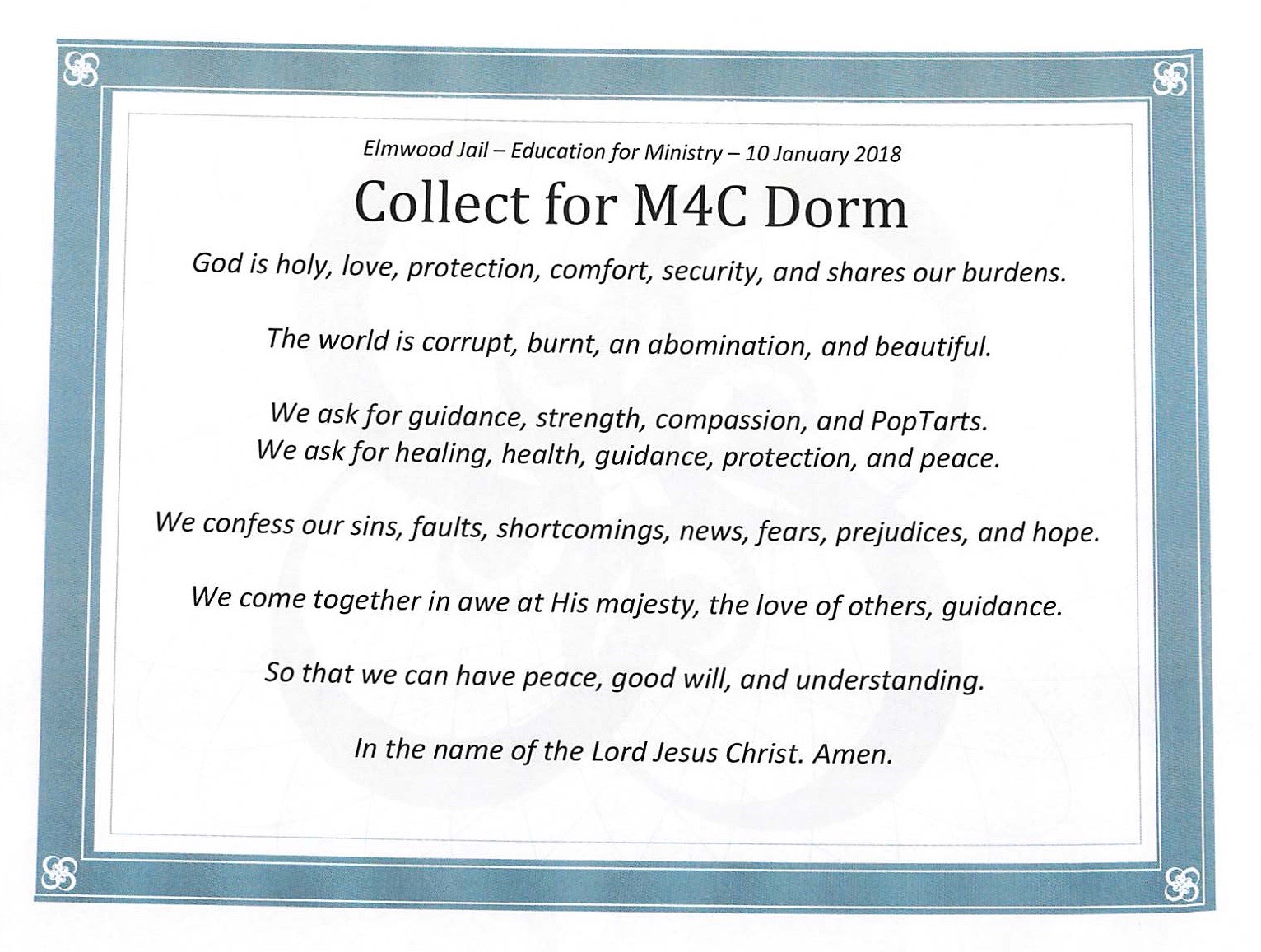
Collect for Elmwood Jail M4C Dorm 10 Jan 2018

In Week 16 of our Education for Ministry (EfM) 36 week seminar, the students write a Collect together. A collect is a prayer meant to gather the intentions of the people and the focus of worship into a succinct prayer. In the Week 16 exercise, EfM prompts us with the first few words of each line and the students fill in the rest. By writing their own Collect, students learn the difference between kinds of prayer: Petition, Intercession, Penitence, Thanksgiving, and Adoration.

I lead three EfM seminars a week, two at at Elmwood Jail in Milpitas and the third at St. Andrew’s Episcopal Church (all in the Silicon Valley). My Co-Mentors Joel and Diane and Karen and I are all Accredited Mentors.  After each group wrote their own Collect, I read them the prayers written by the others.

Here are the three Collects:

Collect from Elmwood M4C Dorm EfM Class

God is holy, love, protection, comfort, security, and shares our burdens.

The world is corrupt, burnt, an abomination, and beautiful.

We ask for guidance, strength, compassion, and PopTarts.

We ask for healing, health, guidance, protection, and peace.

We confess our sins, faults, shortcomings, news, fears, prejudices, and hope.

We come together in awe and wonder at His majesty, the love of others, guidance.

So that we can have peace, good will, and understanding.

In the name of the Lord Jesus Christ.
Amen.

Collect from Elmwood M2B Dorm EfM Class

God is wonderful, loving, father, strong, life.

The world is a mess, suffering, needing peace, capable.

We ask for peace, mercy, love, hope, freedom, safety, protection.

We ask for food for the hungry, a house for the homeless, peace for those in war-torn countries, and health for the unhealthy.

We confess sin, misgivings, our love, ignorance – lack of knowledge.

We give thanks for life, families, safety, health, our EfM Mentors, friendships, and Honey Bun pastry.

We come together in awe and wonder at new learning, every day, God’s presence at Elmwood Jail.

So that we can have love, understanding, faithfulness.

In the name of Jesus.
Amen.

Collect from St. Andrew’s EfM Class

God is love, healer, generous, compassionate.

The world is sick, poor, in need, progressive.

We ask for health, healing, open hearts and minds.

We ask for abundance for the poor, courage for leaders, wholeness for the sick.

We confess our prejudice, limitations, slowness.

We give thanks for those who came before us, healers, saints, new babies and parents, courageous leaders.

We come together in awe and wonder at a new year, God’s presence in our lives, grace.

So that we can be fearless, and the sick will be comforted.

In the name of our healing Father.
Amen.

This jail-based EfM program is supported by the Correctional Institutions Chaplaincy, the Episcopal Diocese of El Camino Real, St. Andrew’s Episcopal Church (Saratoga, California), and the University of the South – School of Theology.

If you want to receive Katysblog posts by email, please sign up using the Sign Me Up! button (upper right).

1 Comment

Filed under Church, Mentoring & Other Business

Postcast Interview

Katy Dickinson Sun Microsystems badge 398 in 2010

I very much enjoyed being interviewed by Akshay Birla for his “Life of the Mind” podcast last month. He just published the interview as “Episode 19 | Katy Dickinson on Technology, Mentoring, and Religion”.

Katy Dickinson has been around the tech-block. Hired by Eric Schmidt at Sun Microsystems, she literally wrote the book on the software development lifecycle that Sun used for release of almost 10,000 releases. She is a technologist, entrepreneur, mentor, and writer.

In our conversation Katy talks about her work as a technologist on creating processes:
A process has to not assume that you have world-class people working on it. A process assumes that that not everybody — while they are good-intentioned and competent — [is] perfect. You have to have a system that allows for lack of perfection but can work if you have the best that there is.

and the futility of only having excellent coders:
A good coder is a wonderful thing to have but you have to create something that the customer wants and feels comfortable with. Good coding and user experience are sometimes at odds.

But we spend the most of our conversation talking about mentoring programs that deliver high return-on-investment, and the intersection of religion and technology.

On the importance of example and networking provided by the Grace Hopper Celebration:
While they may be the only women in the room – which has certainly been my experience in 30+ years in the Silicon Valley – there are a lot of rooms.

Listening to your own recorded voice is always surprising – it sounds so different from the inside!

Happy New Year!

Sun Microsystems gate Menlo Park California in 2010

If you want to receive Katysblog posts by email, please sign up using the Sign Me Up! button (upper right).

Leave a comment

Filed under Church, Hopper - Anita Borg Institute, Mentoring & Other Business, Mentoring Standard, News & Reviews

What is Bad About Jail, What is Good About Jail

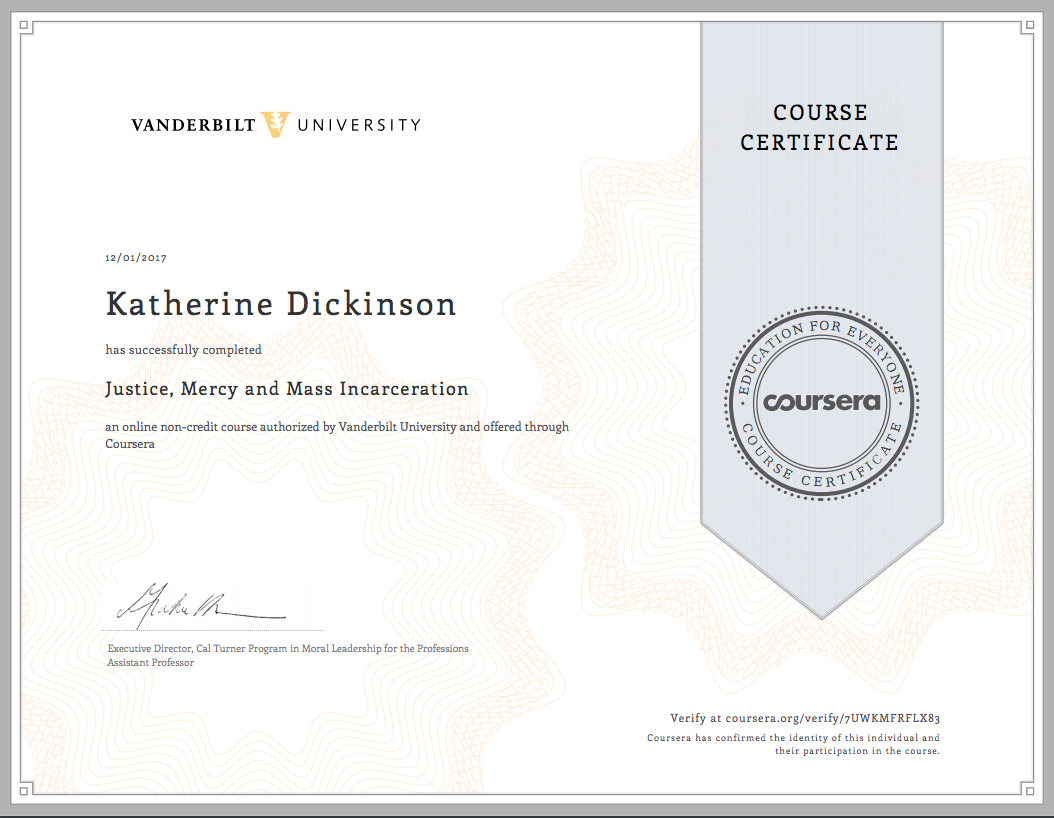
2017 Vanderbilt University Coursera Justice Mercy Mass Incarceration 1 Dec 2017

I recently finished a fascinating six week Vanderbilt University class called “Justice, Mercy and Mass Incarceration” presented through Coursera online.  The course goals were “to discover alternatives to the current systems of crime and punishment in order to imagine a more inclusive, just and moral society”.  It was taught by Graham Reside, Assistant Professor, Vanderbilt University Divinity School.  This is my second online class in the area of justice and criminology, the first being “Crime, Justice and Society” by The University of Sheffield, presented online by FutureLearn.  I am both interested in the topic and in the MOOC (massive open online course) method in which these classes are presented.

Since 2015, I have developed and led a seminar at Elmwood Jail in Milpitas, California, in the Silicon Valley. Our seminar curriculum and books are from the Education for Ministry (EfM) program of the University of the South – School of Theology. EfM is a four year college-level certification program, started in 1975. So far as we know, ours is the only jail-based EfM program, although there are two dozen prison-based programs in the USA. In addition to covering the official EfM material, in the seminar we also work on listening, respectful group interactions, study skills, and basic leadership skills – like how to open and close a class with prayer.

This jail-based EfM program is supported by the Correctional Institutions Chaplaincy, Episcopal Diocese of El Camino Real, St. Andrew’s Episcopal Church (Saratoga, California), and the University of the South – School of Theology. I worked with a group of volunteers from St. Andrew’s to start our first weekly seminar in a medium security dorm, and we have recently added a second weekly seminar in a minimum security dorm. Two of the EfM students at Elmwood are in Year 3 (Church History), two are in Year 2 (New Testament), with the remaining students in Year 1 (Hebrew Bible). The EfM year is only nine months long but my Co-Mentors and I run the jail-based seminars back-to-back (since inmates do not get summer vacations).  About two thirds of the inmate students in our EfM seminar are men of color – mostly Latino – and the rest are white.  We conduct discussions in English (and Spanglish) but provide Bibles, Books of Common Prayer, and Dictionaries in both English and Spanish.

In leading this EfM seminar, I have observed many consequences of incarceration. One of my reasons for taking “Justice Mercy and Mass Incarceration” was to understand more of the context of what I am observing when I am teaching in jail. Last month, I told the seminar students about the “Justice, Mercy, and Mass Incarceration” class and asked them to tell me one good thing and one bad thing about being in jail. Here is what six of them said:

What is Bad About Jail

  • I don’t see my family.
  • Some innocent people are punished (but not many).
  • I am not there for my kids.
  • I can’t be there to help my wife when she needs me.
  • Not being there for loved ones: I am frozen, unable to do anything.
  • Being a number – losing who you are.
  • I never get the time back.
  • I have no say. I am less of a citizen.
  • I am treated as low in the hierarchy.
  • There is no mercy, no leniency.
  • I can’t be there for my babies, my wife. I am hurting.
  • I am missing my family.
  • I lose my job, my apartment, my wife and kids, my paycheck, everything.

What is Good About Jail

  • Takes evil off the street.
  • Families are safe from bad people.
  • I have a clear mind. I am closer to God.
  • I have more belief, more faith, more spirituality. I am more close to God.
  • I have free time to spend on prayer, sobriety, like the worst-ever vacation. We can be with ourselves without a phone or Facebook.
  • If I stay clean, I have a clear mind, can reflect and prepare for becoming a better person out there.
  • I can clear my mind, rethink decisions on things I have done (and things I did not get caught for).
  • I can stay off drugs, not putting poison into my system.
  • It has made me think, be a better person. Reflection, closer to God. I am learning a lot.
  • There is free medication (health care).

There are connections and discrepancies between what “Justice, Mercy, and Mass Incarceration” teaches and what the EfM student inmates say. They agree on the benefit of taking violent, evil, bad people off the street. They also agree that imprisonment has the potential for supporting personal reform – inmates rethinking who they have been and who they want to become. “Justice, Mercy, and Mass Incarceration” does not spend a great deal of time on effective reform but in the recommended 1998 documentary film “The Farm: Angola Prison”, several of the long-term inmates had clearly over time become very different people, positive forces in the prison community.  My hope for my EfM students is whether they are inside or outside, they can make a positive difference in the world.

2017 FutureLearn University of Sheffield Crime Justice and Society certificate July 2017

If you want to receive Katysblog posts by email, please sign up using the Sign Me Up! button (upper right).
Leave a comment

Filed under News & Reviews, Politics

Creating a Pitch for Lebanon

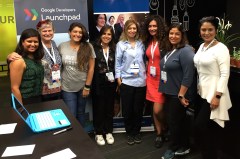
TechWomen Team Lebanon October 2017 San Francisco

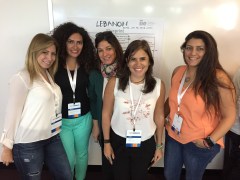
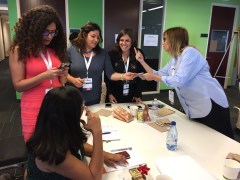
As a TechWomen Impact Coach for 2017 Team Lebanon, I am honored to serve for my seventh year in this remarkable mentoring program of the U.S. Department of State’s Bureau of Educational and Cultural Affairs (ECA).  Our team includes five Emerging Leaders from Lebanon (Lara Chikhani, Layal Jebran, Maya Itani, Rana El Chemaitelly, and Rasha Sukkarieh), plus three experienced mentors from the Silicon Valley: Mercedes Soria (Knightscope), Fatema Kothari (Verizon, and the Internet Society) and me.  We have been working hard for weeks at three TechWomen workshops plus twice a week remote meetings to develop our pitch for presentation this Friday.  Team Lebanon’s project is called “Ask an Expert” – a social enterprise to benefit senior citizens and refugees.  Wish us luck!

TechWomen Team Lebanon October 2017 San Francisco

TechWomen Team Lebanon October 2017 San Francisco

If you want to receive Katysblog posts by email, please sign up using the Sign Me Up! button (upper right).
Images Copyright 2017 by Katy Dickinson

1 Comment

Filed under Mentoring & Other Business, Mentoring Standard, News & Reviews

Africa: People, Food, Technology, Business

Katy Dickinson and John Plocher 2014 Church of St. George Lalibela Ethiopia

Tomorrow, I am giving a presentation to my home congregation of St. Andrew’s Episcopal Church (Saratoga, California) about my nine trips to Africa since 2010. The talk is called “Africa: People, Food, Technology, Business”. I have linked the talk here so that my audience can access my pictures and stories after.  My bold intention in giving this talk is to present a small part of the wonderful complexity of the African continent, and to encourage them to visit and get involved in African enterprises.

“If you only visit two continents in your lifetime, visit Africa – twice.” – R.Elliot

TechWomen and TechGirls in Tunisia 2015

Katy Dickinson presenting to AIMS and TechWomen at in Cape Town by Rejoyce GaVhi Feb2015

If you want to receive Katysblog posts by email, please sign up using the Sign Me Up! button (upper right).
Images Copyright 2010-2017 by Katy Dickinson

Leave a comment

Filed under Church, Home & Family, Mentoring & Other Business, News & Reviews

Fabric Arts and Crafts in Sierra Leone

Fabric shopping, Sierra Leone, July 2017

While visiting Sierra Leone in West Africa earlier this month, my daughter Jessica traveled with fellow TechWomen mentor, Terri Khonsari, and with Ibrahim Kalokoh and Joseph Ellie of Families Without Borders Tech Center (FWB). Some of our activities were arranged by Mrs. Thaimu (“Mrs. T”), an entrepreneur in Makeni who works with FWB.

In addition to giving presentations at FWB, the University of Makeni in Makeni, and at Fourah Bay College (University of Sierra Leone) in Freetown, we wanted to learn more about Sierra Leone. In particular, we wanted to purchase some of the elegant fabric and embroidery that we had seen Terri wearing in the Silicon Valley.

Our first day, Mrs. T brought us to her home to show us samples and discuss options for design.  Then, we went fabric shopping, followed by a trip to the tailor. Most of the fabric we purchased was cotton, often with local designs but mostly manufactured outside of the country.  One variegated brown cloth  was made locally from kola nuts. Our shirts, tunics, and dresses were completed in just a few days. We ended up fabric shopping several times during the whole trip: the vast design range and high quality of available materials are remarkable.  Jessica and I will be sewing with our new fabric for quite a while!

In addition to fabric, I purchased a batik panel at the Tacugama Chimpanzee Sanctuary gift shop. It shows a woman in local costume against a map of Sierra Leone. I made it into a pillow for my office – to remember my first trip to West Africa.

23 March 2019: see also Arts and Crafts in Sierra Leone

Mrs. Thaimu, Makeni, Sierra Leone, July 2017

Fabric shopping, Sierra Leone, July 2017

Embroiderer, Makeni, Sierra Leone, July 2017

Tailor, Makeni, Sierra Leone, July 2017

Embroiderer, Makeni, Sierra Leone, July 2017

Kola nut fabric with embroidery, Sierra Leone, July 2017

Sierra Leone woman batik, July 2017

Sierra Leone woman batik, July 2017

Sierra Leone woman batik pillow and embroidered clothes, July 2017

If you want to receive Katysblog posts by email, please sign up using the Sign Me Up! button (upper right).
Images Copyright 2017 by Katy Dickinson

3 Comments

Filed under Home & Family, News & Reviews

Truth on the Internet, Sierra Leone

Fourah Bay College, Sierra Leone, July 2017, photo by Salwa Campbell

While Jessica and I visited Sierra Leone earlier this month, we gave presentations to Terri Khonsari‘s technical center Families Without Borders, and the University of Makeni in Makeni, and at Fourah Bay College (University of Sierra Leone) in Freetown – to about 300 students in all. We answered many questions but variations of one question came up most often everywhere we went: “How do you tell what is true on the Internet?”

Since we were presenting on web research, e-learning (also known as educational technology), and blogging, and since the topic of fake news has been much discussed worldwide during the last year, I suppose we should not have been surprised at the frequency of this question.  We answered it in a variety of ways, including many that have been widely discussed elsewhere. For example, Factcheck.org provides this list on “How to Spot Fake News”:

  1. Consider the source
  2. Read beyond the headline
  3. Check the author
  4. What’s the support?
  5. Check the date
  6. Is this some kind of joke?
  7. Check your biases
  8. Consult the experts

Two other ways we answered the question:

  1. During our Internet Treasure Hunt exercise at Families Without Borders in Makeni, we asked the 50+ students to find out what the CIA World Fact Book thought was the population of Sierra Leone, and then what Wikipedia said (since they do not agree). We then asked them to find an error on the Wikipedia page and discussed how these mistakes or differing opinions can happen.  We encouraged them to help by correcting the Wikipedia page and directed them to instructions on how to do so.
  2. At Fourah Bay College in Freetown, after asking about Finding Truth, a first year Engineer asked me why someone does not fix the Internet – make it always correct. I looked at the large and eager young audience and asked why someone does not fix them – make their own answers always correct. They laughed. I followed up by saying that the Internet was and continues to be created by people of many viewpoints who may want to deceive, or who may not know what is correct, or for whom there may be many versions of Truth.

Families Without Borders, Makeni, Sierra Leone, July 2017

University of Makeni, Sierra Leone, July 2017

If you want to receive Katysblog posts by email, please sign up using the Sign Me Up! button (upper right).
Images Copyright 2017 by Katy Dickinson and Salwa Campbell

1 Comment

Filed under Home & Family, Mentoring & Other Business, Mentoring Standard, News & Reviews, Politics