Tag Archives: SEED

Mentoring in Engineering and Computer Science

Work to balance the diversity of Participants in terms of demographics, professional area, and geographic location.

The context of the Engineering community is key here. It bounds the SEED program and defines its organizational character. Compare this to the Mentoring@Sun program, started in 1992 as a general Sun-wide mentoring program. The SEED program was developed by Sun in 2001 to address Engineering organization needs that were not met by Mentoring@Sun. That is, SEED is an internal mentoring and leadership growth program designed to meet the needs of a key professional area, running in parallel with a more general internal program.

  • Both SEED and Mentoring@Sun are very effective at making connections between organizational silos, what Helen calls cross-pollinating.
    For more on this, read my blog entry Internal or External Mentoring Program? (30 June 2009).Scope:
    SEED mentors can be from any part of Sun so long as they are at principal-level or above in seniority. SEED mentees, however, must all be working in Engineering, which is defined as:

    “Hardware and software engineering positions where the primary job purpose is to perform engineering research, design, and development activities resulting in innovative Sun products for external customers. Also included are staff positions providing strategic support to engineering research, design, and development activities.”

    Again, the Engineering professional context provides specific program boundaries: only these positions are included, others are not. (This would sound like inappropriate exclusivity if Engineering did not make up about half of Sun’s employees.)

    Training Focus:
    Each mentoring program should provide training that helps the pairs feel comfortable from the start and work well together for the entire term. Training is particularly important in special cases, such as when mentor and mentee work in different professional areas (Microelectronics and Finance, for example), have a wide gap in their relative experience or seniority (such as a Senior Director mentoring a recent college hire Member of the Technical Staff), are working at a distance (for over half of SEED mentoring pairs, the mentor and mentee work in different cities, states, or countries), or come from very different cultures.SEED offers two hours of individual training by phone for each mentoring pair. Using a standard set of materials (Helen and I update these annually), pair training is tailored to their strengths and challenge areas. The geek personality is common enough that our mentoring training materials have a special section for Engineering. Engineers are professional problem solvers who are usually very smart analytical logical thinkers. Sometimes it can be a stretch for them to see the other person’s point of view. Many of them do not suffer fools. Mentoring training for extreme geeks may focus on teaching how to disagree agreeably (using tactful phrases) and learning when problem solving may not be what is needed or wanted by their mentoring partner.

    Management Style:
    Managing an Engineering mentoring program requires communicating well and maintaining trust with Engineers. SEED is a prestigious leadership grooming program, so the decision of which applicants get accepted can be controversial. The selection system must be fair and seen to be fair. Selection criteria for SEED are based on the values of the Engineering community (such as: demonstrated technical excellence, creativity, leadership, holding patents, publishing papers, earning an excellent letter of recommendation by an executive, etc.) Many of SEED’s selection criteria are also reflected in job promotion criteria for Engineering staff. Sun Engineering has an egalitarian open door culture which values data-driven decisions and a transparent management style. While respecting confidentiality, SEED routinely makes a great deal of program information available to Sun Engineering. SEED program participants regularly contribute suggestions on how to improve the program and its web tools.

    What is the Geek Personality?

    A brief digression into the personal and social context of Engineers since this has such a strong influence on mentoring in Engineering…

    While Sun Engineering staff include a very broad range of personality types, there are some unusual concentrations. SEED mentoring training includes a section on Myers-Briggs style personality types. This provides a good context and vocabulary for mentoring pairs to discuss differences and commonalities and promote mutual understanding. (We skip this section of training for staff who think the use of personality types is Psychology black magic.) Sun used to offer personality assessments as part of its regular career coaching benefit. In 2002, I used a survey to collect information from 143 Sun Engineering staff about their formally assessed personality type. While not a statistically valid sample, it is nonetheless interesting:

  • 59% of the Sun Engineering staff reported that they had been assessed as I
    (introvert)About 50% of the US population are I (introvert)
  • 66% of the Sun Engineering staff reported that they were NT (intuitive thinkers)About 10% of the US population are NT (intuitive thinkers)

(Yes, this does mean that Engineers are abnormal, statistically at least).

Introverts have been defined as “people who find other people tiring” (see “Caring for Your Introvert” by Jonathan Rauch, The Atlantic, March 2003). A t-shirt popular with Engineers says “You read my t-shirt. That’s enough social interaction for one day.” (see Think Geek T-shirt). SEED works hard to make its communications comfortable for an introverted group. For example, we lay out the expected interactions and always allow the participants to engage at their own comfort level. One analysis of downside to being an introvert is that:

      “In our extrovertist society, being outgoing is considered normal and therefore desirable, a mark of happiness, confidence, leadership. Extroverts are seen as bighearted, vibrant, warm, empathic. ‘People person’ is a compliment. Introverts are described with words like ‘guarded,’ ‘loner,’ ‘reserved,’ ‘taciturn,’ ‘self-contained, private’ – narrow, ungenerous words, words that suggest emotional parsimony and smallness of personality. Female introverts, I suspect, must suffer especially. In certain circles, particularly in the Midwest, a man can still sometimes get away with being what they used to call a strong and silent type; introverted women, lacking that alternative, are even more


    likely than men to be perceived as timid, withdrawn, haughty.”(Ibid, 2003 article by Jonathan Rauch)

For more on Social Context, Gender, and Mentoring, see my blog entry Picking Your Mentor, Picking Your Mentee.

Finding Mentors for Engineering

Since 2001, I have matched almost 1,200 mentoring pairs; 70% of the mentors were executives (Directors, Vice Presidents, Principal Engineers, Fellows, etc.). SEED gets an average of 90% participant satisfaction rating on its quarterly reports, year after year. What do these executive mentors look for in mentees? Why do so many find SEED to be such a satisfying program? Most of the questions mentors ask when I contact them about working with a potential mentee are structural: availability, time commitment required to participate, potential areas of difficulty (like being in the same management chain or speaking different primary languages), and physical or time zone proximity are common questions. Along with those are asked more substantive questions about intellectual common ground, interests, and personal compatibility. Somewhere in this mix, almost all potential mentors ask something like “Why me? What does this person want to know that I am uniquely able to teach?” (For more on mentor questions and preferences, read my 6 July 2009 blog entry Picking Your Mentor, Picking Your Mentee).

Notice that relatively few questions are about the topic or professional area to be discussed. SEED Mentors have served from all areas of Engineering worldwide, plus Operations, Sales, Service, Legal, Information Technology, Finance, Human Resources, and Marketing. Most of the non-Engineering staff were recruited as SEED mentors at the specific request of a mentee who asked to learn from them. I originally recruited the General Counsel as a mentor because a Software Engineer wanted to learn more from the lawyer’s success as a business leader. (He enjoyed the experience and has served as a mentor five times since.) I recruited a Finance Vice President because a Systems Program Manager wanted a mentor who really understood financial planning, revenue and cost management. Sun Microsystems is an Engineering-driven company, so most non-Engineering staff are eager to help (as well as extend their own connections in Engineering).

I have observed that the more experienced or senior a mentor is, the more willing they are to discuss a very broad range of topics. It is usually the more junior mentors who question their breadth of ability or the value of their experience outside of their immediate area of professional expertise. The mentors who seem to get the most out of their SEED experience are the executives. One Software Vice President told me that his hour with his mentee was his vacation, the only time all week when he knew the answers. A different Software Vice President told Helen that he always looked forward to meeting with his mentee: it was his only non-confrontational meeting. This positive experience is reflected in SEED’s metrics for repeat mentor participation:

  • 48% of the total 460+ potential mentors on SEED’s current list have been mentors more than once. This includes principal-level senior staff
    plus executives.(This does not count their service in Mentoring@Sun or other Sun mentoring programs.)
  • 65% of those repeat mentors are executives.
  • 54% of all of the executives who have ever been SEED mentors have mentored more than once.45 executives have have served as a SEED mentor five or more times.4 Sun executives have mentored ten or more times with SEED.

A Marketing Vice President wrote in evaluation of his sixth SEED mentoring experience:

“This continues to be a great program and I get a lot out of it — possibly more than the mentees.”

Series

Information is from my experience since 2001 managing Sun’s SEED Engineering-wide world-wide mentoring program, and from the Mentoring@Sun general mentoring program, and the mentoring program for new Sun Vice Presidents managed by Helen Gracon since 1996. Helen Gracon also provides training for SEED. This is part of a continuing series on mentoring programs. Other entries in this series:

For more about SEED, see the program home page at http://research.sun.com/SEED.

By Katy Dickinson
Director, Business Process Architecture
Chief Technologist’s Office & Sun Labs, Sun Microsystems

1 Comment

Filed under Mentoring & Other Business

Picking Your Mentor, Picking Your Mentee

Information in this entry is taken from my experience since 2001 managing Sun’s SEED Engineering-wide world-wide mentoring program. This is part of a continuing series on mentoring programs, answering some of the questions I am most frequently asked. Other entries in this series:

Using a Formal, Structured Approach

This entry speaks to would-be-mentees as well as to potential mentors on how to pick their mentoring partner. Both are addressed here so mentor and mentee can see the whole picture. Specific mentor matching systems are covered in Mentor Selection Systems. In general, I recommend a formal, structured approach like that we use in the SEED program, because I have seen this approach work in almost 1,200 matches, 70% of which were with an executive mentor. You can learn more about SEED by reading the blog entries listed above. Also, flow charts of how SEED’s process works are available at “SEED: Sun engineering enrichment & development” Research Disclosure Database Number 482013, defensive publication in Research Disclosure, Published in June 2004, Electronic Publication Date : 17 May 2004 (5 pages, PDF format).

Doris Lessing at lit.cologne 2006, from Wikipedia “That is what learning is. 

You suddenly understand something you’ve understood all your life,

but in a new way.”

– Doris Lessing (2007 Nobel Prize in Literature, 1919-now)

For the Mentee: Start with a Mentor Wish List and Learning Goals

Before the mentor matching cycle starts, each SEED mentee is asked to prepare a 10 name Mentor Wish List which is prioritized and includes a reason why the mentee would prefer to work with each mentor included. Three learning goals are also part of the SEED Mentor Wish List.

  • Why 10 names?
    I have run mentoring terms in which we asked for 5 names but it wasn’t enough: I ended up going back to the mentee for more potential mentor names too many times. I have also run terms in which we asked mentees for 15 names but since each name represents serious thought
    and research and we very rarely ended up needing all 15, we cut it down. In practice, 10 potential mentor names seems the right number. In the current group I am matching of 80 mentees (just 14 still unmatched), I have only had to go back to 2 so far for additional names.
  • Why prioritize potential mentors?
    • First, to get the mentee-to-be to think seriously about who they want their mentor to be by forcing a ranked comparison. It takes time and mature consideration to work through all of this. Creating the Mentor Wish List is probably the hardest part of the SEED program; however,
      that advance thinking contributes to a more successful mentoring partnership.
    • Second, to help the program staff decide when there are duplicate requests for the same mentor. In SEED’s current terms, 80 mentees prepared 10-name lists, which resulted in 387 unique mentor requests. There were 10 potential mentors with multiple 1st Priority requests and 39 mentors who were requested by 5 or more mentees. When a mentor is requested by more than one mentee, SEED’s primary basis for picking one mentee over the other is the priority order. The mentee’s seniority (number of years at Sun) may be used as a tiebreaker, with the
      more senior mentee getting preference.
  • Why require mentees to write reasons for preference?
    This is to answer the #1 question asked by potential mentors: “Why me? What does this person want to know that I am uniquely able to teach?” That is, before they make any decision, potential mentors (especially executives whose time is particularly valuable) want to gauge the mentee’s motivation and seriousness. They want to see if spending six months with this mentee is a good use of time. SEED sends each potential mentor an email including the potential mentee’s resume, 3 learning goals, plus reasons for preference. We offer additional information (the application form and letters of recommendation) but most matches are made based on the first email plus a pre-match conversation between the potential mentor and potential mentee. Very often, the potential mentee’s own words in their preference statement makes the match. Some mentees think to save time by providing the same reason for preference for all of their potential mentors. Mentor Wish Lists are returned for revision when this happens. Reasons for preference should be as unique as the mentors themselves.
  • Why require learning goals?
    The mentee’s three learning goals give the potential mentor an idea of initial topics for discussion (where their conversations will begin). This helps the potential mentor evaluate whether they can help the mentee. The SEED Engineering mentoring program takes a long-term view and does not have a preference for one kind of learning over another. That is, the mentoring partnership learning does not have to have anything to do with the mentee’s current job. Some people want to learn to be better technical managers, others want to know how to get their ideas to customers faster. Many want to improve their soft skills: public presentation or speaking, negotiating, conflict management, and coaching. Still others want to improve their work and family balance and still have a great career. More general and broader learning goals usually work better than specific or very technical goals. Extremely specific goals or requests to work on a particular project with the mentor often discourage even the most accomplished mentor and make the mentee very difficult to match. Three examples of 3 broad learning goals: 

    1. Learn more about how to lead a virtual team.
    2. Learn how to communicate with my management team.
    3. Learn how to communicate better with customers.1. To be engaged intellectually with senior peers.
    2. To apply my analytical skills and interests to a new and interesting area.
    3. To increase my own motivation.

    1. Diversify my knowledge by learning from individuals in other business units at Sun.
    2. How to take on more responsibility and enhance my visibility at Sun.
    3. Improve my understanding of corporate expectations from a technical leader and improve my leadership skills.

For the Mentee: Who Goes on Your Mentor List?

Potential Mentors should be included on a Mentor Wish List primarily because of their accomplishments, experience, personality, capabilities, or skills. For
more on this “Demonstrated Accomplishment” selection system, see

Mentor Selection Systems
.

The Cheshire cat as John Tenniel envisioned it in 1866, from Wikipedia Alice: “Would you tell me, please, which way I ought to go from here?” 

“That depends a good deal on where you want to get to,” said the Cat.

“I don’t much care where -” said Alice.

“Then it doesn’t matter which way you go,” said the Cat.

Alice in Wonderland, 1865, by Lewis Carroll

The focus of mentoring in the SEED program is long-term professional and technical development. It is not appropriate for a mentee to request a mentor with the sole aim of being hired into a specific job, securing project funding, or gaining a particular political advantage.

Social Context, Gender, and Mentoring

In addition to Demonstrated Accomplishments, many mentees seek a mentor who shares their social or personal context in terms of gender, race, ethnicity, shared language, nationality, or other demographics. These characteristics may properly be part of why a particular mentor is requested; however, in my experience these characteristics by themselves do not provide enough commonality for six months of discussions, so no one of them will be successful as the sole reason for preference. When SEED receives a Mentor Wish List containing inappropriately simplistic reasons for preference like “He is a very successful Chinese in Sun” or “Female Mentor in a top role in an organization”, that list is returned to the potential mentee for expansion.

However, these social and personal characteristics can be very important in professional life and are appropriate topics for some mentor-mentee discussions. Gender in particular may have an influence on how mentors and mentees respond to mentoring programs. Women and non-US staff have taken advantage of the SEED program at a consistently higher rate than their representation in Engineering overall. The Anita Borg Institute for Women and Technology and the Michelle R. Clayman Institute for Gender Research, Stanford University, prepared an excellent study in 2008 called Climbing the Technical Ladder: Obstacles and Solutions for Mid-Level Women in Technology (by Caroline Simard, Andrea Davies Henderson, Shannon K. Gilmartin,
Londa Schiebinger, and Telle Whitney) which reported:

    “Women at the mid level are more likely to rate the availability of mentors and mentoring programs as important to retention than are men (48.7% versus 36.2%). (The gender difference on this item is especially wide at the entry level, where 60.6% of technical women point to a need for to mentoring programs, compared to 39.1% of men.)”

As reported in SEED’s “5 Years of Mentoring by the Numbers” (by Katy Dickinson, presented at the October 2006 Grace Hopper Celebration of Women and Computing, 30 pages, PDF format), based on SEED’s data since 2001, there are three consistent gender patterns with regard to mentor matching in Sun Engineering:

  • More male mentors are requested by both male and female mentees overall.
  • Female mentors seem more willing than male mentors to accept a mentee, regardless of gender.
  • Female mentees request twice as many female mentors on their Mentor Wish Lists as do male mentees.

Some questions this has raised:

  • “Is there a substantive difference in reported satisfaction between mentees with male mentors and those with female mentors?”One of the opinions (often a seemingly-unquestioned assumption) I often hear from managers of other mentoring programs is that women exclusively want and benefit from having mentors who are also women. While the SEED Engineering mentoring program’s data show that female mentees have a strong preference for female mentors, it also shows that men and women mentees report the same program satisfaction
    (90% average), regardless of their mentor’s gender. That is, SEED’s data over many years show that there is no real difference in reported satisfaction. The sample size of female mentees is smaller than the sample of males (this is Engineering, after all); however, there is no pattern of satisfaction difference.
  • “What is the downside to special mentoring programs for women?”As Dr. Ellen Spertus wrote in “Why are There so Few Female Computer Scientists?” (MIT AI lab Technical Report 1315, August 1991):”While there is a need for affirmative action programs, they have large negative effects that must be considered. Even if a program does not entail lower standards for women, doubts are cast on a woman’s qualifications in a society that already mistrusts them. Programs with lower qualifications may be a tactical mistake (in addition to being unjust) because people may be put in situations for which they are not qualified, giving them less overall success and self-confidence than they would have had otherwise. These negative effects should be weighed when considering implementing an affirmative action program.”

For the Mentee: Researching Potential Mentors

A good background search by the mentee will result in more detail and understanding of the potential mentor, also resulting in a more convincing reason for preference. Many times, the mentee’s explanation convinces the potential mentor to consider them seriously. Sometimes, it makes the match. Mentees should not confuse researching mentors with asking someone to be their mentor: these are two different steps.

Mentor Research Steps:

  1. The mentee should start by thinking about mentoring relationships she has already had (personal, academic, or professional) and ask herself:
    What would I do the same or differently? Do I want a mentor who is similar or different? She should also think about what she wants to learn from another mentoring relationship: what need or gap do she want to fill in her accomplishments, experience, personality, capabilities, or skills? Are there patterns of behavior or performance feedback to be considered?
  2. The mentee’s second step in researching potential mentors should be to ask her supervisor or manager for support and advice. The manager knows the mentee and has a professional stake in the mentee’s success. Also, the mentee should ask for advice from other people who know her well – taking advantage of their experience, wisdom, and networks.
  3. A general search for background on the potential mentor using a web search engine is the next step. In particular, the mentee should look for professional profiles on web communities such as LinkedIn or Plaxo (rather than the more social communities such as Facebook). Many Directors and Principal Engineers will have executive profiles prepared by their company. Most Vice Presidents will have such a page.
    The web home page of potential mentors’ professional or academic organizations may also be a fruitful source of information. Groups such as
    Association for Computing Machinery (ACM) and IEEE offer biographies of award winners, office holders, etc.
  4. In searching for mentors, it may help the mentee to go through a list of leaders or executives in her professional or academic area to pick out the people who have titles the mentee wants for herself someday. The mentee should pick out names of people who are already far down the career path in which she has an interest. This is like doing research for a university paper – hunting for leads, backtracking, looking for key words, hunting again. Mentees should expect to spend many hours developing a good Mentor Wish List.
  5. The mentee’s manager can provide perspective by checking the Wish List after it is complete, before the mentee goes into the mentor matching cycle.
Mohandas Karamchand Gandhi, pictured in the 1930s, from Wikipedia “Where the ultimate goal is the search of truth, 

no matter how a man’s plans are frustrated

the issue is never injurious and often better then anticipated.”

– Mahatma Gandhi (1869-1948)

For the Mentor: Deciding to Become a Mentor

Since the mentee drives the relationship, the mentor is usually in the position of deciding whether to accept a specific mentoring proposal, rather than having to seek out a mentee. Common questions from mentors include:

Why become a mentor?

  • One SEED mentor who had turned down several mentee requests wrote when he did accept someone: “I’ve been struggling with this however I’ve (finally) decided that I want to do it. I’ve asked other people for help along these lines so I guess it’s time for me to give a little back.”
  • A Vice President-Fellow mentor who had already served in several SEED terms wrote in his first email to his new mentoring partner: “I look forward to our mentor-mentee relationship. This will be a good experience for both of us. I will learn some and you will learn some, it is up to us to make the most out of it.”
  • A Distinguished Engineer wrote in his quarterly report: “This is a very worthwhile program that I’m pleased to be able to participate in. In the two times I’ve participated as a mentor I’ve gotten at least as much out of the experience as the mentee.”
  • A Vice President wrote in evaluation of his 6th SEED mentoring experience: “This continues to be a great program and I get a lot out of it — possibly more than the mentees.”
  • A Software Staff Engineer wrote about his 2nd SEED mentorship: “Love the SEED program. Low cost to shareholders, high value to
    shareholders.”
  • A Distinguished Engineer who is an 11-time mentor wrote: “SEED is a great opportunity for both Mentor and Mentee. It opens both
    personal and technical doors by providing a 1-1 context outside of normal work requirements.”
  • In addition to giving personal and professional satisfaction, becoming a mentor can help expand understanding and experience.
    Mentoring may also specifically support professional development in organizations where leadership is one of the criteria for evaluating promotion potential.

In their own words:

  • “What do mentors do?”
  • Working in parallel with the mentee’s manager (and communicating with the manager as appropriate while respecting confidentiality), the mentor recommends training and experiences, makes introductions, provides continuing advice, assistance and support, and evaluates progress. Some mentors may discuss or work together on projects with mentees. Mentors may also be asked to support the development of the mentee’s “soft” skills such as public presentation/speaking, negotiating, conflict management, and coaching.

  • “What do mentors look for in mentees?”
    The mentor should be interested in at least some of the same work areas, problems, or projects as the mentee. However, working in the same broad professional area (software, microelectronics, sales, etc.) may or may not be an advantage to a mentoring pair. There have been very successful mentoring partners who shared a technical focus but were in very different areas. Sometimes having a different specialty can be a real advantage because there is more to talk about and learn. Personal compatibility and commonality (with both the mentee and their manager with whom the mentor may need to communicate from time to time). Physical proximity or time zone proximity may or may not be important. Proximity may mean that the mentor and mentee have offices near each other or that one of them can travel for an in-person visit from time to time. However, while face-to-face meetings are valuable, they are not always possible. A great deal can be accomplished over the phone and by email. For many years, the majority of SEED mentor-mentee pairs have worked at a distance (in difference cities, states, or countries). In a global workforce, potential mentees may work in an area where there are few or no senior Engineering staff available to mentor them. In their case, being mentored “at a distance” is their only choice. 

    In their own words:

    • In April 2003, a mentor wrote in his quarterly report: “…the impact one can make by being a mentor in a non-US Geo is considerably high, as per my personal experience. I derived a lot of satisfaction and good perspective during this mentoring program. Also, this Mentoring program made me to think about some issues affecting the local engineering center, and we are working towards addressing these issues.”
    • In July 2009, a mentee working in Japan spontaneously wrote an evaluation of his relationship with his mentor (who works in Israel): “I cannot thank more for his effort he put into this program, his frankness and openness as well as shared knowledge not only regards to the professional life but also the personal life. … Though my goal was slightly different at the beginning of the term, learning from someone who is ahead in professional life, while managing his work-life balance provide me a new perspective. Managing balance is still challenging for me, but sharing simular experience about family from different point of view was and continue to be helpful for myself. Visiting the differences in each others’ culture starting from the calendar was, for me an exotic experience and continue to be interesting one. I am looking forward to continuing our relationship.”
  • Availability (if the mentor is a senior executive or a manager with a large staff, she will have less time).
    Potential conflicts of interest or areas of discomfort with the mentee or the mentee’s manager (for example, it may be a problem if the mentor and mentor are in the same management chain, or if there are close personal relationships). Mentor and mentee should talk about these potential conflict areas before being matched.

Common questions mentors report thinking about when deciding whether to accept a particular Mentee include:

  1. Why me? What does this person want to know that I am uniquely able to teach?
    Potential mentors (especially executives whose time is particularly valuable) want to gauge the mentee’s motivation and seriousness. They want to see if spending six months with this mentee is a good use of time.
  2. Do I already know the mentee who has requested me (or know of them, or know their manager)?
    That is, is there a prior connection or knowledge? The prior connection may allow the mentoring partnership to start sooner and at a deeper level, or the history between the mentor and mentee may slow or prohibit the development of a partnership. In any case, it needs to be thought through.
  3. Is there a line reporting relationship?
    It may be a problem if the mentor and mentor are in the same management chain.
  4. What is my availability during the mentoring term?
    Most mentors take mentoring very seriously and want to be sure they have the time to do a good job as a mentor. If the potential mentor has just taken a big new job or has irreducibly large personal or professional time commitments, she probably will not accept a mentee until her schedule is lighter.
  5. Can I effectively partner “at a distance”?
    Mentoring across distance and time zones may be a skill that the potential mentor needs to develop. SEED mentoring pairs who work at a distance have for many years report the same satisfaction level as those working locally; however, mentors and mentees both report that working at a distance is more time consuming.

Circumstances mentors have identified as being important when considering a mentee include a mix of:

  • Mentor’s availability when asked (almost always the #1 consideration)
  • How well the potential mentor’s and mentee’s schedules match (and their flexibility to accommodate  each other’s schedules)
  • Mentee’s accomplishments, experience, seniority
  • Mentee’s capabilities, skills, potential
  • Common intellectual or professional interests
  • Personal compatibility or common ground (including linguistic abilities: whether the mentor and mentee share a common language)
  • Physical, geographic, or time zone proximity
Senator John F. Kennedy in his Senate Office, 1959, from Wikipedia “Leadership and learning are indispensable to each other.” 

– John F. Kennedy (35th U.S. President, 1917-1963)

Photos are from Wikipedia

1 Comment

Filed under Mentoring & Other Business

What I Love About Sun – After 25 Years

I just filled in the order for my anniversary gift from Sun Microsystems. It feels odd to have worked at one company for 25 years (since June 1984). I have been thinking about why I have stayed so long. Here is what I love about Sun:


    • Smart people who create amazing technology.At Sun, I have had the privilege to work with many great innovators and those who foster innovation, including:
      Carol Bartz,
      Whit Diffie,
      James Gosling,
      Vinod Khosla,
      Greg Papadopoulos,
      Radia Perlman,
      Eric Schmidt
      (who hired me), and
      Ivan Sutherland.

      I believe that the world is a better place because of Sun Engineering.

    • Generous people who think beyond themselves.Sun is a company for people with big hearts.

      I am proud of both large and small gifts, particularly:


        • The 545 senior staff and executive mentors in my
          SEED worldwide Engineering mentoring program who spend time they rarely have to help others down the path they have walked
        • The anonymous donor of the Free Milk Foundation half gallon which quietly appears in our hall’s refrigerator every Monday morning
        • Sun’s CTO, Greg Papadopoulos, who has supported the
          Anita Borg Institute and its Grace Hopper Celebration of Women in Computing, the American Heart Association’s
          Heart Walk, the SETI Institute, and so many other worthy efforts
        • Sun’s commitment to ecologically responsible products, and to volunteering in our local communities worldwide.
    • People with a sense of fun.Sun Engineers will put unreasonable effort into creating a great joke.
      Ever since I watched the senior Software developers putting Eric’s office into the pond in 1985, I have enjoyed Sun’s pranks and April Fools jokes. Sun has a sense of humor.

As the Oracle-Sun proposed acquisition progresses, I hope that what I love about Sun will be valued, grow, and continue to create great technology with a passion which makes the world better.

7 Comments

Filed under News & Reviews

Two Talks

I recently gave two talks here at Sun Menlo Park:


    • To TechBridge, for “Take Our Daughters and Sons to Work Day” on 23 April
    • To the annual Sun Design Summit (27-28 April), on “One time vs. Cyclic Survey” design

For “Take Our Daughters and Sons to Work Day” on 23 April, I talked with a group of 30 teen girls from the TechBridge after-school program for girls, sponsored by the  Chabot Space & Science Center in Oakland, California. I was the last speaker in their busy day at Sun. I told them about my work with SEED Engineering Mentoring but also about my kids and WP668, the
1916 railroad caboose in my backyard where I have my office. I showed them photos on my blog and  my daughter’s blog. After my talk, the girls tried to program a peanut butter and jelly robot, which was very funny. At the end, they said what they enjoyed most about their Sun day. The Executive Briefing Center tour and Nicole Yankelovich’s Collaborative Environments project from Sun Labs were tops. One girl even said that learning about having an office caboose was her favorite!

To the designers and usability experts at Sun, I talked about surveys in general, and the difference between one-time and cyclic surveys. Six years ago, I created Sun’s “How to Survey” web page in self defense. As a Six Sigma Master Black Belt, I was getting too many requests for information about survey design, tools, policies, etc. So, I put together and maintain a SunWeb page which covers:


    • Key Questions
    • Reference Documents by Sun Experts
    • Additional Resources:
      Policies, Helpful External Tools, Books and Articles,
      Survey Tools & Services
    • Example Surveys

Most of my presentation was drawn from information and resources I have posted on “How to Survey”. I chose to submit this topic for Kartik Mithal’s Design Summit because usability and design staff are so frequently involved in customer data collection. Also, because so much of the good advice in this area comes from Usability Engineers, such as:

Robin Jeffries
, Jakob Nielsen, and Jared Spool. The second page of my presentation was:

Why Should You Care? cat ear and eye<br /> photo: copyright 2009 Katy Dickinson
Listening to the

Voice of the Customer

Makes Your Work More Effective. 

Surveys are One Good Way to Listen.

.


I think both talks went well: the audience and I learned something. One of the TechBridge teachers told me about the fun and interesting Algebra vs. The Cockroaches computer game*. Several of the Design Summit audience members sent me additional information to post on the “How to Survey” SunWeb page.

* Algebra vs. The Cockroaches is now on my Good Free Games list.

Katy Dickinson speaking at Sun Design Summit 2009<br /> photo: copyright 2009 Terri Yamamoto Katy Dickinson's badge Sun Design Summit 2009<br /> photo: copyright 2009 Katy Dickinson

Images Copyright 2009 Katy Dickinson and Terri Yamamoto

Leave a comment

Filed under Caboose Project and Other Trains, News & Reviews

Sun’s Technology Advisory Board (TAB)

I usually write about my work here at Sun for the SEED worldwide Engineering mentoring program. Another of my programs is Sun’s Technology Advisory Board or TAB, which I manage for Greg Papadopoulos (Sun’s Chief Technology Officer and Executive Vice President of Research and Development).

What does TAB Do?
Since 2005, TAB has met several times a year to discuss key technical topics and trends, partnering to shape Sun’s technological vision for future development and product plans. The role of a TAB member is to support Sun’s Chief Technologist’s Organization in making recommendations to the CTO and Chief Executive Officer, as well as to the Chairman of the Board and Sun’s Board of Directors. Here they are at yesterday’s meeting:

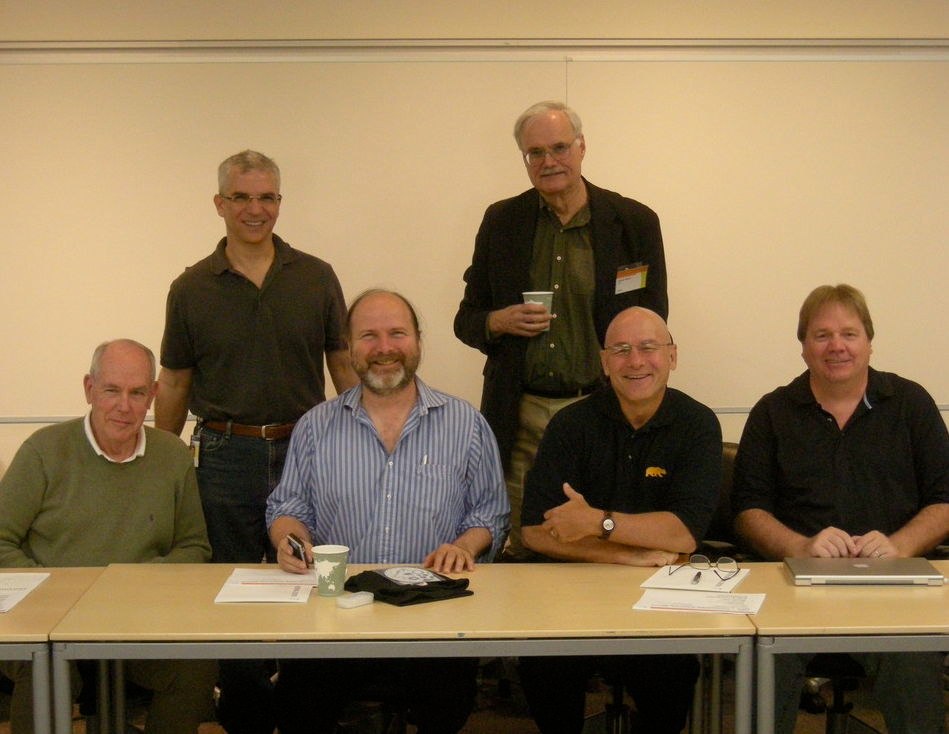
TAB, Sun Microsystems Technology Advisory Board, Greg Papadopoulos, Steve Ward, Ivan Sutherland, Danny Hillis, Dave Patterson, Mike Splain, June 2008

TAB in June 2008
L to R Standing: Greg Papadopoulos, Steve Ward
L to R Seated: Ivan Sutherland, Danny Hillis, Dave Patterson, Mike Splain
Who are They?

Image Copyright 2008 by Katy Dickinson
Links updated 11 January 2017

1 Comment

Filed under Mentoring & Other Business

How to Survey, Part 2 (Best Practices)

In my 16 April blog entry How to Survey, I presented 3 sections: Key Questions, Tools and Services, and Reading. In this entry, I present some Best Practices based on my experience and the advice of two wise and capable women with whom I had the honor to work: Dr. Robin Jeffries and Dr. Kornelija Zgonc. All errors may be attributed to my misunderstanding, not their teaching!

The most recent survey completed by my department here in the Chief Technologist’s Organization at Sun Microsystems was the SEED mentoring program quarterly report for April 2008. See Mentoring Success Metrics (April 30, 2008) for details. SEED (Sun Engineering Enrichment and Development) has been collecting quarterly feedback from a web-based survey since 2002, so this is a mature example of a cyclic survey. The SEED survey is not anonymous. Most of the practices below are also appropriate for one-time surveys and for anonymous surveys.

Characteristics of a Good Web-based Survey (with examples from SEED):

  • It is Short. The SEED survey consists of 14 questions. One way to shorten surveys: don’t ask for information that can easily be mined from another source.
  • It is Easy to Use and Understand. Use pull down menus wherever possible to provide clear options. When a range of answers is possible, offer the same one-to-seven range, with “1” being low, “4” neutral, and “7” being high. State questions as simply as possible and test for clarity (if it is possible to misunderstand, someone will). Avoid jargon, abbreviations, and local slang.
  • It is Easy to Analyze the Responses. Use very few open text fields. Use a seven point range so that there is a clear low, neutral, and high (more on this below). “Does Not Apply” and “No Response” are always options. “No Response” is the default option (that is, the respondent must make an active change to answer).
  • For Cyclic Surveys – Prior and Future Versions are Comparable. Questions do not change much over time.
  • It is Trustworthy. Send a survey copy immediately in email to the respondent. Make survey analysis results available to respondents promptly. Actively protect private and anonymous information. Say in the survey introduction what will happen with the results (then, do what you say). Remember Robin Jeffries’ First Law of Surveys: “Don’t ask questions unless you are prepared to act on the results!”

The following Attributes of Poor Surveys list is material developed by Kornelija Zgonc, former Sun Chief Master Black Belt, and my Six Sigma mentor:

What’s Wrong?

  • Survey goals unclear
  • No forethought about your processes
  • Lots of yes/no questions
  • Lots of written questions
  • Focus on symptoms
Why it’s a Problem:

  • Take-aways unclear
  • Don’t know how to implement changes
  • Limited analytics; need big sample sizes
  • Unclear or unfocused questions
  • Get more questions, not answers!

The following Attributes of Great Surveys is also material developed by Kornelija Zgonc:

  • Goals, processes, and possible cause/effect relationships are analyzed up front
  • Widely-scaled numerical questions allow lots of analytics and keep sample sizes low
  • Only need a few written questions to address unforeseen situations or problems
  • Survey has action-oriented focus to generate solutions, not more questions

Why a 1 to 7 Range?
Multiple choice options make it easier to statistically analyze survey results. One of the common and energetic “discussions” among those who design surveys is what range to allow for numerical questions. Simply put: how many number choices should the respondent be offered? Too short a range (like: 1=bad, 2=neutral, 3=good) may not reflect an accurate subtlety of opinion. However, too many options can give a false confidence in the value and gradation of the answer. Don’t ask for more precision than your users are likely to know!

A range of seven is the best choice. When seven or more numbers are offered in a scale (like: 1=strongly disagree, 2=disagree, 3=disagree, 4=neutral, 5=agree, 6=agree, 7=strongly agree), the data collected behaves and can be analyzed like continuous variables. (Data are discrete if there are a limited number of values possible. Example: number of legs on a cat, number of letter grades possible on a test. Data are continuous when the measurements can have any value. Examples: time, weight.) This allows tremendous analysis flexibility because there are many more statistical tools for continuous data analysis than for discrete  data analysis.

Why Statistics Don’t Matter (sometimes) With all deference to my colleagues who are statisticians and Six Sigma Master Black Belts, sometimes statistics don’t matter.

  • The survey itself is a form of communication, regardless of whether it is answered, analyzed, or acted on. The survey may change the nature of the audience’s awareness.
  • If you don’t ask the right audience or collect enough responses, the answer does not matter.
  • Some people will never give a top or bottom score under any circumstances.
  • Refine, reduce, remove:
    • Too many surveys make people hate or ignore you.
    • Too many questions will cause your audience to abandon the survey part way through.
  • If your questions are too personal or respondents are embarrassed to tell the truth
    (for example: admitting they don’t know the answer), answers will be worthless.

Links and formatting on this post refreshed 11 October 2017

1 Comment

Filed under Mentoring & Other Business

50 new SEED participants selected today

Selection Process Complete!

This morning, we selected the 50 participants in the Sun Engineering Enrichment and Development (SEED) mentoring program for the Worldwide Established Staff, January – July 2008 term. SEED received a total of 104 SEED applications, unfortunately more than the program can accommodate. Even after sorting out the twenty who were ineligible (mostly because they were too junior or their applications were not complete), today’s selection was very difficult. This group of applicants was
remarkably senior, well regarded, accomplished and particularly diverse geographically.

SEED recently ran a special term for staff in Beijing, Bangalore, Prague, and St. Petersburg, so there were fewer applicants this term from those locations. Nonetheless, this new group promises to offer a broad and valuable range of cultural
viewpoints. With so many superb candidates, we could not limit our choices to just
the 40 we had intended to accept! Next step: the term’s 15-name Mentor Wish Lists from the newly selected participants are due on 7 December.

Term Scope

SEED’s four basic General Selection Criteria are:

    1. All Participants are in Engineering.
    2. Only regular Sun employees may participate.
    3. Superior annual performance ratings are preferred.
    4. Manager support is required.

In addition, there are two specific selection criteria for Established Staff:

    1. Hold a senior position: they must be at a Principal job level or above.
    2. Have been with Sun for two or more years as of the term start month.
      That is, this term’s applicants must have been hired before 2006.

Participant Information Summary

Location of Participants


    • 1 Australia, 2%
    • 1 Belgium, 2%
    • 3 China, 6%
    • 1 Czech Republic, 2%
    • 2 France, 4%
    • 1 Germany, 2%
    • 2 India, 4%
    • 1 Ireland, 2%
    • 1 Japan, 2%
    • 1 Norway, 2%
    • 1 Russia, 2%
    • 1 Switzerland, 2%
    • 34 USA, 68%
      • 5 Central USA, 10%
      • 7 Eastern USA, 14%
      • 22 Western USA, 44%

Division of Participants


    • 2 CTO/Sun Labs, 4%
    • 6 Microelectronics, 12%
    • 5 Sales (Global Sales and Services), 10%
    • 11 Services (Global Sales and Services), 22%
    • 19 Software Group, 38%
    • 1 Storage Group, 2%
    • 5 Systems Group, 10%
    • 1 Worldwide Operations, 2%

Gender of Participants

    • 9 Female, 18%
    • 41 Male, 82%

11 Managers, 22% (the rest are individual contributors)

10 Previously Applied to SEED, 20% (the rest are 1st time applicants)

Countries of origin for participants in this term include: Australia, Belgium, Canada,
China, Czech Republic, Egypt, England, France, Germany, India, Israel, Japan,
Korea, Malaysia, Nicaragua, Norway, Pakistan, Peru, Romania, Russia,
Spain, Switzerland, and the USA

More information on the SEED Engineering mentoring program is available at

http://research.sun.com/SEED/

Leave a comment

Filed under Mentoring & Other Business