Tag Archives: San Jose

30th Anniversary SMUM Community Ministry

P1070035

On 15 September 2013, Santa Maria Urban Ministry (SMUM) celebrated its 30th anniversary with a “Fiesta for the Future” hosted by St.Jude’s Episcopal Church in Cupertino. SMUM was founded in 1983 as an outreach ministry of the Episcopal Diocese of El Camino Real, to provide emergency food to the residents of San José’s inner city. In addition to continuing to serve the needs of clients and promote their self-sufficiency, SMUM has developed transformative programs (pre-school, homework and computer lab, English as a Second Language, VITA tax services, backpack and Christmas present distribution…) to serve the needs of and promote self-sufficiency within the San José community.

The evening included a worship service lead by the Right Reverend Bishop Mary Gray-Reeves, a silent auction, folk dancing, music, and dinner with thanks to honor to the hundreds of donors and volunteers who have made this generous program a long-term success.

P1070070

IMG_0095

P1070017

P1070038

IMG_0115

Images Copyright 2013 by Alfonso Mendez and Katy Dickinson

Leave a comment

Filed under Church, News & Reviews

American Association of University Women – AAUW San Jose

P1060792

This weekend, I became a member of the San Jose branch of the American Association of University Women – AAUW. I was honored to give a presentation about mentoring at the national AAUW meeting in New Orleans in June and have continued to be impressed by the effective and interesting work of this venerable organization. Newly-elected Santa Clara County Supervisor Cindy Chavez joined the San Jose branch the same day I did – that’s her photo above. I am also a member of the California On-line AAUW branch.

Patrick Schmitt (Chancellor at the West Valley-Mission Community College District) gave a excellent talk about the future of higher education. He predicted that in 30 years, the higher education model will be “bespoke” – customized and driven by student success and student-focused measures. This reminded me of the future presented in Neal Stephenson’s remarkable novel Diamond Age. AAUW San Jose also awarded tech-camp and college scholarships to over a dozen young women at the meeting.

P1060786

P1060803

Images Copyright 2013 by Katy Dickinson

1 Comment

Filed under Mentoring & Other Business, News & Reviews

How to Tie Dye – at the Lair of the Bear Family Camp

P1040713

One of our annual Camp Blue Art Grove activities at the Lair of the Golden Bear – University of California at Berkeley family camp – is tie dye. This craft is particularly associated with the 1960s hippie youth movement, and with U.C. Berkeley. After vacations at the Lair for 21 years, I have developed a reliable system for producing vibrant tie dye results in a camp setting. Tie dye is messy, so you may want to wear old clothes and wear gloves. Or, you can enjoy the mess – like my husband who paints “Lair socks” on his bare feet.  This is a good craft for all ages – with little kids getting as good results as adults.

Camp Blue provides:

  • Rubber bands
  • Plastic bags
  • Soda ash in a tub
  • Dye in tubs – with squirt bottles
  • Instructions

You need to bring:

  • Cotton shirts, pillowcases, socks, underwear or anything else you want dyed from home.  100% cotton works best. Wash and dry in advance.  This year, I brought a white Coldwater Creek dress blouse that had a unremovable stain – it came out a nice plum color with white bands on the sleeves. Walgreen’s sells good-quality plain and patterned t-shirts ($12 for three). I brought shirts that said California, San Jose, and Willow Glen and worked the words into my pattern. Note that the white stitching may not absorb dye, so design around that.  You can buy white t-shirts at the Camp Store but be sure to wash them before starting your project.
  • Clothes line and clothes pins
  • Plastic clothes hangers
  • Laundry soap

My tie dye process:

  1. Follow posted camp instructions to create patterns using rubber bands on the dry cloth.  The fabric squeezed by the rubber bands will absorb the least dye.  There are many tie dye projects and patterns available on the web if you want to plan in advance.  Starting with a simple bull’s eye pattern is easiest. Place the pattern center mid-chest (not mid-tummy) for better results.
  2. Soak the rubber banded cloth in the soda ash tub to help it absorb the dye.
  3. Dip, soak, spray, or otherwise color the cloth with one or more dyes. Go from light to dark (yellow then blue, not the other way) and plan for dye colors to interact.  Use the dyes on the first day they are available – dye that has been sitting out does not work as well.
  4. Put the dyed cloth in a plastic bag (one item per bag). Tie the bag at the top and poke a small hole in the bottom. Hang the bag on a clothes line out of the sun – so that the excess dye can drip out the hole. Leave the bag closed for 24 hours. Do not walk under where the dye is dripping – it is still potent!
  5. After a day, use scissors to cut the top off each bag and snip each rubber band to remove it. Touch the cloth as little as possible. Immediately hang each item on the clothes line before going on to the next.  (Pick up all of the plastic bits and throw them away!)  You can use clothes pins or hangers – hangers are better.  Keep the items separated so that they do not drip or brush together.  Do not wring or rinse at this time. Leave hanging for 24 hours.  If it rains, bring everything inside and be resigned to having pale colors.
  6. Once the items are dry, wash in cold water. At Lair Camp Blue, you can run a washer load of dark laundry (jeans and items that will not show any dye) with the tie dye. If you use a camp washer, be sure to run it again (on empty or with another load of darks) so that no dye remains to surprise the next user. Alternatively, you can rinse by hand in the laundry sink but this is tedious and does not work as well.  Dry everything on a warm setting.

I have dyed shirts with this process that have not faded after five years.

P1050693

P1040722

Images Copyright 2013 by Katy Dickinson

1 Comment

Filed under Home & Family, News & Reviews

Local News, Distant News

P1040445

For neighborhood news here in Willow Glen, California, we have email lists. I manage a list for the houses in our immediate area – where yesterday I announced finding a thrown-away kitten (and settled the cute little guy in a new home that night) – and there are other lists for our Northeast Quadrant, and for our whole section of the City of San Jose (Willow Glen takes up about 3 square miles).

For national news, I listen to National Public Radio on station KQED. I sometimes check in at the New York Times but their 10-story-a-month free-limit blocks my regular usage.  I have been a KQED sustaining member for decades and don’t want to pay more than that for news.

For international updates, I read Al Jazeera (English) and the BBC – two services with similar web designs but different points of view and sources. My daughter Jessica recommended Al-Jazeera, a service started by the royal family of Qatar where she studied at CMU-Q. Maybe Qatar’s backing is why Al Jazeera has no advertisements? Current stories I found interesting on Al-Jazeera:

Image Copyright 2013 by Katy Dickinson

Leave a comment

Filed under Church, News & Reviews

State Plates

IMG_0778

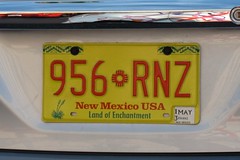
I have been playing the license plate game for some months. My game version requires a good-quality photo of each state plate – which is tricky when the car is moving. (Don’t try this while driving!) This is only one variation of the license plate game – and not the most complex. “Preamble” by Mike Wilkins phonetically spells out the preamble to the Constitution of the United States using 51 US license plates – that ambitious project is in the Smithsonian collection.

So far, I have 47 of the 50 United States (missing are Delaware, Maine, and South Dakota), plus some others. There is much variety in plate design even within one state, and some are masked by big license holders – making identification a challenge. San Jose, California, where I live gets many visitors, so driving around a big parking lot usually yields at least one addition.

If you take a photo of a license plate, sometimes a double helix security watermark appears running up the center – to identify forgeries, I would guess. The watermark is clearest on the plates below for Indiana, Oklahoma, Nebraska, New Jersey, North Carolina, Rhode Island, Tennessee, Utah, and Wyoming.

Some plates feature background images (mountains, flowers, farms, birds) or a motto (“Grand Canyon State” “Sweet Home” “The Spirit of America” “Live Free or Die”), others have just the dull URL of their Department of Motor Vehicles or government home page. Viginia is the simplest – no images or mottos. My favorite is the feisty motto of Washington DC: “Taxation Without Representation”.

Alabama . Alaska . Arizona
Arkansas . California . Colorado
Connecticut . Florida . Georgia
Hawaii . Idaho . Illinois
Indiana . Iowa . Kansas
Kentucky . Louisiana . Maryland
Massachusetts . Michigan . Minnesota
Missouri . Mississippi . Montana
IMG_1233 . Nevada . New Hampshire
New Jersey . New Mexico . New York
North Carolina . North Dakota . Ohio
Oklahoma . Oregon . Pennsylvania
Rhode Island . South Carolina . Tennessee
Texas . Utah . Vermont
Virginia . Washington . West Virginia
IMG_8049 . Wyoming . Washington DC
US Department of State - Consular . Baja California - Mexico . Alberta - Canada
British Columbia - Canada . Quebec - Canada . US Government
Illinois - September 11, 2001 . Wisconsin - Menominee Nation

Images Copyright 2013 by Katy Dickinson

Leave a comment

Filed under Home & Family, News & Reviews

Bee Exercise Routine

IMG_9253

Since July 2012, I have walked over 1,250 miles, according to my FitBit activity tracker – that comes out to about 4 miles a day. On my long walks in the Willow Glen neighborhood of San Jose, California, I often see fellow exercisers, such as the bumblebee pictured here. She seems to be doing calisthenics while collecting thistle pollen.

IMG_9247

IMG_9249

IMG_9250

IMG_9252

IMG_9255

IMG_9256

IMG_9246

Images Copyright 2013 by Katy Dickinson

1 Comment

Filed under Home & Family, News & Reviews

Controversial Winchester Story

IMG_9225

I just finished reading Captive of the Labyrinth: Sarah L. Winchester, Heiress to the Rifle Fortune by Mary Jo Ignoffo (2010). This biography of Sarah Winchester (1839-1922) was loaned to me by friend and neighbor Rev. Stephenie Cooper, who is also interested in local history.

As a native San Franciscan, I have seen freeway billboards for the “Winchester Mystery House” for decades. I have frequently walked by San Jose’s historic Victorian mansion –  on my way to the Winchester movie theater next door or the Santana Row shopping district across the street. I was curious enough about this local legend to read the book and also watch  “Winchester Mystery House Explored: Secrets of the Mansion” (1997), a twenty minute video-tour distributed through the attraction’s gift shop.  The video seems typical of the spooky and suggestive patter fed to visitors on their $40 tour.  Despite all of the spiritualist hype, the mansion is a genuine California Historical Landmark.  It is also listed in the US National Register of Historic Places and is a San Jose Historic Landmark.

The detailed and documented history presented by Professor Ignoffo (History Department, De Anza College) is quite different from the wild story in “Secrets of the Mansion”:

  • The San Francisco earthquake of 1906 severely damaged Sarah Winchester’s San Jose house and was responsible for most of its resulting oddities: “The house’s so-called stairs that lead to nowhere had previously lead to an upper floor.  Likewise, doors that now open into thin air were once entryways to suites of rooms…” (Ignoffo, p.4).
  • She was involved in design and extensive construction of the San Jose house from 1886 to 1906.  After the quake, Sarah Winchester ordered the rubble cleared and the house made safe but by 1908 “…Winchester had ceased making additions to her San Jose house”  (Ignoffo, p.163).  According to Roy Leib in 1925: “She did not hire a single carpenter after her house was damaged in the earthquake of 1906” (Ignoffo, p.165). The 38-year 24-hour daily construction of the San Jose house mentioned several times in the video seems to be fiction.
  • With regard to Sarah Winchester’s supposed insanity and fear of ghosts, Ignoffo writes: “Much later, after Sarah Winchester’s death, her relatives, employees, servants, and gardeners scattered across California.  None of them ever claimed that Winchester was superstitious, guilty, mad, or a spiritualist.  A few tried to make a public statement in her defense” (Ignoffo, p.165).

Sadly, the “Mystery House” legend of obsessive continual construction is encapsulated in the formal California Historical Landmark property description:

NO. 868 WINCHESTER HOUSE – Built by Sarah Winchester, widow of rifle manufacturer William Winchester, this unique structure includes many outstanding elements of Victorian architecture and fine craftsmanship. Construction began in 1884 and continued without interruption until Mrs. Winchester’s death in 1922. The continual building and remodeling created a 160-room house covering an area of six acres.
Location: 525 S Winchester Blvd, San Jose

Professor Ignoffo’s history is of a very private woman who was deeply interested in landscape design, horticulture, agriculture, and woodworking and was rich enough to implement her taste in her own home.  After the 1906 earthquake, Sarah Winchester turned her attention to management and expansion of her other properties in Atherton, Palo Alto, Burlingame, and Los Altos, and to generously endowing a medical facility to treate tuberculosis patients, in honor of her husband William Wirt Winchester who died of that disease in 1881.

IMG_8916

IMG_9222

IMG_9219

IMG_9176

IMG_9216

IMG_9189 . IMG_9190

Images Copyright 2013 by Katy Dickinson

1 Comment

Filed under News & Reviews