Tag Archives: San Jose

Road Diet Controversy in Willow Glen

IMG_8735

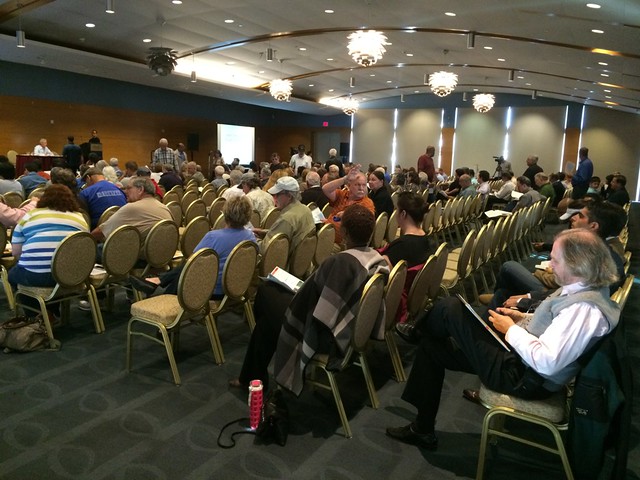
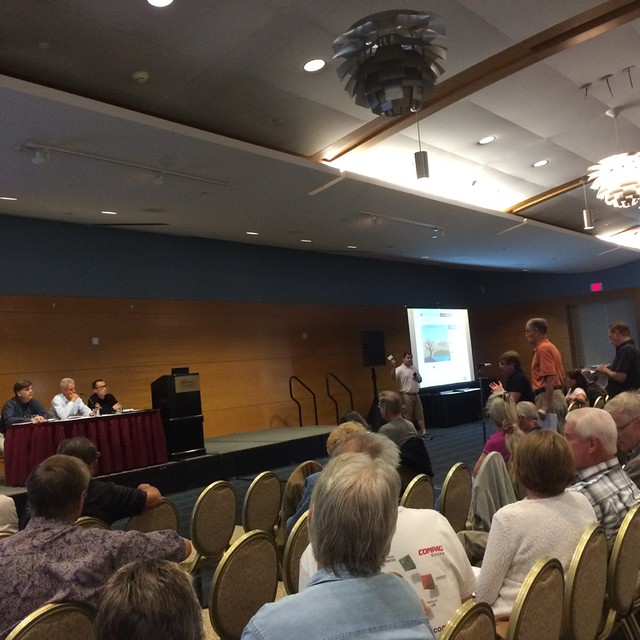
The Road Diet has caused a great deal of energetic debate in the Willow Glen neighborhood of San Jose, California, most recently among the 500+ who attended the public discussion at Willow Glen High School on 18 June 2015.  Most of the discussion was about:

  1. Bad for Business: The Road Diet trial has reportedly had a very negative effect on local businesses (particularly in the 0.4 mile downtown area on Lincoln Avenue between Willow Street and Minnesota Avenue).  Many small business owners at the meeting spoke of a significant decline due to customer frustration with traffic congestion.  Several spoke about shopping elsewhere to avoid the intermittent Lincoln Avenue gridlock.
  2. Good for Bikes: Several in the bicycling community reported their satisfaction at having a new bike lane, even if it does not connect yet to other bike corridors.
  3. Driver Frustration caused by increased traffic congestion on Lincoln Avenue was a common topic.
  4. Data, Analysis, and Interpretation: Questions were raised by many about Road Diet data – as well as concern about key elements (like accidents, pedestrian traffic, and parking) not being measured at all.

Here is a summary by the Willow Glen Business Association about the Road Diet:

In Fall 2014 District 6 Council Member Pierluigi Oliverio proposed that the City of San José Department of Transportation (DOT) implement a trial road diet on Lincoln Avenue in Spring 2015.   The trial was completed in March, April and May 2015.   You may read the DOT’s reports about the trial here:

What is a Road Diet? Watch this video to learn about road diets.

A recent news story “San Jose: Lincoln Avenue ‘road diet’ divides Willow Glen community” reported on how the Road Diet is polarizing this small community.

Council Member Olivierio wrote (in November 2014) that he backed the Road Diet to help the Willow Glen business district “…feel quaint, pedestrian friendly, and become a more desirable location to shop and stroll.” According to Interim Director Jim Ortbal of the Department of Transportation (DOT), the purpose of the Lincoln Avenue Road Diet was threefold:

  • Improve safety for all users
  • Create a calmer traffic environment
  • Enhance travel for people walking and biking

DOT staff reported at length on traffic volume and speed data for 45 locations in the Willow Glen area.  However, on 18 June, the DOT was not able to present information indicating success on any of the three goals.  For example, DOT said they could not report on safety because it would take one to two years of data collection to determine patterns.  When pressed, DOT staff said that there were about the same number of accidents reported to the police.  Some speakers (including myself) testified to the current situation causing dangerous traffic congestion and frustration for both drivers and walkers at certain times of day. Other members of the public said that they felt safer walking in the area as a result of the Road Diet. DOT reported a small increase in bikers but they did not measure walkers.

A group of four Stanford University Public Policy graduate students conducted their own Analysis and Recommendations for Lincoln Ave Road Diet.  Their recommendations were:

  • Clarify and prioritize the goals of the road diet to better gauge whether the road diet successfully achieves its policy objectives.
  • Determine the road diet’s impact on Lincoln Avenue businesses by gathering and analyzing pre- and post-diet data on business sales receipts.
  • Survey area residents to gauge perceptions of the road diet’s impact on livability.
  • Gather more pedestrian and bicycle traffic count observations over a longer time period to determine if the post-diet increases are statistically significant.

Some of the best suggestions I heard at the 18 June public hearing were:

  • Create a pedestrian scramble at both Willow/Lincoln and Minnesota/Lincoln rather than making walkers wait for two long lights.
  • Get rid of the Road Diet middle passing lane (that some were calling the “suicide lane” and others said was often blocked by parked trucks making deliveries), allowing just one lane in each direction, then increase the available parking with diagonal striping, and maybe widen the sidewalks at the same time.
  • Build a parking structure (for example in the now-empty lot on the corner of Willow/Lincoln) to reduce the number of cars circling trying to find a place to park.

The DOT is asking for a quick decision on the success of the 3-month Road Diet so that they can know what to do when they repave Lincoln Avenue in October 2015.

Click here to see the entire Willow Glen Road Diet Series.

IMG_8298

IMG_8320

Images Copyright 2015 by Katy Dickinson

6 Comments

Filed under News & Reviews, Politics

3 Realizations About Seattle

IMG_8006

Last week, I stayed with my wonderful daughter Jessica and son-in-law Matthew while visiting Seattle, Washington, to speak on “History of Women in Computing and Women Leaders in Computing” at Microsoft Research. I was last in Seattle on New Year’s Eve 1999, when John and group of friends rented the Virginia City and another private rail car for a three day celebration trip from San Jose, California. In 1999, we saw very little of the city, so this was my first real tour. Jessica generously drove me into the Cascade Range the first day (where we walked a tiny part of the Pacific Crest Trail), and we walked around the city proper after that.

I gained three realizations about Seattle:

  1. Although it is 54 miles from Seattle, I learned how big and present Mount Ranier is during this trip. Even on the hottest day, the huge snow-clad volcano looms at the ends of long streets and above buildings.
  2. Another presence I did not expect was the many seagulls. We saw them at the port but they also flocked on rooftops at sundown to eat the rising bugs.
  3. I am a big fan of civic ironwork and Seattle offers a remarkable selection for the connoisseur of this humble art form.

I learned that there is more to Seattle than coffee and software!

IMG_8079

IMG_7940

IMG_7773

IMG_7807

IMG_8036

IMG_8053

IMG_7934

IMG_7953

IMG_7737

Images Copyright 2015 by Katy Dickinson

Leave a comment

Filed under Home & Family, News & Reviews

Public Objects to San Jose Water Company Plan

IMG_7355

On 28 May 2015 in downtown San Jose, California, the San Jose Water Company held the first and only public hearing on their Proposed Water Shortage Contingency Plan – that is, how they will respond to Executive Order B-29-15 by the Governor of the State of California (signed 1 April 2015) requiring a further statewide 25% reduction in potable urban water usage through February 28, 2016. The private San Jose Water Company serves over a million people in the greater San Jose metropolitan area (about 230,000 paying customers) – including many in core Silicon Valley cities: Campbell, Cupertino, Los Gatos, Santa Clara, San Jose, and Saratoga.

In his introductory remarks, John B. Tang (Vice President of Government Relations and Corporate Communications, San Jose Water) said that they expected a decision by the California Public Utilities Commission (PUC) by 15 June 2015. He further mentioned that there has already been a 17 foot drop in groundwater during the last year (subsidence) and that it would take up to 300% of normal rainfall to retreat from the drought.  Mr. Tang said that San Jose Water is asking for residential customers to cut 30% of their water usage – by average rather than by individual customer usage. There will be an appeal process published later to address issues of medical needs and larger-than-4 family size. Palle Jensen (Senior Vice President-Regulatory Affairs, San Jose Water) and Bob Day (Director of Customer Service, San Jose Water) also spoke.  Mr. Jensen in particular expressed his frustration in only having 25 days to prepare their plan.  He several times blamed the plan’s shortcomings on the short development time allowed and on requirements given to San Jose Water by the Santa Clara Valley Water District and other agencies.

My son Paul and I were among about 350 upset local citizens, landowners, and small business owners who attended the meeting.  All who spoke objected to how the San Jose Water Company has chosen to respond to the Governor’s new water reduction order. Of the dozens who came to the microphone after many hours of patiently standing in line in the auditorium, no one objected to conserving water or minimized the seriousness of the California drought, now in its fourth year. They did energetically disapprove of how the San Jose Water Company proposes to respond.

Specifically:

  • California’s Executive Order calls for a 25% water usage reduction as compared 2013 and directs that “These restrictions should consider the relative per capita water usage of each water suppliers’ service area, and require that those areas with high per capita use achieve proportionally greater reductions than those with low use.” [emphasis added]
  • The San Jose Water Company’s plan calls for a 30% reduction of the average water usage across residential customers.  Apartments and business will only have to reduce landscape watering.  However, private homes will have in addition to conserve inside water usage. According to the 2010 U.S. Census, 31% of  City of San Jose citizens live in “Housing units in multi-unit structures” – that is, about a third of area housing that will not have to conserve water under this plan.
  • The single most recommended change requested by the public to the San Jose Water plan was to ask that reductions be based on individual (per capita) usage for all customers rather than by average of only residential customers.
  • The criticism most frequently expressed at the hearing was that no notes were taken by the three executives (other than to record who spoke and what city they came from) and no recording was made – indicating that this meeting was only for legal requirements, rather than to listen seriously.  There was no indication that the San Jose Water Company proposal would be modified before its submission to the PUC.  However, the executives did say that they would consider changes to the program in the future.
  • The size of a residential lot is not taken into consideration in the proposed plan.  Several speakers from the public said that they have many large trees that will die without water this summer.  One woman with a big lot said she had already deeply cut her water use and the new plan would require her to cut 88% of her water usage in addition to paying much higher water rates because of drought surcharges.  She said it cost her over $4,000/each to have large dead trees removed so that they did not create a fire hazard. Another man with a larger property said he had already cut his water usage by 45% but was being asked to reduce even more.  The San Jose Water executives eventually mentioned that the Santa Clara Valley Water District has an agricultural exemption program that homeowners who grow their own food or have orchards can investigate.
  • Some businesses (commercial nurseries, golf courses) are exempt from the restrictions; however, swimming pool and spa companies will not be allowed to fill new pools.  About five of the speakers from the audience identified themselves as being associated with pool or spa companies who foresaw serious job losses.  They said that swimming pools use less water than even drought-resistant landscaping (and one third of the water of a grass lawn), so the restriction on filling new pools did not make sense.
  • One speaker reported that other water companies in the San Francisco Bay Area are being far less strict in their requirements of customers.  For example, the nearby East Bay Municipal Utility District (“East Bay MUD”) is only seeking to reduce water use by 20%.
  • Several speakers objected to San Jose Water encouraging neighbors to tattle on each other. There is even a special webpage to make local spying easy. (Compare this to a southern California community that last month started giving cash rewards to their Water Saver of the Month to encourage conservation success.)

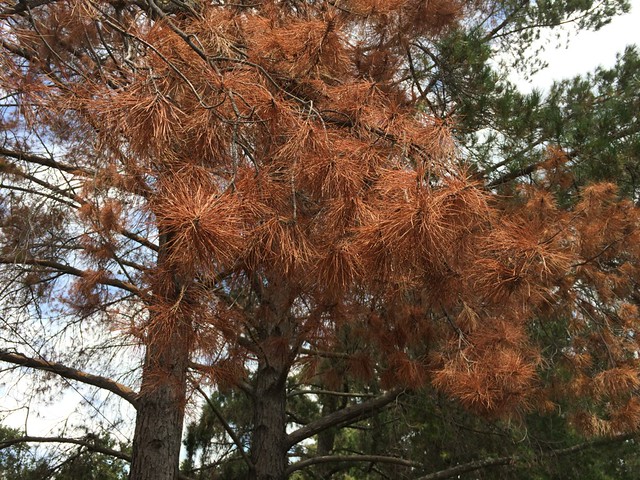
Our own family lives in the Willow Glen neighborhood of San Jose, part of the San Jose Water Company’s service area.  We have a large lot bordered by the Guadalupe River. As I wrote in February, the Guadalupe River in San Jose was dry in summer 2014 for the first time since we bought our house 18 years ago. The river rose this winter but only a few water pools are left now. Our riparian property is home to a large number and variety wild animals, including birds, reptiles, amphibians, and insects.  We have dozens of very large trees – old native oaks, cottonwoods, redwoods, ashes, olives and other nut and fruit trees – that are already stressed by the long drought. We have been reducing our water use for many years and are in the process of applying to the Landscape Conversion program of the Santa Clara Valley Water District. That is, we are letting our lawn die and planning to replace the grass with less-water-hungry plants. We will redirect the lawn water to do what we can to save our trees.  Fires set by the homeless who often settle along the riverbank are a big concern for us.  There was a serious fire caused by a campfire a few years ago just upstream from our house.  We are very motivated to keep our trees watered and in good health to reduce fire risk.

From the 9th edition of the New Sunset Western Garden Book: The Ultimate Gardening Guide (2012) p.719:

How to Fight Drought:
When drought comes, and with it the possibility of local bans on lawn watering or punishing hikes in water bills, what can you do? It’s too late at that point to install a water-conserving landscape, but you can take steps to save the plants you have.
Save established trees and shrubs first. These are costly to replace and have the greatest impact on your landscape. (A lawn can be replaced with sod in an afternoon, but a 70-foot-tall redwood can take 20 years or more to replace)….”

IMG_7205

IMG_7222

IMG_7357

Images Copyright 2015 by Katy Dickinson

1 Comment

Filed under Home & Family, News & Reviews, Politics

San Jose Night Walks

IMG_4411

I have been joining the San Jose Night Walks (starting from Starbird Park, at 7 pm every Friday). Night Walks are a program sponsored by the City of San Jose as a means of reducing violence. People of faith walk together through neighborhoods identified by the San Jose Police Department as hot spots for gang activity. We talk with neighbors, distribute books to kids, and pick up trash along the route.  This program has already been successful in San Jose and other cities as well. Success is measured by a drop in crime in the neighborhood while connecting with local residents. Rev. Peggy Bryan of St. Andrew’s Episcopal Church (Saratoga, CA) is our walk leader.  Starbird is the second walk route started by Reg. Peggy Bryan in San Jose.

IMG_4423

IMG_4417

IMG_4821

IMG_4839

IMG_4833

IMG_6442

IMG_6665

Images Copyright 2015 by Katy Dickinson

Leave a comment

Filed under Church, News & Reviews

Making Sourdough Bread

IMG_4728

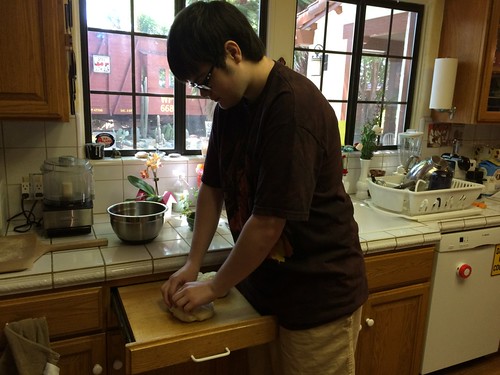
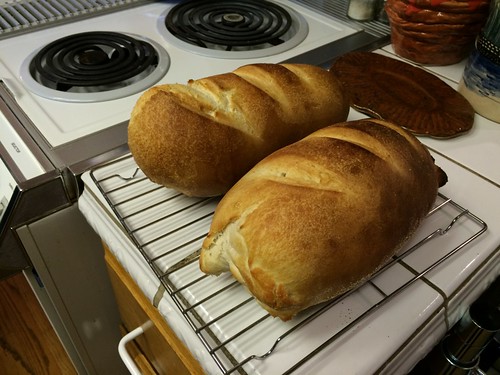
Kathy Jenks (my partner at Mentoring Standard) and I discussed our current work projects on Thursday as Kathy taught my son Paul how to make sourdough bread. We have been growing the yeast in our San Jose kitchen for the last week. She used the book Bread: A Baker’s Book of Techniques and Recipes by Jeffrey Hamelman (2012) as a reference.

Paul is a skilled ceramicist and his current classes at San Jose State University include both raku ware pottery and metal work, so kneading and moulding a loaf then baking it came easily to him. Future loaves will have a more regular shape, I am sure, but these tasted wonderful!

IMG_4754

IMG_4761

Here are some of Paul’s recent art projects:

IMG_4263

dragon 3 . dragon 14

tiki 2
Images copyright 2015 by Katy Dickinson and Paul D. Goodman

Leave a comment

Filed under Home & Family, Mentoring & Other Business

Unidextrous

IMG_4730

Yesterday afternoon, my husband and I had an accident while working on a home improvement project, which resulted in a 5 hour visit to the Good Samaritan Hospital (San Jose) Emergency Room.  We were lifting a big air filter in his workshop and it escaped our grasp.  I came home from the ER with a bruised left hand and seven stiches in my little finger. I am ridiculously right-sided but even so, it is hard working with one hand.  So far, the most difficult part of being unidextrous is washing on my right side and earning stabs of pain when I unthinkingly use my left hand.  The wages of clumsiness.

IMG_4719

Images Copyright 2015 by Katy Dickinson

2 Comments

Filed under Home & Family

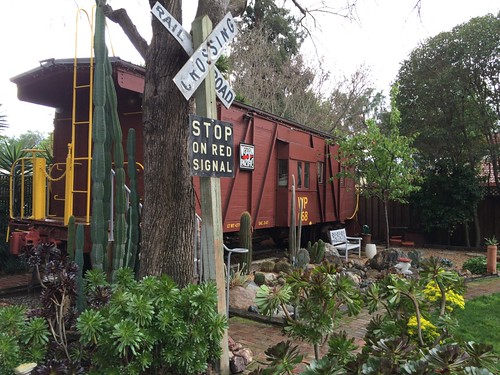
WP668 Caboose in Spring Rain

WP 668 Railroad Caboose, February 2015

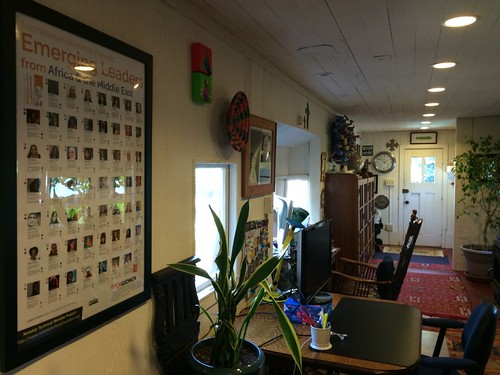
Lovely to sit in my office in WP 668 (the 1916 railroad caboose in our San Jose backyard) and listen to spring rain.  Lovely to have spring rain in the middle of California’s big drought!

Inside WP 668 Railroad Caboose, February 2015

Images Copyright 2015 by Katy Dickinson

Leave a comment

Filed under Home & Family, News & Reviews