My husband and I go for a long walk around our north Willow Glen neighborhood almost every evening. After years of covering the same ground, I noticed the wide variety and age of signs and marks under foot. A humble history is written in the pavement.
First are the concrete marks – impressions indicating what company installed the sidewalk and what year they did it. All of the marks seem to be dated between 1940 and 1967. The WPA (Works Progress Administration) put in the oldest walks during the Great Depression, followed by contract concrete companies during the 1950s and 1960s. Newer sidewalks are not so marked.
The Willow Glen community centers around Lincoln Avenue (one of the regular areas where we walk), renamed in 1865 after the assassination of President Abraham Lincoln. Willow Glen voted to become part of San Jose in 1936 but still has its own newspapers, community blog, Founders Day parade and other unique events.
On our walks I see many pavement service covers (manhole covers, water and telephone access plates, drain grates, etc.) that are marked not only with their function but who made them and where they were made. Some are brass or steel, some concrete, some are made of plastic resin. Some designs are ornate but others are very plain. All of the marked locations are either in the local San Francisco Bay Area (Oakland, San Francisco, Los Gatos, or San Jose, California) or very far away (China, India, Mexico). Technology generations are represented by Bell System (defunct company), Pacific Telephone (defunct company), SBC (defunct company), Broadband…
Come walk with me to see this strange collection…
WPA
1940 Concrete Mark
WPA
1941 Concrete Mark
A.A. Lopez
1954 Concrete Mark
N.R. Esparza Contractor
1955 Concrete Mark
M. Padia Cement Contractor
1956 Concrete Mark
M. A. Preble Contractor
1956 Concrete Mark
Silvery Tersini Driveways
Streamlined 1958 Mark
A.L. Bynum
1959 Concrete Mark
James Griffiths
1960 Concrete Mark
Lloyd Newgren Contractor
1965 Concrete Mark
A&B Concrete Const.
1967 Concrete Mark
volunteer shoe, hand, dog
marks on concrete
Brooks Products
Oakland
Water Meter
San Jose Foundary
San Jose, Cal
drain grate
G.R. Bothwell
San Jose Calif
drain grate
Voltage
PG&E
Forni Corp
Keystone Los Gatos
Bell System
access cover
Christy
Pacific Telephone
access cover
hand welded
SBC telephone
access cover
welded
Broadband CCP
access cover
India
drain
grate
Sanitary Sewer
China
manhole cover
Art Concrete Wks
Oakland Patented
Water Meter cover
San Jose
Water Works
access cover
American Brass and Iron Foundary
Storm Sewer manhole cover
Oakland, California
Sewer
SBF Mexico
manhole cover
Street Washer Lawn Cock
Mfg by M. Greenberg’s Sons
S.F. Cal access cover
Painted curb notice with fish (next to drain grates)
No Dumping Hotline 945-3000 – Flows to Guadalupe River
We were very excited that Jessica, my 20-year-old daughter, attended this week’s Presidential inauguration in Washington, DC. You can see her blog entries and photos at http://feelingelephants.wordpress.com/. Ours is a politically passionate family. One of my earliest memories was glee that my candidate (John F. Kennedy) won the presidential election over my older brother’s candidate (Barry Goldwater), in 1964.
Our family has always been split between liberal and conservative. The divergence of our current family politics is best shown in two objects: a framed picture of the late President Ronald Reagan that my father put up in the front hall of their San Francisco house (intended to be seen by everyone who came over for parties to phone Obama voters, hosted by my mother), and the shoe with BUSH –> in gold paint on the toe that someone gave my father for Christmas:
I was at work at Sun during Tuesday’s inaugural morning so I went over to the Menlo Park campus Crossroads conference room to watch history unfolding
live by CNN TV broadcast on the big screen. Because I usually get my news from National Public Radio (NPR), it was particularly interesting to see how the great and powerful look and interact:
The senior President Bush does not seem to be aging well. He sat next to Hilary Clinton and behind the new First Lady Michelle Obama, so there were many pictures of him with his mouth open looking confused.
Hilary Clinton, on the other hand, looked radiant two days before her confirmation as our new Secretary of State.
It was fascinating to watch outgoing President George W. Bush during his last minutes in office. I saw Bush pat the leg of one of the tall Marines in full dress uniform as he walked past – like you would pat a friendly dog.
Except when greeting people, President Obama seemed grim during much of the event. The only time I caught a big smile was when he messed up his inaugural
oath (he had to take it again later). The biggest smile of the day, however, was that of cellist Yo-Yo Ma who appeared delighted to be performing with violinist Itzhak Perlman. There was much wondering how the instruments and musicians could play “Air and Simple Gifts” so well on that cold day. This was cleared up when it was announced today that those on the inaugural stage heard the musicians live but a prior recording was broadcast for everyone else. However
real the broadcast, Ma’s smile and the superb music were a genuine delight.
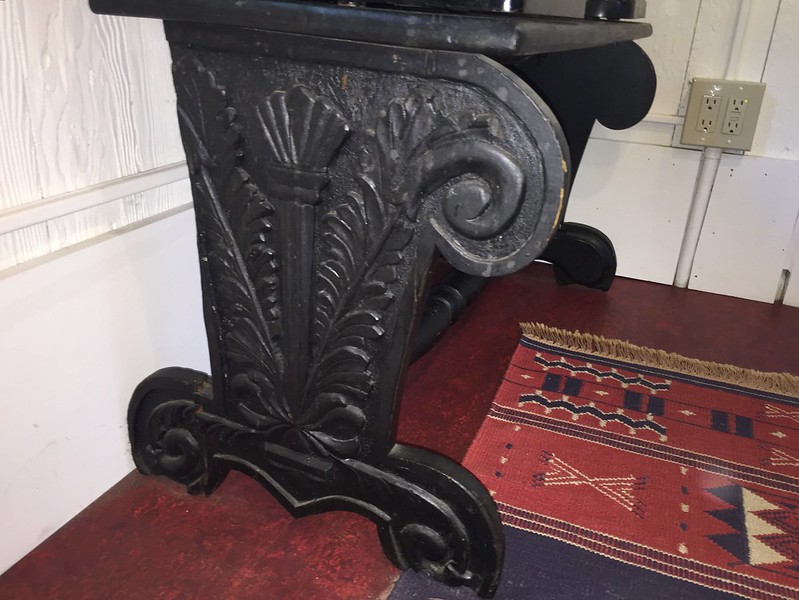
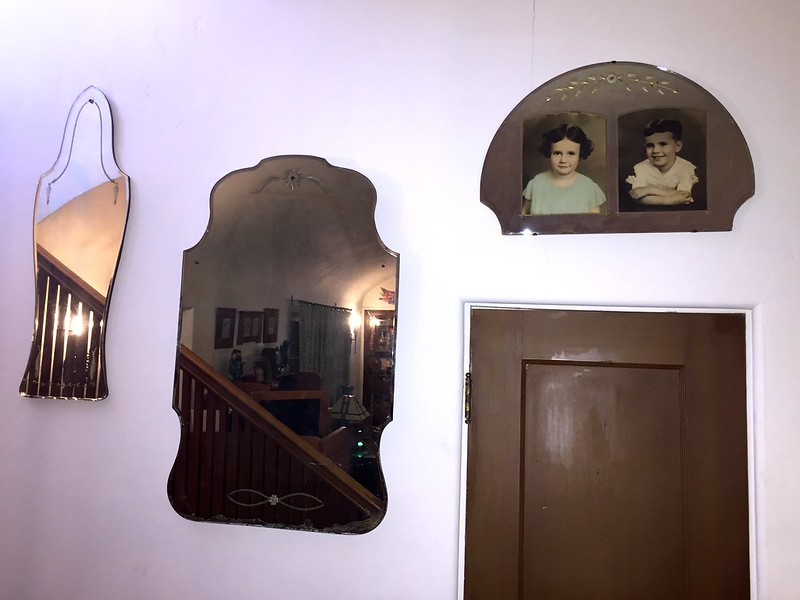
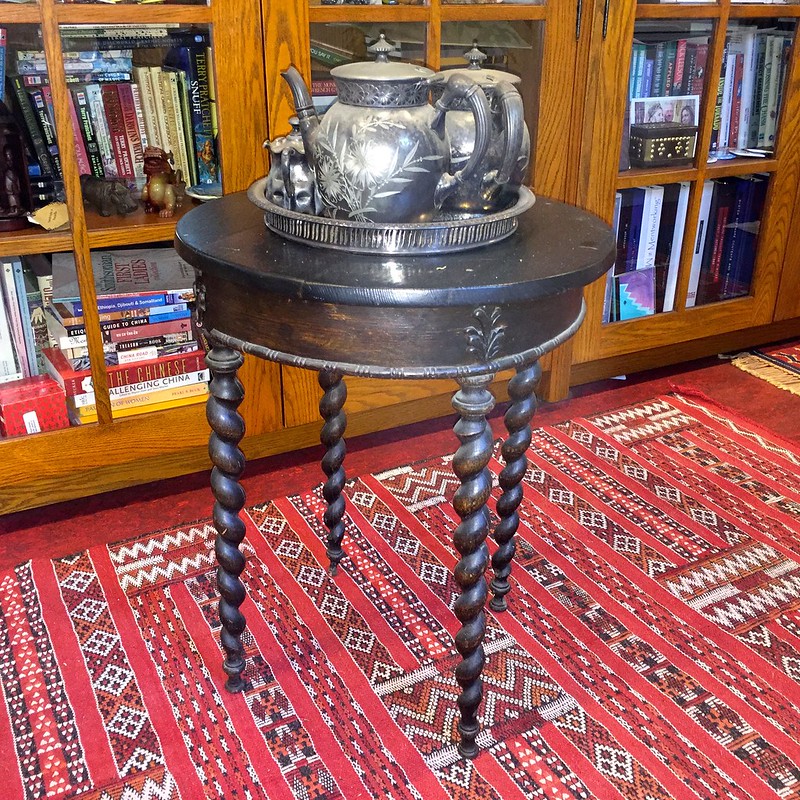
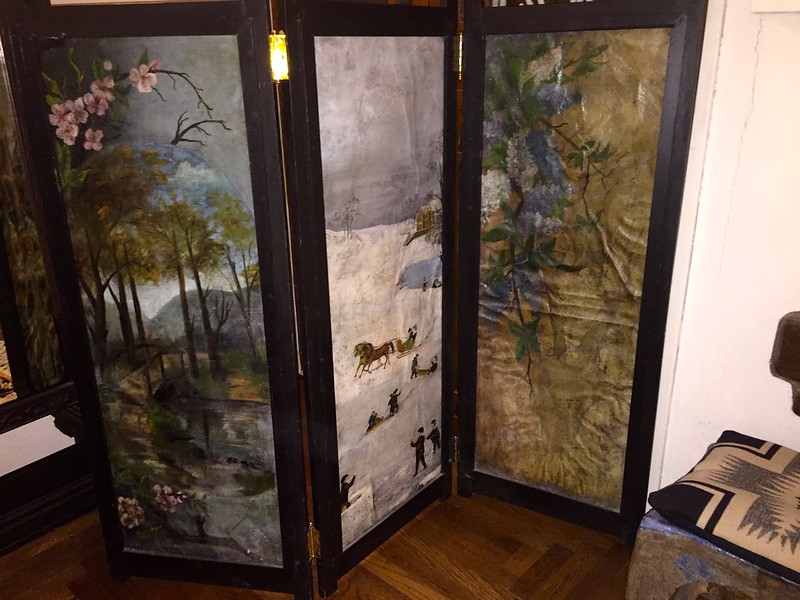
My brothers and I are working out an equitable and peaceable way to distribute family stuff. Unfortunately, we are the descendants of many generations of craft workers, artists, and collectors, so there are a great many things to be considered: furniture carved by our Mother‘s Grandmother, mirrors and stained glass created by our Mother‘s Grandfather, our Father’s Grandfather’s iron train set, our Father’s Mother’s painted set of cider mugs with matching pitcher, paintings and drawings by our Mother, etc.
Having seen several excellent examples of nasty, greedy, and predatory behavior during estate distributions, we are seeking a better way to bestow heirlooms fairly. Our motivation comes from growing up during a family fight over an estate that started in 1990 and lasted for more than ten years; the quarrel about which descendant got what eventually outlasted the lifetime of the original executor. We hope to avoid that experience in our generation. As our Father says: “I would rather burn it than fight about it.”
I am writing this out because when I searched the web for a good example, a property distribution process to model ours on, everything I found seemed to be associated with contentious divorces. I did not find any models in which the parties were assumed to be on speaking terms. My brothers and I each want some family stuff but we also want to preserve our good relationship more than we want any particular thing. I hope that the system we have developed over the last six years will be of use to other families who share our values.
Our parents are both living and have very generously and foresightedly agreed to distribute a selection of their family possessions in advance of their passing (which we hope will be many years in the future). My brothers and I have been in this distribution process for the last six years and have already sorted out who gets which of the larger pieces of furniture. In addition to getting a family chore done, we are learning more about each other and getting closer through these discussions. In this context “distribute” means transferring ownership but not necessarily the objects themselves. For example, my parents dining room table was given to me several years ago in one of our distributions; however, my parents will continue to use the table for their lifetimes.
At first, the distribution lists were annual and small, with just three or four heirlooms going to each of us. The distribution we are discussing now is our most ambitious, with fifty-four heirlooms to be sorted into three groups of eighteen. Here is an overview of the process we originally used:
Our parents make a list of heirlooms for us to consider and distribute. Usually, this means my having several discussions with our Mother since I live closest. One of my brothers lives at the other end of California and the other lives across the country, in Massachusetts.
My brothers and I ask questions – how big is it? what condition is it in? where did it come from – is there any special meaning to it? Sometimes pictures are distributed.
My brothers and I check with our spouses to collect their opinions.
My brothers and I have a three-way phone call during which we decide who gets what. The call is only between the three of us, no spouses or parents.
I tell our Mother what we decided in our call.
Our Mother writes each of us a letter giving us the items.
With so many more items to distribute this time, it has been harder to come to a decision. Our Mother sent us a list in August we are still discussing. We had not seen many of the items, so the whole family took a house tour when my brothers visited during Christmas. We walked around the house we grew up in and asked our Mother to point to each item on her list. Last Saturday, my brothers and I had a preliminary phone call.
We discussed what “family furniture” meant to us. If our Mother bought it, does that still count as “family”? When our Great Grandparents’ early Victorian house on Circle Park in Knoxville, Tennessee, was torn down in 1964, our Grandmother removed the front doors. Eventually our Mother had the doors installed on her house in San Francisco. Are those antique doors “family furniture”?
My brothers asked me to sort the fifty four items into three groups prior to our next call. I decided to ignore the potential market value of the items and focus on three important categories: size, history, and who actually wants the thing. I created three groups of 18 items with roughly the same number of things in each of these categories in each group:
Size:Small (antique toys, table clocks, the Cherokee hunting bow, the cider set), Medium (side tables, small chairs, stained glass panels and mirrors, our Great Grandfather’s glass case of stuffed birds), and Large (the front doors, our Father’s white leather arm chair, an 8′ tall hall mirror in a gold plaster frame, a huge wooden ice box, a set of balloon back chairs with seat cushions embroidered by our Great Grandmother).
Special Family Origin: anything made by a family member, the bannister from the Circle Park house, our Great Grandmother’s wicker rocking chair, etc.
Desireability: Anything that more than one of us expressed interest in during the preliminary phone call.
I sent the sorted groups to my brothers with the following proposed process:
Step 1 – Before the Meeting – Review the groups, ask questions, talk with spouses, say if there are one or two “heart’s desire” items
Step 2 – During the Meeting – Each of us picks a group (1, 2 or 3)
Step 3 – Accept / acknowledge conditions to replace installed items (such as the front doors)
Step 4 – Discuss trades. Other than trades, the group is distributed intact, where and as is.
I am curious to see how well this sorting worked and whether the distribution discussion goes better as a result.
Note: None of the items pictured are for sale. I do not provide pricing or sales advice for similar items. Please do not ask.
Images Copyright 2008-2016 by Katy Dickinson
13 June 2016: Images retaken and reposted, note added. 4 Feb 2021: photo links updated.
If you want to receive Katysblog posts by email, please sign up using the Sign Me Up! button (upper right on Katysblog home).
For my birthday, my mother gave me two books and a chicken. The chicken is an elegant ceramic cooking pot made by Win Ng in the late 1960s. It is practical and well made and has cooked many family dinners.
Win Ng was a family friend, ceramicist, and co-founder of the popular Taylor & Ng store in San Francisco. When I was a little girl, he adopted one of our Siamese kittens, which gave us something to discuss when we visited his store. Long after the store closed, my mother rented studio space from Win Ng on Belcher Street in San Francisco. She still has one of his larger ceramic sculptures on her garden deck.
Win Ng Chicken Cooker:
Win Ng Ceramic Cube:
Images Copyright 2008-2011 by Katy Dickinson
Updated 17 August 2016
So, I have been gardening but we haven’t gotten much done on WP668, our backyard caboose. However, four caboose projects which depend on other people’s work are creeping toward completion:
The metal roof should be installed on within a week – I am waiting for the
exact date to be set.
I ordered the Western Pacific Feather River Route replacement decal today
(from the Western Pacific Railroad Museum in Portola, they had extras). The metal
plate on which the decal will go is is 23-1/2″ tall by 25-1/2″ wide.
The new subfloor and linoleum go in on 19-20 May.
Vince Taylor may have the stained glass panels done this month. He came by on Saturday to show me the scale drawings and more glass samples. He would have been done sooner but had a big show at Filoli which changed his schedule.
Last weekend, we enjoyed many of our family’s traditional Christmas events, including: going to The Great Dickens Christmas Fair and singing carols on a cable car in San Francisco. We picked up my daughter Jessica and her boyfriend Matt at SFO airport on Wednesday. (They were due home from college Tuesday night but their second flight was cancelled and they had to stay over in Dallas, Texas, courtesy of American Airlines.)
On Saturday, Jessi and her friends dressed up to go to the Dickens Fair at the San Francisco Cow Palace. My mother and friend Laura went too. Sunday, we went to the Lessons and Carols service at St. Andrew’s Episcopal Church in Saratoga, then picked up Matt and drove to the city to sing carols with my parents. (Jessica revised our carols book this year.) We rode from Van Ness and California up and over Nob Hill to the Embarcadero. We walked around there to see the decorations before taking the cable car back. Today, my mother is coming to San Jose to assemble and bake fruitcakes. Tonight, we go to Christmas Eve service at St. Andrew’s. Christmas is at our house tomorrow; we are expecting 12 for dinner.
SFO: Jessica and Matt
home from college
Dickens Fair – Mad Sal’s Ladies’
Oratorical and Recreational Society
Dickens Fair – Gilbert & Sullivan’s
Pirates of Penzance
Dickens Fair –
Pirates of Penzance
Dickens Fair –
Jessica and Friends
Dickens Fair –
Dark Garden tableau
Dickens Fair –
Dark Garden tableau
San Francisco
cable car sign
Family Christmas
carol song book
Eleanor and Paul
with cable car
San Francisco
cable car view
John and Paul
singing
John and Eleanor
singing
John and Jessica
singing
Family with
cable cars
Paul and Eleanor
on cable car
Cable car on
California
Giant red ornament
plaza decorations
Paul inside
red balls
Jessica inside
red balls
Matt inside
red balls
Family with
red ornaments
Hyatt Regency
sculpture and lights
Jessica and Matt
pool reflections
Hyatt lights
and tree
Hyatt tree
and hanging lights
Paul and Jessica
and Matt at Hyatt
Wade at
Hyatt
Images Copyright 2007 by Katy Dickinson and John Plocher
Next on my re-read list is
Herman Melville‘s Moby Dick, and then Richard Henry Dana‘s Two Years Before the Mast.
My favorite part of Dana’s story is the last chapter in which he visits
San Francisco Bay. The description of the Bay Area taken from his diary
in the late 1830’s (before the Gold Rush) is fascinating.




 KatysBlog