Tag Archives: Mentoring

Mentoring Program Web Tools and Process

Web tool design is a technical art which requires an unusual combination of software programming, usability engineering, and program management skills. As Director of Sun Microsystems’ SEED Engineering-wide worldwide mentoring program since 2001 (and the program’s Process Architect), I have been gifted with two talented staff members who can do this work. Tanya Jankot has been SEED’s Applications Engineer since 2003. Before Tanya  Justin Yang held the position of SEED Program Manager for two years.

SEED developed its own set of tools for mentoring program and information management. These tools have not been “productized”. Why not use an external-to-Sun set of web tools? For the answer, read my 30 June 2009 blog Internal or External Mentoring Program?

Tools and Process Overview

The original SEED program was based on a year-long need analysis and program design in 2000 by a team mostly made up of Sun Human Resources (HR) and Engineering staff. The process itself was created on-the-fly during the first pilot term in 2001. The SEED mentoring program has expanded to a much larger audience in recent years and SEED’s web tools have developed and been redesigned accordingly. In the program’s first year, 2001-2002, there was just one term. In 2008-2009, there have been 12 overlapping terms in four groups (Recent Hires, Established Staff, PreSEED, and special pilots). Since the SEED team and I were creating a new mentoring system essentially from scratch in the 2001 pilot term, our guidelines for process and tool development were:

  1. Keep it simple
  2. Check in with customers and stakeholders frequently
  3. Only include the minimum: question the need for each step before it goes in, and again at every review, and again before publication
  4. Let the process define the web tools
  5. Assume that process and tool users will have access to only the most basic web resources and performance
  6. Collect and analyze data routinely and make decisions based on those data

These guidelines have continued to serve SEED well. We also kept using the concept of a “pilot” to expand the program. In pilot terms, the rules, process, and/or scope are somewhat different from the regular SEED program. The Established Staff group was created in 2002 and the PreSEED program was created in 2008 using pilot programs; both have been very popular offerings. A pilot allows us to put something imperfect out there to see
what works. Sometimes pilots fail (for example, the SEED-2 or SEED Alumni term in 2007 only attracted ten participants).

SEED now has two major formal processes, for participant selection, and for mentor selection. These processes are published in full detail for the use of Sun internal program participants. Flow charts are also available in the appendix of “Sun Mentoring: 1996-2009” the Sun Labs 2009 Technical Report  (includes a copy of the Research Disclosure Database Number 482013, defensive publication from Research Disclosure, Published in June 2004, Electronic Publication Date : 17 May 2004).

In November 2008, Tanya created and gave an internal-to-Sun presentation on developing simple web technologies using the SEED tools as examples. Her presentation was created to educate other Sun project teams and web teams. The information following about SEED web tools is derived from Tanya’s presentation. Her overview statements about the SEED’s current web tools:

  • The technology was built to model SEED mentoring processes which were already designed and pilot tested (we tried to fit the tools into the existing work flow rather than build processes around the tools).
  • The tools have evolved with the program: need for greater automation to allow scaling, new requirements as the program expanded across geographical areas regions, organizations, etc.
  • SEED relies on existing Sun corporate data systems as much as possible, only
    gathering additional information not already available elsewhere.

More specific details follow about SEED’s web tools and the technology and process behind them. Screen shots and other confidential data have been removed from Tanya’s original presentation material.


Developing Simple Web Technologies for the SEED Mentoring Program

Tools Behind the Program

  • The systems supporting the SEED program have evolved with it over time. They currently include:
    – A system to manage each term’s application process. Details are in Term Application Materials and Term Application Management, below.
    – A system to support the mentor matching process. Details are in Mentor Request Management, below.
    – An archive of program applicants, participants, mentors, etc. which enables long-term program management and metrics. Details are in
    SEED Program Database, below.
    – Applications to support regular program activities, such as regular quarterly feedback reports and bi-annual events for mentees, mentors, and the mentee’s managers.
  • Tool development goals:
    – Ensure the integrity and confidentiality of applicant and participant data.
    – Increase the ease-of-use for program participants and SEED staff.
    – Increase program efficiency and quality of data available to the SEED team, extend the number of participants, raise the value of participant experience, and justify their trust in the program

Simple Technologies

  • “SAMP” (Solaris, Apache, MySQL, and Perl & PHP)
  • htaccess and Sun confidential employee records access authentication
  • Queries to the Sun confidential employee records system
  • Email
  • Other technologies available within Sun and Sun Labs, such as a name auto-suggest widget and a survey tool.
  • And still making use of old-fashioned static web pages

Term Application Materials

  • SEED terms have an application period, usually lasting two to three weeks, with firm deadlines.
  • htaccess and Sun confidential employee records access are used for authentication
  • In addition to submitting a completed application form, applicants must also submit their resume, their manager must submit a letter of recommendation, and in some cases they must also secure additional letters of recommendation from Sun executives. All materials are submitted through web-based forms.
  • Design considerations
    – Applicants are located worldwide.
    — Application materials need to be as clear and simple as possible because for many employees, English is not their primary language.
    — Applications must be functional on all Sun systems and locations. This includes Sun hardware with Solaris software, Sun Ray systems, experimental systems, as well as a variety of Macs, laptops, and PCs.
    – Application materials must reflect Sun’s organizational structure and HR policies in an understandable way. Many applicants are new to Sun and are not familiar with its organization or policies.
    — Divisions, organizations
    — Job Codes, titles
    – Manager and executive recommendation letters are submitted confidentially but are a required part of an application. A secure mechanism is needed for applicants to view the status of their application but not the details of all materials.
    – In order to ensure that all materials are submitted correctly and not “lost” (i.e., a recommendation letter is submitted against an incorrect applicant SunID), Sun confidential employee records system lookup, email confirmations, and SQL audits of the database are used.
    – Each term’s application materials are stored in a separate database for easy management. Key applicant data that needs to be tracked long-term is loaded into the SEED archive database at the end of the application period.

Term Application Management (SEED Team Website)

  • A central website used by the SEED program staff to efficiently track the status of applicants and their materials.
  • At the end of the term application period, key applicant data is verified against Sun’s Human Resources records.
  • Used by SEED’s executive selection committee to review each applicant thoroughly.
  • Tool goals
    – Present useful summary data in a small amount of space.
    – Accurately reflect the status and materials received for each applicant.
    – Allow a complete review of each applicant’s submitted materials.
    – Make information easy to find to answer questions from applicants, participants, managers, and mentors quickly and accurately.
    – Print in a useable format.

Mentor Request Management

  • Upon acceptance to the program, all participants are required to submit a 10-name “Mentor Wish List” of mentors they would like to work with.
  • At the close of the mentor request period and receipt of all wish lists, the SEED program staff begins the mentor match process. For each participant, the goal is to match them with the highest priority eligible mentor from their Mentor Wish List.
  • A decision is made in each case where more than one Participant requests the same potential mentor. In SEED’s current terms, 80 mentees prepared 10-name lists, which resulted in 387 unique mentor requests. There were 10 potential mentors with multiple 1st Priority requests and 39 mentors who were requested by 5 or more mentees. This is a common problem: as many as twenty-two(!) potential mentees in one term have requested the same mentor. The primary basis for this decision is the priority order on the Mentor Wish List provided by the Participant. The Participant’s seniority (number of years at Sun) may be used as a tiebreaker, with the more senior Participant getting preference.
  • Tool Requirements
    – For each mentor requested, both name and SunID are required to be entered due to variations in name entry and frequent errors in entering SunIDs.
    – A name auto-suggest widget has been very useful in creating cleaner submissions.
    – The Mentor Request form includes a validation step in order to check for known conflicts in the SEED Potential Mentors list.

SEED Program Database

  • The SEED program database drives the long-term management of the program.
  • It allows us to track past applicants, participants, and mentors, as well as manage our list of 450+ Potential Mentors: mentors who have volunteered to work with program participants.
  • These records allow for regular metrics analysis of the program, currently done annually. Automated metrics tracking is a goal that is in progress.
  • Challenges
    – Maintaining the data so it is meaningful over time. For example, divisional organizational changes (reorg) make it difficult to summarize the number of participants we have had from each organization over the life of the program.
    – Keeping the mentor records up-to-date: removing broken links, updating titles in a timely way.
    – We need to maintain records of all program mentors, participants, and applicants, even after they have left Sun.

Conclusions

  • The systems and tools that support SEED have evolved with the program over time. They are not a single unified system, but being modular are easy to modify or extend when changes are required.
  • Using the technologies that are available and used by others allows you to be more efficient: learning from their work, and sharing components when possible.

Series

This is part of a continuing series on mentoring programs. Information is to answer frequently asked questions, based on my experience since 2001 managing Sun’s SEED Engineering-wide world-wide mentoring program. Other entries in this series were integrated into “Sun Mentoring: 1996-2009” the Sun Labs 2009 Technical Report.

25 October 2013 – links and text updated

Leave a comment

Filed under Mentoring & Other Business

Picking Your Mentor, Picking Your Mentee

Information in this entry is taken from my experience since 2001 managing Sun’s SEED Engineering-wide world-wide mentoring program. This is part of a continuing series on mentoring programs, answering some of the questions I am most frequently asked. Other entries in this series:

Using a Formal, Structured Approach

This entry speaks to would-be-mentees as well as to potential mentors on how to pick their mentoring partner. Both are addressed here so mentor and mentee can see the whole picture. Specific mentor matching systems are covered in Mentor Selection Systems. In general, I recommend a formal, structured approach like that we use in the SEED program, because I have seen this approach work in almost 1,200 matches, 70% of which were with an executive mentor. You can learn more about SEED by reading the blog entries listed above. Also, flow charts of how SEED’s process works are available at “SEED: Sun engineering enrichment & development” Research Disclosure Database Number 482013, defensive publication in Research Disclosure, Published in June 2004, Electronic Publication Date : 17 May 2004 (5 pages, PDF format).

Doris Lessing at lit.cologne 2006, from Wikipedia “That is what learning is. 

You suddenly understand something you’ve understood all your life,

but in a new way.”

– Doris Lessing (2007 Nobel Prize in Literature, 1919-now)

For the Mentee: Start with a Mentor Wish List and Learning Goals

Before the mentor matching cycle starts, each SEED mentee is asked to prepare a 10 name Mentor Wish List which is prioritized and includes a reason why the mentee would prefer to work with each mentor included. Three learning goals are also part of the SEED Mentor Wish List.

  • Why 10 names?
    I have run mentoring terms in which we asked for 5 names but it wasn’t enough: I ended up going back to the mentee for more potential mentor names too many times. I have also run terms in which we asked mentees for 15 names but since each name represents serious thought
    and research and we very rarely ended up needing all 15, we cut it down. In practice, 10 potential mentor names seems the right number. In the current group I am matching of 80 mentees (just 14 still unmatched), I have only had to go back to 2 so far for additional names.
  • Why prioritize potential mentors?
    • First, to get the mentee-to-be to think seriously about who they want their mentor to be by forcing a ranked comparison. It takes time and mature consideration to work through all of this. Creating the Mentor Wish List is probably the hardest part of the SEED program; however,
      that advance thinking contributes to a more successful mentoring partnership.
    • Second, to help the program staff decide when there are duplicate requests for the same mentor. In SEED’s current terms, 80 mentees prepared 10-name lists, which resulted in 387 unique mentor requests. There were 10 potential mentors with multiple 1st Priority requests and 39 mentors who were requested by 5 or more mentees. When a mentor is requested by more than one mentee, SEED’s primary basis for picking one mentee over the other is the priority order. The mentee’s seniority (number of years at Sun) may be used as a tiebreaker, with the
      more senior mentee getting preference.
  • Why require mentees to write reasons for preference?
    This is to answer the #1 question asked by potential mentors: “Why me? What does this person want to know that I am uniquely able to teach?” That is, before they make any decision, potential mentors (especially executives whose time is particularly valuable) want to gauge the mentee’s motivation and seriousness. They want to see if spending six months with this mentee is a good use of time. SEED sends each potential mentor an email including the potential mentee’s resume, 3 learning goals, plus reasons for preference. We offer additional information (the application form and letters of recommendation) but most matches are made based on the first email plus a pre-match conversation between the potential mentor and potential mentee. Very often, the potential mentee’s own words in their preference statement makes the match. Some mentees think to save time by providing the same reason for preference for all of their potential mentors. Mentor Wish Lists are returned for revision when this happens. Reasons for preference should be as unique as the mentors themselves.
  • Why require learning goals?
    The mentee’s three learning goals give the potential mentor an idea of initial topics for discussion (where their conversations will begin). This helps the potential mentor evaluate whether they can help the mentee. The SEED Engineering mentoring program takes a long-term view and does not have a preference for one kind of learning over another. That is, the mentoring partnership learning does not have to have anything to do with the mentee’s current job. Some people want to learn to be better technical managers, others want to know how to get their ideas to customers faster. Many want to improve their soft skills: public presentation or speaking, negotiating, conflict management, and coaching. Still others want to improve their work and family balance and still have a great career. More general and broader learning goals usually work better than specific or very technical goals. Extremely specific goals or requests to work on a particular project with the mentor often discourage even the most accomplished mentor and make the mentee very difficult to match. Three examples of 3 broad learning goals: 

    1. Learn more about how to lead a virtual team.
    2. Learn how to communicate with my management team.
    3. Learn how to communicate better with customers.1. To be engaged intellectually with senior peers.
    2. To apply my analytical skills and interests to a new and interesting area.
    3. To increase my own motivation.

    1. Diversify my knowledge by learning from individuals in other business units at Sun.
    2. How to take on more responsibility and enhance my visibility at Sun.
    3. Improve my understanding of corporate expectations from a technical leader and improve my leadership skills.

For the Mentee: Who Goes on Your Mentor List?

Potential Mentors should be included on a Mentor Wish List primarily because of their accomplishments, experience, personality, capabilities, or skills. For
more on this “Demonstrated Accomplishment” selection system, see

Mentor Selection Systems
.

The Cheshire cat as John Tenniel envisioned it in 1866, from Wikipedia Alice: “Would you tell me, please, which way I ought to go from here?” 

“That depends a good deal on where you want to get to,” said the Cat.

“I don’t much care where -” said Alice.

“Then it doesn’t matter which way you go,” said the Cat.

Alice in Wonderland, 1865, by Lewis Carroll

The focus of mentoring in the SEED program is long-term professional and technical development. It is not appropriate for a mentee to request a mentor with the sole aim of being hired into a specific job, securing project funding, or gaining a particular political advantage.

Social Context, Gender, and Mentoring

In addition to Demonstrated Accomplishments, many mentees seek a mentor who shares their social or personal context in terms of gender, race, ethnicity, shared language, nationality, or other demographics. These characteristics may properly be part of why a particular mentor is requested; however, in my experience these characteristics by themselves do not provide enough commonality for six months of discussions, so no one of them will be successful as the sole reason for preference. When SEED receives a Mentor Wish List containing inappropriately simplistic reasons for preference like “He is a very successful Chinese in Sun” or “Female Mentor in a top role in an organization”, that list is returned to the potential mentee for expansion.

However, these social and personal characteristics can be very important in professional life and are appropriate topics for some mentor-mentee discussions. Gender in particular may have an influence on how mentors and mentees respond to mentoring programs. Women and non-US staff have taken advantage of the SEED program at a consistently higher rate than their representation in Engineering overall. The Anita Borg Institute for Women and Technology and the Michelle R. Clayman Institute for Gender Research, Stanford University, prepared an excellent study in 2008 called Climbing the Technical Ladder: Obstacles and Solutions for Mid-Level Women in Technology (by Caroline Simard, Andrea Davies Henderson, Shannon K. Gilmartin,
Londa Schiebinger, and Telle Whitney) which reported:

    “Women at the mid level are more likely to rate the availability of mentors and mentoring programs as important to retention than are men (48.7% versus 36.2%). (The gender difference on this item is especially wide at the entry level, where 60.6% of technical women point to a need for to mentoring programs, compared to 39.1% of men.)”

As reported in SEED’s “5 Years of Mentoring by the Numbers” (by Katy Dickinson, presented at the October 2006 Grace Hopper Celebration of Women and Computing, 30 pages, PDF format), based on SEED’s data since 2001, there are three consistent gender patterns with regard to mentor matching in Sun Engineering:

  • More male mentors are requested by both male and female mentees overall.
  • Female mentors seem more willing than male mentors to accept a mentee, regardless of gender.
  • Female mentees request twice as many female mentors on their Mentor Wish Lists as do male mentees.

Some questions this has raised:

  • “Is there a substantive difference in reported satisfaction between mentees with male mentors and those with female mentors?”One of the opinions (often a seemingly-unquestioned assumption) I often hear from managers of other mentoring programs is that women exclusively want and benefit from having mentors who are also women. While the SEED Engineering mentoring program’s data show that female mentees have a strong preference for female mentors, it also shows that men and women mentees report the same program satisfaction
    (90% average), regardless of their mentor’s gender. That is, SEED’s data over many years show that there is no real difference in reported satisfaction. The sample size of female mentees is smaller than the sample of males (this is Engineering, after all); however, there is no pattern of satisfaction difference.
  • “What is the downside to special mentoring programs for women?”As Dr. Ellen Spertus wrote in “Why are There so Few Female Computer Scientists?” (MIT AI lab Technical Report 1315, August 1991):”While there is a need for affirmative action programs, they have large negative effects that must be considered. Even if a program does not entail lower standards for women, doubts are cast on a woman’s qualifications in a society that already mistrusts them. Programs with lower qualifications may be a tactical mistake (in addition to being unjust) because people may be put in situations for which they are not qualified, giving them less overall success and self-confidence than they would have had otherwise. These negative effects should be weighed when considering implementing an affirmative action program.”

For the Mentee: Researching Potential Mentors

A good background search by the mentee will result in more detail and understanding of the potential mentor, also resulting in a more convincing reason for preference. Many times, the mentee’s explanation convinces the potential mentor to consider them seriously. Sometimes, it makes the match. Mentees should not confuse researching mentors with asking someone to be their mentor: these are two different steps.

Mentor Research Steps:

  1. The mentee should start by thinking about mentoring relationships she has already had (personal, academic, or professional) and ask herself:
    What would I do the same or differently? Do I want a mentor who is similar or different? She should also think about what she wants to learn from another mentoring relationship: what need or gap do she want to fill in her accomplishments, experience, personality, capabilities, or skills? Are there patterns of behavior or performance feedback to be considered?
  2. The mentee’s second step in researching potential mentors should be to ask her supervisor or manager for support and advice. The manager knows the mentee and has a professional stake in the mentee’s success. Also, the mentee should ask for advice from other people who know her well – taking advantage of their experience, wisdom, and networks.
  3. A general search for background on the potential mentor using a web search engine is the next step. In particular, the mentee should look for professional profiles on web communities such as LinkedIn or Plaxo (rather than the more social communities such as Facebook). Many Directors and Principal Engineers will have executive profiles prepared by their company. Most Vice Presidents will have such a page.
    The web home page of potential mentors’ professional or academic organizations may also be a fruitful source of information. Groups such as
    Association for Computing Machinery (ACM) and IEEE offer biographies of award winners, office holders, etc.
  4. In searching for mentors, it may help the mentee to go through a list of leaders or executives in her professional or academic area to pick out the people who have titles the mentee wants for herself someday. The mentee should pick out names of people who are already far down the career path in which she has an interest. This is like doing research for a university paper – hunting for leads, backtracking, looking for key words, hunting again. Mentees should expect to spend many hours developing a good Mentor Wish List.
  5. The mentee’s manager can provide perspective by checking the Wish List after it is complete, before the mentee goes into the mentor matching cycle.
Mohandas Karamchand Gandhi, pictured in the 1930s, from Wikipedia “Where the ultimate goal is the search of truth, 

no matter how a man’s plans are frustrated

the issue is never injurious and often better then anticipated.”

– Mahatma Gandhi (1869-1948)

For the Mentor: Deciding to Become a Mentor

Since the mentee drives the relationship, the mentor is usually in the position of deciding whether to accept a specific mentoring proposal, rather than having to seek out a mentee. Common questions from mentors include:

Why become a mentor?

  • One SEED mentor who had turned down several mentee requests wrote when he did accept someone: “I’ve been struggling with this however I’ve (finally) decided that I want to do it. I’ve asked other people for help along these lines so I guess it’s time for me to give a little back.”
  • A Vice President-Fellow mentor who had already served in several SEED terms wrote in his first email to his new mentoring partner: “I look forward to our mentor-mentee relationship. This will be a good experience for both of us. I will learn some and you will learn some, it is up to us to make the most out of it.”
  • A Distinguished Engineer wrote in his quarterly report: “This is a very worthwhile program that I’m pleased to be able to participate in. In the two times I’ve participated as a mentor I’ve gotten at least as much out of the experience as the mentee.”
  • A Vice President wrote in evaluation of his 6th SEED mentoring experience: “This continues to be a great program and I get a lot out of it — possibly more than the mentees.”
  • A Software Staff Engineer wrote about his 2nd SEED mentorship: “Love the SEED program. Low cost to shareholders, high value to
    shareholders.”
  • A Distinguished Engineer who is an 11-time mentor wrote: “SEED is a great opportunity for both Mentor and Mentee. It opens both
    personal and technical doors by providing a 1-1 context outside of normal work requirements.”
  • In addition to giving personal and professional satisfaction, becoming a mentor can help expand understanding and experience.
    Mentoring may also specifically support professional development in organizations where leadership is one of the criteria for evaluating promotion potential.

In their own words:

  • “What do mentors do?”
  • Working in parallel with the mentee’s manager (and communicating with the manager as appropriate while respecting confidentiality), the mentor recommends training and experiences, makes introductions, provides continuing advice, assistance and support, and evaluates progress. Some mentors may discuss or work together on projects with mentees. Mentors may also be asked to support the development of the mentee’s “soft” skills such as public presentation/speaking, negotiating, conflict management, and coaching.

  • “What do mentors look for in mentees?”
    The mentor should be interested in at least some of the same work areas, problems, or projects as the mentee. However, working in the same broad professional area (software, microelectronics, sales, etc.) may or may not be an advantage to a mentoring pair. There have been very successful mentoring partners who shared a technical focus but were in very different areas. Sometimes having a different specialty can be a real advantage because there is more to talk about and learn. Personal compatibility and commonality (with both the mentee and their manager with whom the mentor may need to communicate from time to time). Physical proximity or time zone proximity may or may not be important. Proximity may mean that the mentor and mentee have offices near each other or that one of them can travel for an in-person visit from time to time. However, while face-to-face meetings are valuable, they are not always possible. A great deal can be accomplished over the phone and by email. For many years, the majority of SEED mentor-mentee pairs have worked at a distance (in difference cities, states, or countries). In a global workforce, potential mentees may work in an area where there are few or no senior Engineering staff available to mentor them. In their case, being mentored “at a distance” is their only choice. 

    In their own words:

    • In April 2003, a mentor wrote in his quarterly report: “…the impact one can make by being a mentor in a non-US Geo is considerably high, as per my personal experience. I derived a lot of satisfaction and good perspective during this mentoring program. Also, this Mentoring program made me to think about some issues affecting the local engineering center, and we are working towards addressing these issues.”
    • In July 2009, a mentee working in Japan spontaneously wrote an evaluation of his relationship with his mentor (who works in Israel): “I cannot thank more for his effort he put into this program, his frankness and openness as well as shared knowledge not only regards to the professional life but also the personal life. … Though my goal was slightly different at the beginning of the term, learning from someone who is ahead in professional life, while managing his work-life balance provide me a new perspective. Managing balance is still challenging for me, but sharing simular experience about family from different point of view was and continue to be helpful for myself. Visiting the differences in each others’ culture starting from the calendar was, for me an exotic experience and continue to be interesting one. I am looking forward to continuing our relationship.”
  • Availability (if the mentor is a senior executive or a manager with a large staff, she will have less time).
    Potential conflicts of interest or areas of discomfort with the mentee or the mentee’s manager (for example, it may be a problem if the mentor and mentor are in the same management chain, or if there are close personal relationships). Mentor and mentee should talk about these potential conflict areas before being matched.

Common questions mentors report thinking about when deciding whether to accept a particular Mentee include:

  1. Why me? What does this person want to know that I am uniquely able to teach?
    Potential mentors (especially executives whose time is particularly valuable) want to gauge the mentee’s motivation and seriousness. They want to see if spending six months with this mentee is a good use of time.
  2. Do I already know the mentee who has requested me (or know of them, or know their manager)?
    That is, is there a prior connection or knowledge? The prior connection may allow the mentoring partnership to start sooner and at a deeper level, or the history between the mentor and mentee may slow or prohibit the development of a partnership. In any case, it needs to be thought through.
  3. Is there a line reporting relationship?
    It may be a problem if the mentor and mentor are in the same management chain.
  4. What is my availability during the mentoring term?
    Most mentors take mentoring very seriously and want to be sure they have the time to do a good job as a mentor. If the potential mentor has just taken a big new job or has irreducibly large personal or professional time commitments, she probably will not accept a mentee until her schedule is lighter.
  5. Can I effectively partner “at a distance”?
    Mentoring across distance and time zones may be a skill that the potential mentor needs to develop. SEED mentoring pairs who work at a distance have for many years report the same satisfaction level as those working locally; however, mentors and mentees both report that working at a distance is more time consuming.

Circumstances mentors have identified as being important when considering a mentee include a mix of:

  • Mentor’s availability when asked (almost always the #1 consideration)
  • How well the potential mentor’s and mentee’s schedules match (and their flexibility to accommodate  each other’s schedules)
  • Mentee’s accomplishments, experience, seniority
  • Mentee’s capabilities, skills, potential
  • Common intellectual or professional interests
  • Personal compatibility or common ground (including linguistic abilities: whether the mentor and mentee share a common language)
  • Physical, geographic, or time zone proximity
Senator John F. Kennedy in his Senate Office, 1959, from Wikipedia “Leadership and learning are indispensable to each other.” 

– John F. Kennedy (35th U.S. President, 1917-1963)

Photos are from Wikipedia

1 Comment

Filed under Mentoring & Other Business

What I Love About Sun – After 25 Years

I just filled in the order for my anniversary gift from Sun Microsystems. It feels odd to have worked at one company for 25 years (since June 1984). I have been thinking about why I have stayed so long. Here is what I love about Sun:


    • Smart people who create amazing technology.At Sun, I have had the privilege to work with many great innovators and those who foster innovation, including:
      Carol Bartz,
      Whit Diffie,
      James Gosling,
      Vinod Khosla,
      Greg Papadopoulos,
      Radia Perlman,
      Eric Schmidt
      (who hired me), and
      Ivan Sutherland.

      I believe that the world is a better place because of Sun Engineering.

    • Generous people who think beyond themselves.Sun is a company for people with big hearts.

      I am proud of both large and small gifts, particularly:


        • The 545 senior staff and executive mentors in my
          SEED worldwide Engineering mentoring program who spend time they rarely have to help others down the path they have walked
        • The anonymous donor of the Free Milk Foundation half gallon which quietly appears in our hall’s refrigerator every Monday morning
        • Sun’s CTO, Greg Papadopoulos, who has supported the
          Anita Borg Institute and its Grace Hopper Celebration of Women in Computing, the American Heart Association’s
          Heart Walk, the SETI Institute, and so many other worthy efforts
        • Sun’s commitment to ecologically responsible products, and to volunteering in our local communities worldwide.
    • People with a sense of fun.Sun Engineers will put unreasonable effort into creating a great joke.
      Ever since I watched the senior Software developers putting Eric’s office into the pond in 1985, I have enjoyed Sun’s pranks and April Fools jokes. Sun has a sense of humor.

As the Oracle-Sun proposed acquisition progresses, I hope that what I love about Sun will be valued, grow, and continue to create great technology with a passion which makes the world better.

7 Comments

Filed under News & Reviews

Two Talks

I recently gave two talks here at Sun Menlo Park:


    • To TechBridge, for “Take Our Daughters and Sons to Work Day” on 23 April
    • To the annual Sun Design Summit (27-28 April), on “One time vs. Cyclic Survey” design

For “Take Our Daughters and Sons to Work Day” on 23 April, I talked with a group of 30 teen girls from the TechBridge after-school program for girls, sponsored by the  Chabot Space & Science Center in Oakland, California. I was the last speaker in their busy day at Sun. I told them about my work with SEED Engineering Mentoring but also about my kids and WP668, the
1916 railroad caboose in my backyard where I have my office. I showed them photos on my blog and  my daughter’s blog. After my talk, the girls tried to program a peanut butter and jelly robot, which was very funny. At the end, they said what they enjoyed most about their Sun day. The Executive Briefing Center tour and Nicole Yankelovich’s Collaborative Environments project from Sun Labs were tops. One girl even said that learning about having an office caboose was her favorite!

To the designers and usability experts at Sun, I talked about surveys in general, and the difference between one-time and cyclic surveys. Six years ago, I created Sun’s “How to Survey” web page in self defense. As a Six Sigma Master Black Belt, I was getting too many requests for information about survey design, tools, policies, etc. So, I put together and maintain a SunWeb page which covers:


    • Key Questions
    • Reference Documents by Sun Experts
    • Additional Resources:
      Policies, Helpful External Tools, Books and Articles,
      Survey Tools & Services
    • Example Surveys

Most of my presentation was drawn from information and resources I have posted on “How to Survey”. I chose to submit this topic for Kartik Mithal’s Design Summit because usability and design staff are so frequently involved in customer data collection. Also, because so much of the good advice in this area comes from Usability Engineers, such as:

Robin Jeffries
, Jakob Nielsen, and Jared Spool. The second page of my presentation was:

Why Should You Care? cat ear and eye<br /> photo: copyright 2009 Katy Dickinson
Listening to the

Voice of the Customer

Makes Your Work More Effective. 

Surveys are One Good Way to Listen.

.


I think both talks went well: the audience and I learned something. One of the TechBridge teachers told me about the fun and interesting Algebra vs. The Cockroaches computer game*. Several of the Design Summit audience members sent me additional information to post on the “How to Survey” SunWeb page.

* Algebra vs. The Cockroaches is now on my Good Free Games list.

Katy Dickinson speaking at Sun Design Summit 2009<br /> photo: copyright 2009 Terri Yamamoto Katy Dickinson's badge Sun Design Summit 2009<br /> photo: copyright 2009 Katy Dickinson

Images Copyright 2009 Katy Dickinson and Terri Yamamoto

Leave a comment

Filed under Caboose Project and Other Trains, News & Reviews

Two College Talks

15 March 2010: More on this topic is in the blog entry “Transitions for Young Adults with Neurocognitive Deficits”

I gave two college talks last week – driving 372 miles south on Friday (San Jose – San Luis Obispo – San Jose), then 103 miles north on Saturday (San Jose – Lafayette – San Jose).

Friday’s talk was called “Mentoring in Engineering & Computer Science & Technology Jobs”, given at the sold-out  National Association of Engineering Student Councils (NAESC) conference at CalPoly in San Luis Obispo (SLO). For more, see my  1 April 2009 blog entry.

Saturday’s talk in Lafayette was called “What Happens After College? – Kids with Neurocognitive Disability Working in Engineering and Computing”, at the Orion Academy “3rd Annual Seminar on Post-Secondary Transition Planning for Young Adults with Aspergers, NLD and other Neurocognitive Deficits”. For more, see my 30 March 2009 blog entry.

From the comments and emails, I think both talks went well.  Some photos follow. You can also read Wendy Dow’s “University Recruiting Topics Studentzone” blog entry (13 April 2009) about the CalPoly talk [no longer available online].

Gonzales – driving south to SLO

Gonzales - driving south to SLO - San Luis Obispo, California photo: copyright 2009 Katy Dickinson

The hills of SLO

The hills of SLO - San Luis Obispo, California photo: copyright 2009 Katy Dickinson

CalPoly sign

CalPoly sign - California Polytechnic State University photo: copyright 2009 Katy Dickinson

Curie and Einstein at CalPoly

Curie and Einstein at CalPoly photo: copyright 2009 Katy Dickinson

Sun Table at CalPoly

Sun Table at CalPoly photo: copyright 2009 Katy Dickinson

Katy at Orion Seminar

Katy speaking at Orion Academy Seminar photo: copyright 2009 Peter Korn

Images Copyright 2009 by Katy Dickinson and Peter Korn
29 Dec 2016 – Links Updated (as Possible)

2 Comments

Filed under Mentoring & Other Business, News & Reviews

Mentoring in Engineering & Computer Science & Technology Jobs

I am giving two industry workshops called “Mentoring in Engineering & Computer Science & Technology Jobs” this Friday at the  National Association of Engineering Student Councils (NAESC) conference in San Luis Obispo (SLO). The sold-out NAESC conference is sponsored by Sun (among others) and hosted by the California Polytechnic State University (“CalPoly”). The material I will talk about includes:

  • Mentoring
    • What do Mentors do?
    • Benefits of Mentoring
    • Formal versus Informal Mentoring
    • How to Find a Mentor?
    • How to Make Mentoring Work Better
    • Getting a Job
      • Finding an Engineering or CS Job – What Counts?
      • Ways to Get Experience Before Getting a Job

    The “Getting a Job” section includes some of the same material I developed for the Orion Academy talk I am giving this Saturday (see my 30 March 2009 blog for more). I took the material on the “Formal versus Informal Mentoring” page from my 12 February 2009 blog on that topic. The “Benefits of Mentoring” slide was inspired by a presentation given last year by a great and long-time SEED mentor Mary Artibee:

    • Benefits of Mentoring
    • For the Mentee
      • Working with a master of your craft: learn faster,
        learn what matters
      • Borrow mentor’s network, increased connections
      • Start building your professional reputation
      • Earn mentor’s good recommendation
      • Gain a broader scope, wider perspective, inspiration
      • For the Mentor
        • A new and direct source: ideas, information, energy
        • Paying back, helping as they were helped
        • Gain a broader scope, wider perspective, inspiration

      My NAESC talk is available for your review even if you are not going to the conference in SLO. Much of the mentoring information in this presentation
      was developed as part of the  SEED Engineering worldwide mentoring program.

      1 Comment

      Filed under Mentoring & Other Business

      Sun’s Technology Advisory Board (TAB)

      I usually write about my work here at Sun for the SEED worldwide Engineering mentoring program. Another of my programs is Sun’s Technology Advisory Board or TAB, which I manage for Greg Papadopoulos (Sun’s Chief Technology Officer and Executive Vice President of Research and Development).

      What does TAB Do?
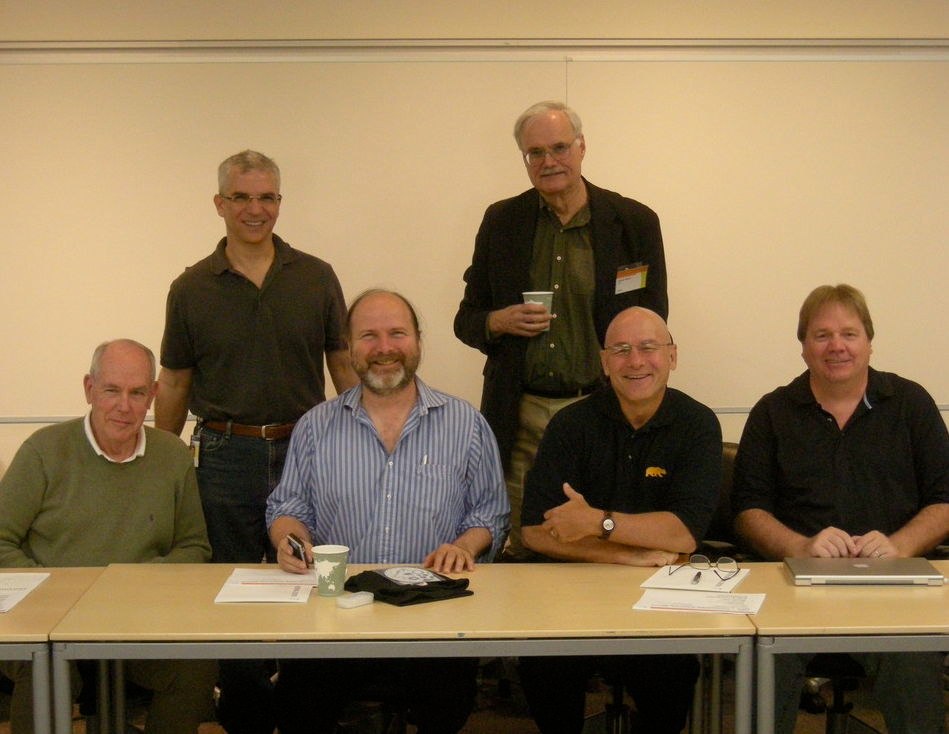
      Since 2005, TAB has met several times a year to discuss key technical topics and trends, partnering to shape Sun’s technological vision for future development and product plans. The role of a TAB member is to support Sun’s Chief Technologist’s Organization in making recommendations to the CTO and Chief Executive Officer, as well as to the Chairman of the Board and Sun’s Board of Directors. Here they are at yesterday’s meeting:

      TAB, Sun Microsystems Technology Advisory Board, Greg Papadopoulos, Steve Ward, Ivan Sutherland, Danny Hillis, Dave Patterson, Mike Splain, June 2008

      TAB in June 2008
      L to R Standing: Greg Papadopoulos, Steve Ward
      L to R Seated: Ivan Sutherland, Danny Hillis, Dave Patterson, Mike Splain
      Who are They?

      Image Copyright 2008 by Katy Dickinson
      Links updated 11 January 2017

      1 Comment

      Filed under Mentoring & Other Business