Tag Archives: Mentoring

Women in the Global Economy: Leading Social Change

IMG_6067

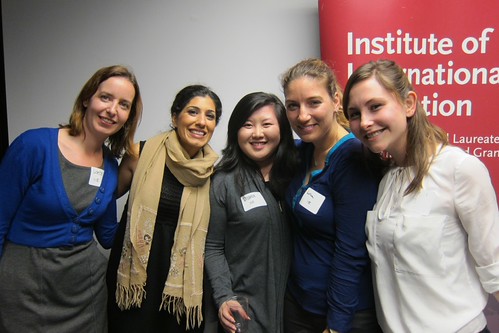
Trish Tierney (Executive Director of the Institute of International Education in San Francisco) is the editor of a new IIE-published book called Women in the Global Economy: Leading Social Change. Many of the TechWomen mentors and program staff joined Trish with authors Nuket Kardam and Fredric Kopp (both from the Monterey Institute of International Studies) and social media expert Beth Kanter, to celebrate last night at IIE’s penthouse offices near the Lion Gate entrance to Chinatown.

My husband and I enjoyed hearing the authors speak about the book, seeing our IIE and 2011-2012 TechWomen colleagues and friends, discussing plans for the upcoming TechWomen-2013 program (selection of mentees from the Middle East and Africa is going on now), what I am doing at MentorCloud and John’s new job at EVault, and answering questions from potential TechWomen mentors. The rooftop view at sunset is lovely! Mimi Hills and my husband won the door prizes – a copy of the new book in an handmade bag. I look forward to reading it.

IMG_6057 . IMG_6095

IMG_6039

IMG_6052

IMG_6134

Images Copyright 2013 by Katy Dickinson

Leave a comment

Filed under Mentoring & Other Business, News & Reviews

TechWomen Mentors Lunch

IMG_5976 . IMG_5949

16 TechWomen 2011-2012 mentors (and potential-2013 mentors) gathered at my house in San Jose California last weekend for a potluck lunch and to hear Conference Chair Taghrid Samak tell us about EgyptNEGMA (Entrepreneurship for Development in Egypt – to be held next week at MIT).  One of our own TechWomen mentees, Heba Hosny, is an EgyptNEGMA-2013 finalist. My guests enjoyed the new porch and a tour of WP668 – the backyard caboose where I have my office.  Three had also been mentors in my SEED mentoring program at Sun Microsystems.  It was such a pleasure to be able to host this remarkably talented and energetic group of technical women!

IMG_5979

IMG_5986

Images Copyright 2013 by Katy Dickinson

Leave a comment

Filed under Caboose Project and Other Trains, Home & Family, Mentoring & Other Business

Mentor Certification: Knowledge, Skills, Attitudes

IMG_5817

Last weekend, I completed my second mentor certification class (1st re-certification) by The University of the South – School of Theology, Education for Ministry (EfM) program.  It was an honor and pleasure to work with an inspired, generous, and talented group.  I value this structured and carefully managed program – not the least because I have the opportunity to improve through specific feedback and advice from other experienced mentors.

About EfM:

EfM is a unique certificate program of experiential theological education for laity under the direction of The School of Theology – University of the South. Since its founding in 1975, this international program has assisted more than 30,000 students in discovering how to respond to the call of Christian service. EfM helps students encounter the breadth and depth of the Christian tradition and bring it into conversation with their experiences of the world as they study, worship, and engage in theological reflection together.

EfM mentor certification requires 18 hours of training and observed interactions every 18 months.  EfM groups can meet either in-person (as does our group at St. Andrew’s Episcopal Church, Saratoga, California) or on-line. Here is an excerpt from the “Knowledge, Skills and Attitudes Expected of Mentors” document which guides the training and evaluation of EfM mentors:

Mentoring is an art.  The following list of competencies are like “paints and brushes” that allow the art to flourish.  These basic competencies help mentors and trainers to discern and evaluate mentor effectiveness.

Each mentor is rated by the mentor trainer in each competency as “not observed” or “needs improvement” or “proficient”.

Knowledge:

  • familiarity with the variety of voices within the Christian tradition
  • know the purpose of EfM and the components of an EfM seminar
  • know the theories and model of theological reflection in EfM:
    • four sources (action, tradition, culture, position)
    • four “movements” (identify, explore, connect, apply)
    • perspective questions (creation, sin, judgment, repentance, redemption)
  • know how to recruit, register, start, and maintain a group

Skills:

  • framing questions
  • facilitating reflection
  • sharing leadership
  • planning and managing the seminar
  • managing energy
  • listening
  • communicating clearly

Attitudes:

  • openness to growth
  • invitation
    • empowerment
    • valuing participation
  • encouragement
  • respect for human and theological differences
  • comfort with ambiguity
  • willingness to receive and give feedback
  • willingness to transmit EfM

IMG_5827

Images Copyright 2013 by Katy Dickinson

2 Comments

Filed under Church, Mentoring & Other Business

TSA Afraid of Rocks

IMG_5890

Ever since I read “Why It’s Time To Break The Code Of Silence At The Airport” by Christopher Elliott (15 February 2013, TheHuffingtonPost) and my daughter’s TSA posts (including “TSA Touching Crosses The Line: Update”), I have been considering how much more invasive and offensive the TSA has become over time and how we enable this behavior by not objecting to it.

This weekend, I flew from the San Francisco Bay Area to Los Angeles for training (to renew my mentor certification with Education for Ministry, a program of the University of the South – School of Theology), and to visit my brother and family in La Crescenta. I used two small-ish airports, San Jose (SJC) and Burbank (BUR) for convenience.

This morning, I walked quickly to the head of the extremely short security check point line at Burbank, hoping to have time for a quiet coffee before boarding my flight home. However, I was pulled out of line in the nearly-empty security area not once but twice.

  1. The first time I was pulled from line was so that the security lady could feel my face – after her full-body scanner drew a little yellow box around my apparently-dangerous earring. As you can see from the picture below (and as she herself could clearly see), there wasn’t anything for her to find while she patted down my ear, cheek, and short hair.
  2. The second time I was pulled out a few minutes later was so that the security man could unpack my small roller bag, re-scan my toiletries, and try to take away my rock.  I was bringing home a small piece of granite as a souvenir of La Crescenta.  He said, after feeling my rock, that I had to get rid of it or check my bag because a rock could be a weapon.  It seems that there is a TSA rule saying that rocks over five pounds are dangerous.  I chose to keep my rock, so I was escorted out of the security area, then had to walk back to the airline counter (where the counter lady told me that she hears an unusual number of complaints about the Burbank TSA), check my carry-on bag, and go through security all over again.

I made my flight home, but no quiet coffee for me.  I object.

IMG_5892 . IMG_5893

Images Copyright 2013 by Katy Dickinson

Leave a comment

Filed under Church, Home & Family, Mentoring & Other Business, News & Reviews, Politics

Honoring Our Own Generosity

IMG_5648 . IMG_5647

LORD POLONIUS
My lord, I will use them according to their desert.

PRINCE HAMLET
God’s bodykins, man, much better: use every man
after his desert, and who should ‘scape whipping?
Use them after your own honour and dignity: the less
they deserve, the more merit is in your bounty.
Take them in.

– William Shakespeare, Hamlet Act II, Scene ii, 1600

I recently returned home from my fifth trip to the Middle East, visiting Jordan and Lebanon. I was in Jordan as a member of the TechWomen delegation – TechWomen is an initiative of the U.S. Department of State’s Bureau of Educational and Cultural Affairs (ECA). I visited Lebanon to see my friends, the TechWomen program alumnae and to talk with Al-Makassed (the Makassed Philanthropic Islamic Association of Beirut).

As the Vice President for MentorCloud, I talked a great deal about mentoring during my trip. I traveled with my daughter Jessica. She and I were welcomed with world-class generosity and open hearts and minds. In discussing the motivations for mentors, I often use the phrase paying it forward. That is, mentors often say that they are giving back the wise and generous advice and support that they themselves were given during their development. I was surprised and concerned when discussing these motivations for mentors not once but twice to be told that in Arabic, the saying is not “Give and Take” but “Take and Give”. This seemed to reflect doubt among some audience members that mentoring would work in their culture. I have been thinking about these discussions for the two weeks that I have been home.

During one of our long bus trips in Jordan, our tour guide played a video for us in which His Majesty King Abdulla of Jordan gives a Royal Tour of his country. “Jordan – The Royal Tour” is a 2002 tourism promotion piece but a good overview nonetheless. During the tour, King Abdulla tells a story from his youth. His uncle (then heir-apparent to King Hussein) and he were traveling in the desert and met an old man on a white horse. The man wanted to give them lunch, so he sold the stallion, his only possession, to buy fifteen sheep for a feast. Of course, when this became known, the white stallion was repurchased with fifteen more sheep as a present in return. King Abdullah calls this tradition of generous welcome the “code of the desert”. My experiences in the Middle East have been consistent with the King’s story – I have been honored by extraordinary generosity.

So, why would my Middle Eastern audiences doubt their community’s welcoming of mentoring – a relationship based on long-term generosity? As a life-long fan of William Shakespeare, I thought of the interchange above between Hamlet and Polonius – about the merit in treating others according to our own honor and dignity. Coming to terms with our own generosity and motivations is part of the journey that leads many of us to become mentors.

Recommended additional reading: “Is Giving the Secret to Getting Ahead?”  by Susan Dominus, 13 March 2014, _New York Times_

IMG_4380

Images Copyright 2013 by Katy Dickinson

2 Comments

Filed under Mentoring & Other Business

Encountering Wild Cyclamen in Jordan

Last Import-95

When the TechWomen delegation visited the northern Jordan mountains near village of Koura, I was surprised to see a wild Cyclamen flowering in a limestone field.    The surprise was that a pretty flower I have always considered as a delicate indoor table decoration would be someone else’s wildflower.

As a lifelong gardener and long-time reader of Pacific Horticulture, I am familiar with much of the native and ornamental flora of California and the American West. Many of the plants and trees I saw in Jordan and Lebanon were also familiar – since the climate is not too different from my home. Except for the overwhelming amount of limestone, the parts of Jordan I saw look like California’s Gold Country or the mountains and desserts of the State of Nevada where my family has often gone exploring. I understand that Jordan’s Wadi Rum has more of the granite that is so common here in the western USA.

My unexpected encounter with a wild cyclamen gave me a better understanding of how the biologist felt who identified the thought-to-be-long-extinct Coelacanth in a fisherman’s net in 1938.

Added 4 December 2014 – November photo of TechWomen’s Seham Al Jaafreh of Jordan with cyclamen in Washington DC:

IMG_2979

Images Copyright 2013-2014 by Katy Dickinson

2 Comments

Filed under Mentoring & Other Business

Mentoring vs. Coaching vs. Sponsorship

Last Import-1

During recent weeks while I was traveling with the TechWomen delegation in Jordan, and then when I was talking about MentorCloud and mentoring with  Al-Makassed (the Makassed Philanthropic Islamic Association of Beirut) and TechWomen participants in Lebanon, my frequent explanations about professional mentoring got shorter. In particular, my differentiations between mentoring, coaching, and sponsorship got more crisp through repetition. I understand clearly these three words are often used interchangeably and that each of the three kinds of relationships often contain elements of the other two. However, I have found it helps to distinguish the three.  Key differentiating elements are:

  • Power (positional or hierarchical authority, degree of control)
  • Topic (specific tasks, life change)
  • Duration of the relationship (short-term, long-term)
  • Reward (benefit or pay, particularly to the senior member of the relationship)

Sponsorship or Patronage

In this relationship, the patron or sponsor is in a position of authority and intentionally using their power to advance the interests or career of their favorite, client, or sponsee. Sponsorship can be positive (as in the development of a successor or talented junior associate) or negative (as seen in destructive favoritism or political corruption). The favorite may be a long-term political or organizational dependent. A sponsor or patron may protect and support the favorite over time while they grow their abilities or advance within an organizational structure. The patron may directly control the work of the favorite, takes responsibility for the favorite, and may benefit directly by their work – or indirectly by accepting credit for their success. The favorite’s own capabilities may be questioned because the patron is seen to be responsible for their achievements. This is a limited relationship – that is, a patron will have only one or a very small number of favorites. See Wikipedia’s article on
Patronage for legal and illegal examples.

Coaching

Coaching is a relationship or kind of communication with the primary goal of conveying specific knowledge, training, or skills. A coach is more knowledgeable and experienced than their client or student, at least in the target topic or task area. The coach may be paid to be in the relationship as the student’s work supervisor, master craftsman, or teacher. A coach may have many students but the relationship is often limited to the time it takes to transfer the specific information or deliver expected results.  The coach may or may not have longer-term hierarchical authority over the student.

Mentoring

Mentoring is a longer-term relationship focused on larger professional or life issues. The mentor is usually much more experienced than the mentee but may or may not be an expert in the same professional area. The mentor and mentee should not be in a supervisory relationship; that is, the important power difference between them is one of wisdom rather than positional authority. Mentor and mentee often work together long-term and become friends. The mentor may advocate for the mentee but does not control the mentee and does not take responsibility for the mentee’s success. Mentors may have many mentees, sometimes in one-to-one or one-to-many structures.  Mentors are usually unpaid professional volunteers who get satisfaction from “paying it forward” – that is, giving back some of the guidance that benefited them during their own development.  Mentoring is a personal relationship in a professional setting.

Key deliverables from the mentor are:

  • Introductions to experts or wise people who can help the mentee.
  • References to key resources, training, experiences which will expand the mentee’s understanding, experience, or context.
  • Feedback – the mentor acts as a sounding board for the mentee.  The mentor may offer specific advice or may only provide enough guidance for the mentee to figure out his or her own way.

Additional Reading:

Last Import-16

Images Copyright 2013 by Katy Dickinson

1 Comment

Filed under Mentoring & Other Business