Tag Archives: Jessica

Keeping in Touch with my College Kid

My daughter
Jessica
is now in her second undergraduate year at
Carnegie Mellon University
in Pittsburgh, Pennsylvania. She is
doing well and enjoying herself despite the un-California-like weather of her
school home. She is in CMU’s
Humanities Scholars Program
majoring in Political Science with minors in Music and Computer
Science. She also working on the P4
project
at CMU’s
Posner Collection
(to record more of Shakespeare and Twain for
YouTube) and she teaches karate.
She is a very busy kid. I miss her. How do we keep in touch?

One way is through our blogs. Reading

FeelingElephants
lets me know some of what Jessica is thinking and experiencing.
My respect and admiration for my daughter grows when I read her blog (although I
despair that she will ever learn to spell). Jessica says she started blogging
to reduce the number of status update calls required for friends and family.
I find it easier to write for
Katysblog when I have Jessica in mind.

Another way to keep current with my busy college kid is through scheduled
weekly phone calls, sometimes using Skype.
Also, for the second year, Jessica and I will be attending the

Grace Hopper Celebration of Women in Computing
conference together soon.
In 2007, Jessica was on my “Girl Geeks” panel at Hopper, this year her own poster
(on academic plagiarism) was accepted.

Jessica bought me a book before she left for college last year called
I’ll Miss You Too: An Off-to-College Guide for Parents and Students
by mother and daughter Margo E. Woodacre Bane and Steffany Bane
(Sourcebooks Trade, 2006, ISBN-10: 1402206410, ISBN-13: 978-1402206412).
It is a good resource book on the transitions, joys, and challenges of
having a kid in college.

Katy and Paul and Jessica using Skype

Katy and Paul and Jessica using Skype
photo: copyright 2008 John Plocher
Jessica on Skype

Jessica on Skype
photo: copyright 2008 John Plocher

Images Copyright 2008 John Plocher

Leave a comment

Filed under Home & Family

Why read a book?

Last month while camping in the Sierras, I saw a woman reading a book using a
Kindle
(Amazon’s Wireless Reading Device). It looked interesting (portable,
convenient, easy to use) but I wasn’t tempted. Why not? I have always been
addicted to books but more particularly, to books in the form of a codex.

I recently finished reading The Archimedes Codex (by Reviel Netz and
William Noel, Da Capo Press, 2007, ISBN-10: 030681580X, ISBN-13: 978-0306815805)
which presents the many “technology upgrades” that the works of
Archimedes survived
between about 212 BC (when the great mathematician and scientist was
killed by a Roman soldier in Syracuse, Sicily) and now. The Archimedes
Codex
is the story of how three of Archimedes’ works started out in scroll form
and ended up as a medieval codex in very poor condition sold at public auction
in 1998 as the Archimedes
Palimpsest
. Since 1998, Archimedes’ works have gone through their
most recent IT upgrade and next month (at

2 pm on October 29th, 2008
to be precise), a digital version of the
Archimedes Palimpsest is scheduled to be released on the web.

Will Noel (of Baltimore’s
Walters Art Museum
) writes in The Archimedes Codex:

      “Nothing is more dangerous for the contents of old documents than an
      information-technology upgrade, because mass data transfer has to take
      place and somebody has to do it. The transition from the roll to the
      codex – the book format we know today – was a revolution in the history
      of data storage.” (pp.70-71)

      “As the ancient world disappeared, its gods went with it. And as
      Christianity became the official religion of the Roman Empire, many
      classical texts, if they were not condemned as dangerous, were dismissed
      as irrelevant. It is not that Christians willfully destroyed them very
      often; they just ceased to copy them.” (p.74)

I think we live in a time when books are changing form, just as they did in
the 1st through 4th century AD when the codex took over from the scroll.
Which books will survive the transition from codex to Kindle?
My
daughter
is working on the P4
project
at Carnegie Mellon’s
Posner Collection
to record more of Shakespeare and Twain for YouTube.
I am enjoying watching this project develop.

The best list of reasons I have found to prefer reading a book in codex
form to reading the same text on a computer is in Reading the OED: One Man,
One Year, 21,730 Pages
by Ammon Shea (Perigee Trade, 2008)
ISBN-10: 0399533982, ISBN-13: 978-0399533983. This book is full of obscure but
delightful words from the OED like “Nod-crafty (adj.) ‘Given to nodding the
head with an air of great wisdom.'” and “Peristeronic (adj.) ‘Suggestive
of pigeons.'”
In Chapter F, Ammon Shea writes of his admiration for all of the amazing new
ways to search and understand that are now available because of the electronic
version of the Oxford English Dictionary (OED). Shea then describes why
he still prefers the codex. Here are some of his reasons:

What Can’t You Do With an Electronic Book?

    • Drop it on the floor in a fit of pique, or slam it shut.
    • Leave a bookmark with a note on it, then happily find it years later.
    • Get tactile pleasure from rubbing the pages.
    • Have a sense of time and investment because of pages read. On a
      computer “…everything is always in the same exact spot. When reading a
      book, no matter how large or small it is, a tension builds, concurrent
      with your progress through its pages.”
    • Sit down prior to using it, open it up and sniff its pages.
    • Have “…that delicious anticipatory sense that I am about to be
      utterly and rhapsodically transported by the words within it.”

I would add to Shea’s list the physical delight in the art of
book making. A computer offers nothing like the feel of the
embossed image of a book cover under my finger tips. Shea ends with:

      “But what does the computer know of the comforting weight of a book in
      one’s lap? Or of the excitement that comes from finding a set of books,
      dusty and tucked away in the back corner of some store? The computer
      can only reproduce the information in a book, and never the joyful
      experience of reading it.” (p.58)

4 Comments

Filed under News & Reviews

Posner Poetry and Prose Project

My daughter Jessica has started “P4”, an intern project for the

Posner Center at Carnegie Mellon University
.
Posner houses rare and historic books and art on the CMU campus in
Pittsburgh, Pennsylvania. P4 stands for Jessica’s
Posner Poetry and Prose Project.
P4 is an effort to bring high quality recordings of beloved works
of literature to YouTube’s broad audience. Jessica has started
by seeing what is already available. Wonderful efforts she has found so far:


    • The 116 Project
      for which “this cool dude wanders around with a
      minicam and a beat up book of sonnets and asks random people to
      read Sonnet 116 by William Shakespeare”

    • “The Cremation of Sam McGee”
      by Robert W. Service (1874-1958),
      read by Urgelt

    • “If”
      by Rudyard Kipling (1865-1936), read by Dennis Hopper

I am looking forward to more as her P4 project develops over the
semester.

Leave a comment

Filed under News & Reviews

National Cathedral and Washington DC

A week ago, we got home from a trip to Washington DC. This was my second trip in 6 months to our nation’s capital, after a visit gap of many decades. Even though the weather was very hot and muggy, it was particularly enjoyable to go with my family (my son Paul, daughter Jessica and her boyfriend Matt, husband John, and our friend Laura Biche). We were mostly there to hear Jessica sing opera but during the days, we did manage to visit a few wonderful places: the Lincoln Memorial, Vietnam Veterans
Memorial
, Smithsonian Air & Space Museum, Smithsonian Natural History Museum, and the National Cathedral. We went by the Folger Shakespeare Library and were sorry to find it closed for the day. Congresswoman Eshoo’s office tried to get us White House tour tickets but they were unavailable.

The National Cathedral was very moving; I had never visited before. Since National Cathedral is Episcopal (and we are Episcopalian), we went to Sunday morning worship services. I have toured big impressive cathedrals and temples in many countries but they almost always belong to someone else’s religion: the Episcopal church mostly erects small buildings. I felt proud that this big beautiful place was created for the glory of God by my own church. The Space Window (including its moon rock fragment, a gift by the Apollo astronauts on the 5th anniversary of their moon landing) was particularly impressive. The memorial windows to Confederate Generals R.E. Lee and Stonewall Jackson and the tomb of U.S. President Woodrow Wilson were also notable.

Paul reading the
Gettysburg Address

Paul Reading the Gettysburg Address, Lincoln Memorial Washington DC<br /> photo: copyright 2008 Katy Dickinson

Resting in the shade
Lincoln Memorial

Resting in the shade at the Lincoln Memorial Washington DC<br /> photo: copyright 2008 Katy Dickinson

Abraham Lincoln
Lincoln Memorial

Abraham Lincoln at the Lincoln Memorial Washington DC<br /> photo: copyright 2008 Katy Dickinson

.

.

American Flag<br /> photo: copyright 2008 Katy Dickinson

Women Soldiers
Vietnam Veterans Memorial

Women Veterans Vietnam Veterans Memorial Washington DC<br /> photo: copyright 2008 Katy Dickinson

Paul, Jessica, Matt in front of the
Wright Brothers’ 1903 Flyer

Paul, Jessica, Matt in front of the Wright Brothers' 1903 Flyer Washington DC<br /> photo: copyright 2008 Katy Dickinson

Laura at
Morrison-Clark Hotel

Laura Biche dressed for church, 1864 Morrison-Clark Hotel, Washington DC<br /> photo: copyright 2008 Katy Dickinson

Fireplace at the
Morrison-Clark Hotel

Fireplace at, 1864 Morrison-Clark Hotel, Washington DC<br /> photo: copyright 2008 Katy Dickinson

John and Laura
National Cathedral

John and Laura, National Cathedral Washington DC<br /> photo: copyright 2008 Katy Dickinson

Rev.M.L. King tribute
“I have a dream”

Rev. Dr. Martin Luther King, Jr. I have a dream National Cathedral Washington DC<br /> photo: copyright 2008 Katy Dickinson

Space Window
National Cathedral

Space Window National Cathedral Washington DC<br /> photo: copyright 2008 Katy Dickinson

Glass Reflections on Wilson’s
Presidential Seal, National Cathedral

Glass Reflections on Wilson's Presidential Seal, National Cathedral Washington DC<br /> photo: copyright 2008 Katy Dickinson

Creation doorway
National Cathedral

John and Laura, National Cathedral Washington DC<br /> photo: copyright 2008 Katy Dickinson

Creation of the Moon
National Cathedral

Creation of the Moon National Cathedral Washington DC<br /> photo: copyright 2008 Katy Dickinson

Exterior
National Cathedral

Exterior National Cathedral Washington DC<br /> photo: copyright 2008 Katy Dickinson

Midsummer Night’s Dream
Folger Shakespeare Library

Midsummer Night's Dream Folger Shakespeare Library Washington DC<br /> photo: copyright 2008 Katy Dickinson

Macbeth
Folger Shakespeare Library

Macbeth Folger Shakespeare Library Washington DC<br /> photo: copyright 2008 Katy Dickinson

King Lear
Folger Shakespeare Library

King Lear Folger Shakespeare Library Washington DC<br /> photo: copyright 2008 Katy Dickinson

Dino Cookies
Natural History Museum

Dino Cookies Natural History Museum Washington DC<br /> photo: copyright 2008 Katy Dickinson

Sandstone Concretion
Natural History Museum

Sandstone Concretion Natural History Museum Washington DC<br /> photo: copyright 2008 Katy Dickinson

Hope Diamond
Natural History Museum

Hope Diamond Natural History Museum Washington DC<br /> photo: copyright 2008 Katy Dickinson

324 pounds of Natural Sheet Copper
Natural History Museum

324 pounds of Natural Sheet Copper Natural History Museum Washington DC<br /> photo: copyright 2008 Katy Dickinson

John, Paul, Laura, Jessi, Matt
Natural History Museum

John, Paul, Laura, Jessi, Matt Natural History Museum Washington DC<br /> photo: copyright 2008 Katy Dickinson

Images Copyright 2008 by Katy Dickinson and John Plocher

Leave a comment

Filed under News & Reviews

MAGIC in Newsweek

On 21 May, I wrote about the new MAGIC girls’ mentoring program working with The Girls’ Middle School (GMS) in Mountain View, CA. Last week, I was pleased and surprised to find MAGIC mentioned in the June 16, 2008 issue of Newsweek in an article called “Revenge of the Nerdette”. I knew about the article in advance because my daughter Jessica was interviewed for it (alas, she did not get mentioned). In fact, I wrote a blog entry on 10 April called “How to Talk with the Press” because Jessica called me for advice on that subject. (Jessica called from from Carnegie Mellon and left me a voice mail message, something like: “Mom, Mom Newsweek wants to interview me, what do I do?“.)

“Revenge of the Nerdette” By Jessica Bennett and Jennie Yabroff is interesting and worth reading. MAGIC got mentioned in the last paragraph:

      Outreach programs such as TechBridge, an after-school workshop for middle- and high-school girls, and MAGIC (More Active Girls In Computing), a national mentoring program for aspiring computer scientists, are among the dozens of programs aimed at getting girls to think about futures in science and technology. The Nerd Girls also conduct weekly outreach: “We try to give them real examples of what engineers do,” says Panetta. “You love watching special effects in ‘Harry Potter’? That’s an engineer. You like the iPhone? An engineer made that. Cheerleading? Dancing? How about sports engineering?” Because you know, girls: the geeks really are inheriting the earth.

We on the MAGIC core team are still forming the program. It is gratifying if strange to get such high visibility press so early. Not that I am complaining!

1 Comment

Filed under Home & Family, Mentoring & Other Business

Living in a Cat World

15 March 2010: More on this topic is in the blog entry “Transitions for Young Adults with Neurocognitive Deficits”

Yesterday, my daughter Jessica published a wonderful blog post called Some things that work about a superb teacher, Linda Herreshoff. Linda was my son’s teacher for three years at Jordan Middle School in the Palo Alto Unified School District. Linda’s class is full of kids like Paul, who have social-cognitive challenges often diagnosed with an Autism Spectrum label, like: Asperger’s syndrome, high functioning Autism, Non-Verbal Learning Disorder, or Pervasive Developmental Disorder – Not Otherwise Specified (PDD-NOS). Almost all of Linda’s kids are boys who are smart or very smart and have parents who will not give up. Paul matured and learned and thrived in Linda’s class as never before. Her love, wisdom, teaching skill, and patience are awesome.

Part of Jessica’s blog post was a reference to the Liller Family Blog Entry on Asperger’s Syndrome, which starts off with this excellent summary:

Most children live in a dog world: A dog loves to be around people and socially interact with them. They willingly show affection, and follow their master’s commands. They also love to play and hang around other dogs no matter what activity their engaged in.

Asperger’s children live in a cat world: A cat is generally a loner. They prefer doing things their own way and like/need their solitude. Cats come to people on their own terms in their own time and they aren’t very social unless they choose to be. They have a routine and like to stick to it. They have one interest at a time (usually that silly piece of string they love to paw at). And when backed into a corner, a cat will lash out.

Paul is almost six feet tall now and just about done with his Sophomore year in High School. We were thrilled today to hear that he has just passed the California High School Exit Exam (CAHSEE). (Paul will be in High School for two more years. He took the CAHSEE this year just in case he needed several tries to pass it.) During our family dinner tonight celebrating Paul’s passing the CAHSEE, John and Jessica and Paul and I made a list of benefits and disadvantages of Paul’s social-cognitive challenges. As you will see, the two are almost mirror images of each other:

  • Benefits
    • Completely unaware of peer pressure
    • Amazing ability to concentrate
    • Generous, loving, and much given to small acts of meaningful kindness
    • Believes in long-term commitment, dedicated and loyal
    • Fastidious
    • Doesn’t lie well
    • Good sense of direction, sequencing, and paths
    • Loves ritual
    • Good at card and board games because he remembers all of the rules and the details of play
  • Disadvantages
    • Perseverant, stubborn, hard to influence
    • Gets stuck emotionally – sometimes needs help to move on
    • Can’t organize things – homework or papers or his room
    • Finds change difficult
    • Slow to mature
    • Extremely literal
    • Holds grudges with a very long memory
    • Does not take tests well
    • Follows all of the rules and expects everyone else to also

Of course, some of these behaviors sound like any teenage boy… (Also, Jessica says she treats all of her Engineering friends like they have Asperger’s and this works very well.)

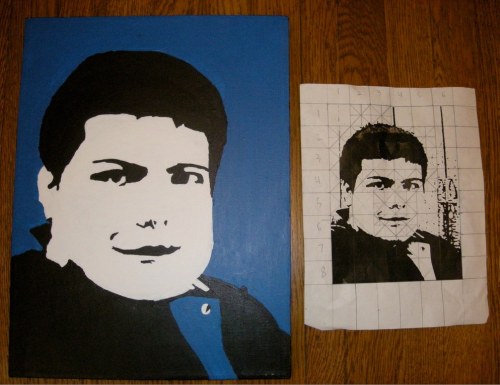
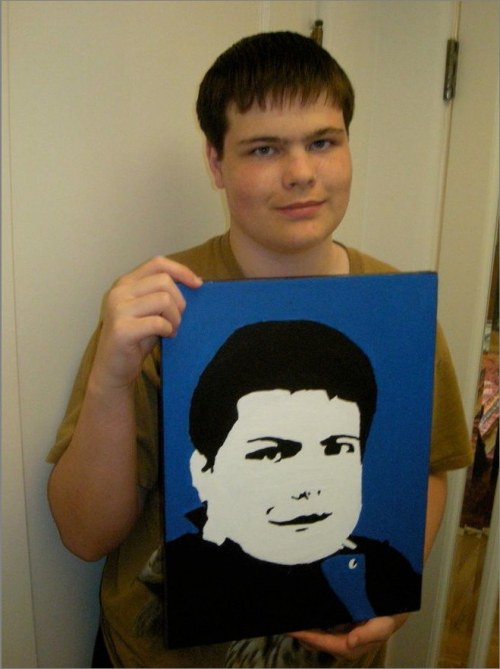
Paul has been enjoying taking Art this year. Here he is with his new self-portrait.
2 July 2020 update: see Paul’s art portfolio on Paulselement
Paul's portrait and planning sheet photo: copyright 2008 Katy Dickinson

Paul and his portrait photo: copyright 2008 Katy Dickinson

Images Copyright 2008 by Katy Dickinson

29 Dec 2016 – Links Updated

2 Comments

Filed under Home & Family

How to Talk with the Press

My daughter Jessica is a Freshman at Carnegie Mellon University in Pittsburgh, Pennsylvania. When she was in High School, one of her essays was published in a book called She’s Such a Geek: Women Write About Science, Technology, and Other Nerdy Stuff, edited by Annalee Newitz, and Charlie Anders (2006, ISBN-10: 1580051901, ISBN-13: 978-1580051903). Jessica is also an enthusiastic blogger. All of which may be why she was called for a press interview last week for a major article on Girl Geeks. Jessica called John and me anxious for advice on how to talk with the press. Here is what we told her:

    1. Answer the question asked, ask for clarification if you don’t understand what is being asked. Ask to skip ahead to the next if a question is too private.
    2. Keep positive and avoid speaking ill of anyone; damnation by faint praise is OK if you really feel strongly.
    3. Think about what simple message you want to convey and stay on message, it can be “tech is good for girls and girls are good at tech” or “women have great ideas in computer science” or even just “read my blog!” Your message may have nothing to do with the question or subject of the interview.
    4. Express opinions in opinion words like “I think that…” or “What I see is…” rather than statements of fact and sweeping statements that are open to broad interpretation.
    5. Be very polite and appreciative of the interview, send a thank you email after, no matter how the interview went.
    6. Ask if the reporter will tell you when the article is published (it sometimes takes months).
    7. Don’t be upset if they misquote you or take your words out of context or even distort or make up words for you, it often happens.
    8. Provide solid facts and references if you have them.
    9. Enjoy the experience!

I passed this list by Carrie Motamedi, a friend here at Sun who has a great deal of experience with the press. Carrie’s additions:

    • Make sure to call out any information you are giving as background but don’t want to be quoted on. (In general there is no such thing as “off the record” but most reporters will respect background if you call it out.)
    • What is the topic? If it is something controversial or a trend – do your homework and see what else has been written and what point you can make that will add to the overall conversation happening.
    • You can always go back to the reporter after the call if you feel you misspoke on something or want to add.
    • Read some articles of the reporter before your interview so you know something about them, how they write (can also use this as an icebreaker).
    • If there is a specific point you want to make, try and think of an analogy that would make sense to a broad audience (think 4th grade level).
    • Don’t be disappointed if the piece doesn’t come out at all or you aren’t in the final cut – there are lots of edits which happen and interviews that get cut.

Jessica had a two hour interview and said she thought it went well. We are looking forward to reading what gets published…

For what happened next, read my blog entry MAGIC in Newsweek, 15 June 2008. For still another followup, check out What Have I Been Up To? Causing Trouble (mostly), Jessica’s blog entry from 21 March 2011.

She's Such a Geek book cover

2 Comments

Filed under Home & Family, News & Reviews