Tag Archives: House Work

1007 Circle Park, Knoxville, Tennessee

circlepark.knoxville.TN . circlepark.knoxville.1938
1007 Circle Park Drive Knoxville Tennessee 1007circle.knoxville.1964 . DSCN6989

My mother, Eleanor Creekmore Dickinson, grew up at 1007 Circle Park Drive, Knoxville, Tennessee. This address does not exist any more. In the mid-1960’s, the whole neighborhood was torn down to make room for the University of Tennessee. You can check out Circle Park on Google Maps: the satellite view shows that Circle Park itself is still there but the round street around it is now called Circle Park Drive SW or Circle Park Drive. Originally, Circle Park was a private open space owned by the houses around it.

It is surprising how much of a presence a house that does not exist still has. 1007 Circle Park stood on its own acre of land. It had towers, secret passages (an air gap between inner and outer walls), and a teardrop-shaped carriage drive in the side yard with a porte-cochere to keep the rain off. There were stables and three servant quarters in the back. My great grandfather, Walter Van Gilder, bought the house around 1910. It was ornate Victorian in style, built around the time of the American Civil War.

After 1965, when Evelyn Van Gilder Creekmore and Robert Elmond Creekmore (my grandparents) knew that their home would be torn down, they took as much of the house with them as they could when they moved. This included doors, architectural trim, windows, banisters, and ironwork as well as furniture. Over the years those pieces have been installed in a variety of our family’s houses in California and Tennessee.

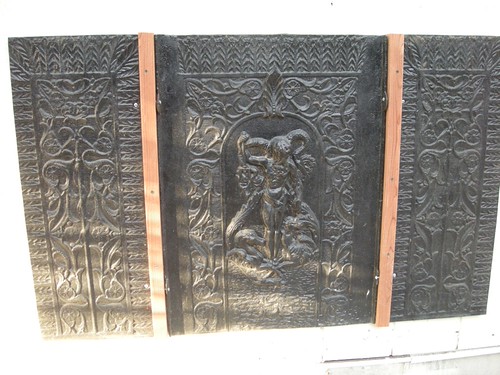
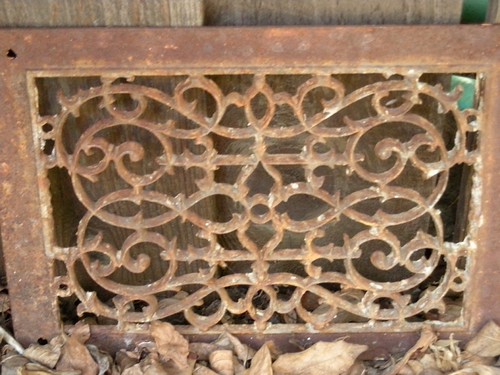
My husband, John Plocher just finished bolting the extremely heavy black iron fireback (featuring Poseidon and seahorses) into the exterior wall of his new workshop. In our house, we also have furniture carved by Ellen Bolli Van Gilder (my great grandma), a parlor screen with six paintings by my ancestress Mary Esperandieu, the newel post from the 1007 Circle Park staircase, a heater grate, a metal fire screen, several panels of stained glass and clear leaded glass, and a variety of mirrors that Walter Van Gilder made himself for 1007 Circle Park.

A photo below shows the front door of 1007 Circle Park on the day my mother married my father in 1952. In the picture, she is being escorted to the wedding by her father, R.E. Creekmore, flanked by my other grandparents (B.W.O. Dickinson and Gladys Grace Oakes Dickinson) and Ellen Bolli Van Gilder. The doors and stained glass panel in the back of that 1952 photo are the same doors and stained glass panel in my parents’ house in San Francisco in 2006, shown below with my mother at the door. Walter Van Gilder made the glass panel.

26 December 2012 blog – The Walter Van Gilder stained glass panel was installed in our home in Willow Glen, California, after being re-leaded and restored.

DSCN6999 . DSCN6982
DSCN6984 . DSCN6985
DSCN6986 . 1952.wedding2.frontdoor
1947.eleanor.richard.lou . 1955.Richard.Louise . 2006.house3.Eleanor

Images Copyright 1938-2009 by Katy Dickinson and Eleanor Dickinson

19 Comments

Filed under Home & Family

New Walks of Old Brick

The prior owner of our 1930 home in Willow Glen (San Jose, CA) passed on to us a large number of bricks and garden stones which I have been using for the last ten years in my landscaping. Most of the bricks are very old and worn, some are half-melted clinkers, others are still new-looking with crisp corners.  Several years ago, when we replaced the old leaky swimming pool with WP668, our 1916 backyard caboose, we had to take up several long brick walkways. Since then, we have been re-using the bricks in new walks. Some of the original walkways are in the Jack-on-Jack (or Stacked Bond) pattern, others are in a Basket Weave classic brick pattern.

To get ready for our annual Easter egg hunt and garden party, we installed several new walkways using old bricks. The new walks went in places where the walking surface was uneven or hard to roll a cart or wheelbarrow over. In the new walks, we used both Jack-on-Jack and Basket Weave patterns to match what was already there. Most are set in sand on top of weed cloth with wood borders. On one high-traffic section, we used concrete borders and mortar. Even though it took a week of work and what we have now is very different from what was there before, none of our thirty party guests noticed the change. The advantage of using old bricks in new walks is that if you are careful, they look like they have always been there.

2006 – Removing Pool and Bricks
2006 - Removing Pool and Bricks, San Jose California, photo: copyright 2009 Katy Dickinson
. April 2009 – installation
April 2009 - new brick walk installation, San Jose California, photo: copyright 2009 Katy Dickinson
April 2009 – new walk finished
April 2009 - new brick walk finished, San Jose California, photo: copyright 2009 Katy Dickinson
. another new walk
April 2009 - new brick walk finished, San Jose California, photo: copyright 2009 Katy Dickinson
Daniel at work
Daniel at work, San Jose California, photo: copyright 2009 Katy Dickinson
. Daniel and WP668
Daniel and WP668 caboose, San Jose California, photo: copyright 2009 Katy Dickinson

WP668 Caboose, April 2009
WP668 Caboose, April 2009, San Jose California, photo: copyright 2009 Katy Dickinson

Images Copyright 2009 by John Plocher and Katy Dickinson

1 Comment

Filed under Caboose Project and Other Trains, Home & Family

Caboose Stained Glass, Bookcases

The Memorial Day long weekend was a very busy time for WP668, our backyard caboose. Now that the rough electrical inspection has been passed, on Saturday, we finally filled in the trench running through the ballast under WP668.  Vince Taylor delivered and installed our new stained glass bay window, and the three big red bookcases were delivered by Crate and Barrel. We were getting ready for Sunday when we served a brunch to the winners from the SAMA Auction. We did not get everything done but the caboose looks great and our guests said they had a wonderful time.

It was a delight to see the lovely windows Vince created. You can see his initial drawings and art glass samples on my

11 Feb 2008
blog entry. Here are some photos from Saturday:

John finishing exterior wiringJohn finishing exterior wiring WP668 caboose photo: copyright 2008 Katy Dickinson Open pipe trenchOpen electrical trench WP668 caboose photo: copyright 2008 Katy Dickinson Filled in pipe trenchFilled in electrical trench WP668 caboose photo: copyright 2008 Katy Dickinson
Vince and John prepare bay windowVince and John prepare bay window WP668 caboose photo: copyright 2008 Katy Dickinson 1st stained glass panel going infirst stained glass panel going in bay WP668 caboose photo: copyright 2008 Katy Dickinson Train silhouetteTrain silhouette detail stained glass WP668 caboose photo: copyright 2008 Katy Dickinson Lizard silhouetteLizard silhouette detail stained glass WP668 caboose photo: copyright 2008 Katy Dickinson
Vince in windowVince Taylor in window WP668 caboose photo: copyright 2008 John Plocher Vince and JohnVince Taylor and John installing window WP668 caboose photo: copyright 2008 Katy Dickinson Vince starting on 2nd windowVince Taylor starting on 2nd stained glass window WP668 caboose photo: copyright 2008 John Plocher
Two windows doneTwo windows done WP668 caboose photo: copyright 2008 Katy Dickinson 3rd window ready to go3rd window ready to go WP668 caboose photo: copyright 2008 John Plocher Three windows doneThree windows done WP668 caboose photo: copyright 2008 Katy Dickinson
Vince in windowVince Taylor in window WP668 caboose photo: copyright 2008 John Plocher Delivery truckDelivery truck WP668 caboose photo: copyright 2008 Katy Dickinson 1st bookcase arriving1st bookcase arriving WP668 caboose photo: copyright 2008 Katy Dickinson 3rd bookcase going in3rd bookcase going in WP668 caboose photo: copyright 2008 Katy Dickinson

Glass and bookcases in place

Glass and bookcases in place WP668 caboose photo: copyright 2008 Katy Dickinson

Images Copyright 2008 by Katy Dickinson and John Plocher

Leave a comment

Filed under Caboose Project and Other Trains, Home & Family

New Fence in Willow Glen

January’s storms blew down the 94′ fence which runs along the side of WP668, our backyard caboose. On the other side of the fence, one of the San Jose community gardens and Guadalupe River embankment land belongs to the Santa Clara Valley Water District.  It took me many weeks work, including getting a formal permit document from the SCV Water District, to arrange for a new fence. Last week, it was finally installed.  Today, SCV Water District inspected it and found it good.

John and I picked galvanized steel mesh with brown plastic slats for the fence fabric instead of the wood used in the old fence. Not only was a metal and plastic fence less expensive than wood but, while the new fence is not pretty, it is very durable and will never look worse.

During the 3 day installation, we were surprised to find that the fence runs on top of what was once the concrete foundation of a chicken barn. We already knew that our home was on land that was a chicken ranch in the 1920s but we didn’t know just where the barn was until the new fence posts hit concrete. One of the community garden old timers told John that the gardeners there often hit barn concrete. We ended up paying extra for Duran Fencing (San Jose, CA) to pound holes through that foundation.   Duran did a good job (and squashed as few of my border plants as possible in the process).

While the fence was down, we got to visit the community garden plots and take pictures of the side of WP668 we don’t usually see from a distance. Photos follow.

Blown down old fence

Blown down old fence, Willow Glen California<br /> photo: copyright 2008 Katy Dickinson

Old fence gone

Old fence gone, Willow Glen California<br /> photo: copyright 2008 Katy Dickinson

John raking debris

John raking old fence debris, Willow Glen California<br /> photo: copyright 2008 Katy Dickinson

Fence line

Fence line, Willow Glen California<br /> photo: copyright 2008 Katy Dickinson

WP668 caboose

WP668 caboose, Willow Glen California<br /> photo: copyright 2008 Katy Dickinson

New posts

New posts, Willow Glen California<br /> photo: copyright 2008 Katy Dickinson

Wetting new concrete

Wetting new concrete, Willow Glen California<br /> photo: copyright 2008 Katy Dickinson

New posts standing

New fence posts standing, Willow Glen California<br /> photo: copyright 2008 Katy Dickinson

Rails and Fabric

Fence Rails and Fabric, Willow Glen California<br /> photo: copyright 2008 Katy Dickinson

Unrolling fence fabric

Unrolling fence fabric, Willow Glen California<br /> photo: copyright 2008 Katy Dickinson

Unrolling new fence

Unrolling new fence, Willow Glen California<br /> photo: copyright 2008 Katy Dickinson

Last fencing roll

Last fencing roll, Willow Glen California<br /> photo: copyright 2008 Katy Dickinson

New fence!

New fence, Willow Glen California<br /> photo: copyright 2008 Katy Dickinson

Community garden

Community garden, Willow Glen California<br /> photo: copyright 2008 Katy Dickinson

Community garden

Community garden, Willow Glen California<br /> photo: copyright 2008 Katy Dickinson

Community garden

Community garden, Willow Glen California<br /> photo: copyright 2008 Katy Dickinson

Community garden

Community garden, Willow Glen California<br /> photo: copyright 2008 Katy Dickinson

Community garden

Community garden, Willow Glen California<br /> photo: copyright 2008 Katy Dickinson

Images Copyright 2008 by Katy Dickinson and John Plocher

Leave a comment

Filed under Home & Family

Bougainvillea in Bondage (Photos)

When we  flew to Mulege, Baja Mexico last month, we saw many lovely bougainvillea vines in full bloom, some trained as small trees with trunks often a foot or more wide. I decided to convert my backyard Barbara Karst Bougainvillea into a small tree. This
will give us a red flowering canopy in the summer and, as the vines grow thicker and develop bark, should also protect the tropical plant against the short winter freezes we get here in San Jose, California. This also allowed us to remove the garden fence which is no longer needed because we replaced our pool with WP668, our backyard caboose.

I started with the vine spread out along a black metal garden fence. Over two days, I compressed the thorny vines into a column using green plastic garden tape. Finally, I enclosed the compressed vines between three black metal panels which are zip tied together. (I removed the garden tape after enclosing the vines between the panels.) My vine is now a 6′ column with a fountain of vines coming out the top. It looks squashed at the moment but it is growing fast. Here is how far I have gotten on this project:

Vine tree in Baja

Mulege Bougainvillea vine tree, Baja Mexico photo: copyright 2008 Katy Dickinson

My Vine Blooming in 2007

Barbara Karst Bougainvillea vine blooming photo: copyright 2007 Katy Dickinson

Step One – Tie it Up

Bougainvillea vine, Step One - Tie it Up photo: copyright 2008 Katy Dickinson

Step Two – Vine In Bondage

Bougainvillea vine Step Two - Vine In Bondage photo: copyright 2008 Katy Dickinson

Images Copyright 2007-2008 by Katy Dickinson

Leave a comment

Filed under News & Reviews

Caboose Stained Glass Update

The restoration of WP668, our backyard caboose, is making progress:

  • Last weekend, John continued to install the wood facing which holds the new window frame in the bay. (For comparison, I included a photo of what WP668’s damaged bay window looked like when we first saw it in December 2005.)
  • Last month’s storms blew down our 94′ fence which runs along the side of WP668. I am working to get that replaced. I already had Davey Tree out to trim the trees and dracenas in the way of the new fence.
  • Stained glass artist Vince Taylor brought by his drawing for WP668’s new window, along with some glass samples. If you look closely at my photo of Vince’s drawing below, you will see the silhouette of a train in the hills. Vince is using the photo by Dave Stanley below as inspiration for the train image. (1973 photo used with permission of Dave Stanley.) Vince is also going to add a lizard silhouette to one of the rocks in the foreground.

WP668.caboose.2005

VinceTaylor.2008

WP668.Sacramento2.DaveStanley.1973

Images Copyright 2005-2008 by Katy Dickinson and John Plocher

Leave a comment

Filed under Caboose Project and Other Trains, Home & Family

WP668 Caboose Restoration Update

Since we moved WP668 into our backyard on 12 May, we have been working on her between other family and job obligations. It will take at least the next year to get the biggest projects done. Our first efforts have been:

      • Neatly trimming trees that were damaged during the crane lift
      • Setting up a temporary power connection for the ceiling lights so we can work inside
      • Sweeping and vacuuming the dust of ages
      • Replacing missing and broken glass in windows, cleaning the windows that survived vandalism during storage
      • Replacing the fence we took down to move WP668 in
      • Buying and installing the car stops

A prior owner of WP668 cut through inside and outside walls to install a big window. He just made the hole – the window was never added. We have removed the cut 1″x6″ tongue and groove interior planks above and below the hole and are installing new 2″x6″ fir tongue and groove exterior boards to fill the hole. We will eventually replace the interior boards also.The caboose originally had 6 small sash windows that rose between the interior and exterior walls plus a 2 piece sliding window in each bay plus 2 sidelights in each bay. There are also glass windows in the doors at each end. We are retaining and restoring (or replacing) all of the windows except the one sash cut out by the prior owner since that wall will eventually feature floor-to-ceiling glass fronted bookcases. We are still working on filling the exterior wall hole. John and Paul primed the new fir tongue and grove boards last weekend with white paint. John is filling the irregular cavity spaces between the interior and exterior walls with cut-to-fit rigid foam insulation.

It was my job to remove the interior boards around the hole. I found that getting 91-year-old fitted and nailed boards out without splitting them is tricky. We saved the pieces in case we need original wood for repairs elsewhere. We are leaving all interior work until it starts to rain again next Autumn.

Someone asked why we have named WP668 “Kate Hall”. The name comes from Shakespeare’s Taming of the Shrew (Act II, Scene i), a play from about 1590 much-quoted to those of us named Katherine:

    • PETRUCHIO: Good morrow, Kate; for that’s your name, I hear.
    • KATHARINA: Well have you heard, but something hard of hearing: They call me Katharina that do talk of me.
    • PETRUCHIO: You lie, in faith; for you are call’d plain Kate,
      And bonny Kate and sometimes Kate the curst;
      But Kate, the prettiest Kate in Christendom
      Kate of Kate Hall, my super-dainty Kate,
      For dainties are all Kates, and therefore, Kate,
      Take this of me, Kate of my consolation;
      Hearing thy mildness praised in every town,
      Thy virtues spoke of, and thy beauty sounded,
      Yet not so deeply as to thee belongs,
      Myself am moved to woo thee for my wife.
    • KATHARINA: Moved! in good time: let him that moved you hither
      Remove you hence: I knew you at the first
      You were a moveable.

2 Comments

Filed under Caboose Project and Other Trains, Home & Family