Tag Archives: Education for Ministry

Why can’t theology be like science fiction?

University of the South School of Theology EfM Year 4 Books 2014

I admit to reading a great deal of science fiction and fantasy (in addition to literature, history, science, business, technology and other categories of composition), and that science fiction is perhaps not the best starting place for studying Theology, Ethics and Interfaith Encounters – the topics for my fourth year in the Education for Ministry  (“EfM”) program of the University of the SouthSchool of Theology.  Nonetheless, in some ways, science fiction can be more rigorous than theology.

The Webster definition of Theology: “The study of religious faith, practice, and experience. The study of God and God’s relation to the world. A system of religious beliefs or ideas.”  Webster’s definition for Science Fiction is: “Stories about how people and societies are affected by imaginary scientific developments in the future.”

My textbooks for this year are pictured above. EfM is an excellent program. I found all of these books interesting and worth reading (some are inspiring, superb, and worth reading more than once!). Since my EfM group is in Week 30 of a 36 week curriculum, I have finished reading all but the last on this list:

  • Education for Ministry – Reading and Reflection Guide Volume A (2013)
  • Theology for a Troubled Believer: An Introduction to the Christian FaithDiogenes Allen (2010)
  • And God Spoke: the Authority of the Bible for the Church Today, Christopher Bryan (2002)
  • The Christian Moral Life: Practices of Piety, Timothy F. Sedgwick (2008)
  • Living on the Border of the Holy: Renewing the Priesthood of All, L. William Countryman (1999)
  • My Neighbor’s Faith: Stories of Interreligious Encounter, Growth, and Transformation, Edited by Jennifer Howe Peace, Or N. Rose, and Gregory Mobley (2012)

Last week, as I was finishing Living on the Border of the Holy, I identified a source of some of my frustration with my EfM reading this year.  When a fantasy or science fiction author creates a fictional universe, self-consistency is a major concern:

What distinguishes a fictional universe from a simple setting is the level of detail and internal consistency. A fictional universe has an established continuity and internal logic that must be adhered to throughout the work and even across separate works. So, for instance, many books may be set in conflicting fictional versions of Victorian London, but all the stories of Sherlock Holmes are set in the same Victorian London. However, the various film series based on Sherlock Holmes follow their own separate continuities, and so do not take place in the same fictional universe….

A famous example of a fictional universe is Arda, of J. R. R. Tolkien’s books The Lord of the Rings and The Silmarillion. He created first its languages and then the world itself, which he states was “primarily linguistic in inspiration and was begun in order to provide the necessary ‘history’ for the Elvish tongues.” [from Wikipedia’s fictional universe article]

If a popular author does not present logic, continuity, and good writing, the powerful and vocal fan community is pleased to point out every inconsistent detail at length. (Continuity is also a major concern in films – if for no other reason than to avoid being listed on websites devoted to movie mistakes.)  Since reading my first science fiction book many decades ago, I have come to expect logic, continuity, and good editorial practices to be key drivers.  I have not always found those characteristics while reading these theology books.

Example One – from Living on the Border of the Holy

In Living on the Border of the Holy, the geographic metaphor in the title is found throughout the whole book.  “Border” is used 108 times, “borderland” is used 42 times, and “country” (as in “border country” – but not counting hits for the author’s name) is used 65 times.  The image of a border country is explained in many  ways that I found contradictory and confusing:

  • “The encounter with the HIDDEN is a kind of fault line running through the middle of our lives; no one can escape its presence. The HIDDEN forms a border country that turns out to be. paradoxically, our native land.” (p.6)
  • “The border country, therefore, is a place of intense vitality.  It does not draw us away from the everyday world so much as it plunges us deeper into a reality of which the everyday world is the surface.” (p.11)
  • “It can be helpful to imagine our human encounter with the HOLY as life in a border country. It is a country in which, at privileged moments of access, we find ourselves looking over from the everyday world into another, into a world that undergirds the everyday world, limits it, defines it, gives it coherence and meaning, drives it. Yet this hidden world is not another world, but the familiar world discovered afresh.” (p.8)
  • “The border country is the realm in which human existence finds its meaning. The border itself is the indispensable condition for this. If you could slip over entirely into the HIDDEN HOLY, you would no longer be in touch with the basic materials and experiences of human life. If you try to slip over entirely into the everyday world, then actions and experiences merely follow each other in succession without forming a larger whole.” (p.161)

In addition to reading two hundred pages, I spent time prayerfully considering Living on the Border of the Holy, and I discussed it for several hours with my EfM group.  The mixed geographic metaphor and strained logic did not help my understanding:

  • How can a land-feature simultaneously demarcate, undergird, and be a fault line?
  • How can it both be someplace to which we have “privileged moments of access” and also our “native land”?

If this were a science fiction or fantasy book, I think these basic logic and presentation contradictions in the setting would have been sorted out by the editor before publication.  I finally started ignoring the faulty metaphor and got on with considering the excellent content of Living on the Border of the Holy, especially its remarkable analysis of the priestly calling.

Example Two – from Theology for a Troubled Believer

There is no thematic metaphor in Theology for a Troubled Believer but there is certainly a strong cultural point of view. When I read stories about sympathetic, intelligent but non-humanoid characters, I can feel my mind opening to understand how human thinking and capabilities are influenced by our sensory input and body design.  Notable examples of such aliens include:

I admire authors who can understand and present a very different way of thinking and carry it forward through an extended work of fiction. In contrast, when I read Theology for a Troubled Believer, I was frequently irritated (and occasionally infuriated) by the author’s narrow, privileged, academic, and American context for a topic that is far beyond one culture’s circumstances. For example:

  • “The systemic search for reasons, or for the logos for anything and everything, is something we today take for granted.  It is part of our mental makeup.  We do it automatically.” (p.xviii) [While true for many educated Americans, I do not think that the “systemic search for reasons” is part of humanity’s mental makeup.]
  • “…we who live in democracies find it strange to consider the act of the Good Samaritan and the acts of the ‘sheep’ in the parable of the Sheep and Goats as acts of justice.  To those who think in terms of democratic societies, it is an act of mercy, not justice.” (p.23) [People living outside of democracies may also share this thinking.]
  • “The natural world is also a witness to God’s power, wisdom, and goodness…. Nature is not used to move from unbelief to belief.  Nature was always used by people who had already been moved by God’s grace to a life of faith as a way to gain a better idea of God’s power, wisdom, and goodness from nature’s immense size, intricate order, and usefulness to human life.” (p.50) [This sweeping generalization is not even true for the many Americans whom Nature has lead to belief!]

In addition to his insensitivity to other cultures, the author’s arrogance toward believers in Judaism and Islam is breathtaking. However, Diogenes Allen is most snarky about fellow scholars, particularly “philosophers of religion”. His negativity is tiring as a continuing theme.  The best part of this book is Diogenes Allen’s inspiring analysis of the parable of the Good Samaritan and the absolute value of human beings – that alone makes Theology for a Troubled Believer worth the slog.  However, I think if this book was in the science fiction or fantasy genre, a sensible editor would have gone to work with her red pen to make some much-needed improvements in its point of view and writing mechanics.

Example Three – from And God Spoke

I include And God Spoke because it was easily the best book of theology I read this year. And God Spoke is accessible, funny, and succinct. It includes lovely quotes by famous writers (C.S. Lewis: “Now the trouble about trying to make yourself stupider than you really are is that you very often succeed.”) and excellent writing in general:

“We need to beware a naïve belief that thinks it can take a couple of verses of scripture in isolation from their wider context and find there universal moral rules that are to be applied remorselessly in all cases, however complex. We need equally to beware of a naïve skepticism that can see in scripture only a mass of contradictions and inconsistencies from which it is possible to prove anything and nothing.” (p.10)

All in all, this is a book that makes the study of Christian faith, practice, and experience a pleasure.   Interestingly, there is a section in And God Spoke that analyzes how words are used, based on the modes of language presented by literary critic Northrop Frye. Christopher Bryan writes about visionary or imaginative language as:

“…words used to take us beyond our reason or our loyalties to worlds where our ordinary modes of consciousness are only one possibility among many, where imagination, fantasy, dreams, and intuition have play…. Words used in this last mode can carry us in imagination to other worlds — to the worlds of the gods, of myth, of universes transcending the universe we know. And here we find stories of our relationship to those worlds — stories of creation, fall, and redemption. Here we find those grand, overarching narratives that shape our understanding of the universe around us, and our place in it.” (pp.35-36)

The author goes on to write that visionary language is the most significant and normative for much of the Bible. Imaginative language is thus a shared mode of expression for both the Bible and for science fiction / fantasy. And God Spoke meets the best standards of science fiction and is a good example to all future books of theology.

Science Fiction and Fantasy Books
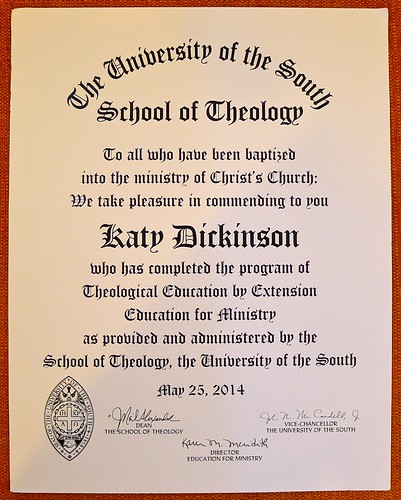

University of the South, School of Theology EfM, Diploma Katy Dickinson 2014
My EfM Diploma! (arrived early)

Images Copyright 2014 by Katy Dickinson

2 Comments

Filed under Church, News & Reviews

Silicon Valley Bethlehem and Cable Car

P1110946

We enjoy Christmas events old and new here in the Silicon Valley. Our EfM class went to the Bethlehem – Walk Through the Christmas Story together a week ago – followed by dinner at Mio Vicino in Santa Clara.   An unofficial highlight of the show was watching one of the flock headbutting all of the other sheep in turn while the shepherds and angel said their lines.

Last night a group of us current and former-Huawei staff got together for dinner (at Il Postale in Sunnyvale) followed by a motorized Cable Car Ride to see the holiday lights in Willow Glen.

P1110973

P1110995

P1120078

P1120108

P1120105

P1120096

Images Copyright 2013 by Katy Dickinson

Leave a comment

Filed under Church, News & Reviews

Unemployment Reporting, EfM

P1070410

Last summer, as soon as I was laid off from MentorCloud (great vision and staff, being paid would have been better…), I filed my unemployment claim with the California Employment Development Department (EDD).

Things have changed with EDD since I last wrote about it in 2009. The every-two-weeks reporting forms are the same but instead of a check in the mail, now they send a VISA credit card from Bank of America. This has lead to some problems.

Unfortunately, BofA is not my bank and the name on the BofA card is not precisely the same version of my name that is on my regular bank account, so they will not set up an auto-transfer. I get no notice when EDD puts funds into the VISA account, so every week, I have to: go to the BofA ATM to ask for the balance (the teller inside BofA cannot do this for an EDD card), if there is any money in the account, I go to my regular bank and tell them the precise balance, then my bank can transfer the funds into my checking account. I could just use the EDD VISA card to pay for stuff but not knowing how much is in it and telling EDD exactly what I spend money on do not work for me.

The EDD reporting form asks questions like:

  • Was there any reason (other than sickness or injury) that you could not have accepted full-time work each workday?
  • Did you look for work?
  • Did you work or earn any money, WHETHER YOU WERE PAID OR NOT?

That last one is difficult for me to answer, because of my work as an accredited Education for Ministry (EfM) mentor for the University of the South – School of Theology. The EfM program pays me a $126/month stipend during nine months of the year. I tried reporting that amount to EDD once a month during the week in which it was deposited but that did not work.  EDD stopped deposits and after two fussy letters, scheduled a phone call for me to explain about EfM. The call time was set for sometime during 3 pm to 5 pm Wednesday. When the EDD representative finally called at 5:15 pm, I explained that EfM is a weekly adult formation class for the laity – a four-year program of Bible study, church history, and theology I joined in 2010. The small payment is not per-hour or per-session but per-month and only for nine months – even though I work on the EfM program year-round. Nonetheless, the EDD representative asked me to report as if it were paid $28/weekly. Now that is sorted out, I hope that they will resume payments to the BofA VISA card.

Image copyright 2013 by Katy Dickinson

19 October 2019: Links Updated. For more about MentorCloud business practices, see Collecting a Labor Judgement (15 January 2016).

1 Comment

Filed under Home & Family, Mentoring & Other Business, News & Reviews

Dunk the Bishop and Other Convention Activities

P1100964

Last weekend, the Episcopal Diocese of El Camino Real on California’s central coast held its 2013 convention – and celebrated the start of our seventh year under the inspiring leadership of Bishop Mary Gray-Reeves. I have been honored to be elected to serve as a convention delegate (or alternate) for the last ten years. My home parish of St. Andrew’s hosted the convention this year in Saratoga.

ECR includes 13,000 people in 47 congregations:

The Diocese of El Camino Real stretches from south of San Francisco to north of Santa Barbara. The congregations of El Camino Real are found in the five counties of San Benito, San Luis Obispo, Santa Clara, Santa Cruz and Monterey. Although the youngest diocese in California, ECR’s Trinity Cathedral, in San Jose, is the oldest cathedral structure in the State of California.

Conventions are for celebration of our ministry, updates, and managing the business of the church. However, this year we also enjoyed dunking Bishop Mary. She gamely “volunteered” to get wet as a fundraiser for our youth mission trip. Tickets were sold: $10 for 3 balls to try to dunk, or $20 not to dunk the Bishop. The youth raised $1,200 from ticket sales in one night!  As always, the Rev. Stephenie Cooper and my husband John Plocher were the “Assistant Secretaries for Everything Else” – that is, running the computers and displays for the ECR  convention.

Other more-conventional (ahem) activities included:

  • Celebrating the two month visit of The Rev. Fred Kalibwami to ECR from the Diocese of Western Tanganyika (DWT)
  • Bishop Mary’s annual address to the diocese, including announcing the purchase of  Sargent House for the Bishop’s new offices in Salinas.
  • Honors to notable volunteers and lifetime contributors:
    • Bishop’s Cross Recipients: The Rev. Roger Barney, and The Rev. Canon Linda Taylor
    • Simple Servant Awards: Don and Diane Cooley, and Rosemary Tisch
  • Lunch gathering of the Education for Ministry mentors in ECR (including me!)
  • Reports on key ministries – outreach to the jails, campus ministry at four universities, and caring for the poor and homeless in our communities.
  • Election of delegates to the General Convention of the Episcopal Church (held every three years). I was elected as first Alternate for the 2015 General Convention.
  • Displays by diocesan and charity groups, plus sales of crafts and Bishop Mary’s newest book Unearthing My Religion

P1100997

P1110017

P1110022

IMG_0262

P1110218

Images Copyright 2013 by Katy Dickinson

1 Comment

Filed under Church, Home & Family, News & Reviews

Mentor Certification: Knowledge, Skills, Attitudes

IMG_5817

Last weekend, I completed my second mentor certification class (1st re-certification) by The University of the South – School of Theology, Education for Ministry (EfM) program.  It was an honor and pleasure to work with an inspired, generous, and talented group.  I value this structured and carefully managed program – not the least because I have the opportunity to improve through specific feedback and advice from other experienced mentors.

About EfM:

EfM is a unique certificate program of experiential theological education for laity under the direction of The School of Theology – University of the South. Since its founding in 1975, this international program has assisted more than 30,000 students in discovering how to respond to the call of Christian service. EfM helps students encounter the breadth and depth of the Christian tradition and bring it into conversation with their experiences of the world as they study, worship, and engage in theological reflection together.

EfM mentor certification requires 18 hours of training and observed interactions every 18 months.  EfM groups can meet either in-person (as does our group at St. Andrew’s Episcopal Church, Saratoga, California) or on-line. Here is an excerpt from the “Knowledge, Skills and Attitudes Expected of Mentors” document which guides the training and evaluation of EfM mentors:

Mentoring is an art.  The following list of competencies are like “paints and brushes” that allow the art to flourish.  These basic competencies help mentors and trainers to discern and evaluate mentor effectiveness.

Each mentor is rated by the mentor trainer in each competency as “not observed” or “needs improvement” or “proficient”.

Knowledge:

  • familiarity with the variety of voices within the Christian tradition
  • know the purpose of EfM and the components of an EfM seminar
  • know the theories and model of theological reflection in EfM:
    • four sources (action, tradition, culture, position)
    • four “movements” (identify, explore, connect, apply)
    • perspective questions (creation, sin, judgment, repentance, redemption)
  • know how to recruit, register, start, and maintain a group

Skills:

  • framing questions
  • facilitating reflection
  • sharing leadership
  • planning and managing the seminar
  • managing energy
  • listening
  • communicating clearly

Attitudes:

  • openness to growth
  • invitation
    • empowerment
    • valuing participation
  • encouragement
  • respect for human and theological differences
  • comfort with ambiguity
  • willingness to receive and give feedback
  • willingness to transmit EfM

IMG_5827

Images Copyright 2013 by Katy Dickinson

2 Comments

Filed under Church, Mentoring & Other Business

TSA Afraid of Rocks

IMG_5890

Ever since I read “Why It’s Time To Break The Code Of Silence At The Airport” by Christopher Elliott (15 February 2013, TheHuffingtonPost) and my daughter’s TSA posts (including “TSA Touching Crosses The Line: Update”), I have been considering how much more invasive and offensive the TSA has become over time and how we enable this behavior by not objecting to it.

This weekend, I flew from the San Francisco Bay Area to Los Angeles for training (to renew my mentor certification with Education for Ministry, a program of the University of the South – School of Theology), and to visit my brother and family in La Crescenta. I used two small-ish airports, San Jose (SJC) and Burbank (BUR) for convenience.

This morning, I walked quickly to the head of the extremely short security check point line at Burbank, hoping to have time for a quiet coffee before boarding my flight home. However, I was pulled out of line in the nearly-empty security area not once but twice.

  1. The first time I was pulled from line was so that the security lady could feel my face – after her full-body scanner drew a little yellow box around my apparently-dangerous earring. As you can see from the picture below (and as she herself could clearly see), there wasn’t anything for her to find while she patted down my ear, cheek, and short hair.
  2. The second time I was pulled out a few minutes later was so that the security man could unpack my small roller bag, re-scan my toiletries, and try to take away my rock.  I was bringing home a small piece of granite as a souvenir of La Crescenta.  He said, after feeling my rock, that I had to get rid of it or check my bag because a rock could be a weapon.  It seems that there is a TSA rule saying that rocks over five pounds are dangerous.  I chose to keep my rock, so I was escorted out of the security area, then had to walk back to the airline counter (where the counter lady told me that she hears an unusual number of complaints about the Burbank TSA), check my carry-on bag, and go through security all over again.

I made my flight home, but no quiet coffee for me.  I object.

IMG_5892 . IMG_5893

Images Copyright 2013 by Katy Dickinson

Leave a comment

Filed under Church, Home & Family, Mentoring & Other Business, News & Reviews, Politics

Merry Christmas

IMG_1379

Best wishes to you and your family for a happy holiday season, from all of us here in the Silicon Valley!

Between trying to get the construction workers finished enough to be out of our house by Christmas, and all of the usual holiday preparations and activities, December 2012 has been particularly busy. There has finally been sufficient progress on the new porch to allow us to have family and guests in the house.  The roof and final plastering were finished just before dinner yesterday – barely in time for us to go Christmas caroling on the cable car in San Francisco.  Jessica and Matthew were able to get off from work to join us for Christmas – for which we are very joyful!

  • I went shopping in Chinatown with Sally and Lorene (our tradition for over twenty years). We were sad to see the closed up Sam Wo restaurant where we used to eat raw fish salad for lunch during our annual walking tour of Grant Street stores.
  • John and I were delighted to hear our young friends Max and Beth perform as part of the Cantabile Youth Singers at the ornate St. Joseph Basilica in San Jose.
  • My son Paul and I picked out and walked home a Christmas tree – which sat in a bucket of water on the driveway for two weeks until the contractors left and we could move all of the furniture back.  Jessica and Matthew and Paul brought the tree inside and decorated it tonight.  The decorations are eclectic but cheerful.  I still need to put out the nativity figures John bought in Bethlehem.
  • My EfM class went to see the Bethlehem Christmas story re-enactment, and then went out to dinner together and exchanged gifts.
  • Last Sunday was the St. Andrew’s Episcopal Church children’s pageant.
  • We have very much enjoyed Willow Glen’s enthusiastic Christmas light displays – which give every street its own twinkly charm as we go about our holiday business.
  • Today we went to the Dickens Fair at the Cow Palace in San Francisco to enjoy a Victorian Christmas, high tea, and last-minute shopping.
  • Tomorrow, John starts cooking for our Christmas feast on Tuesday!
IMG_0499 . IMG_0487

IMG_0697

IMG_1210

IMG_0796

IMG_0925

IMG_0808

IMG_1565

Images Copyright 2012 by Katy Dickinson

2 Comments

Filed under Church, Home & Family, News & Reviews