Tag Archives: Disabilities

Paul is a Senior

My 16-year-old son Paul has had a rough year. Our family’s continuing medical adventure began when Paul started having chronic and severe headaches in January. We have spent the last six months with Pediatricians, Neurologists, Neurosurgeons, Pain Specialists, Psychologists and Psychiatrists, Occupational and Physical Therapists, and Nurse practitioners. Recently, Paul has benefited from Chiropractic care in addition to the medicines provided by the Pain Management Clinic at Packard Children’s Hospital.

Yesterday was Paul’s last day at the Packard Hospital School. He is now a Senior in High School and is looking forward to going back to Paly in September. The Hospital School has a good art, theater, and science program for its patient students. Here is Paul with some of his recent art:

Paul Dickinson Goodman<br /> photo: copyright 2009 Katy Dickinson

punched out sun face masks

punched out sun face masks by Paul Dickinson Goodman<br /> photo: copyright 2009 Katy Dickinson

elements drawing

elements drawing by Paul Dickinson Goodman<br /> photo: copyright 2009 Katy Dickinson

wire and bead fish

wire and bead fish by Paul Dickinson Goodman<br /> photo: copyright 2009 Katy Dickinson

Some of Paul’s art from earlier this year:

three ceramic mugs

three ceramic cups by Paul Dickinson Goodman<br /> photo: copyright 2009 Katy Dickinson

ceramic leaf tray

ceramic tray by Paul Dickinson Goodman<br /> photo: copyright 2009 Katy Dickinson

carved head

blue scupture head by Paul Dickinson Goodman<br /> photo: copyright 2009 Katy Dickinson

Images Copyright 2009 Katy Dickinson

Leave a comment

Filed under Home & Family

Two College Talks

15 March 2010: More on this topic is in the blog entry “Transitions for Young Adults with Neurocognitive Deficits

I gave two college talks last week – driving 372 miles south on Friday (San Jose – San Luis Obispo – San Jose), then 103 miles north on Saturday (San Jose – Lafayette – San Jose).

Friday’s talk was called “Mentoring in Engineering & Computer Science & Technology Jobs”, given at the sold-out  National Association of Engineering Student Councils (NAESC) conference at CalPoly in San Luis Obispo (SLO). For more, see my  1 April 2009 blog entry.

Saturday’s talk in Lafayette was called “What Happens After College? – Kids with Neurocognitive Disability Working in Engineering and Computing”, at the Orion Academy “3rd Annual Seminar on Post-Secondary Transition Planning for Young Adults with Aspergers, NLD and other Neurocognitive Deficits”. For more, see my 30 March 2009 blog entry.

From the comments and emails, I think both talks went well.  Some photos follow. You can also read Wendy Dow’s “University Recruiting Topics Studentzone” blog entry (13 April 2009) about the CalPoly talk [no longer available online].

Gonzales – driving south to SLO

Gonzales - driving south to SLO - San Luis Obispo, California photo: copyright 2009 Katy Dickinson

The hills of SLO

The hills of SLO - San Luis Obispo, California photo: copyright 2009 Katy Dickinson

CalPoly sign

CalPoly sign - California Polytechnic State University photo: copyright 2009 Katy Dickinson

Curie and Einstein at CalPoly

Curie and Einstein at CalPoly photo: copyright 2009 Katy Dickinson

Sun Table at CalPoly

Sun Table at CalPoly photo: copyright 2009 Katy Dickinson

Katy at Orion Seminar

Katy speaking at Orion Academy Seminar photo: copyright 2009 Peter Korn

Images Copyright 2009 by Katy Dickinson and Peter Korn
29 Dec 2016 – Links Updated (as Possible)

2 Comments

Filed under Mentoring & Other Business, News & Reviews

What Happens After College? (Geeks and the Silicon Valley)

15 March 2010: More on this topic is in the blog entry “Transitions for Young Adults with Neurocognitive Deficits

On Saturday, 4 April 2009, I am giving a talk in Lafayette, California, called “What Happens After College? – Kids with Neurocognitive Disability Working in
Engineering and Computing”
at the Orion Academy 3rd Annual Seminar on Post-Secondary Transition Planning for Young Adults with Aspergers, NLD and other Neurocognitive Deficits.

I put together this presentation based on information and advice from many sources as well as from my own experience as the parent of a 16-year-old son with social-cognitive disability. I had particular fun creating the “Geeks and the Silicon Valley” section of the talk. I included my favorite quote from
Larry Wall (creator of Perl): “Most of you are familiar with the virtues of a programmer. There are three, of course: laziness, impatience, and hubris” plus an xkcd cartoon, pictures of tshirts (“You read my t-shirt. That’s enough social interaction for one day.”) from Think Geek and the xkcd store, and other geeky stuff.

The second part of the talk covers what counts in finding a job in the Silicon Valley (Recommendations, Academics, Experience, Being Fast), how to get experience before getting a job (Open Source, Internships, Volunteer Projects, College Jobs), and other essential knowledge. I make several references to The Unwritten Laws of Engineering (Revised and Updated, 2001) by James Skakoon and W.J. King, available from the ASME product catalog. My last quote is
from Ivan Sutherland in his 1996  Technology and Courage (Sun Labs Perspectives-96-1):

“I, for one, am and will always be a practicing technologist.
When denied my minimum daily adult dose of technology, I
get grouchy. I believe that technology is fun, especially when
computers are involved, a sort of grand game or puzzle with
ever so neat parts to fit together… If the technology you do
isn’t fun for you, you may wish to seek other employment.
Without the fun, none of us would go on.”

You can  review my presentation online, or you can attend the event to hear it in person!

3 Comments

Filed under Home & Family, News & Reviews

High School IEP – Individualized Education Program

We held my son Paul’s IEP today and I thought it might help other parents going through this annual special education ritual to read about it. Paul just finished his Sophomore (grade 10) year in High School here in the San Francisco Bay Area. An IEP or Individualized Education Program is a meeting and set of documents describing the interventions or accomodations which will support the unique educational needs of a particular disabled child. The IEP is essentially the record of what has happened during the prior year and what the school, teachers, parents, and child agree will help that child learn best within the school. (There are much more precise and complex ways to define an IEP, of course.) IEPs can be used in public or private schools. Paul attends public school.

Paul has had an IEP since about 2nd grade. When he was younger, the IEP focussed more on understanding and evaluating his disabilities and what services might help him. Now that Paul is almost 16, the IEP is more focussed on the resources and program needed to support Paul’s more-or-less understood educational, social, and cognitive challenges.

Once, when Paul was worried that his IEP accomodations were not fair and that taking advantage of them was like cheating, one of the school administrators explained to him that he had to work so much harder and longer hours than most students because of his disabilities, the accomodations were to level the playing field so that he could compete in the mainstream school. This made good sense to Paul.

This morning, after weeks of preliminary discussions, nine of us met for the IEP.  As he has matured, Paul himself has been increasingly consulted during his IEPs and he spoke at length several times during this meeting. We all left an hour and a half later with a twenty-ish page stack of papers but a short list of accomodations and course work for Paul’s 2008-2009 (Junior) year in High School. Here is what we signed off on:

    • Accomodations:
      1. Uses own laptop computer at school
      2. Access to school computer, printer access (while working at school)
      3. Extra time on exams and assignments, when pre-arranged with teacher
      4. Alternative setting for test taking, as needed (allowed same access
        to test instructions and question answering as other students taking that test)
      5. Possible that test can be read aloud if needed
      6. Classroom aide in English and History, transitional aide support in Geometry
      7. Homework log prepared by classroom aide
    • Classroom Aide’s Duties:
      1. Note taking assistance
      2. Collect papers distributed in class
      3. Facilitate turning in assignments
      4. Social diffusion (modeling)
      5. Completion of homework log
    • Tentative 2008-2009 Course Work:
      1. Geometry
      2. Ceramics
      3. English
      4. U.S. History
      5. Physical Education
      6. Study Skills (2 periods)

This year (2007-2008), Paul took one more solid subject (Biology) along with Math, Art, English, History, and P.E. but he had only one Study Skills period. We all decided that since Paul recently passed his High School exit exam and has almost completed his required courses for graduation, the stress of a 4th solid wasn’t worth it. We will find out in August which teachers are assigned to these classes and how Paul’s schedule works out in detail.

Leave a comment

Filed under Home & Family, News & Reviews

Living in a Cat World

15 March 2010: More on this topic is in the blog entry “Transitions for Young Adults with Neurocognitive Deficits”

Yesterday, my daughter Jessica published a wonderful blog post called Some things that work about a superb teacher, Linda Herreshoff. Linda was my son’s teacher for three years at Jordan Middle School in the Palo Alto Unified School District. Linda’s class is full of kids like Paul, who have social-cognitive challenges often diagnosed with an Autism Spectrum label, like: Asperger’s syndrome, high functioning Autism, Non-Verbal Learning Disorder, or Pervasive Developmental Disorder – Not Otherwise Specified (PDD-NOS). Almost all of Linda’s kids are boys who are smart or very smart and have parents who will not give up. Paul matured and learned and thrived in Linda’s class as never before. Her love, wisdom, teaching skill, and patience are awesome.

Part of Jessica’s blog post was a reference to the Liller Family Blog Entry on Asperger’s Syndrome, which starts off with this excellent summary:

Most children live in a dog world: A dog loves to be around people and socially interact with them. They willingly show affection, and follow their master’s commands. They also love to play and hang around other dogs no matter what activity their engaged in.

Asperger’s children live in a cat world: A cat is generally a loner. They prefer doing things their own way and like/need their solitude. Cats come to people on their own terms in their own time and they aren’t very social unless they choose to be. They have a routine and like to stick to it. They have one interest at a time (usually that silly piece of string they love to paw at). And when backed into a corner, a cat will lash out.

Paul is almost six feet tall now and just about done with his Sophomore year in High School. We were thrilled today to hear that he has just passed the California High School Exit Exam (CAHSEE). (Paul will be in High School for two more years. He took the CAHSEE this year just in case he needed several tries to pass it.) During our family dinner tonight celebrating Paul’s passing the CAHSEE, John and Jessica and Paul and I made a list of benefits and disadvantages of Paul’s social-cognitive challenges. As you will see, the two are almost mirror images of each other:

  • Benefits
    • Completely unaware of peer pressure
    • Amazing ability to concentrate
    • Generous, loving, and much given to small acts of meaningful kindness
    • Believes in long-term commitment, dedicated and loyal
    • Fastidious
    • Doesn’t lie well
    • Good sense of direction, sequencing, and paths
    • Loves ritual
    • Good at card and board games because he remembers all of the rules and the details of play
  • Disadvantages
    • Perseverant, stubborn, hard to influence
    • Gets stuck emotionally – sometimes needs help to move on
    • Can’t organize things – homework or papers or his room
    • Finds change difficult
    • Slow to mature
    • Extremely literal
    • Holds grudges with a very long memory
    • Does not take tests well
    • Follows all of the rules and expects everyone else to also

Of course, some of these behaviors sound like any teenage boy… (Also, Jessica says she treats all of her Engineering friends like they have Asperger’s and this works very well.)

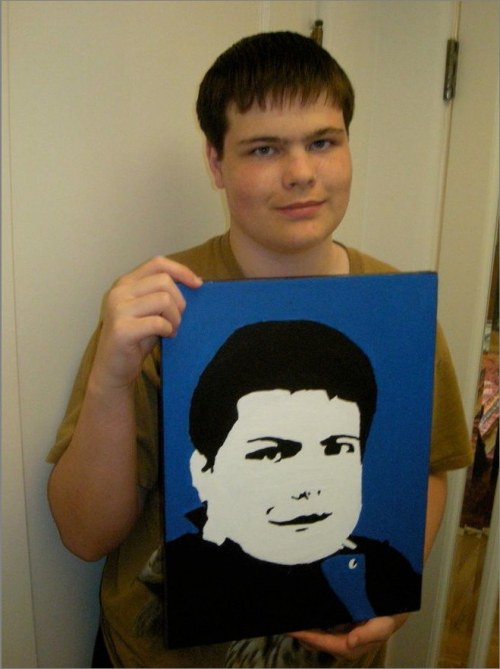
Paul has been enjoying taking Art this year. Here he is with his new self-portrait.
2 July 2020 update: see Paul’s art portfolio on Paulselement
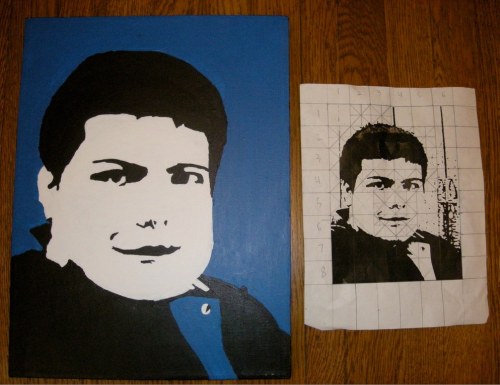
Paul's portrait and planning sheet photo: copyright 2008 Katy Dickinson

Paul and his portrait photo: copyright 2008 Katy Dickinson

Images Copyright 2008 by Katy Dickinson

29 Dec 2016 – Links Updated

2 Comments

Filed under Home & Family

Paul’s Computer Drawings

Paul D Goodman 2007 computer drawing of loon
On October 10, 2007, I posted two of my son Paul’s drawings – one from 1999 and the other from his first Palo Alto High School art class, this year. Here are three more images that Paul created on his laptop computer. Paul is 15 years old and spends time each day drawing on his laptop. Since he has a variety of learning disabilities, it is a joy to see him express himself so well artistically. Paul has also discovered SketchUp and is having a wonderful time drawing 3-D images (which are harder to show in a blog).

More:

Paul D Goodman 2007 computer drawing of boxes

Paul D Goodman 2007 computer drawing of 3 towers

If you want to receive Katysblog posts by email, please sign up using the Sign Me Up! button (upper right on Katysblog home).
Images Copyright 2007 by Paul Dickinson Goodman
Updated 5 April 2020

1 Comment

Filed under Home & Family

Paul’s Drawings

Paul D Goodman 2007 ink drawing spirals
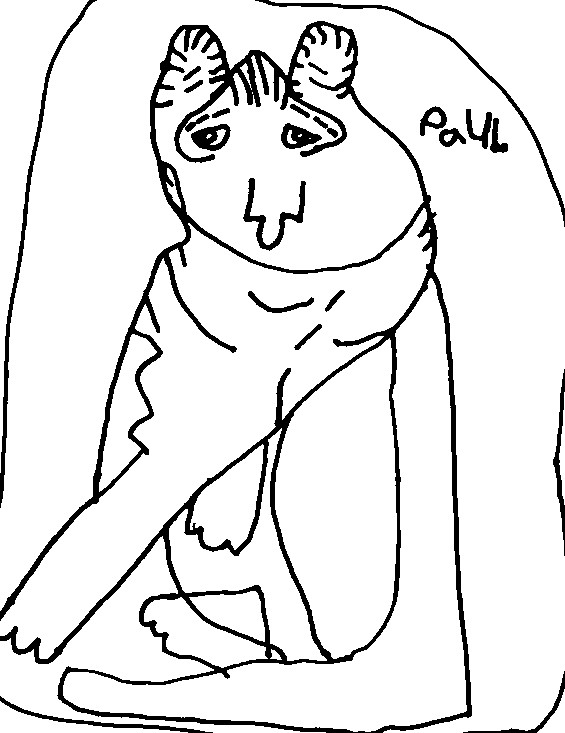
My son Paul is just 15 and is taking his first Palo Alto High School art class as a Sophomore. He spends hours each day drawing on his laptop, so we have been curious to see how he does with more traditional art materials like charcoal, ink, and paint. In 1999, when Paul was in 2nd grade at Peninsula School, one of his drawings was selected for a children’s art show at the Animal Art Gallery in Menlo Park, California, – his first exhibit! I include that drawing below with one of his recent pictures. For the spiral picture, Paul’s art teacher asked the students to use black and white to show negative space with a clear center point.

More:

Paul D Goodman 1999 drawing of cat

If you want to receive Katysblog posts by email, please sign up using the Sign Me Up! button (upper right on Katysblog home).
Images Copyright 1999 – 2007 by Paul Dickinson Goodman
Updated 5 April 2020

2 Comments

Filed under Home & Family