Process Success Measures

In 2002, I gave a lunchtime presentation on process design to Sun’s Six Sigma Black Belt community. In that talk I proposed two measures for process success. While any individual process will have its own particular success measures, two simple metrics for overall success for any process are:

  1. The process is used long-term by a variety of people.
  2. It is updated and improved by people other than the ones who created it.

I was reminded of those key measures this week when I used two very different but successful systems for which I have had the honor to be one of the architects:

  1. Sun Labs’ Archivist, an archival and clearance system for intellectual property
  2. El Camino Real Department of Missions (DOM), a management system for small congregations, many of them working and worshiping across cultural lines

Both the Archivist and DOM systems have now been in use for many years and are successfully managed by people who were not involved in their original development. I am proud of these projects and their phase transition from development to long-term sustained use. I am also pleased to see how well their pattern matches the two success metrics I proposed in 2002. Below is more about Archivist and DOM.


Sun Labs’ Archivist

In 2000, James Gosling, Jos Marlowe, and I started a two-year project to create a new archiving and clearance system for Sun Laboratories. You can read some of the history of this system in “Sun Labs: The Second Fifty Technical Reports A Commemorative Issue” by Jeanie Treichel, Katie Chiu, Christopher Wu and Jeanne Wang (Sun Labs Report TR-2009-101, published in March 2009).

We based the process for Archivist on a system created while I was the Process Architect for the Sun Standards group. That group needed a fast way to submit contributions to an SSO (Standards Setting Organization) such as the IETF (Internet Engineering Task Force), while protecting Sun’s intellectual property. Part of the SSO submission system was the Technical Information Clearance Process (TICP) which was a core piece of what became Archivist. The SSO submission process project team included Carl Cargill, Catherine Mccarthy, Lisa Goldman and Philip Rosenzweig. Sadly, Phil Rosenzweig died on one of the planes in New York City on 11 September 2001, before the SSO submission project was complete.

Here is the original Executive Overview for Archivist from 2000:

    Sun Labs is faced with a dilemma: we wish to derive the benefits of quality control and process while at the same time shortening our time-to-release. In particular, we wish to protect our intellectual property and increase our patent portfolio while simultaneously speeding up the time it takes to review technical information prior to publication. This process architecture is our attempt to resolve the dilemma. The Archivist is both an archival mechanism and a clearance process.

Think of The Archivist clearance process as a state dinner: the menu is fixed and protocol is closely observed. Think of The Archivist Fasttrack as a scramble-bar cafeteria where one can select individual dishes. The advantage of a state dinner is that it is safe, repeatable, and the participants know exactly what to expect (with regard to structure). The advantage of a cafeteria is that it is flexible and very fast. We expect that as the Fasttrack cafeteria grows in its selection and quality of service, the volume of users will shift from The Archivist clearance to Fasttrack clearance: thus, cycle time will be greatly reduced.

Here is the 2000 description for use of Archivist for clearance and archiving:

Clearance is distinct from archival. Archived material may or may not go through clearance.

Examples of archived material are:

  • An email or a note describing an idea
  • Audio and video tapes
  • Objects (such as boards)
  • Letters
  • Notebooks

Examples of documents that have been cleared are:

  • White papers (either on paper or the web)
  • SML Tech reports (paper or web)
  • Third-party publications (e.g. conferences, encyclopedias)
  • External presentations

Rule of thumb: if you think your document will be leaked or by any means published outside, use the process.

Sun Labs started in 1991, so Archivist was not the first archiving system for Sun Labs but it has been by many times the longest lived. In creating Archivist, we identified two key customers: Ivan Sutherland (Sun Fellow and Vice President), and Jeanie Treichel (Sun Labs founding Program Manager and Technical Reports Editor). Ivan Sutherland is famous in Sun Labs for his saying “It’s not an idea until you write it down.” There were many other reviewers and contributors but we knew that if Ivan and Jeanie were happy with Archivist, it would be good enough for everyone else.

Archivist has gone through several major revisions since it was created in 2000. It has been used by hundreds of Sun Labs staff in the US, UK, and France to enter over ten thousand items. Archivist continues in active use today under the management of Sun Labs’ technical staff.

As of now, I have 113 of my own documents entered into Archivist. Recently, Helen Gracon and I entered into Archivist most of the key documents from the Mentoring@Sun program. More about Mentoring@Sun is available in the recent Sun Labs Technical Report “Sun Mentoring: 1996-2009” (by Katy Dickinson, Tanya Jankot, and Helen Gracon).


El Camino Real Department of Missions

From 2003-2007, I was the volunteer Convener for DIEM (the Department of Intercultural Evangelism and Mission), providing oversight, finance, and management support to thirteen mission congregations (Latino, Anglo, and Asian) of the El Camino Real Episcopal Diocese. I served as Convener under two Bishops: the (late) Right Reverend Richard Shimpfky, and the Rt. Rev. Sylvestre D. Romero.

2003-2007 was a difficult time of transition for our diocese but nonetheless the elected and appointed DIEM members developed a solid process for Mission Liaisons, as well as the “Mission and Vision” structure for the missions as a group. The “Mission Congregation Liaison Job Description” was only one page long but it represents an amiable solution to years of discussion on how best to provide mission oversight.

In 2008, I was elected to DOM (the successor to DIEM) for a three year term. At last night’s monthly DOM meeting, I was pleased to get slightly updated versions of the process documents DIEM created in 2005 while I was Convener. DOM and its nine remaining missions is now managed by our new Bishop, the Rt. Rev. Mary Gray-Reeves, with the Rev. Canon Jesus Reyes acting as Convener.

28 March 2014 and 6 January 2018- links and formatting of this blog post were updated

1 Comment

Filed under Church, Mentoring & Other Business, News & Reviews

New Wikipedia Entry: Katherine Johnson

My husband John and I just spent most of the afternoon creating a new  Wikipedia entry about Computer Science Pioneer Katherine Johnson (based on my 23 December 2009 blog entry). My daughter Jessica also advised on the project. Even though we started out with all of the information in HTML, we ended up reworking the text and references to fit into Wikipedia’s format and style. My initial Wikipedia discussion comment indicated that the blog entry came first, yet within seconds of publication, an automatic searchbot tagged the article
as a near-duplication of my original blog entry. I went left a second comment acknowledging the source.

This is my first original Wikipedia entry. I started thinking about what I could add to Wikipedia after reading Clay Shirky’s excellent 2008 book Here Comes Everybody earlier this year. Jessica is reading my copy of Shirky’s book now and adding her margin comments to mine.
I am curious to see what kind of comments are made on the Katherine Johnson Wikipedia entry and whether any valuable information is added.

1 Comment

Filed under News & Reviews

Getting Ready for Christmas

My daughter Jessica arrived home a few days ago but soon left on a ski trip with her fiance Matt and his family. She comes back this afternoon. While she was briefly home, we went to the Great Dickens Christmas Fair at the Cow Palace. My mother and I also went to the Dickens Fair after Thanksgiving with my brother Pete and his family, so we have had quite the Victorian Christmas so far. (I have seen Gilbert and Sullivan’s Mikado twice this year!) I have also visited family, participated in the annual Sun Labs Christmas Cookie Exchange, and enjoyed the SunCaroler’s Menlo Park campus walking concert, the 1st annual Willow Glen Lions Holiday Party, and other delights of the season.

Dickens Fair

DSCN8159

Marley confronts Scrooge

DSCN8140

Pirate’s Cove

DSCN8150

Dark Garden Tableau

DSCN8154

Images Copyright 2009 Katy Dickinson and John Plocher

Pete and family at the Dickens Fair

DSCN7279

Ko-Ko and Katisha, The Mikado

DSCN7332

Ballena Bay Pewter, Dickens Fair

DSCN8142

SunCarolers annual walking concert

DSCN8080

Willow Glen Lions Party

DSCN8099

Sun Labs Cookie Party

DSCN8036

Family visit

DSCN7491

Uncle Wayne’s Workshop

DSCN7463

Paul, Lynda, Daniel (cousins)

DSCN7478

Paul and Jessica

DSCN8106

Paul and Jessica

DSCN8117

Jessica and Matt

DSCN8160

Leave a comment

Filed under Home & Family

Katherine Johnson, Computer and Pioneer

Creative Commons License
This work is in the Public
Domain

Welding WP668 caboose stair rail
photo: 1979 U.S. Department of Energy A benefit of creating the

Famous Women in Computer Science
list is learning new stories of amazing women
who have been recommended by my generous readers. Notable even in this
remarkably accomplished group is Katherine Johnson. Ms Johnson was brought to
my attention by
Kristin Yvonne Rozier
, a Research Computer Scientist at

NASA Ames Research Center
here in the San Francisco Bay Area. When I first
met Kristin, she worked at

NASA Langley Research Center
, where Katherine Johnson had also worked.

About Katherine Johnson

Katherine Johnson made significant contributions to America’s aeronautics and space advances and she was a pioneer in advancing our society. Her accomplishments contributed to the success of our nation’s early space program and in the early application of digital electronic computers at NASA. Her courage and perseverance helped to lead the way for both women and African-Americans in technical fields.

Education and Early Work

Katherine Coleman was born in 1918 in White Sulfur Springs, West Virginia. Her mother, Joylette, had been a teacher and her father, Joshua, was a farmer who also worked as a janitor. Since local schools only offered classes to African-Americans through the eighth grade, her father drove the children to a school 125 miles away. Katherine graduated from high school at 14, from college at 18. She taught in elementary and high schools in West Virginia and Virginia for 17 years. Then, Katherine Johnson went to work as a “computer” for the Langley Research Center, part of the National Advisory Committee for Aeronautics (NACA). NACA later became the National Aeronautics and Space Administration (NASA).

Katherine Johnson at NASA

According to her oral history archived by the National Visionary Leadership Project:

“…in June 1953, Katherine was contracted as a research mathematician at the Langley Research Center… At first she worked in a pool of women performing math calculations. Katherine has referred to the women in the pool as virtual `computers who wore skirts.’ Their main job was to read the data from the black boxes of planes and carry out other precise mathematical tasks. Then one day, Katherine (and a colleague) were temporarily assigned to help the all-male flight research team. Katherine’s knowledge of analytic geometry helped make quick allies of male bosses and colleagues to the extent that,’they forgot to return me to the pool.’ While the racial and gender barriers were always there, Katherine says she ignored them. Katherine was assertive, asking to be included in editorial meetings (where no women had gone before.) She simply told people she had done the work and that she belonged.”

At NASA, Katherine Johnson started work in the all-male Flight Mechanics Branch and later moved to the Spacecraft Controls Branch. She calculated the trajectory for the space flight of Alan Shepard, the first American in space, in 1959 and the launch window for his 1961 Mercury mission. She plotted backup navigational charts for astronauts in case of electronic failures. In 1962, when NASA used computers for the first time to calculate John Glenn’s orbit around Earth, officials called on her to verify the computer’s numbers. Ms. Johnson later worked directly with real computers. Her ability and reputation for accuracy helped to establish confidence in the new technology. She calculated the trajectory for the
1969 Apollo 11 flight to the Moon. Later in her career, she worked on the Space Shuttle program, the Earth Resources Satellite, and on plans for a mission to Mars.

Katherine Johnson’s Legacy

In total, Katherine Johnson co-authored 26 scientific papers, of which only one can now be found. The practice in 1960 would have been not to list the female Computers as formal co-authors, so that she was listed as an author is significant.

Katherine Johnson’s social impact as a pioneer in space science and computing may be seen both from the honors she has received and the number of times her story is presented as a role model. Since 1979 (before she retired from NASA), Katherine Johnson’s biography has had an honored place in lists of African-Americans in Science and Technology. In an era when race and gender held back many, Katherine Johnson’s courage, perseverance, and talent helped her to succeed. The continuing need for historical success models for both women and African-Americans makes Katherine Johnson particularly important.

Katherine Johnson and Computer Science

Much of Katherine Johnson’s life predates the academic discipline now called Computer Science; however, she has two strong ties to the field. First, as a “Computer” scientist she is one of few people to carry this historical title which refers to when humans did what computers do now. It’s the same work, just less automated back then. Second, she was one of the earliest people in the area now called verification of avionics software systems. In 1962, people were still used to check the results found by NASA’s mechanical computers: to verify that the trajectories were correctly computed. When Katherine Johnson worked with the flight research team, she probably influenced the ways in which early computers were initially integrated into avionics systems by determining how they could be most useful, and that they were reliable enough. Like Katherine Johnson, many of those who work today in avionics software verification have math degrees because of the nature of the tools used. NASA now calls workers in that area Research Computer Scientists. Work at NASA is interdisciplinary, so it is hard to classify people into traditional categories; however, avionics hardware and software verification are unquestionably part of what we now call Computer Science.

Curriculum Vitae

Katherine Johnson

Experience Summary

    • 1953-1986 NASA Langley Research Center, Virginia
    • 1953-1958 Computer (mathematician), Langley Research Center with
      the National Advisory Committee for Aeronautics (NACA)
    • 1958-1986, Aerospace Technologist, NASA
    • 1952-1953 Substitute math teacher for Newport News, VA, public schools
    • 1936-1952 Teacher in rural Virginia and West Virginia high schools and elementary
      schools

Education

    • 1940 West Virginia University graduate program in Math
    • 1937 West Virginia State University (West Virginia State College),
      BS in Mathematics and French, summa cum laude
    • 1932 West Virginia State High School

Awards

    • 2006, Honorary Doctor of Science by the Capitol College of Laurel Maryland
    • 1999, West Virginia State College Outstanding Alumnus of the Year
    • 1988, Honorary Doctor of Laws, from SUNY Farmingdale
    • 1986, NASA Langley Research Center Special Achievement award
    • 1985, NASA Langley Research Center Special Achievement award
    • 1984, NASA Langley Research Center Special Achievement award
    • 1980, NASA Langley Research Center Special Achievement award
    • 1971, NASA Langley Research Center Special Achievement award
    • 1967, Apollo Group Achievement Award – this award included one of only 300 flags flown to the moon on-board the Apollo 11
    • 1967, NASA Lunar Orbiter Spacecraft and Operations team award – for pioneering work in the field of navigation problems supporting the five spacecraft that orbited and mapped the moon in preparation for the Apollo missions

Publications

    • NASA TND-233, “The Determination of Azimuth Angle at Burnout for Placing a Satellite over a Selected Earth Position” 1960. Authors: T.H. Skopinski, Katherine G. Johnson

      This is a formal peer-reviewed NASA report. The practice at the time would have been not to list the female Computers as formal co-authors, so the fact that she was included is significant.

Published Biographies and References

Personal

    • On August 26, 1918, Katherine Coleman was born in White Sulfur Springs, West Virginia. In 1939, she married James Francis Goble and started a family. The Gobles had three daughters: Constance, Joylette, and Katherine. In 1956, James Goble died of an inoperable brain tumor. In 1959, Katherine Johnson married Lt. Colonel James A. Johnson. She sang in the choir of Carver Presbyterian Church for fifty years.
    • Katherine Johnson and her husband live in Hampton, Virginia, and enjoy spending time with six grandchildren and four great-grandchildren. Ms. Johnson still plays piano, bridge, and solves puzzles.

Grateful thanks to
Lesa B. Roe
, Gail S. Langevin, and Jim Hodges of NASA Langley, and to Kristin Yvonne Rozier of NASA Ames for their help in collecting and developing this information. All honor to Katherine Johnson for leading the way.

1 Comment

Filed under News & Reviews

How Speed Mentoring Works

SEED (Sun Engineering Enrichment & Development) is Sun Microsystems Engineering’s world-wide employee mentoring program, started in 2001. Speed mentoring is SEED’s newest offering: a series of short focused conversations about specific questions. This business method can serve as an introduction for mentees and mentors both to mentoring and to each other.

The first SEED Speed Mentoring session was held at Sun Microsystems during lunchtime on 9 December 2009 in Menlo Park, California. Thirteen mentors and twenty mentees signed up. 88% of the mentors and mentees reported being satisfied to very satisfied with their experience. No one reported being dissatisfied. Thanks to Helen Gracon, Rob Snevely, and Rick Aaron for supporting me in running this event!

Topics most discussed were:

  • Career development (77%)
  • Improving professional visibility (65%)
  • Technical skills development (54%)
  • Improving leadership or management skills (50%)
  • Discussing best path to success (46%)

Some replies to the follow-up survey question “What would you say to someone who was interested in participating in a future SEED Speed Mentoring session?”:

  • Excellent service from Sun. Anyone who is interested in career development, should avail this one.
  • Go for it but don’t expect it to answer all your questions.
  • Know what you want to get out of the sessions ahead of time. Try to conduct some research on who the mentors are ahead of time.
  • Sure. Do it. It’s a few hours that has a decent chance of broadening your perspectives.
  • Go in with a plan of what you want to discuss. Be aware of the limitations of such an exercise.
  • I would highly recommend it. It doesn’t take much time at all but can quickly provide some feedback and give one’s thinking process a nudge.
  • Please participate, since it inspires you to do routine things differently. It provides useful pointers to making career changes. It helps to make better choices Towards technical skills gained at work.

There are probably many successful ways to run a speed mentoring event. Here is SEED’s instruction document (approved for public distribution), complete with a flow chart:

How Speed Mentoring Works (4 pages, PDF format)

Pictures from the first SEED Speed Mentoring Session:

DSCN7913 . DSCN7916
DSCN7920 . DSCN7928

Images Copyright 2009 Katy Dickinson
Edited and updated 15 May 2018

2 Comments

Filed under Mentoring & Other Business

Christmas Prep

My family is mostly enjoying the preparations for Christmas. Today, I mailed the
last of six boxes full of gifts to distant friends and relations. Postage cost about $125- this year, even after using three USPS Flat Rate Boxes. The staff in Sun’s Menlo Park Campus mail room helped me with box sizes until we found the cheapest rates.

We don’t have a Christmas tree yet. We are thinking of buying a live tree and then donating it to Our City Forest for planting in January. We hosted the Silicon Valley Lines Model Railroad Club annual holiday party last week. Tonight, we host the
Spiral holiday dinner party. We will also host Christmas dinner, a party to celebrate my daughter Jessica’s 21st Birthday and Engagement, plus New Year’s Eve. In addition to our own celebrations, my husband John Plocher has been helping Santa Maria Urban Ministry (SMUM) with their holiday events and food distribution. I have been working on the St. Andrew’s Medical Assistance (SAMA) Christmas craft sale of goods from the Holy Land.

Busy times!

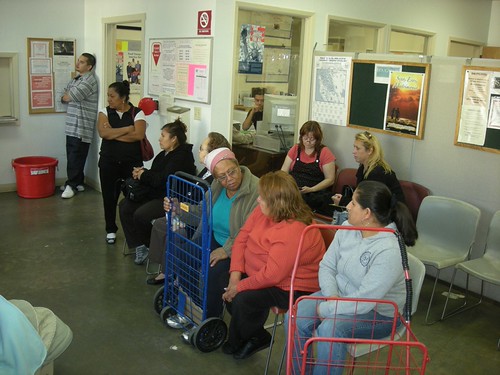
Waiting for food at SMUM

DSCN7266

Filling SMUM food boxes

DSCN7239

In the SMUM food line

DSCN7268

Office building window lights

DSCN7771

Neighborhood Deer Lights

DSCN7694

Our house – train lights with the moon

DSCN7680

Christmas night lights

DSCN7673

Same house during day

DSCN7564

Flat daytime Santa

DSCN7565

SAMA mother of pearl

DSCN7864

SAMA sale

DSCN7861

SAMA sale – camels

DSCN7856

SAMA sale

DSCN7869

SVL party train

DSCN7845

Christmas cockatiels

DSCN7957

SMUM Santa

DSC_0137

SMUM Christmas

DSC_0155

Images Copyright 2009 Katy Dickinson and John Plocher

Leave a comment

Filed under Home & Family

Freezing Flowers

It has been raining and hailing and there is a freeze warning in effect now
for our area (the Santa Clara Valley Including San Jose), saying that a “very cold air
mass over the region combined with mostly clear skies and light winds will allow overnight
lows to drop into the 20s tonight. Several hours of sub-freezing temperatures
are likely. Temperatures may fall into the teens in the coldest valleys.”
John and I spent part of this afternoon putting tarps and sheets over our citrus
bushes, bougainvillea vine, and young
avocado tree. He welded standing
frames so that the wet tarps will not crush the plants.
Our front porch now has a rough curtain around it
with the birds of paradise –
Strelitzia
– and potted plants inside.

The San Francisco Bay Area weather confuses plants. We still see flaming
Fall colors in the Chinese Pistache –
Pistacia chinensis

trees, while the early Spring flowers like Narcissus
are starting to bloom, at the same time that there
is snow on
Mount Hamilton
and the surrounding hills.

DSCN7574 DSCN7609 DSCN7189 DSCN7164
DSCN7167 DSCN7177 DSCN7190 DSCN7191

Images Copyright 2009 Katy Dickinson

Leave a comment

Filed under News & Reviews