Southern Pacific Photo Collection

WP679-2-caboose

Some years ago, my husband John bought an estate collection of 820 photographic slides taken by a Mr. J.R. Benedict of Redwood City, California.  During 1970-1975, J.R. Benedict took pictures of Southern Pacific railroad equipment in the San Francisco Bay Area, particularly on the Peninsula.  Pictures of BART and the 1975 bicentennial American Freedom Train are included.

Recently, John sent the slides to Scan Cafe for digitizing. This was an experiment to see if this digitizing service produced quality scans at a reasonable price. The results are good. John posted all of the slides in a collection on our family photo archive site so that railroad fans (including Southern Pacific enthusiasts, railroad modellers, and historians) can have access to the 26 sets of images.

Sadly, although there are a few pictures of steel-strapped wooden cabooses which are sisters to WP668, our backyard caboose, there do not seem to be images of our own particular piece of rolling stock.  John is looking to donate the physical slides themselves (an a DVD full of the digitized images) to a railroad historical society in the hopes that others will find the images interesting and useful.

WP603+WP680-caboose

Images Copyright John Plocher 2012

1 Comment

Filed under Caboose Project and Other Trains, Home & Family, News & Reviews

Bees at Home

IMG_7533

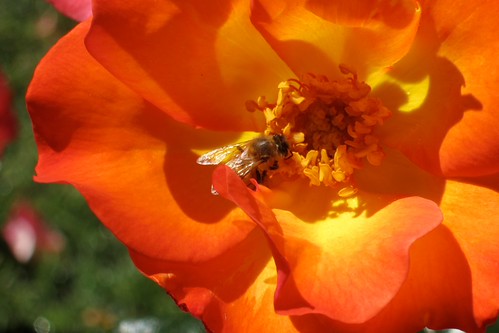
Living on the Guadalupe River in San Jose, California, we have had a variety of unwanted creatures move in with us, including: squirrels, mice, and recently, roof rats. We discovered the roof rats because they eat the outside of our lemons and the inside of our oranges, then leave the cored or peeled remainders hanging on the tree or all over the walkway under it: nasty! Apparently, the smart rodents eat citrus fruit to counteract rat poison.

Our latest move-in is a hive of honeybees under our roof tiles. A neighbor who is a beekeeper looked them over and said that the hive is healthy, not aggressive, and doing no harm at the top of the house. He advised leaving the insects in place and said that we would not have problems with squirrels or roof rats in the future because the bees would drive them off. He also observed that our garden (especially the roses) was perfect for bees – and offered to put two hives on our riverbank and split the resulting honey with us. We are looking forward to becoming beekeepers ourselves!

IMG_7516 copy

IMG_7520

Images by Katy Dickinson Copyright 2012

Leave a comment

Filed under Home & Family, News & Reviews

King Valentino

IMG_7356

Our 17-year-old Valentino was an only cat for five years since his sister Garbo died. From December – April 2012, he reluctantly was host to my mother’s two Siamese, with much battling for turf and attention. Since my mother and her cats recently moved to a nearby senior community, Tino has been very happy to be the king cat again.

Image by Katy Dickinson 2012 Copyright

Leave a comment

Filed under Home & Family

Douglas Fir Discovered

IMG_7196

One of the interesting parts of owning an older house is discovering how it is built. Our 1930 Spanish Mission Revival home in Willow Glen has delightful arts and crafts style details, including oak parquet floors downstairs and on the upstairs landing. When my husband John first bought the house in 1998, many of the floors were covered with icky dark pink carpet. We ripped most of that out and refinished the upper floors and stairs ten years ago.

There was one room downstairs that still had the pink carpet. This is the only downstairs bedroom, so person using it does not have to share a bathroom.  Our son Paul had the room until his sister Jessica moved out last summer, just before she got married. In 2002, Paul and his grandmother painted a mural of the Pokemon fire chicken Moltres on the wall. Late last year, Paul moved into Jessica’s old room upstairs so that my mother could move in after my father died. She and her cats recently moved into a senior community nearby, so we have finally gotten rid of the last of the pink carpet.

Under the horrible cat-stinky carpet, we discovered an equally smelly rug pad. Under that was amazingly ugly linoleum. Today, the linoleum came off and we discovered that we have a potentially-lovely wooden floor of Douglas Fir wood. We are delighted – Doug fir is not as good as oak parquet but it is much better than pink carpet.  We will get the boards refinished and the room will become John’s new office.

Pink Carpet:

IMG_7195

Linoleum:

IMG_7199

Douglas Fir boards:

IMG_7370
Images by Katy Dickinson 2012 Copyright

1 Comment

Filed under Home & Family, News & Reviews

New Caboose Photo Found!

IMG_7305

One of our ongoing projects is looking for historical photos of WP668, the railroad caboose in our backyard where I have my office. WP668 was built in 1916 but the earliest known photos are from 1973. We keep hoping that images from 1916-1972 will be discovered. I was delighted today to find another image of our caboose on p.244 of a recently-published book John bought for me: The Western Pacific by Ken Meeker, 2011 (Publisher: White River Productions; ISBN: 1-932804-11-0). The image was taken by Dave Stanley in 1973. The caption text from p.244:

Sacramento Northern’s Holland Branch was an obscure freight-only, 16-mile-long line constructed in 1929 to tap the vast agricultural riches of the Sacramento River Delta’s Holland Tract. Diverging from the SN main line at Riverview, the line provided access to numerous on-line packing sheds. Outbound shipments of asparagus, celery, pears, molasses, and sugar made the branch a moneymaker during its earlier years. After completing daily switching chores at the Clarksburg sugar refinery on September 14, 1973, Tidewater Southern 746 departed Clarksburg Junction and headed back to West Sacramento with two cards of molasses and a classic home-built WP composite bay window caboose bringing up the rear. The distinctive grade at this location was necessary to enable the tracks to reach the top of the levee that protected the narrow waterway of Winchester Lake.

Earlier in the book, there is a photo of one of WP668’s sisters, caboose WP676, with this caption:

Hard-pressed for cabooses during World War II, Western Pacific constructed 62 composite wood and steel bay window models using 15001-16000 series outside-braced Pullman-Standard box cars originally built in 1916. The composite cars were used system wide prior to the arrival of all-steel cabooses in 1955. As steel cars arrived, the composite crummies were bumped to local and branch-line assignments. February 3, 1969 finds caboose 676 (built in 1944) trailing the westbound Reno Local at Martin, Nevada.

This is the second book in which a photo of WP88 is published. The other is Western Pacific Color Guide to Freight and Passenger Equipment by Jim Eager, 2001 (Publisher: Morning Sun Books; ISBN-10: 158248063X, ISBN-13: 978-1582480633). All of the published references to our caboose are listed on WP668.org.

Our caboose was a popular location for Easter Eggs during the great backyard hunt last week:

IMG_7096 . IMG_7094

Images Copyright 2012 by Katy Dickinson

Leave a comment

Filed under Caboose Project and Other Trains, Home & Family

Bees and Democracy

IMG_2287

I have been reading a fascinating article in the March 2012 Smithsonian Magazine called “Hive Mind” by Carl Zimmer. The article describes the work of Cornell University biologist Thomas Seeley, an expert in honeybees, swarm intelligence, and collective decision making.

The decision-making power of honeybees is a prime example of what scientists call swarm intelligence. Clouds of locusts, schools of fish, flocks of birds and colonies of termites display it as well.

Seeley and his colleagues have discovered a few principles honeybees use to make smart decisions:

  1. Enthusiasm: passion in the bee communications dance
  2. Flexibility: decaying number of dance repetitions is tied to the value of what the dance is communicating
  3. Quorum: silencing lower value dance communications as the number of higher value dancers rises to a decision threshold

Seeley draws comparisons between how a honeybee hive makes decisions and how both the human brain and a democracy work:

Both swarms and brains make their decisions democratically. Despite her royal title, a honeybee queen does not make decisions for the hive. The hive makes decisions for her. In our brain, no single neuron takes in all the information from our senses and makes a decision. Millions make a collective choice. …Groups work well, he argues, if the power of leaders is minimized. A group of people can propose many different ideas – the more the better, in fact. But these ideas will only lead to a good decision if listeners take time to judge their merits for themselves… Groups also do well if they’re flexible, ensuring that good ideas don’t lose out simply because they come late in the discussion.

Just because animals do something does not mean it is also appropriate for people. Nonetheless, comparing human systems to patterns in nature presents both in an interesting context.

Image Copyright 2009 by Katy Dickinson

Leave a comment

Filed under News & Reviews, Politics

Easter Egg Hunt

IMG_7101

IMG_7149

We had more than a dozen children over with their families and friends for our annual backyard Easter Egg Hunt and potluck brunch in Willow Glen (San Jose, California). Among the kids, our son Paul was the oldest egg hunter at 19 and Howard was the youngest, at age 3. The devious Bunny and his helpers came up with the following poem hints about hiding places for the coveted Gold and Silver eggs:

GOLD:
My roost once used to roll and pitch
My halo exists at other men’s whims
In finding me please don’t twitch
The creek where you’d fall, nobody swims

SILVER:
I creep at the edge of an –ito
Don’t over-step or you will cheat-o
Chameleon-like I hide
Hurry quick! I won’t abide.

The Gold egg was found quickly (on top of the electrical box behind the light on the porch of WP 668, our caboose), but the Silver egg eluded all hunters until late afternoon. It was wrapped in tape and painted to look like a stone in the arroyito.  The rules of the hunt are the same year after year:

    1. There are no eggs in the flower beds (also: no eggs are on the bank, in the cactus, or outside of the backyard)
    2. Kids get to go into the yard youngest first, and then one every 30 seconds until age 10 – after which, everyone can go
    3. Parents may not help hunt (except for the Gold and Silver eggs)
    4. The only clues are in the poems on where the Gold and Silver eggs are
    5. Kids can keep their eggs and baskets or empty out the candy and leave them with us for next year
IMG_7123 . IMG_7128

IMG_7157

Images Copyright 2012 by Katy Dickinson and John Plocher

3 Comments

Filed under Caboose Project and Other Trains, Home & Family, News & Reviews