
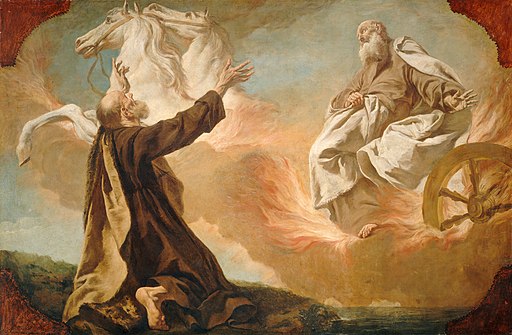
Elijah Taken Up in a Chariot of Fire, by Giuseppe Angeli, c. 1740.*
As part of my Islamic Studies certificate, I took a Graduate Theological Union (GTU) class in the Spring 2025 term called, “Martyrdom and Afterlife in the Qur’ān,” for which my final paper was, “Heaven in the Qur’ān and Christian Testament.” Our inspiring professor was Dr. Mahjabeen Dhala who presented us with a challenging reading list and led our class of Muslims, Christians, and Baháʼís in a series of discussions about death, the afterlife, martyrdom, and the end of days. I have studied with Dr. Dhala before and this class confirmed that she is one of the best teachers at the GTU.
I took the opportunity of the twenty-eight page final paper to explore a subject that I have been thinking about. Here is my introductory paragraph,
“In both Christianity and Islam, heaven exists and has always existed but there are different beliefs on how the living can engage with it. This paper provides an overview of some of these Abrahamic religions’s relationships with heaven, highlighting two key dissimilarities. The scope is intentionally constrained in addressing this vast and complex topic. I am not attempting to be comprehensive or to present all variants of belief. I will not discuss the specifics of physical resurrection, interim or last judgements, the Christian Jesus versus the Muslim Jesus (ʿĪsā ibn Maryam), or a variety of other tempting and fascinating topics. My comparisons will include the physicality of heaven, how some artists have envisioned how heaven looks, engaging with heaven during life, orthodox beliefs about heaven, when heaven opens, and mystical or heavenly cities. Writing this paper has become a journey of discovery as much as a research project. I keep finding new materials and points of view on eschatology and the end times. The Oxford Handbook of Systematic Theology offers this traditional definition, “eschatology comprised the ‘four last things’ that Christian faith expects to be the destiny of humans at the end of time: resurrection, last judgement, heaven, and hell.” Comparative eschatology is a big subject but considering the more limited question of what Islam and Christianity have to say about heaven seems possible in the space of a relatively short paper.”
You can read the whole paper here.
*This work is in the public domain in its country of origin and other countries and areas where the copyright term is the author’s life plus 100 years or fewer.
If you want to receive Katysblog posted by email, please sign up using the Sign Me Up! field (upper right on Katysblog home page).








 KatysBlog
