Last weekend, John and I flew south to see the grey whales at Laguna San Ignacio in Baja, California. Our pilot was Charlie Jackson, Sun Labs’ Webmaster. Our Cessna 182 Skylane II was one of four private planes of the Shoreline Flying Club based in Palo Alto, California. We went out on two boats hosted by Antonio’s Ecotours (based in Laguna San Ignacio). These pictures were taken with disposable water sports cameras. I will write more about our amazing trip but first, here are some whale and dolphin photos. Yes! That is my very own hand petting a baby grey whale.
El Vizcaino Biosphere Reserve Sign
Pelican
Laguna San Ignacio
Shell Mound
Whale Bones on Beach
Tour Boat
Charlie and the Whale
Grey Whale Nose
Grey Whale Under Water
My Hand and a Baby Grey Whale!
Dolphins
Images Copyright 2008 by Katy Dickinson and John Plocher
Last night I updated the new SAMA web page and started adding Middle Eastern
Recipes – see http://st-andrews-sama.org.
SAMA – St. Andrew’s Medical Assistance – is an outreach program of St. Andrew’s Episcopal
Church. We are getting ready for the SAMA fundraising dinner (to be on Sunday, 13 April 2008 at St. Andrew’s Episcopal Church, 13601 Saratoga Avenue,
Saratoga, CA.) There will be Middle Eastern food and an auction. I am
in charge of event publicity.
SAMA published a small cookbook called “Favorite Middle Eastern Recipes” some
time ago. The recipes I just added to the web site are:
Baba Ghannouj (Eggplant Dip)
Hummos bi Tahini (Garbanzo Bean Dip)
Fatoosh
Khyar bi Leban (Cucumber with Yogurt)
I will add more recipes as I get them typed in. I also added links to SAMA’s
Middle Eastern Fashion show photos and some of my pictures
of St. Andrew’s lovely stained glass windows:
Stained glass windows at St. Andrew’s Episcopal Church
On
August 4, 2006, I wrote about the subway map project
Danny Cohen and I have been working on for some years. Recently,
a new book was published for those who share our interest:
This fascinating new book “brings together for the first time in a single volume
the official current metro maps and diagrams from over 100 of
the world’s major Subway, U-Bahn, Metro and Underground systems.”
Below are some photos of Danny’s and my own map collection here in the Sun Labs Menlo Park, CA, building.
Our most recent acquisition is a small card showing the Tokyo subway. Along
with our maps is a London Transport
Museum poster of Harry Beck’s original London underground map.
One of my favorite books is the
Richard III mystery by Josephine Tey called The Daughter of Time, 1951. (The title comes from the old proverb
that “Truth is the Daughter of Time”.) In this excellent story about a
detective’s search for the truth about England’s most famously evil king,
the nature of written History is explored:
“‘Truth isn’t in accounts but in account books.’
‘A neat phrase,’ Grant said, complimentary, ‘Does it mean anything?’
‘It means everything. The real history is written in forms not
meant as history. In Wardrobe accounts, in Privy Purse expenses, in
personal letters, in estate books. If someone say, insists that Lady
Whoosit never had a child, and you find in the account account book the
entry: ‘For the son born to my lady on Michaelmas eve: five yards of blue
ribbon, fourpence halfpenny” it’s a reasonably fair deduction that my
lady had a son on Michaelmas eve.'” Chapter 8
I think I first started a life-long hunt for artefacts and records that
contradict Accepted Truth after I visited Olympia, Greece in 1979. In the
museum were many empty pedestals, all that was left of tributes to the
athletes who were winners in the ancient Olympic competitions. I was surprised
to read on one of the classical marble pedestals an inscription honoring
a woman (of Sparta, as I recall) who had won three Olympic chariot races.
In 1979, I had just been graduated from the University of California where I
had taken quite a few Classics courses. However, until I read that inscription,
I did not know that women had ever competed in the Classical Greek Olympics.
Since that revelation, I have found
other sources indicating that women did indeed compete in the ancient Olympics;
however, this is still neither Common Knowledge nor Accepted Truth. For
example, the current Wikipedia entry on the Olympics says simply
(and wrongly):
“Paris [in 1900] was also the first Olympic Games where women were allowed
to compete.”
In The Daughter of Time, hunting for the Truth becomes a passion
and enduring detection game for the characters. I recommend both the
book and the game.
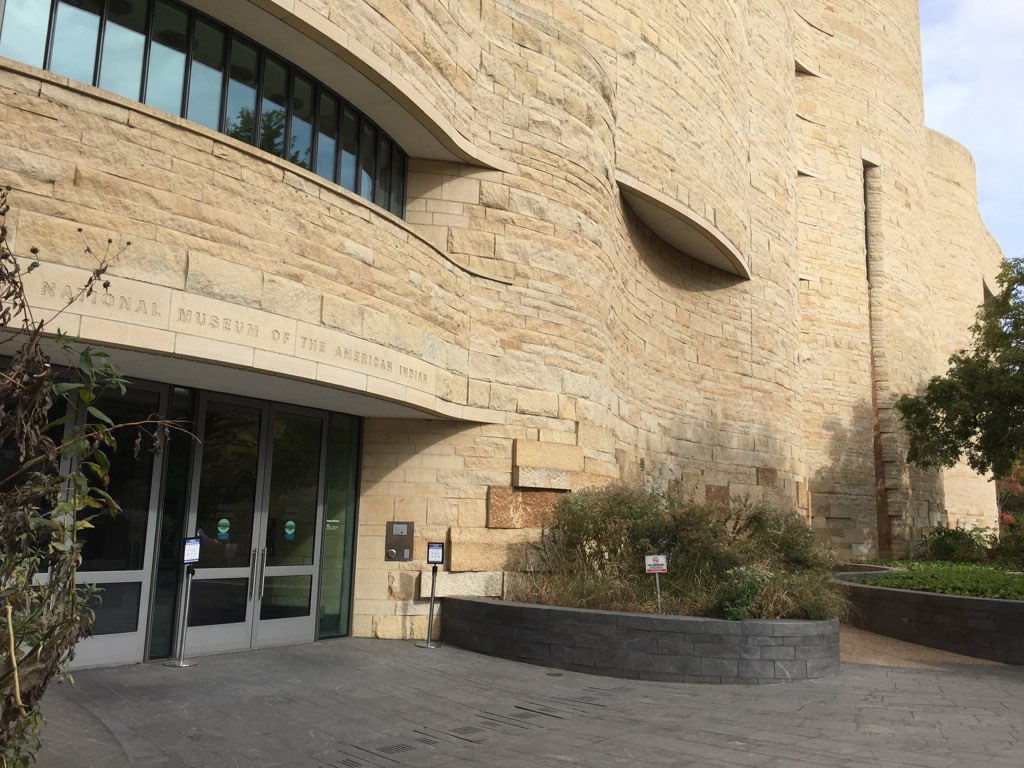
Last month when I visited Washington, D.C. for the first time in many decades, I toured the National Museum of the American Indian, opened as part of the Smithsonian Institution in 2004. It seemed to me that one way of understanding more about the complex relationship between the European/American cultures and the American Indian cultures was to read reports from individuals who had personally experienced both. In the museum store, I bought two books:
Captured by the Indians: 15 Firsthand Accounts, 1750-1870, Editor: Frederick Drimmer, Dover Publications, 1985, ISBN-10: 0486249018, ISBN-13: 978-0486249018
In these books, I was interested to read for the first time about the death by burning in 1782 of General George Washington’s friend, Colonel William Crawford. This disturbing story was told in:
“That is Your Great Captain” by Dr. John Knight, 1783 (in Captured by the Indians)
“To Eat Fire Tomorrow” by John Slover as told to Hugh H. Brackenridge, 1782 (in Captured by the Indians)
“A Narrative of the Life of Mary Jemison” by James E. Seaver, 1824 (in Women’s Indian Captivity Narratives)
Knight and Slover were captured with Crawford after Crawford’s failed expedition against the Ohio Indians (Wyandot, Huron, Delaware, and Shawnee tribes). Knight and Mary Jemison’s husband Hiokatoo (of the Seneca tribe) were witnesses to Crawford’s death; Slover was told of it by his captors.
Trying to sort out what happened by reading these memorable accounts is a good exercise in detection and understanding the difficulties of History even when first-hand accounts are available. For example, a major participant in Crawford’s violent death was Simon Gurty (or Girty). Gurty is described in a footnote in Women’s Indian Captivity Narratives as “…a Pennsylvania adventurer who… alternated allegiance between the Americans and the British, aiding the latter during the War of 1812”.
Here are two accounts of the same exchange between Gurty and the dying Crawford:
“The flames arose and the scorching heat became almost insupportable. Again [Crawford] prayed to Gurty in all the anguish of his torment, to rescue him from the fire, or shoot him dead upon the spot. A demoniac smile suffused the countenance of Gurty, while he calmly replied to the dying suppliant, that he had no pity for his sufferings; but that he was then satisfying the spirit of revenge, which for a long time he had hoped to have an opportunity to wreak upon him.” (Mary Jemison retelling Hiokatoo’s story)
“In the midst of these extreme tortures [Crawford] called to Simon Girty and begged him to shoot him. Girty made no answer. He called to him again. Girty, by way of derision, told the colonel he had no gun. At the same he turned to an Indian who was behind him, laughed heartily, and by all his gestures seemed delighted at the horrid scene.” (John Knight telling what he witnessed)
In seeking more information about these stories, I found yet another version of this exchange:
“Overcome by agony, Crawford cried out, ‘Girty! Girty! For God’s sake, Girty, shoot me through the heart!’ The raucous din grew ominously silent as all eyes came to rest on the man called Girty. After a moment of introspection, he rose from his seated position by the fire and strode to where Crawford lay sobbing. ‘I cannot,’ Girty replied softly. ‘As you can see, I have no gun.’ Turning away from Crawford’s mangled figure, Girty grinned at the onlookers and belched forth a sinister giggle.”
From: “A Monster So Brutal: Simon Girty and the Degenerative Myth of the American Frontier, 1783-1900″. Volume Forty, 1998 Essays in History, Published by the Corcoran Department of History at the University of Virginia. by Daniel P. Barr, Kent State University.
While Gurty is clearly the villain in all three story versions, there are also differences in both specifics and style. The “Monster So Brutal” story version purports to be a retelling of Knight’s and Slover’s accounts – with no reference to Mary Jemison version of Hiokatoo’s story. However, the “Monster So Brutal” story is very exaggerated and includes details I do not find in the first hand accounts. “A Monster So Brutal” also says that Slover was an eyewitness to Crawford’s death. Slover’s account in Captured by the Indians just says “At this time I was told that Colonel Crawford had been burnt…”. Maybe there is more than one version of Slover’s story?
Having read these books, I have a greater appreciation for the complexity of this early period of American history and the interactions of the Indian, British, French, and American cultures. It is certainly more exciting than I remember from my required American History courses in High School and college!
25 Jan 2008: original blog post, 27 Feb 2021: formatting updated, photo added
If you want to receive Katysblog posts by email, please sign up using the Sign Me Up! button (upper right on Katysblog home). Image Copyright 2017 by Katy Dickinson.
I learned to appreciate and collect old
quilts from my mother (
Eleanor Creekmore Dickinson), who was born and raised in East Tennessee. She was
taught to quilt by my Great Grandmother (Ellen Bolli Van Gilder). I still have the
“Grandmother’s Flower Garden” pattern baby quilt my mother sewed as a child.
When my children outgrew asking for cartoon character bedding (we had dinosaurs,
Little Mermaid, Pokemon, and Harry Potter sets, among others), I started putting pieced
patchwork quilts on their beds. I have found eBay
an excellent source for quilts but I have also purchased quilts from antique dealers and
direct from the women who created them. Since I use the quilts on beds, I almost always
buy quilts which are in solid condition, machine pieced, and less than 100 years old.
Quilts which are “collectible” are often unused, because much of their value is based
on their being “like new”. I prefer to use old quilts, enjoying the
softness of the fabric after many washings. Quilt expert Shelly Zegart provides the
following “Condition Listings” for the quilts she sells to banks, hospitals, airports, universities and private collectors:
Mint: Quilt is unwashed, like new condition. No stains, holes, color fading, or wear. No restorations or repairs. All seams and stitching intact. No batting shift noted.
Excellent: Quilt has never been washed. May have minimal fading or staining. No holes or tears. All stitching and seams are intact. May have some batting shift.
Good: Quilt may have been washed. May have some fading, staining, or discoloration. May have some age appropriate wear to fabric or binding. May have been repaired or restored. May have some loose stitching or open seams. May have a batting shift.
Fair: Quilt has been washed. May have fading, wear, and or staining. May have a small tear or hole. May have loose stitching or open seams. Batting may be shifted or exposed.
Poor: Obvious wear, staining, and or fading noted. May have tears, holes, or fraying. Loose stitching and or open seams may be present.
When I look at a quilt, the basic elements I consider are:
Color and design: overall pattern, consistency, quilting vs. piecing as parts of pattern
Quality of work: hand vs. machine, stitches per inch, pattern execution
Fabric and batting content: cotton, wool, synthetic fabrics and thread
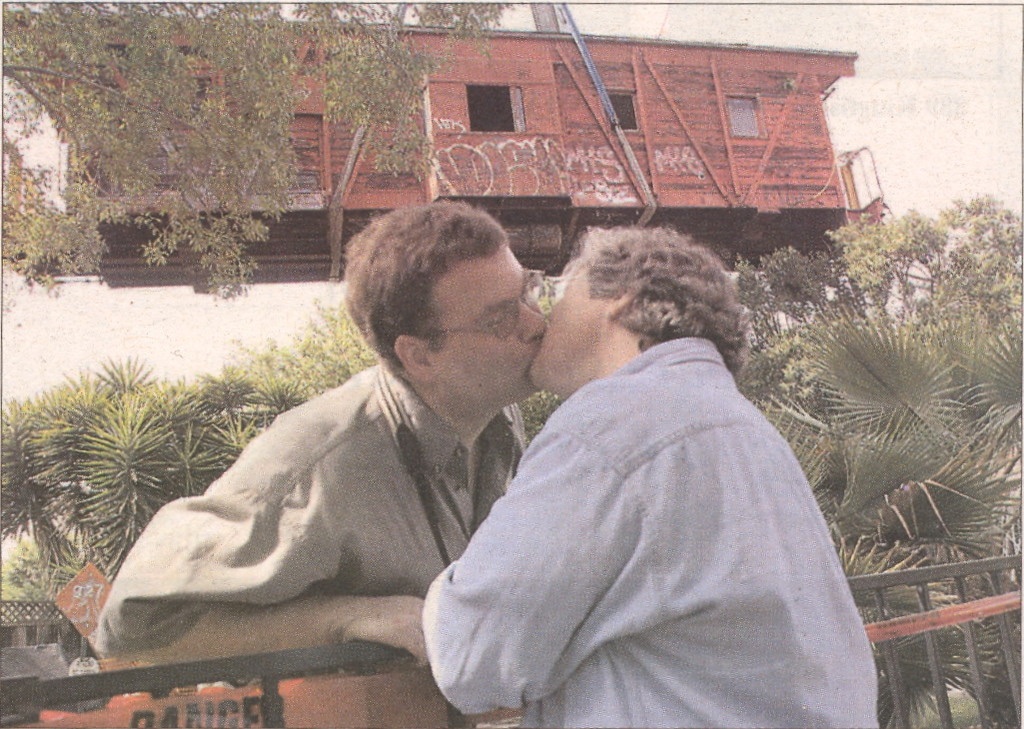
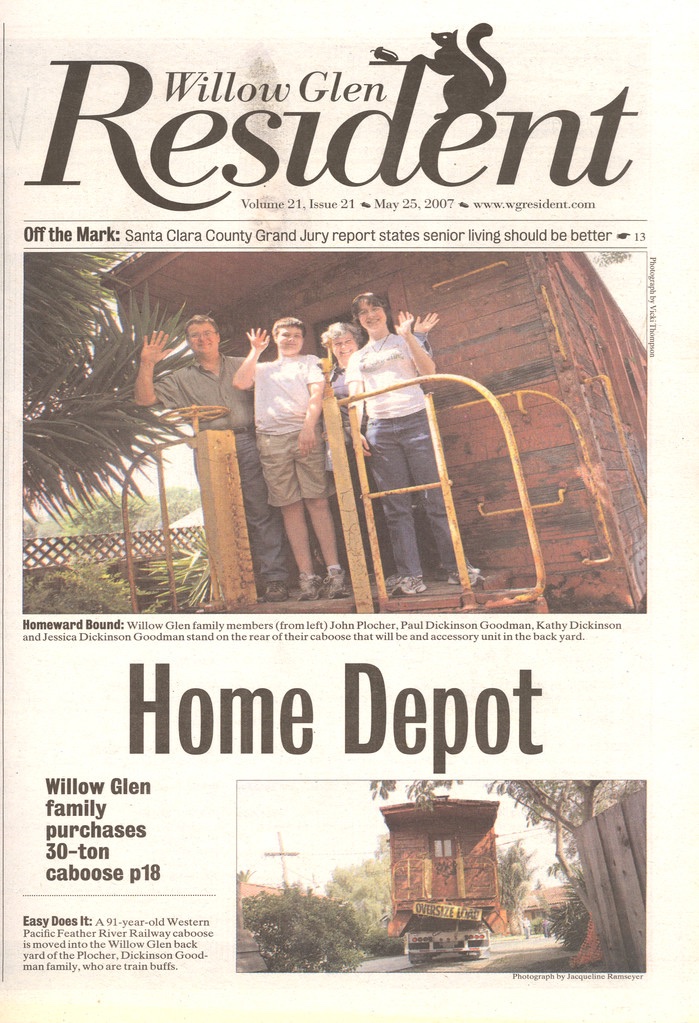
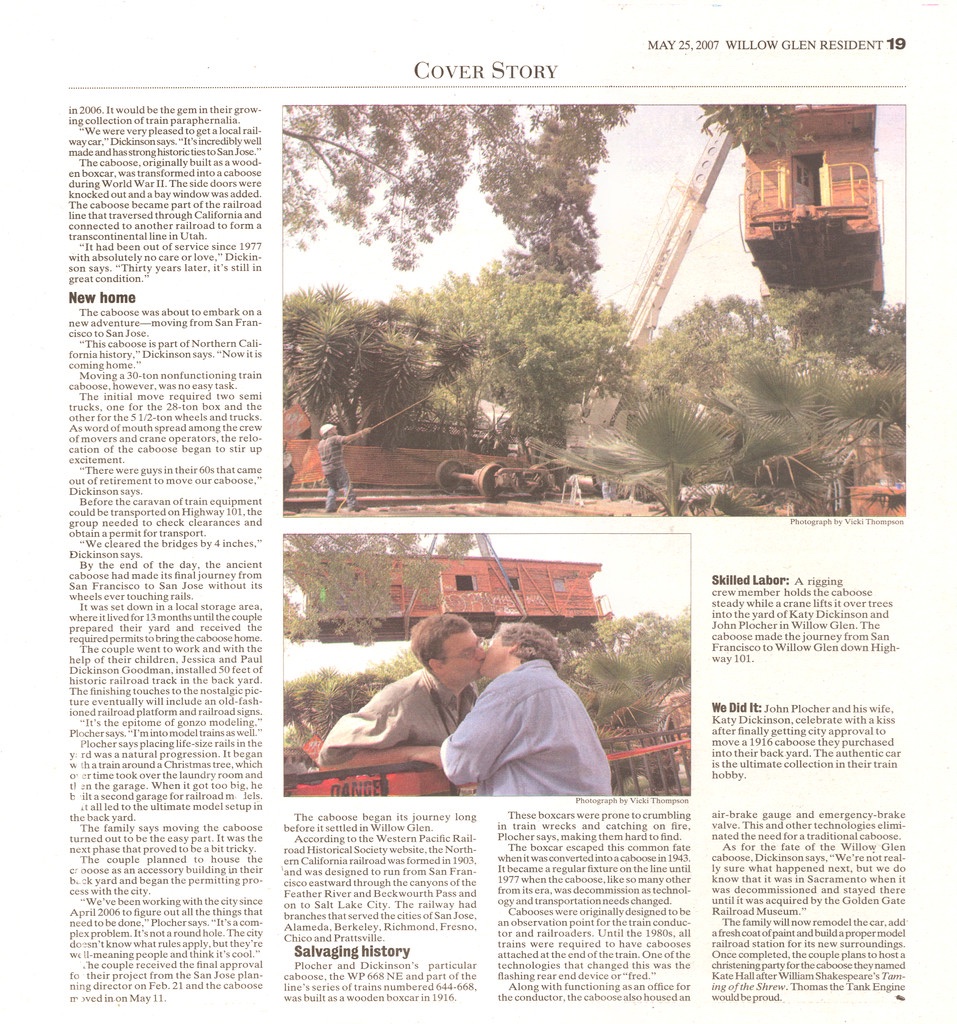
Back on May 25, 2007, I wrote about our WP668 caboose move being the front cover story of the Willow Glen Resident, our local newspaper. We were surprised to find that at the end of last year, my husband John and I made the Year in Review 2007 front page story again with this picture:
We did not see the 28 Dec 2007 paper, so we only found out about the photo being republished when people sent email about it. (Surprise!) The Willow Glen Resident folks were very helpful and gave us extra copies of the paper plus permission to scan and publish it in my blog. Here is the May 25, 2007 story plus the new December 28, 2007 “Year in Review” story: