Our home in Willow Glen (San Jose), California, may be in the Silicon Valley
but it is at the same time in a technological wilderness (“way out in the tulies”
as we say here). We have the misfortune to be 18,000 feet from the closest
central phone office. DSL service only works effectively within 15,000 feet of a
central phone office. That extra 3,000 feet means that we have often had
terrible Internet access, alternating with acceptable service or no service
at all. During the last ten years, we have paid the following Internet
Service Providers (ISPs):
Sprint (broadband antenna) this service is no longer available
Covad (DSL)
AT&T (DSL)
Etheric – Home-based Business Plan (point to point wireless)
Comcast – Business Class (cable broadband, cable modem)
The five ISPs have linked our house to the Internet through different technical means. This week, we switched to Comcast and so far the service and
performance have been excellent. We have had two different ISP antennas
strapped to our chimney; we now have a new Comcast cable box in our basement.
Working from home requires 3 major technical elements to function and
interact well:
Infrastructure at work: servers, routers, virtual private network (VPN),
emergency power system, etc.
ISP – Internet Service Provider (delivers customer access to the Internet)
Home equipment: VPN router, firewall, printer, monitor, keyboard, Sun Ray on my desk,
uninterruptible power supply (UPS) under the desk, etc.
When my husband (John
Plocher) was laid off from Sun several months ago, I joined one of Sun’s work
from home programs for support on the days when I am not in my Menlo Park
office. We have all of the new equipment in place at home and working well
but regularly unusable for one reason or another. We could not tell where
the problems came from each time but suspected it was mostly our ISP.
I have been an enthusiastic Sun Ray
user for over ten years – since the product was in its final testing before
being transferred out of Sun Labs.
I love being able to pop my card out at work then back in at home (or in
Prague for that matter) using the same session.
I hope that switching to yet another new provider will improve our
home access to the point where it just works and we don’t ever have to think
about it again.
The SAMA (St. Andrew’s Medical Assistance) auction and dinner will be held this Sunday, 22 February 2008. The fund raising event will be held at St. Andrew’s Episcopal Church Hall, starting with a silent auction at 5 pm, followed by a Middle Eastern Feast and live auction.
Tickets are $30/adult – $15/child – $100/family (pay at the door) All are welcome!
SAMA exists to provide hope and healing to a hurting world. SAMA raises support annually through the annual Middle Eastern Feast and Auction, Christmas Crafts sale, and other fund raisers.
Ongoing Medical Programs SAMA supports in the Holy Land include:
Ahli Arab Hospital (the only Christian hospital in Gaza)
The Four Homes of Mercy (a home for the severely disabled based in Jerusalem)
SAMA also supports health programs in Africa:
In 2008, SAMA supported St. Mary’s Hospital in Odibo, Namibia. St. Mary’s is an Anglican-supported hospital for which SAMA provided linens for 50 beds as well as funding expansion of their birth delivery room from one bed to two.
In 2008, SAMA also supported the Chiedza Clinic, in Harare, Zimbabwe. The clinic is part of the Chiezda child care center which serves perhaps 300 kids, many of whom are HIV positive, and their families.
As part of St. Andrew’s 50th anniversary celebration in 2007, SAMA raised
almost $5,000 which (in conjunction with Episcopal Relief and Development) purchased 965 specially-treated mosquito nets to prevent malaria in Africa
to see the draft (Feb 19) auction catalog (PDF format).
There may be some changes in the published catalog version.
22 February 2009 – Live Auction Items
Item # 2004
Caboose Brunch
– by John Plocher – Brunch for six in a private 1916 historic railroad caboose (Western Pacific Feather River Railway WP668) in
Willow Glen, San Jose.
Item # 2005
Wine – 1964 Treasure from Louis M. Martini
– Martini Family wine collection – 1964 Special Selection Cabernet Sauvignon. This was a very good year – well known for excellence.
Item # 2006
Wine – 1959 Treasure from Louis M. Martini
– Martini Family wine collection – 1959 Private Reserve Cabernet Sauvignon. A sleeper year but now one of the best. Delicious!
Item # 2007
Rabbit Etching by Eleanor Creekmore Dickinson
– Original delicate and realistic black and white etching of two rabbits by famous San Francisco artist Eleanor Creekmore Dickinson. “Edward Hopper and Walter Hopps” 1983 14″x17″ framed with glass.
Item # 2008
Private Flight Plus Brunch
– Private flight plus lunch. Experienced Palo Alto pilot
Charles Jackson of the
Shoreline Flying Club will be your host for 2 hours in a 4 seat
Cessna 182 Skylane II. Want to tour the San Francisco Bay and see the
Golden Gate Bridge from the air? Here’s your chance!
Item # 2010
Middle Eastern Dinner
– Middle Eastern Dinner for eight on a date after March 2009 that works for both cook and auction item winner.
Item # 2012
Case of Wine – 2006 Soquel Vineyards Partner’s Reserve
– 2006 Soquel Vineyards Cabernet Sauvignon Partner’s Reserve case of wine (12 bottles) from the Garvey Family Vineyard in the Napa Valley
Item # 2013
Exquisite Designer Necklace by Erin Mac
– Necklace by Erin Mac who designs jewelry for the Hollywood Oscar event – Veridian Art Deco Venetian Master-Cut Briolette with an 18k White Gold and Diamond Enhancer on a Stainless Steel Cable with a 14k yellow gold lobster clasp. From the House of Erin MacGeraghty fine jewelry and watches.
Images Copyright 2008-2009 by Katy Dickinson, John Plocher, Charles Jackson, Eleanor Dickinson, Patricia Martini, Erin Mac
My husband John was laid off two months ago and is now an “unclaimed treasure”
(that is, he is on a job hunt). To help pay the bills between jobs, John signed
up for the first time for Unemployment Insurance
with the California Employment Development
Department (EDD).
What is Unemployment Insurance in California?
Unemployment Insurance (UI) is a nationwide program created to provide partial wage replacement to unemployed workers while they conduct an active search for new work. Unemployment Insurance (UI) is a federal-state program, based on federal law, but executed through state law. Employers finance the UI program by tax contributions. In California, the EDD administers the UI program according to guidelines established by the UI Code and the California Code of Regulations, Title 22.
EDD appears to be a completely faceless bureaucracy. That is, there is no
person to call, no place to go to resolve problems. There
is only a phone number. John had a problem with his EDD paperwork
(he received two contradictory UI mailings on the same day and made the wrong
choice) and needed to talk with someone. It took three days of fifty to 100 calls
per day to 800-300-5616 to get someone from EDD on the phone. He called before 8 am and
heard the “We are not here outside of the following hours” message roll immediately
over to the “We are currently receiving more calls than our system can handle. Please
try again later” message. He redialed all day and heard the “Please try again later”
message roll over to the “We are not here” message promptly at 5 pm daily.
Only an EDD person on the phone can help with a UI problem. There are
EDD offices. EDD office staff only provide career and workforce services but
cannot resolve UI problems – they offer you a phone to call 800-300-5616.
Letters from the EDD feature a post office box address, no fax, no local number,
no names, only 800-300-5616 with alternate numbers for Spanish, Cantonese,
Mandarin, and Vietnamese.
Late yesterday afternoon, when John finally spoke with an EDD 800-300-5616
representative, the problem was sorted out promptly. The EDD woman scolded John
for his mistake but said since it was his first infraction, they would probably let it go
and not deny benefits. She went on to complain that there were so many callers
with all the people being unemployed that EDD was working nights, weekends, and
holidays. John gently pointed out that at least she had a job.
Listening to and later reading President Obama’s
inaugural
speech (20 January 2009), one phrase struck me as familiar:
“We remain the most prosperous, powerful nation on Earth. Our workers are no less productive than when this crisis began. Our minds are no less inventive, our goods and services no less needed than they were last week or last month or last year. Our capacity remains undiminished.”
I eventually remembered the words in Kate’s speech at the end of Shakespeare’s
I don’t think Obama was scolding the way Kate is in her speech but
there is the same circumstance of reestablishing a basis for comparison
after much change. Obama has earned his reputation as a great speaker
and I look forward to hearing his addresses for many years to come.
We were very excited that Jessica, my 20-year-old daughter, attended this week’s Presidential inauguration in Washington, DC. You can see her blog entries and photos at http://feelingelephants.wordpress.com/. Ours is a politically passionate family. One of my earliest memories was glee that my candidate (John F. Kennedy) won the presidential election over my older brother’s candidate (Barry Goldwater), in 1964.
Our family has always been split between liberal and conservative. The divergence of our current family politics is best shown in two objects: a framed picture of the late President Ronald Reagan that my father put up in the front hall of their San Francisco house (intended to be seen by everyone who came over for parties to phone Obama voters, hosted by my mother), and the shoe with BUSH –> in gold paint on the toe that someone gave my father for Christmas:
I was at work at Sun during Tuesday’s inaugural morning so I went over to the Menlo Park campus Crossroads conference room to watch history unfolding
live by CNN TV broadcast on the big screen. Because I usually get my news from National Public Radio (NPR), it was particularly interesting to see how the great and powerful look and interact:
The senior President Bush does not seem to be aging well. He sat next to Hilary Clinton and behind the new First Lady Michelle Obama, so there were many pictures of him with his mouth open looking confused.
Hilary Clinton, on the other hand, looked radiant two days before her confirmation as our new Secretary of State.
It was fascinating to watch outgoing President George W. Bush during his last minutes in office. I saw Bush pat the leg of one of the tall Marines in full dress uniform as he walked past – like you would pat a friendly dog.
Except when greeting people, President Obama seemed grim during much of the event. The only time I caught a big smile was when he messed up his inaugural
oath (he had to take it again later). The biggest smile of the day, however, was that of cellist Yo-Yo Ma who appeared delighted to be performing with violinist Itzhak Perlman. There was much wondering how the instruments and musicians could play “Air and Simple Gifts” so well on that cold day. This was cleared up when it was announced today that those on the inaugural stage heard the musicians live but a prior recording was broadcast for everyone else. However
real the broadcast, Ma’s smile and the superb music were a genuine delight.
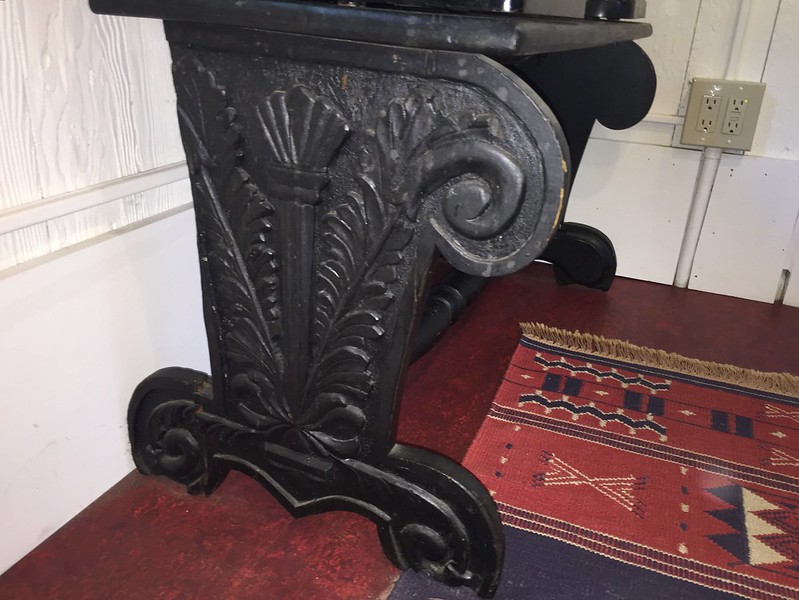
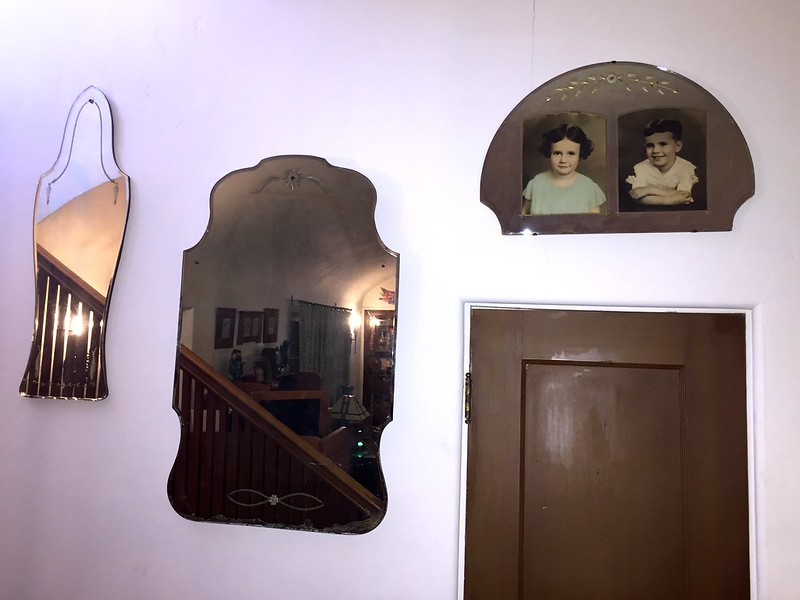
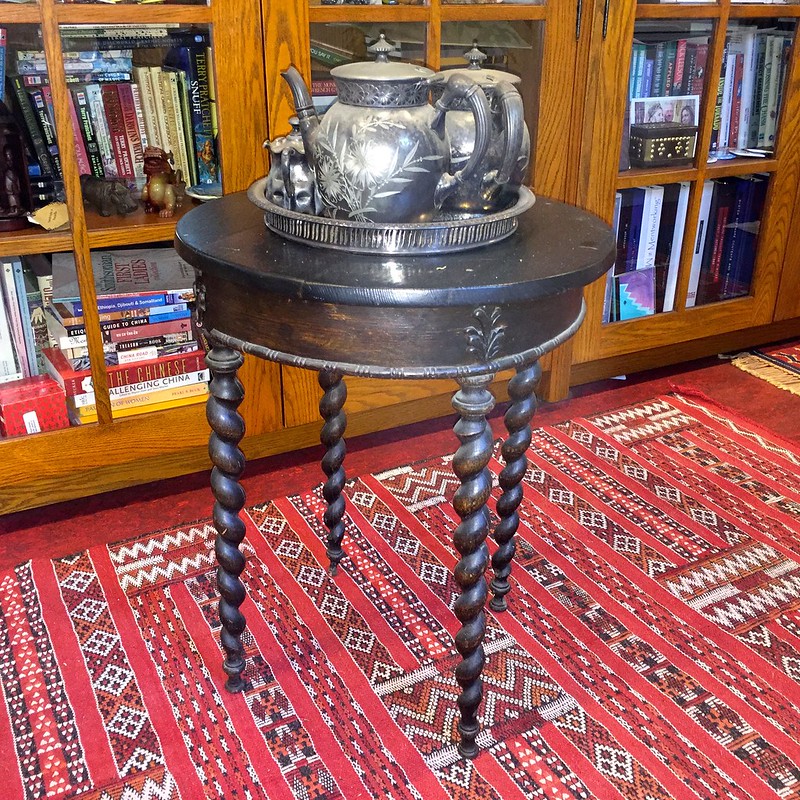
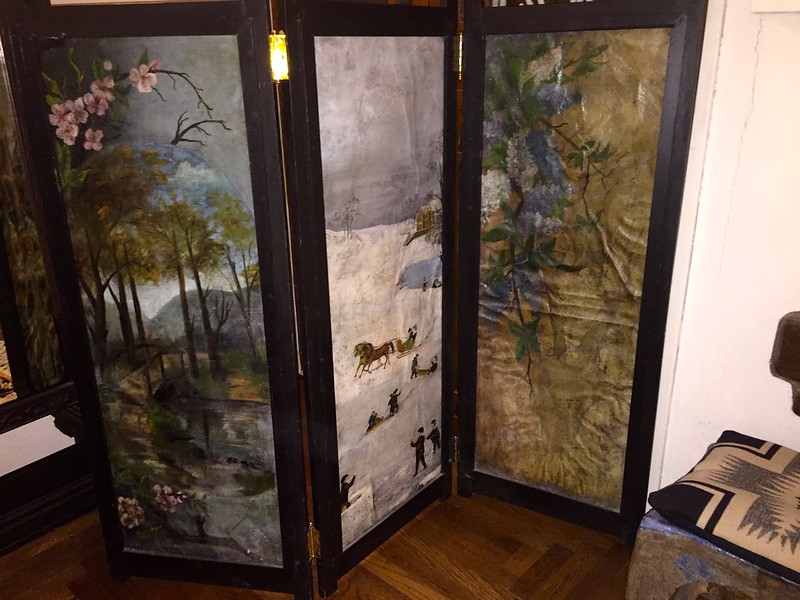
My brothers and I are working out an equitable and peaceable way to distribute family stuff. Unfortunately, we are the descendants of many generations of craft workers, artists, and collectors, so there are a great many things to be considered: furniture carved by our Mother‘s Grandmother, mirrors and stained glass created by our Mother‘s Grandfather, our Father’s Grandfather’s iron train set, our Father’s Mother’s painted set of cider mugs with matching pitcher, paintings and drawings by our Mother, etc.
Having seen several excellent examples of nasty, greedy, and predatory behavior during estate distributions, we are seeking a better way to bestow heirlooms fairly. Our motivation comes from growing up during a family fight over an estate that started in 1990 and lasted for more than ten years; the quarrel about which descendant got what eventually outlasted the lifetime of the original executor. We hope to avoid that experience in our generation. As our Father says: “I would rather burn it than fight about it.”
I am writing this out because when I searched the web for a good example, a property distribution process to model ours on, everything I found seemed to be associated with contentious divorces. I did not find any models in which the parties were assumed to be on speaking terms. My brothers and I each want some family stuff but we also want to preserve our good relationship more than we want any particular thing. I hope that the system we have developed over the last six years will be of use to other families who share our values.
Our parents are both living and have very generously and foresightedly agreed to distribute a selection of their family possessions in advance of their passing (which we hope will be many years in the future). My brothers and I have been in this distribution process for the last six years and have already sorted out who gets which of the larger pieces of furniture. In addition to getting a family chore done, we are learning more about each other and getting closer through these discussions. In this context “distribute” means transferring ownership but not necessarily the objects themselves. For example, my parents dining room table was given to me several years ago in one of our distributions; however, my parents will continue to use the table for their lifetimes.
At first, the distribution lists were annual and small, with just three or four heirlooms going to each of us. The distribution we are discussing now is our most ambitious, with fifty-four heirlooms to be sorted into three groups of eighteen. Here is an overview of the process we originally used:
Our parents make a list of heirlooms for us to consider and distribute. Usually, this means my having several discussions with our Mother since I live closest. One of my brothers lives at the other end of California and the other lives across the country, in Massachusetts.
My brothers and I ask questions – how big is it? what condition is it in? where did it come from – is there any special meaning to it? Sometimes pictures are distributed.
My brothers and I check with our spouses to collect their opinions.
My brothers and I have a three-way phone call during which we decide who gets what. The call is only between the three of us, no spouses or parents.
I tell our Mother what we decided in our call.
Our Mother writes each of us a letter giving us the items.
With so many more items to distribute this time, it has been harder to come to a decision. Our Mother sent us a list in August we are still discussing. We had not seen many of the items, so the whole family took a house tour when my brothers visited during Christmas. We walked around the house we grew up in and asked our Mother to point to each item on her list. Last Saturday, my brothers and I had a preliminary phone call.
We discussed what “family furniture” meant to us. If our Mother bought it, does that still count as “family”? When our Great Grandparents’ early Victorian house on Circle Park in Knoxville, Tennessee, was torn down in 1964, our Grandmother removed the front doors. Eventually our Mother had the doors installed on her house in San Francisco. Are those antique doors “family furniture”?
My brothers asked me to sort the fifty four items into three groups prior to our next call. I decided to ignore the potential market value of the items and focus on three important categories: size, history, and who actually wants the thing. I created three groups of 18 items with roughly the same number of things in each of these categories in each group:
Size:Small (antique toys, table clocks, the Cherokee hunting bow, the cider set), Medium (side tables, small chairs, stained glass panels and mirrors, our Great Grandfather’s glass case of stuffed birds), and Large (the front doors, our Father’s white leather arm chair, an 8′ tall hall mirror in a gold plaster frame, a huge wooden ice box, a set of balloon back chairs with seat cushions embroidered by our Great Grandmother).
Special Family Origin: anything made by a family member, the bannister from the Circle Park house, our Great Grandmother’s wicker rocking chair, etc.
Desireability: Anything that more than one of us expressed interest in during the preliminary phone call.
I sent the sorted groups to my brothers with the following proposed process:
Step 1 – Before the Meeting – Review the groups, ask questions, talk with spouses, say if there are one or two “heart’s desire” items
Step 2 – During the Meeting – Each of us picks a group (1, 2 or 3)
Step 3 – Accept / acknowledge conditions to replace installed items (such as the front doors)
Step 4 – Discuss trades. Other than trades, the group is distributed intact, where and as is.
I am curious to see how well this sorting worked and whether the distribution discussion goes better as a result.
Note: None of the items pictured are for sale. I do not provide pricing or sales advice for similar items. Please do not ask.
Images Copyright 2008-2016 by Katy Dickinson
13 June 2016: Images retaken and reposted, note added. 4 Feb 2021: photo links updated.
If you want to receive Katysblog posts by email, please sign up using the Sign Me Up! button (upper right on Katysblog home).
My daughter Jessica is participating in the University Presidential Inaugural
Conference (UPIC) in Washington, D.C. this week, so she will see
President Obama’s inauguration in person! Jessica was invited (along with thousands
of other kids) because she is an alumna of a Congressional Youth Leadership
Council (CYLC) program she attended in High School. She signed up for this
conference almost a year ago, long before we knew whose inauguration it would be.
You can see Jessica’s pictures and updates on her blog:
http://feelingelephants.wordpress.com/.
Jessica took the bus to Washington DC yesterday bringing the camera she borrowed
from the CMU student newspaper, the Tartan. So far, she has heard a
talk by General Colin Powell.
Tomorrow, they hear from former Vice President Al Gore. Tuesday night after
the inauguration, she will attend an inaugural ball. The picture above is of
Jessica showing us her new ball gown (with the shawl I brought her from Bangalore)
before I packed it. It is so exciting to have a member of our family attend this
historical event!