Category Archives: News & Reviews

Weaving in Harrania, Egypt

Because our daughter Jessica is a weaver, John and Paul and Jessica and I made a point to visit the amazing Ramses Wissa Wassef Art Centre in Harrania, near Giza, during our recent trip to Egypt. We had to insist that our guide take us there (Wissa Wassef does not give the guides kickbacks) but it was well worth making a fuss to see. We went back a second time later! Here is a description of how Ramses Wissa Wassef started this impressive craft center:

Ramses’ interest in tapestry weaving began in 1941 when he was asked by a social welfare organisation to design a small centre in Cairo. While designing the building he asked permission to teach a small group of the children to weave, thus beginning his “experiment in creativity.” Weaving seemed the perfect medium to bring together his appreciation for traditional craftsmanship with the innate creativity of children, which he believed was damaged by routine and formalised education. After apprenticing himself to a weaver to master the basic techniques and exploring natural dyes Ramses began to pass on these skills to a small group of the schoolchildren. Using a high-warp loom, similar to those found millenia before in Ancient Egypt, the children began to weave in local wool dyed with natural dyes such as indigo, cochineal, madder, and reseda. Encouraged by the success of these experiments in 1951 Ramses and his wife Sophie began building a workshop near the small village of Harrania, ten miles from Cairo. At that time no weaving was done in the area, although since the success of the Centre imitations have become widespread. [From About the Art Centre]

We bought two books, some postcards, a ceramic sheep and a bowl, and a delightful small woven tapestry at Wissa Wassef. The larger statues in the gardens were remarkable but there was no way we could get one home. The weaving is so tight on our tapestry that I cannot put my fingernail between the threads.  Most of the tapestries in the Wissa Wassef museum were very large; I am pleased to have a small but lovely sample of this work.  The books are:

  • Egyptian Landscapes: 50 Years of Tapestry Weaving at the Ramses Wissa Wassef Art Centre, Cairo by Hilary Weir, Suzanne Wissa Wassef, Yoanna Wissa Wassef, Opus Publishing Ltd (2006)
  • Threads of Life: A Journey in Creativity by E. A. De Stefano, Ramses Wissa Wassef Art Center (1991)

We also toured two commercial rug factories while we were in Harrania. One place was producing some very good work – the El Harrania Factory.  The owner generously gave my daughter some of his wool as a souvenir and said he trained at Wissa Wassef. The second factory we went to was unremarkable for either quality or creativity (but the prices were very high) – that was the one our guide wanted us to go to!

Wissa Wassef Art Centre

IMG_2205 IMG_1876 IMG_1877 IMG_2170
IMG_1912 IMG_1914 IMG_2153
IMG_2159 IMG_2175 IMG_2178 IMG_2173
IMG_2181 IMG_2186 IMG_2187 IMG_2201

El Harrania Factory

IMG_1902 IMG_1908 IMG_1909

Images Copyright 2010 by Katy Dickinson and John Plocher

1 Comment

Filed under Home & Family, News & Reviews

Lover’s Cove with ten kids

Yesterday, my husband John and I went to Lover’s Cove in Pacific Grove (on Monterey Bay) with ten kids from the SMUM (Santa Maria Urban Ministry) Studio after school program. We have been weekly tutors for these kids (and their brothers and sisters and cousins and friends) for three school years. During the summers, we and the other teachers take them on field trips. Last year, we went with the Studio kids to The Tech Museum of Innovation, Monterey Bay Aquarium, and the San Francisco Zoo. This year, they voted for the beach, Gilroy Gardens, and Raging Waters water park.

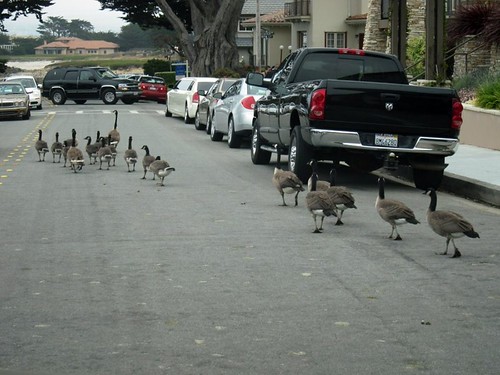
We had a great time at the beach. John and I brought our wet suits and showed the kids the tidal animals: anemones, crabs, barnacles, chitons, and snails. Then, we rented a kayak and I took them on individual tours of the cove so they could see seaweed, starfish and seagulls on the rocks. Lewis and Lawrence and the kids and we had a wonderful time. On the way home, we were held up by a family of Canada Geese which decided to walk down the middle of the road in front of us.

IMG_0481 IMG_0484 IMG_0504
IMG_0523 IMG_0488 IMG_0511
IMG_0532 IMG_0555 IMG_0563

IMG_0551

Images Copyright 2010 by Katy Dickinson and John Plocher

2 Comments

Filed under Church, News & Reviews

FEMA Flood Map Fiasco

For more on this story, read: $1,453 Refunded for FEMA Mistake (23 July 2010) on San Jose Metblogs.

Tomorrow, we are mailing the final letter in an absurd and expensive year-long adventure in bureaucracy.  On 7 July 2009, my husband and I received a letter from our mortgage holder that FEMA (the U.S. Federal Emergency Management Agency) had changed their FIRM (Flood Insurance Rate Map) such that our house was now in a high-risk SFHA (Special Flood Hazard Area). We were now required to buy annual flood insurance for the life of our mortgage loan because of FEMA’s map change.

Our house was built around 1930 next to the Guadalupe River, also known as the Lewis Canal in what is now San Jose, California. The Lewis Canal is named after its engineer, Frank Lewis (who was husband to Martha “Patty” Reed Lewis of the Donner Party). The canal was built about a hundred years ago. The property line behind our house runs down the middle of the river and includes a steep embankment that rises five feet above ground level and then drops twenty feet to the river water.

How did the FEMA map of a hundred-year-old canal and eighty-year-old house change? FEMA maps used to be drawn on a plain background. Some clever person decided to take the old maps (as is – with no change) and superimpose the lines on a background of satellite photos. The resolution of the original map and the satellite map were different. The old map was drawn on square grids and the satellite photos were taken with a round lens – so there was some mismatch and alignment error. A flat picture of the round Earth will always have such errors.

The creation of the new map caused the mortgage company’s flood area determination company (LPS National Flood) to review the situation of the mortgaged properties which might be effected. Although FEMA’s new FIRM did not include any new information with regard to the relative location of our house and the river, the new picture’s misalignment appeared to make the line indicating our house touch the line of the river. That our house is ten feet from the edge of the embankment’s retaining wall did not matter. Taking the most conservative approach, the mortgage company now required us starting immediately to pay $1,453 annually for flood insurance for the duration of the mortgage.

We talked with our mortgage company with no good results. We contacted FEMA with no good results. We contacted LPS National Flood with no good results. We talked with the insurance company with no good results.  Everyone said that even though the new map did not correctly reflect the physical circumstances of our house and the river, the mortgage company could require us to buy flood insurance in perpetuity based on the map. We signed up for flood insurance and continued to fight. We eventually hired J.P. Tanner of Scotts Valley to work with FEMA to correct their map. We learned in the process that hundreds of other home owners along the river were in the same bureaucratic  map-insurance mess as we were.  Eventually, in April 2010, FEMA issued a LOMA (Letter of Map Amendment) formally removing our house from the flood zone.

Once we had the LOMA in hand, we had to convince the mortgage company and the insurance company to withdraw their requirement for flood insurance. I had to send them the LOMA several times but, as of the letter we received this week, we are finally being allowed to cancel our flood insurance.  We hope to get a full refund for the 2009 flood insurance fee which we were required to pay because of the map error. Halleluja!

Of course, two days after the mortgage company sent us the letter saying we did not have to pay for flood insurance, the same company sent us a separate letter saying that our hazard insurance had expired:

“If we do not receive evidence of continuous hazard insurance coverage, it will be necessary for us to secure coverage to protect your interest at your expense. The cost of such insurance may be substantially higher that the amount you would normally pay for hazard insurance coverage. Affiliates of PNC Mortgage may earn commissions or income in conjunction with the placement of this coverage…”

Sigh.

Guadalupe River Pictures

DSCN0316 DSCN0319

Pictures Copyright 2010 Katy Dickinson

3 Comments

Filed under Home & Family, News & Reviews

Summit on Women and IT in Portland

Recently, I participated in the fascinating National Center for Women & Information Technology (NCWIT) annual Summit on Women and IT, in Portland, Oregon. A year ago, I wrote a blog entry called Women in IT: Think Globally, Act Locally about a similar NCWIT event. I learn so much and meet such interesting people through NCWIT!

This year, I lead a table discussion on “Visibility for Women as Great Technical Thinkers” and I was also part of a panel called “Evaluating What We Do: Challenges and Solutions”. For the panel, I presented data, analysis, and methods from my 2009 Sun Mentoring: 1996-2009 Technical Report. Our panel moderator was Dr. Wendy DuBow (NCWIT Research Scientist). The other panelists were Tricia Berry (Director of both the Women in Engineering Program (WEP) and the Texas Girls Collaborative Project (TxGCP) at The University of Texas at Austin), and Dr. Debra Richardson (Dean of Donald Bren School of Information and Computer Science, University of California at Irvine).

Because of another eruption of Iceland’s volcano, a speaker from Scotland could not attend. The last-minute replacement speaker was Brian Nosek Associate Professor of Psychology, University of Virginia and Project Implicit (a collaboration of the University of Virginia, Harvard University, and the University of Washington). Dr. Nosek gave an impressive and surprising presentation on “Mind Bugs – the Ordinary Origins of Bias”. Other presentations which were memorable included a panel on Women in Open Source and a presentation on the University of Michigan’s “Approach to Increasing Faculty Diversity”.

I was pleased to be able to see more of Portland. (Yes, it rained every day.) I enjoyed riding their excellent public transit system and saw Portlandia at last. I first heard about this huge copper statue during a lecture by Tom Wolfe in 1980. I also saw the umbrella man (“Allow Me” sculpture), Powell’s City of Books, and a variety of moose heads (one of which had its own flying squirrel companion).

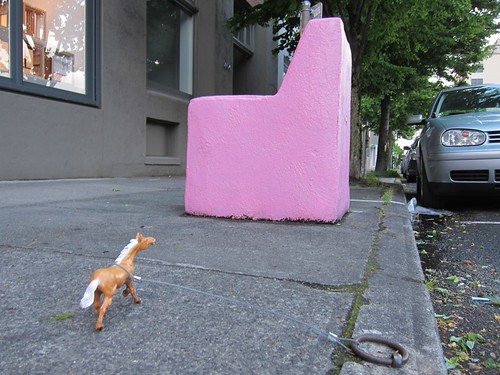
On a street near Powell’s,  there was a delightfully peculiar set of objects: a concrete chair painted bright pink next to a tiny plastic horse carefully tied with a steel cable to an iron ring set into the street curb.  The unexplained arrangement somehow seemed a very-Portland.

IMG_4473 IMG_4499 IMG_4639
IMG_4490 IMG_4497 IMG_4632
IMG_4460 IMG_4496 IMG_4574 IMG_4581

IMG_4485

Images Copyright 2010 Katy Dickinson

Leave a comment

Filed under Mentoring & Other Business, News & Reviews

CMU-Q in Doha, Qatar

John and Paul and I visited my daughter Jessica in Doha while she was a student at CMU-Q (Carnegie Mellon University in Qatar) last semester. She had an excellent experience studing Arabic, history, and politics at CMU-Q and Georgetown. Qatar has a very conservative Islamic culture, similar to that of its neighbor Saudi Arabia. It was fascinating to watch guys in traditional white dress adjust their head scarves the way western women fiddle with their long hair. I have heard that between the expat business people and the guest workers, less than a third of the people in Qatar are citizens. So, we did not feel too out of place being westerners.

We were delighted to hear Jessica sing several roles in the Qatar Foundation’s annual musical, which this year was Oliver!. We went for a long walk on the Cornish and took a pearl boat ride across the bay to the very impressive Museum of Islamic Art in its I. M. Pei building. We toured the markets: Souq Wakif (including its depressing pets for sale), the falcon souq, and the gold souq. And we visited the huge Vegas-like Villagio mall, complete with its Venetian canal and gondolas. We played board games one night with some of Jessica’s faculty friends. She even made us dinner – we brought it from the kitchen in the women’s dorm to where John and Paul were in the park near by. We admired the many new and under-construction modern office buildings downtown but after a few days we ran out of things to do and were happy to move on to Egypt for some world-class sightseeing.

DSCN2212 DSCN2219 IMG_0375 IMG_0400
IMG_0353 DSCN2261 IMG_0548
IMG_0601 IMG_0733 IMG_0750
IMG_0761 IMG_0838 IMG_0776
IMG_0698 IMG_0658 IMG_0665

Images 2010 Copyright by Katy Dickinson and John Plocher

1 Comment

Filed under News & Reviews

Egyptian Desserts

While we were in Egypt last month, we particularly enjoyed the desserts.  One memorable meal was at the Naguib Mahfouz Restaurant in the Cairo souk (5 al-Badestan Lane, Khan al-Khalili, 1, Cairo, Egypt). Named in honor of the only Arabic-language writer to have won the Nobel Prize for Literature, the restaurant features brass tabletops, an impressive molded ceiling, and good food. Dessert was custard with raisins, nuts, and coconut on top, served with mint tea.

The signature Cairo dessert is called Um Ali or Om Ali (“Mother of Ali”), a kind of bread pudding. Two other excellent local treats are Golash (like Baklava) and Konafa (like a firm custard with filo on the bottom and shaved onto the top). We brought home some boxes of pastries as presents after being recommended to El Abd, a downtown Cairo patisserie with an impressive selection. Despite the tempting selection of pastries, one of my favorite sweets in Egypt remains fresh dates.

IMG_1194 IMG_1193 IMG_1199 DSCN2407
IMG_3795 IMG_2304 IMG_2305
IMG_3796 IMG_3798 IMG_3802

Images Copyright 2010 Katy Dickinson

Leave a comment

Filed under News & Reviews

Pharaohs, Columns, Hieroglyphs

While I was in Egypt last month, I learned that the art and religion of the Pharaohs were much more complex than I had been taught in high school and college. My impression from studying art history and religion and even from reading Elizabeth Peters’ novels featuring Amelia Peabody Emerson was that ancient Egypt’s culture was homogeneous and largely unchanging for thousands of years, with the notable exception of the reigns of Akhenaten and Hatshepsut.

We visited the following during our trip:

Museums
–Egyptian Museum (Cairo), Coptic Museum (Cairo)
–MIT Rahina Museum (Memphis)
–Cheops Boat Museum (Giza)
–Imhotep Museum (Sakkara)
–Nubian Museum (Aswan)
–Luxor Museum (Luxor)
Ancient Sites
–Giza (Pyramids and Sphynx), near Cairo
–Sakkara, Dahshur, near Cairo
–Unfinished Oblisk (Aswan Granite Quarry)
–Philae Temple (Agilkia Island – near Aswan)
–Kom Ombo Temple, Edfu Temple (on the Nile between Aswan and Luxor)
–Al-Deir Al-Bahari Temple, Valley of the Kings, Karnak, Luxor Temple (Luxor)

Just considering the three tombs we walked through in the Valley of the Kings (Queen Twosret in KV14, Thutmosis III in KV34, and Ramses III in KV11), there was a remarkable variety. The wall paintings in the tomb of Thutmosis III include hundreds of almost cartoon-like small stick figures (like an ancient book of XKCD drawings), very different from the large highly colored figurative processions painted in the other two tombs. Queen Twosret’s tomb is the deepest in the valley – in the new visitor’s center, a three dimensional translucent plastic model shows how impressively far her tomb extends into the earth – while Ramses III’s tomb is majestic but relatively short.

It was hard not to get lost in either the grandeur or the infinite detail.  Ashraf Azap, our guide, patiently coached us to notice that earlier pharaonic columns had uniform capitals (often in the shape of the papyrus plant or the head of Hathor the mother goddess), while in columns created later by the Ptolemaic dynasty, the capitals were more varied, sometimes each top being different within one temple: palm, papyrus, and lotus all providing design inspiration.  Once at Sakkara, we saw a real dog sitting in the cool shade on top of a truncated  column.

I became particularly fascinated by the variety among Hieroglyphs. Several of these ancient graphical figures became favorites. Some of the carvings are shallow (or very weathered) scratches, others are abstracted, while still others are deeply cut and much more elaborate.  Sometimes a figure faces right to left, other times the same figure faces the other way.  I noticed that in large hieroglyphs of animals, the sculptor sometimes added realistic details like individual feathers on birds. I even found a hieroglyph which irresistibly reminded me of President Barack Obama

IMG_3300 IMG_3321 DSCN3551
IMG_1513 IMG_3330 IMG_3011
IMG_2753 IMG_3311 IMG_3604

IMG_2094
Images by Katy Dickinson and John Plocher 2010 Copyright

Leave a comment

Filed under News & Reviews