Category Archives: Church

Lalibela, Ethiopia

P1210675

15 years ago in California, I bought a silver cross inspired in design by Bet Giorgis, the Church of St. George, in Lalibela Ethiopia. A few days ago, John and I finally visited Lalibela and saw the inspiring medieval monolithic cave churches in this World Heritage Site for ourselves.  Mostly built in the 12th century, Lalibela today is a major tourist and pilgrimage site, featuring good food (especially at the Mountain View Hotel, and the interestingly modern Ben Abeba restaurant) and comfortable hotels with lovely views.

John and I only had one day to visit Lalibela. After the early morning flight from Addis, we saw the cave church at Na’akueto La’ab, the northwestern church group, and Bet Giorgis. The building outsides are well maintained, and the churches themselves are in active use by the Ethiopian Orthodox Church. Inside are ancient painting and icons, worn rugs, big drums, and benches. Long curtains protect the holy space – inside of which is a replica of the tablets in the original Ark of the Covenant – itself said to be in the Church of Our Lady Mary of Zion (in the town of Axum in the Tigray Province, Ethiopia). There are remains of frescoes on some church walls plus elaborate ceiling carvings.  The churches vary in size and design but all are carved from red basalt below ground level – from the living rock.

P1210631

P1210752

P1210683

P1210556

P1210552

P1210546

P1210583

P1210589

P1210465

P1210732

Images Copyright 2014 by Katy Dickinson

1 Comment

Filed under Church, Home & Family, News & Reviews

Equality in Faith for Women

P1190331

In many ways, this is a good time to be a woman of faith. Current examples have come to my attention:

Since I am an Episcopalian Christian, it is no surprise that I know about the first events. You too can follow church gender politics on such websites as Chicks in Pointy Hats.  I learned of the “Women and Mitzvot” ruling when it was announced by Rabbi David Booth at Congregation Kol Emeth (Palo Alto, California) last weekend. I was at Kol Emeth for the Bat Mitzvah of my friend Beth. Beth sang and discussed her Torah portion beautifully – I am very proud of her (and of her brother Max who also read).

“Women and Mitzvot” includes the following remarkable text on p.29:

The role of women in public life has changed dramatically in modernity. In society in general, women are now involved in commerce and the professions on an equal basis with men, and secular law considers women legally free and independent. In Jewish communities, women have been seeking to enrich their lives with more mitzvot. The changes in women’s social lives in general and in Jewish communities are not just a matter of external behavior but reflect a changed perception of women. Women are now seen as equal to men in social status, in intellectual ability, and in political and legal rights. The historical circumstances in which women were exempted from certain mitzvot are no longer operative, and we must embrace the realities of life in the 21st century.

And to that we say “Amen”.

Image Copyright 2014 by Katy Dickinson

Leave a comment

Filed under Church, Home & Family, News & Reviews

Why can’t theology be like science fiction?

University of the South School of Theology EfM Year 4 Books 2014

I admit to reading a great deal of science fiction and fantasy (in addition to literature, history, science, business, technology and other categories of composition), and that science fiction is perhaps not the best starting place for studying Theology, Ethics and Interfaith Encounters – the topics for my fourth year in the Education for Ministry  (“EfM”) program of the University of the SouthSchool of Theology.  Nonetheless, in some ways, science fiction can be more rigorous than theology.

The Webster definition of Theology: “The study of religious faith, practice, and experience. The study of God and God’s relation to the world. A system of religious beliefs or ideas.”  Webster’s definition for Science Fiction is: “Stories about how people and societies are affected by imaginary scientific developments in the future.”

My textbooks for this year are pictured above. EfM is an excellent program. I found all of these books interesting and worth reading (some are inspiring, superb, and worth reading more than once!). Since my EfM group is in Week 30 of a 36 week curriculum, I have finished reading all but the last on this list:

  • Education for Ministry – Reading and Reflection Guide Volume A (2013)
  • Theology for a Troubled Believer: An Introduction to the Christian FaithDiogenes Allen (2010)
  • And God Spoke: the Authority of the Bible for the Church Today, Christopher Bryan (2002)
  • The Christian Moral Life: Practices of Piety, Timothy F. Sedgwick (2008)
  • Living on the Border of the Holy: Renewing the Priesthood of All, L. William Countryman (1999)
  • My Neighbor’s Faith: Stories of Interreligious Encounter, Growth, and Transformation, Edited by Jennifer Howe Peace, Or N. Rose, and Gregory Mobley (2012)

Last week, as I was finishing Living on the Border of the Holy, I identified a source of some of my frustration with my EfM reading this year.  When a fantasy or science fiction author creates a fictional universe, self-consistency is a major concern:

What distinguishes a fictional universe from a simple setting is the level of detail and internal consistency. A fictional universe has an established continuity and internal logic that must be adhered to throughout the work and even across separate works. So, for instance, many books may be set in conflicting fictional versions of Victorian London, but all the stories of Sherlock Holmes are set in the same Victorian London. However, the various film series based on Sherlock Holmes follow their own separate continuities, and so do not take place in the same fictional universe….

A famous example of a fictional universe is Arda, of J. R. R. Tolkien’s books The Lord of the Rings and The Silmarillion. He created first its languages and then the world itself, which he states was “primarily linguistic in inspiration and was begun in order to provide the necessary ‘history’ for the Elvish tongues.” [from Wikipedia’s fictional universe article]

If a popular author does not present logic, continuity, and good writing, the powerful and vocal fan community is pleased to point out every inconsistent detail at length. (Continuity is also a major concern in films – if for no other reason than to avoid being listed on websites devoted to movie mistakes.)  Since reading my first science fiction book many decades ago, I have come to expect logic, continuity, and good editorial practices to be key drivers.  I have not always found those characteristics while reading these theology books.

Example One – from Living on the Border of the Holy

In Living on the Border of the Holy, the geographic metaphor in the title is found throughout the whole book.  “Border” is used 108 times, “borderland” is used 42 times, and “country” (as in “border country” – but not counting hits for the author’s name) is used 65 times.  The image of a border country is explained in many  ways that I found contradictory and confusing:

  • “The encounter with the HIDDEN is a kind of fault line running through the middle of our lives; no one can escape its presence. The HIDDEN forms a border country that turns out to be. paradoxically, our native land.” (p.6)
  • “The border country, therefore, is a place of intense vitality.  It does not draw us away from the everyday world so much as it plunges us deeper into a reality of which the everyday world is the surface.” (p.11)
  • “It can be helpful to imagine our human encounter with the HOLY as life in a border country. It is a country in which, at privileged moments of access, we find ourselves looking over from the everyday world into another, into a world that undergirds the everyday world, limits it, defines it, gives it coherence and meaning, drives it. Yet this hidden world is not another world, but the familiar world discovered afresh.” (p.8)
  • “The border country is the realm in which human existence finds its meaning. The border itself is the indispensable condition for this. If you could slip over entirely into the HIDDEN HOLY, you would no longer be in touch with the basic materials and experiences of human life. If you try to slip over entirely into the everyday world, then actions and experiences merely follow each other in succession without forming a larger whole.” (p.161)

In addition to reading two hundred pages, I spent time prayerfully considering Living on the Border of the Holy, and I discussed it for several hours with my EfM group.  The mixed geographic metaphor and strained logic did not help my understanding:

  • How can a land-feature simultaneously demarcate, undergird, and be a fault line?
  • How can it both be someplace to which we have “privileged moments of access” and also our “native land”?

If this were a science fiction or fantasy book, I think these basic logic and presentation contradictions in the setting would have been sorted out by the editor before publication.  I finally started ignoring the faulty metaphor and got on with considering the excellent content of Living on the Border of the Holy, especially its remarkable analysis of the priestly calling.

Example Two – from Theology for a Troubled Believer

There is no thematic metaphor in Theology for a Troubled Believer but there is certainly a strong cultural point of view. When I read stories about sympathetic, intelligent but non-humanoid characters, I can feel my mind opening to understand how human thinking and capabilities are influenced by our sensory input and body design.  Notable examples of such aliens include:

I admire authors who can understand and present a very different way of thinking and carry it forward through an extended work of fiction. In contrast, when I read Theology for a Troubled Believer, I was frequently irritated (and occasionally infuriated) by the author’s narrow, privileged, academic, and American context for a topic that is far beyond one culture’s circumstances. For example:

  • “The systemic search for reasons, or for the logos for anything and everything, is something we today take for granted.  It is part of our mental makeup.  We do it automatically.” (p.xviii) [While true for many educated Americans, I do not think that the “systemic search for reasons” is part of humanity’s mental makeup.]
  • “…we who live in democracies find it strange to consider the act of the Good Samaritan and the acts of the ‘sheep’ in the parable of the Sheep and Goats as acts of justice.  To those who think in terms of democratic societies, it is an act of mercy, not justice.” (p.23) [People living outside of democracies may also share this thinking.]
  • “The natural world is also a witness to God’s power, wisdom, and goodness…. Nature is not used to move from unbelief to belief.  Nature was always used by people who had already been moved by God’s grace to a life of faith as a way to gain a better idea of God’s power, wisdom, and goodness from nature’s immense size, intricate order, and usefulness to human life.” (p.50) [This sweeping generalization is not even true for the many Americans whom Nature has lead to belief!]

In addition to his insensitivity to other cultures, the author’s arrogance toward believers in Judaism and Islam is breathtaking. However, Diogenes Allen is most snarky about fellow scholars, particularly “philosophers of religion”. His negativity is tiring as a continuing theme.  The best part of this book is Diogenes Allen’s inspiring analysis of the parable of the Good Samaritan and the absolute value of human beings – that alone makes Theology for a Troubled Believer worth the slog.  However, I think if this book was in the science fiction or fantasy genre, a sensible editor would have gone to work with her red pen to make some much-needed improvements in its point of view and writing mechanics.

Example Three – from And God Spoke

I include And God Spoke because it was easily the best book of theology I read this year. And God Spoke is accessible, funny, and succinct. It includes lovely quotes by famous writers (C.S. Lewis: “Now the trouble about trying to make yourself stupider than you really are is that you very often succeed.”) and excellent writing in general:

“We need to beware a naïve belief that thinks it can take a couple of verses of scripture in isolation from their wider context and find there universal moral rules that are to be applied remorselessly in all cases, however complex. We need equally to beware of a naïve skepticism that can see in scripture only a mass of contradictions and inconsistencies from which it is possible to prove anything and nothing.” (p.10)

All in all, this is a book that makes the study of Christian faith, practice, and experience a pleasure.   Interestingly, there is a section in And God Spoke that analyzes how words are used, based on the modes of language presented by literary critic Northrop Frye. Christopher Bryan writes about visionary or imaginative language as:

“…words used to take us beyond our reason or our loyalties to worlds where our ordinary modes of consciousness are only one possibility among many, where imagination, fantasy, dreams, and intuition have play…. Words used in this last mode can carry us in imagination to other worlds — to the worlds of the gods, of myth, of universes transcending the universe we know. And here we find stories of our relationship to those worlds — stories of creation, fall, and redemption. Here we find those grand, overarching narratives that shape our understanding of the universe around us, and our place in it.” (pp.35-36)

The author goes on to write that visionary language is the most significant and normative for much of the Bible. Imaginative language is thus a shared mode of expression for both the Bible and for science fiction / fantasy. And God Spoke meets the best standards of science fiction and is a good example to all future books of theology.

Science Fiction and Fantasy Books
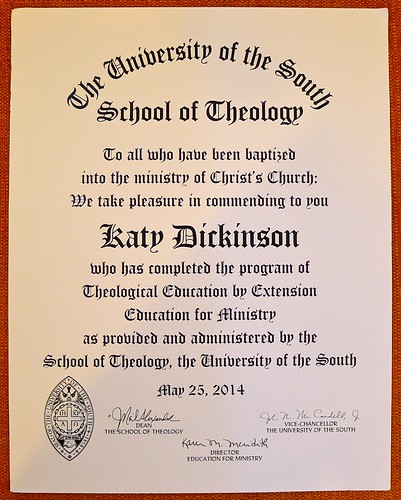

University of the South, School of Theology EfM, Diploma Katy Dickinson 2014
My EfM Diploma! (arrived early)

Images Copyright 2014 by Katy Dickinson

2 Comments

Filed under Church, News & Reviews

Happy 450th Birthday, Shakespeare!

Shakespeare Bust 2014 by Katy Dickinson

Today is the traditional celebration of the birth and death of William Shakespeare – in fact, this is the Bard’s 450th Birthday! I am dedicating this, my 1,500th blog entry since I first wrote posted on 2 June 2005, to my favorite author: William Shakespeare.

I encourage you to spend today with the Bard:

Today is also the birthday of America’s Folger Shakespeare Library, that opened in Washington DC on April 23, 1932 and is home to the world’s largest and finest collection of Shakespeare materials.  Whether you loathe or adore Shakespeare, today is his big day!

On 3 May 2014, the St. Andrew’s Shakespeare Reading Group celebrated The Bard’s 450th birthday with a cake:
William Shakespeare 450th Birthday Cake

King Lear card by Katy Dickinson 2014
Antique German collectable card showing Shakespeare’s King Lear and his court

Images Copyright 2014 by Katy Dickinson

Leave a comment

Filed under Church, News & Reviews

P-Phenylenediamine – Allergy to Hair Dye

P1180837

I have regrettably developed a severe allergy to P-Phenylenediamine and possibly other dye substances. Over the last month, this has taken the form of violent Contact Dermatitis (think about what happens when you touch Poison Oak): inflammation, rash, blisters, itching – all the nasty ways your skin tells you that it is very  unhappy about something you touched. I just finished taking Prednisone for several weeks – Prednisone is a synthetic corticosteroid drug that is particularly effective as an immunosuppressant – and am getting ready for a full allergy test at University of California at San Francisco – Dermatology Clinic.

I am writing this blog not so much to share my woe as to spread the word in case my readers may also experience this allergy. It certainly took me by surprise!

Paraphenylenediamine turns out to be a very common substance, found in:

  • hair dye, coloring rinse, comb-in hair tint, shampoo-in highlight, lowlights
  • skin paint, dark makeup, dark lipstick
  • henna tattoo
  • dye for socks, support hose, shoe dye
  • textile, rubber, and fur dyes
  • violin chin-rest stain
  • antioxidant in antifreeze, fuels, corrosion inhibitor in oils, gasoline sweetener
  • plastic manufacture, rubber antioxidant
  • printing ink, antiozonant
  • milk testing reagent, water testing reagent
  • retarder in acrylate production
  • lithography, photocopying
  • photo or x-ray film developing

A generalized reaction to PPD can also occur from taking closely related saccharin sweeteners, thiazide diuretics, sulfanamide antibiotics, sufonylurea antidiabetic agents, PAS, or celecoxib.

Some persons allergic to PPD will also react to black rubber mix, parabens, benzocaine group anesthetics, PABA family sunscreens, and azo dyes, especially orange and yellow, often in ballpoint pens.

This information is from the American Contact Dermatitis Society (ACDS).

More information:

Image Copyright 2014 by Katy Dickinson – detail showing vanity – from a stained glass window at St. Andrew’s Episcopal Church, Saratoga, California by Mark Adams

1 Comment

Filed under Church, Home & Family, News & Reviews

Easter Egg Hunt 2014

P1180892

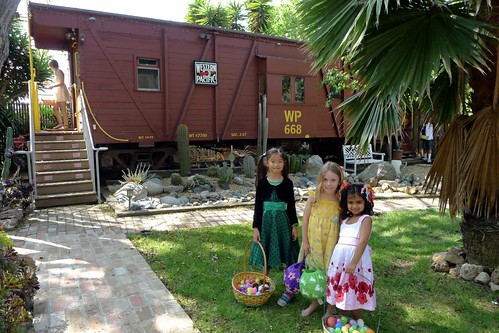
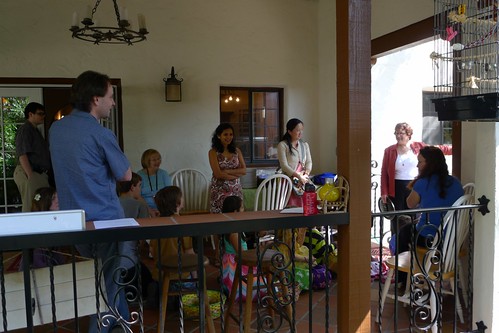
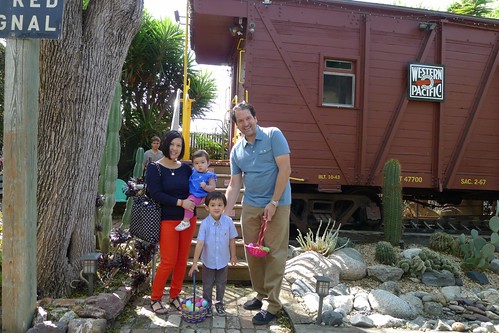
This morning was our annual backyard Easter Egg Hunt – a very popular event among our friends, family, and neighbors. About 15 children (ages 18 months to 21 years) joined the search for hundreds of plastic eggs filled with chocolate candies. For the adults, there were two specially hidden eggs: gold and silver. Only the following poems gave clues to their locations:

I know a bed where the wild thyme blows,
Where iris and nodding rosemary grows,
Quite over-canopied with luscious lemondrops,
With sweet musk-roses and with nasturtium:
There sleep sweet bees sometime of the night,
Lull’d in these flowers with dances and delight;
And there snake throws her cold enamell’d skin,
Weed wide enough to wrap a fairy in.

I have 3 guards for my home-place
The same number of eyes and legs between them
They keep for me in a safer space.
One would walk if he were fitted for a mind-Chem
but instead keeps me in the cool.
One is anxious but smiles except when asleep
One at ball’s drop can only drool
One was born only to be buried down deep
Can you find my comfy ark?
Or will you get lost in the barks?

Thanks to the Associate Easter Bunny, my daughter Jessica for her contributions to the poems (from Washington DC), and thanks to Paul and John for helping create today’s festivities! Clara and Paul and Dan teamed up to find the gold and silver eggs – and were rewarded with Peeps Chocolate Eggs for their hunting prowess.

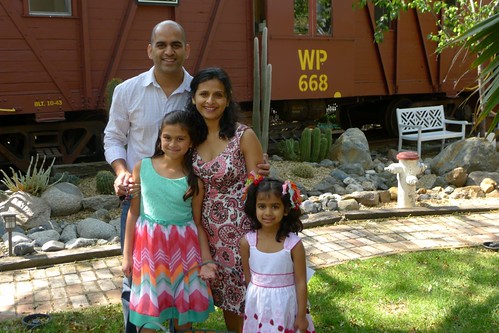
Each Spring, I work for weeks to make our garden a demi-paradise for this event – full of flowers and rock borders suitable for hiding eggs.  Easter coincided this year with the seed storms of the cottonwoods on the Guadalupe River in San Jose. Fluffy white seeds blow over everything like dry snow – so much spiderweb removal was needed, especially on WP668, our backyard caboose.

It is such a joy to watch the children filling their baskets, then re-hiding eggs for each other once the hundreds of eggs hidden in the morning by the Easter Bunny have been collected. A delightful celebration of new life and renewal!

P1180848

P1180873

P1180916

P1180883

P1180902

P1180878

21 April 2014 – On the day after the Easter Egg Hunt, I am still finding eggs in the garden (some after the dogs have chewed them)…

P1180921

Images Copyright John Plocher and Katy Dickinson

1 Comment

Filed under Church, Home & Family, News & Reviews

Swords to ploughshares, Rwanda

P1140282
Machete caked with garden dirt, in Kigali, Rwanda

Swords into ploughshares is from the Book of Isaiah:

And many people shall go and say, Come ye, and let us go up to the mountain of the Lord, to the house of the God of Jacob; and He will teach us of His ways, and we will walk in His paths: for out of Zion shall go forth the law, and the word of the Lord from Jerusalem. And He shall judge among the nations, and shall rebuke many people: and they shall beat their swords into plowshares, and their spears into pruning hooks: nation shall not lift up sword against nation, neither shall they learn war any more. — Isaiah 2:3–4

I thought about Bible verse many times while in Rwanda last week, particularly when watching machetes being used for gardening. I have many garden tools and, despite living on the Guadalupe River and regularly clearing brush as part of my work on the bank, I have never needed a machete. In Rwanda, I several times watched a machete being used as a hoe or to clear an overgrown path, and reflected that it is a good general-purpose implement if other tools are lacking. However, I also remembered Immaculée Ilibagiza writing of her 1994 experience during the Rwanda genocide:

There were many voices, many killers. I could see them in my mind: my former friends and neighbors, who had always greeted me with love and kindness, moving through the house carrying spears and machetes and calling my name. “I have killed 399 cockroaches,” said one of the killers. “Immaculée will make 400. It’s a good number to kill.” (from Left to Tell, 2006)

Rwanda is essentially twenty years old – its remarkable success since 1994 being all the more impressive because of the depths from which the country has risen. Last week, the TechWomen delegation visited the Kigali Genocide Memorial Centre (in which a machete is prominently displayed as the signature weapon) and saw graveyard/memorials along the road into the mountains.  There must be few parts of Rwanda entirely free of the memories and events of 1994’s savagery.  Yet, Rwanda has indeed turned swords into ploughshares (or, machetes into hoes in their case) and gotten on with the necessary business of making things better.

P1150853
Some of my garden tools, in San Jose, California, USA

Images Copyright 2014 by Katy Dickinson

1 Comment

Filed under Church, Mentoring & Other Business, News & Reviews