Category Archives: Caboose Project and Other Trains

TechWomen Dinner at Home

IMG_4735

The Huawei TechWomen mentors and mentees gathered in my home for a potluck dinner tonight. My husband made a halal chicken curry with rice as the entree.  There were women from at least seven countries around our table: China, Egypt, India, Iran, Lebanon, Morocco, and the USA. The guests had fun visiting my office in WP668, our backyard caboose. The food was interesting, plentiful, and delicious. My mother and husband joined the party.  What a delightful group of new friends!

IMG_4727

Images Copyright 2012 by Katy Dickinson and John Plocher

4 Comments

Filed under Caboose Project and Other Trains, Home & Family, Mentoring & Other Business

DCC Brakeman

photo-1

My husband John has been designing model train open source hardware for many years – as I have written about before. Recently, at the urging of fellow enthusiasts (or “Train Nuts” as their wives call them), John brought out his first retail product – the DCC Brakeman. The DCC Brakeman is now for sale for $6.99 at The Train Shop, 1829 Pruneridge Ave, Santa Clara, California, (408) 296-1050. (The first version sold for $6.25 but everyone wanted him to have a weight added, which costs a little more.)  Some assembly is required.

The rule of the railroad used to be that “When a train stops on a main track, flag protection must be provided.”  This little electronic guy is about one inch tall. He represents a flagman with a red lantern – as a visual aid to protect model trains when switching from fouling the main line. He is used in DCC (digital command and control) model train operations – about which you can find out more at the Operations Special Interest Group.  He wears a baseball cap which says DCC.  The little man’s front says Brakeman and his back says Safety First! (“Safety First” has been an American railroad industry motto since around 1910.)

Details on the DCC Brakeman are on John’s website: spcoast.com.

P1020969 . P1020970

IMG_0520

IMG_0519

Images Copyright 2012 by John Plocher

3 Comments

Filed under Caboose Project and Other Trains, Home & Family

Renewed Stained Glass

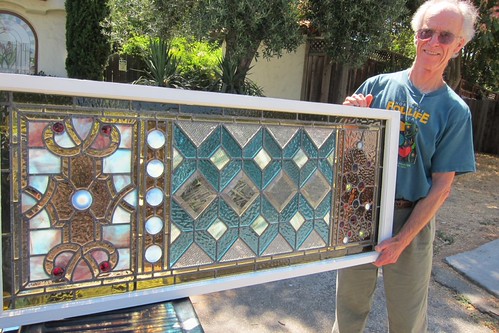
I have written from time to time about the large and elegant stained glass panel created by my great grandfather, Walter Van Gilder. Today, it came home: re-leaded and refreshed by Vincent Taylor Architectural Art Glass. This summer, the panel will be installed in our dining room here in San Jose, California. Its previous homes were Knoxville, Tennessee (where it was made) and San Francisco.

2012:
IMG_9649

2010:
IMG_7300

1952 (above the bride):
1952.wedding2.frontdoor

Vince also spent time cleaning the large of the stained glass panel we commissioned ten years ago – it had gotten foggy on the inside.

IMG_9640 . IMG_9655

Images Copyright 1952-2012 by Katy Dickinson

3 Comments

Filed under Caboose Project and Other Trains, Home & Family, News & Reviews

Willow Glen – Historic Trains

IMG_9054

We live in the Willow Glen neighborhood of San Jose, California. Willow Glen has a very strong Neighhorhood Association which works on “matters such as land use, planning, traffic, safety, open space, parks, and recreation.” Last week, the WGNA put on an event called “Historic Trains: How They Transformed San Jose”. As the proud owners of WP668, the 1916 railroad caboose in our backyard, of course John and I went to Willow Glen High School Library to learn about local history, economics, and railroads. The best part for me was when the speakers from the California Trolley and Railroad Corporation showed historic photos, followed by pictures of what those locations looked like today.

IMG_9070

Images Copyright 2012 by Katy Dickinson

Leave a comment

Filed under Caboose Project and Other Trains, News & Reviews

Southern Pacific Photo Collection

WP679-2-caboose

Some years ago, my husband John bought an estate collection of 820 photographic slides taken by a Mr. J.R. Benedict of Redwood City, California.  During 1970-1975, J.R. Benedict took pictures of Southern Pacific railroad equipment in the San Francisco Bay Area, particularly on the Peninsula.  Pictures of BART and the 1975 bicentennial American Freedom Train are included.

Recently, John sent the slides to Scan Cafe for digitizing. This was an experiment to see if this digitizing service produced quality scans at a reasonable price. The results are good. John posted all of the slides in a collection on our family photo archive site so that railroad fans (including Southern Pacific enthusiasts, railroad modellers, and historians) can have access to the 26 sets of images.

Sadly, although there are a few pictures of steel-strapped wooden cabooses which are sisters to WP668, our backyard caboose, there do not seem to be images of our own particular piece of rolling stock.  John is looking to donate the physical slides themselves (an a DVD full of the digitized images) to a railroad historical society in the hopes that others will find the images interesting and useful.

WP603+WP680-caboose

Images Copyright John Plocher 2012

1 Comment

Filed under Caboose Project and Other Trains, Home & Family, News & Reviews

New Caboose Photo Found!

IMG_7305

One of our ongoing projects is looking for historical photos of WP668, the railroad caboose in our backyard where I have my office. WP668 was built in 1916 but the earliest known photos are from 1973. We keep hoping that images from 1916-1972 will be discovered. I was delighted today to find another image of our caboose on p.244 of a recently-published book John bought for me: The Western Pacific by Ken Meeker, 2011 (Publisher: White River Productions; ISBN: 1-932804-11-0). The image was taken by Dave Stanley in 1973. The caption text from p.244:

Sacramento Northern’s Holland Branch was an obscure freight-only, 16-mile-long line constructed in 1929 to tap the vast agricultural riches of the Sacramento River Delta’s Holland Tract. Diverging from the SN main line at Riverview, the line provided access to numerous on-line packing sheds. Outbound shipments of asparagus, celery, pears, molasses, and sugar made the branch a moneymaker during its earlier years. After completing daily switching chores at the Clarksburg sugar refinery on September 14, 1973, Tidewater Southern 746 departed Clarksburg Junction and headed back to West Sacramento with two cards of molasses and a classic home-built WP composite bay window caboose bringing up the rear. The distinctive grade at this location was necessary to enable the tracks to reach the top of the levee that protected the narrow waterway of Winchester Lake.

Earlier in the book, there is a photo of one of WP668’s sisters, caboose WP676, with this caption:

Hard-pressed for cabooses during World War II, Western Pacific constructed 62 composite wood and steel bay window models using 15001-16000 series outside-braced Pullman-Standard box cars originally built in 1916. The composite cars were used system wide prior to the arrival of all-steel cabooses in 1955. As steel cars arrived, the composite crummies were bumped to local and branch-line assignments. February 3, 1969 finds caboose 676 (built in 1944) trailing the westbound Reno Local at Martin, Nevada.

This is the second book in which a photo of WP88 is published. The other is Western Pacific Color Guide to Freight and Passenger Equipment by Jim Eager, 2001 (Publisher: Morning Sun Books; ISBN-10: 158248063X, ISBN-13: 978-1582480633). All of the published references to our caboose are listed on WP668.org.

Our caboose was a popular location for Easter Eggs during the great backyard hunt last week:

IMG_7096 . IMG_7094

Images Copyright 2012 by Katy Dickinson

Leave a comment

Filed under Caboose Project and Other Trains, Home & Family

Easter Egg Hunt

IMG_7101

IMG_7149

We had more than a dozen children over with their families and friends for our annual backyard Easter Egg Hunt and potluck brunch in Willow Glen (San Jose, California). Among the kids, our son Paul was the oldest egg hunter at 19 and Howard was the youngest, at age 3. The devious Bunny and his helpers came up with the following poem hints about hiding places for the coveted Gold and Silver eggs:

GOLD:
My roost once used to roll and pitch
My halo exists at other men’s whims
In finding me please don’t twitch
The creek where you’d fall, nobody swims

SILVER:
I creep at the edge of an –ito
Don’t over-step or you will cheat-o
Chameleon-like I hide
Hurry quick! I won’t abide.

The Gold egg was found quickly (on top of the electrical box behind the light on the porch of WP 668, our caboose), but the Silver egg eluded all hunters until late afternoon. It was wrapped in tape and painted to look like a stone in the arroyito.  The rules of the hunt are the same year after year:

    1. There are no eggs in the flower beds (also: no eggs are on the bank, in the cactus, or outside of the backyard)
    2. Kids get to go into the yard youngest first, and then one every 30 seconds until age 10 – after which, everyone can go
    3. Parents may not help hunt (except for the Gold and Silver eggs)
    4. The only clues are in the poems on where the Gold and Silver eggs are
    5. Kids can keep their eggs and baskets or empty out the candy and leave them with us for next year
IMG_7123 . IMG_7128

IMG_7157

Images Copyright 2012 by Katy Dickinson and John Plocher

3 Comments

Filed under Caboose Project and Other Trains, Home & Family, News & Reviews