Category Archives: Caboose Project and Other Trains

Caboose Painting Next Week

We are scheduled to start the final phase of exterior paint stripping and
painting of WP668 next week. Avi Lenchner, who has painted two houses for us, of Avi
Decorative Painting, 650-329-0770, Menlo Park, CA, has us on his schedule!

Also, Tanya Jankot found a 2007-2008 Catalog of Classes for

The Crucible
(A nonprofit collaboration of Arts, Industry, Community based in
Oakland, CA) which includes an entry-level Hot Wheels class called

“Caboose Restoration and Modification (Part I)”.

    In 2004, a class at The Crucible restored and modified a vintage fire truck to create our Educational Response Vehicle (ERV). Heartened by the success of that project, we’re at it again. A generous donor has provided us with a 1940s railroad caboose, which we are restoring and adapting to make a café to serve healthy food in our West Oakland neighborhood. Taught by The Crucible’s founder Michael Sturtz in collaboration with a handpicked team of metal fabricators, wood workers, and other artists, this class is a team-oriented, hands-on learning experience, with continuous skill-building opportunities. Aspects of metalworking, blacksmithing, wood refinishing, furniture making, painting, coppersmithing, glass working, and electrical wiring will be part of the work curriculum. And while you’re learning and working, you’ll help create a piece of Crucible history, that will provide meals to students and the neighborhood!

Looks like fun!

Leave a comment

Filed under Caboose Project and Other Trains

Caboose Color for WP668

John is done welding the new caboose landing and place-to-anchor
the new stairs and he has the wood for WP668’s new landing mostly cut,
primed, and drilled for bolts. We have been discussing what color
to paint the caboose. The first color John tried on the new wood was on the orange-ish
end of brown and would have made WP668 look like a huge shoebox-shaped tomato. Ick.

The official color name is “Mineral Brown” but we can see from the peeling paint on WP668
herself that she has worn a wide range of red brown tints with yellow trim over the last
91 years. WP668 was one of the rail cars photographed for the book Western Pacific
Color Guide to
Freight and Passenger Equipment
by Jim Eager (Publisher: Morning Sun Books;
ISBN-10: 158248063X, ISBN-13: 978-1582480633), so we looked in there to see what colors
were actually used on in-service equipment. The book shows that during 1903 – 1983, the
Western Pacific Railroad
had many color combinations: Mineral Brown with
Yellow trim, Mineral Brown with White trim, Silver with Orange trim, Gray-Blue with
White trim, Yellow with Black trim, and Red with White trim.

Almost exactly a year ago, we moved the caboose wheels into our backyard
(see
5 August 2006
blog entry) and bought a brass HO scale model of a steel strapped bay window
WP caboose at The Train Shop (1829 Pruneridge, Santa Clara, CA). Yesterday, John took
that HO model down to the paint store and asked them to match the color in Acrylic paint.
John tried the new color out on WP668 herself just now and it looks perfect.
Here is the model caboose on the actual wheel truck of WP668:

HO scale WP caboose
photo: copyright 2006 Katy Dickinson

Image Copyright 2006 by Katy Dickinson

2 Comments

Filed under Caboose Project and Other Trains

Caboose Welding and Woodwork

John is out in the backyard starting to shape the wood of the new back
platform for WP668, our caboose. Our neighbor Joel is a
plumber and races his dirt track car on weekends. Joel has
several welding sets to put his car back together after the
race. Joel is teaching John how to weld so that he can work
on the steel parts of WP668.

The first kind of welding John tried was oxyacetylene gas; however,
the heavy steel of the caboose made this slow going.
Then, he started learning

MIG (metal inert gas) welding
which is working much better.
John has learned to wear long sleeves and button them to avoid
metal drips and to wear a t-shirt under his long sleeve shirt
to avoid a sunburn from the MIG welder. He puts up a tarp so
that we can’t get our eyes burned looking at the welding from
the house.

We need to extend and strengthen the back caboose platform (more
of a landing or small porch, really) so that it can be connected
to the new stairs. The original metal was in poor shape under the
wood because of water thrown up by the wheels over many decades.
It crumbled when poked. Very little of what John has been
working on will show when the wood is replaced but it will be exceptionally sturdy.

We have hired someone to draw the plans for the steps to the Building
Department’s requirements. The same contractor has a stucco worker who
can put the skin on the cabana (the hot tub changing room and storage shed)
plus a window guy who can produce a custom window for the cabana and consult
on replacement caboose windows. We found it hard to get
contractors for a little jobs like just the cabana or just the caboose
but with both projects together, we can get bids.

Leave a comment

Filed under Caboose Project and Other Trains

Lumber Dimensions Have Changed Since 1916

Between church events last weekend, John finished filling in the hole
a prior owner cut into our 91-year-old caboose’s wall. WP668 was
made from first growth fir in 1916. Except for the hole, the walls and ceiling
are in good condition, as is 1/2 of the floor. The other 1/2 of the floor
needs replacing.

One of the problems in restoration is that standard lumber dimensions have changed
since 1916. The original exterior boards are 2″ x 6″ and the interior
boards are 1″ x 6″. Boards now for sale are called “two by six” but actually
measure 1-1/2″ x 5-1/2″. Similarly, “one by six” boards now measure 3/4″ x 5-1/2″.
This little difference means that John had to add slim filler boards to make
the new tongue and groove slot firmly into the old.

WP668’s original boards were also thicker than standard boards now sold.
Fir in the size we wanted for the interior boards was not readily available, so
John ended up buying unsanded redwood boards and having them milled into tongue
and groove since those were closest to the 1916 thickness. First growth fir
has almost no knots because the trees they were cut from were bigger. That is,
there was more interior wood so fewer boards had scars from branches (knots).
The redwood John bought is good lumber but each board has at least one knot.
All of these differences will eventually be hidden under the paint.

WP668 looks like its interior was sandblasted at least once. Some of the soft
parts of the wood boards have been scoured away. Also, we have found sand between
the walls. We are discussing whether to
paint over the boards as they are or try to sand them more level. My preference
is to leave the dark honey colored ceiling as it is (stains and all), paint
the walls white and refinish the boards on the floor once the damages there
have been repaired. The problem is that about 10′ (1/3) of the ceiling was
painted white after it was sandblasted. (I keep wondering what the
story is behind the white paint since WP668’s original interior paint color was
light green.) I am going to experiment with sanding away the ceiling paint to see
how the wood looks under it. I am concerned that the sanding will change the
color and surface texture. We will see.

Here are some photos of WP668’s ceiling from last year before we put on the
new roof:

WP668 caboose ceiling

wood and paint:

WP668 ceiling wood and paint
photo: copyright 2007 Katy Dickinson
WP668 caboose ceiling

long view:

WP668 ceiling long view
photo: copyright 2007 Katy Dickinson

Images Copyright 2006 by Katy Dickinson

Leave a comment

Filed under Caboose Project and Other Trains

WP6668 Caboose Restoration Photos

Here are some photos of our early projects restoring WP668, the 91-year-old
Western Pacific caboose in our backyard. The yellow car stops will keep her
from rolling. A prior owner of WP668 cut through one inside and outside wall to install
a big window. (He just made the hole – the window was never added.) John has now
filled in the exterior boards and bolted the new wood in place. He was able to insert cut-to-fit
rigid foam insulation into the irregular cavity spaces between the interior and exterior
tongue and groove walls on either side of the new wall patch. So, already both the ceiling
and 1/4 of the caboose walls have modern insulation instead of an air gap. John took a
sample of WP668’s original wood to a local lumber company and they confirmed it was first
growth fir.

WP668 caboose

car stop 1:

WP668 car stop 1
photo: copyright 2007 Katy Dickinson
WP668 caboose

car stop 2:

WP668 car stop 2
photo: copyright 2007 Katy Dickinson
WP668 caboose

inside new wall:

WP668 inside new wall
photo: copyright 2007 Katy Dickinson
WP668 caboose

new wall outside (and John):

WP668 new wall outside (and John)
photo: copyright 2007 Katy Dickinson
WP668 caboose

John and wall:

WP668 John and wall
photo: copyright 2007 Katy Dickinson
WP668 caboose

old wall meets new wall:

WP668 old wall meets new wall
photo: copyright 2007 Katy Dickinson
WP668 caboose

exterior wall filled:

WP668 exterior wall filled
photo: copyright 2007 Katy Dickinson

Images Copyright 2007 by Katy Dickinson

Leave a comment

Filed under Caboose Project and Other Trains

WP668 Caboose Restoration Update

Since we moved WP668 into our backyard on 12 May, we have been working on her between other family and job obligations. It will take at least the next year to get the biggest projects done. Our first efforts have been:

      • Neatly trimming trees that were damaged during the crane lift
      • Setting up a temporary power connection for the ceiling lights so we can work inside
      • Sweeping and vacuuming the dust of ages
      • Replacing missing and broken glass in windows, cleaning the windows that survived vandalism during storage
      • Replacing the fence we took down to move WP668 in
      • Buying and installing the car stops

A prior owner of WP668 cut through inside and outside walls to install a big window. He just made the hole – the window was never added. We have removed the cut 1″x6″ tongue and groove interior planks above and below the hole and are installing new 2″x6″ fir tongue and groove exterior boards to fill the hole. We will eventually replace the interior boards also.The caboose originally had 6 small sash windows that rose between the interior and exterior walls plus a 2 piece sliding window in each bay plus 2 sidelights in each bay. There are also glass windows in the doors at each end. We are retaining and restoring (or replacing) all of the windows except the one sash cut out by the prior owner since that wall will eventually feature floor-to-ceiling glass fronted bookcases. We are still working on filling the exterior wall hole. John and Paul primed the new fir tongue and grove boards last weekend with white paint. John is filling the irregular cavity spaces between the interior and exterior walls with cut-to-fit rigid foam insulation.

It was my job to remove the interior boards around the hole. I found that getting 91-year-old fitted and nailed boards out without splitting them is tricky. We saved the pieces in case we need original wood for repairs elsewhere. We are leaving all interior work until it starts to rain again next Autumn.

Someone asked why we have named WP668 “Kate Hall”. The name comes from Shakespeare’s Taming of the Shrew (Act II, Scene i), a play from about 1590 much-quoted to those of us named Katherine:

    • PETRUCHIO: Good morrow, Kate; for that’s your name, I hear.
    • KATHARINA: Well have you heard, but something hard of hearing: They call me Katharina that do talk of me.
    • PETRUCHIO: You lie, in faith; for you are call’d plain Kate,
      And bonny Kate and sometimes Kate the curst;
      But Kate, the prettiest Kate in Christendom
      Kate of Kate Hall, my super-dainty Kate,
      For dainties are all Kates, and therefore, Kate,
      Take this of me, Kate of my consolation;
      Hearing thy mildness praised in every town,
      Thy virtues spoke of, and thy beauty sounded,
      Yet not so deeply as to thee belongs,
      Myself am moved to woo thee for my wife.
    • KATHARINA: Moved! in good time: let him that moved you hither
      Remove you hence: I knew you at the first
      You were a moveable.

2 Comments

Filed under Caboose Project and Other Trains, Home & Family

Caboose Move on Front Page

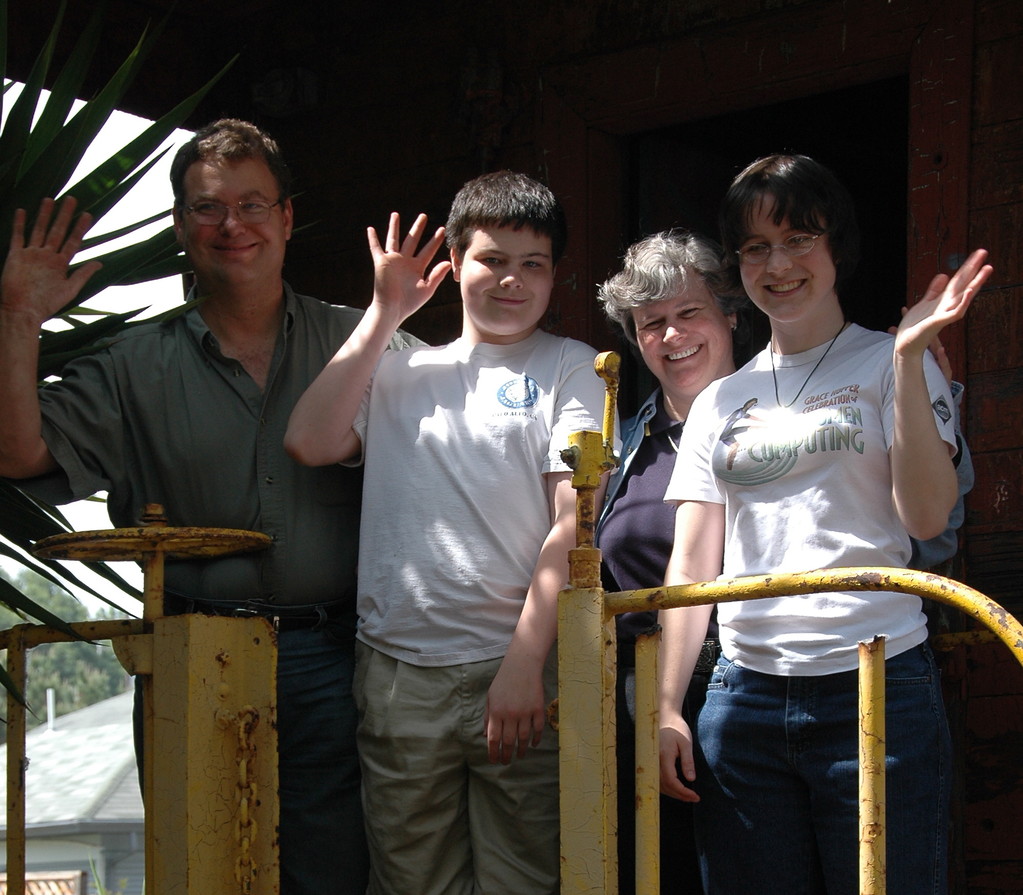
2007 John Paul Katy Jessica in WP668 caboose

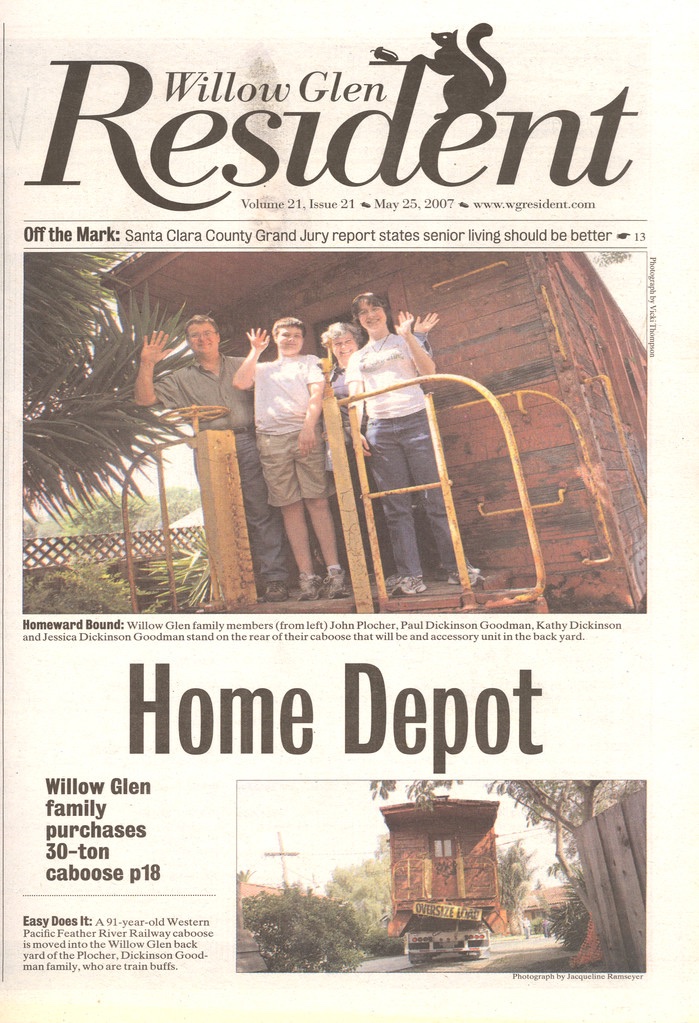
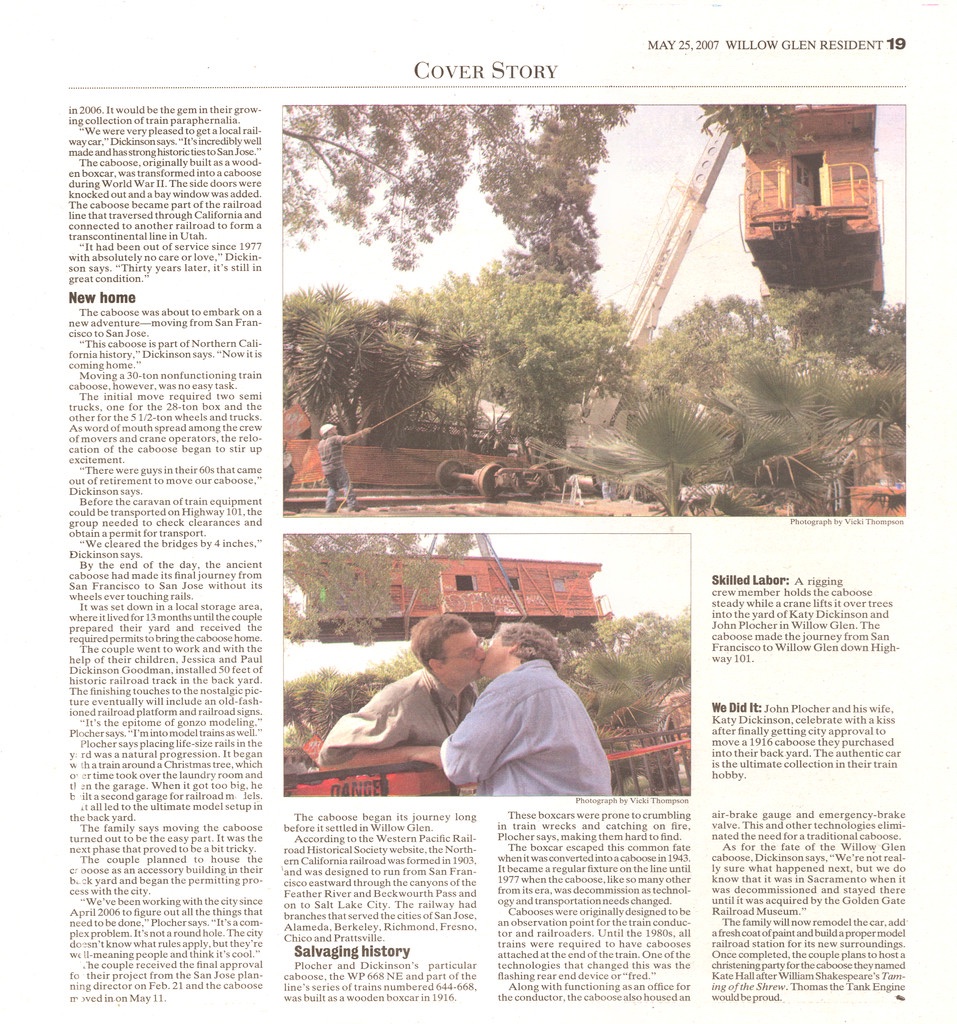
A photo of my family standing on the platform of our caboose is on today’s front cover of our local newspaper, the Willow Glen Resident. Inside on p.18-20, are more color and monochrome photos, nine images in all. The reporter, Mayra Flores DeMarcotte, has been patiently waiting to publish this story ever since February 2007 when she saw our application for a variance presented to the San Jose City Council. Mayra sent two photographers, Jacqueline Ramseyer and Vicki Thompson, to take pictures of the  12 May final move and crane lift of WP668 into our backyard. The name of today’s story is “Home Depot – Willow Glen family purchases 30-ton caboose”.

2007 WIllow Glen Resident 25 May WP668 story 2007 WIllow Glen Resident 25 May WP668 story 2007 WIllow Glen Resident 25 May WP668 story

Two videos of the big move have been posted on YouTube:

What fun!

More story and photos are on the WP668 website.

If you want to receive Katysblog posts by email, please sign up using the Sign Me Up! button (upper right on Katysblog home).
Photo Copyright 2007 by Danek Duvall
News Images Used with Permission, Copyright 2007 Silicon Valley Community Newspapers
Updated 3 April 2020

1 Comment

Filed under Caboose Project and Other Trains, News & Reviews